Written by

Eric
Share this article

.svg)
Subscribe to updates
Last Checked and Updated on July, 2026
Refinance rates have been anything but calm this year. After dipping to a 2026 low near 6.1% back in February, the average 30-year refinance rate has climbed back into the high-6% to low-7% range, according to Bankrate's weekly lender survey. If you locked in your rate between 2022 and 2025, when many buyers paid 7% or higher, today's numbers might still work in your favor.
Key takeaways:
- Total refinance closing costs run 2% to 6% of your loan amount, or roughly $6,000–$18,000 on a $300,000 loan.
- The national average, excluding taxes, is about $2,207 (LodeStar, most recent full-year data) — but your state's recording tax rules can push that much higher.
- New York, Florida, Oklahoma, Pennsylvania, and Texas carry the heaviest tax-driven costs; California, Arizona, and South Dakota sit near the bottom.
- Divide your closing costs by your monthly savings to find your break-even point — the month when refinancing starts putting money back in your pocket.
Here's the part that catches people off guard: the rate you see advertised is never the whole story. I've sat with plenty of borrowers who were ready to sign until the "Cash to Close" line landed in their inbox and the mood in the room changed fast.
Refinancing isn't free, and it shouldn't be treated like a formality. Think of it as a small reinvestment in your finances — one where you need to know exactly where the money goes and how long it takes to earn it back. This guide walks through the real cost of refinancing right now, the fees that catch people off guard, which ones you can push back on, and the math that tells you whether the whole thing is worth doing.
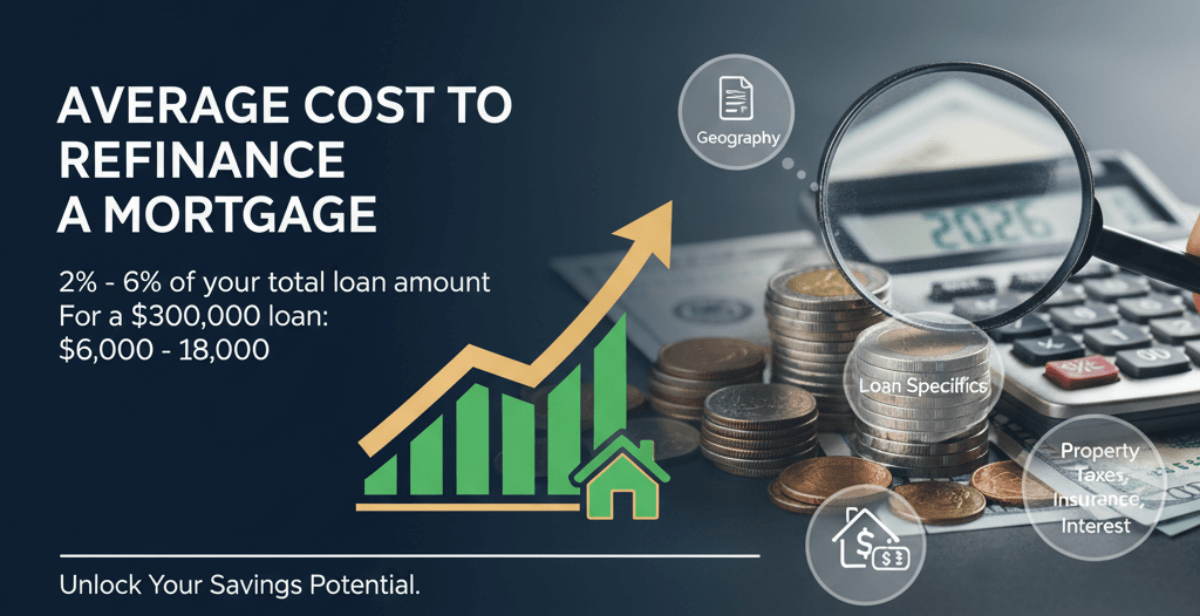
Average Cost to Refinance a Mortgage
Most homeowners pay somewhere between 2% and 6% of their loan amount to refinance. On a $300,000 loan, that works out to $6,000 to $18,000 in total costs, depending on where you live and what kind of loan you're getting.
Why such a wide gap? Two different data sets get quoted side by side, and they're measuring slightly different things. LodeStar Software Solutions, which tracks closing cost data across the industry, puts the national refinance average at roughly $2,207, or about 0.67% of the loan amount and that figure only counts lender and third-party fees, not prepaid taxes or insurance. Freddie Mac's broader 3-6% estimate folds in those prepaid costs, which is why it lands so much higher. Neither number is wrong; they're just answering different questions.
Location does most of the heavy lifting here. States that charge a mortgage recording tax or a documentary stamp tax on the new loan amount, think New York, Florida, or Pennsylvania, sit well above the national average. States with no such tax, like California or Arizona, often land closer to the low end of that 2-6% range.
Breakdown of Refinance Costs
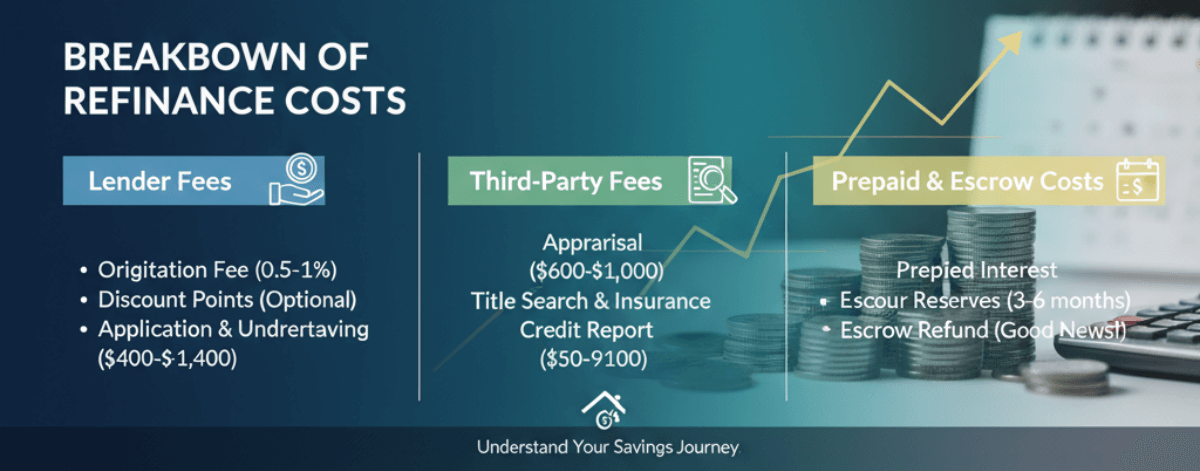
Your Loan Estimate can look like a spreadsheet exported straight into a PDF. To make sense of it, I sort every line item into three buckets: Lender Fees, Third-Party Fees, and Prepaids.
Lender Fees
This is what you pay the mortgage company directly for originating and processing your loan — and it's also where you have the most leverage to negotiate.
- Origination Fee: Usually 0.5% to 1% of the loan amount, or $1,500–$3,000 on a $300,000 loan. This covers the lender's work putting the deal together.
- Discount Points: Optional. Paying an upfront fee to buy down your rate permanently can make sense if you plan to keep the loan for years. Plenty of borrowers this year are paying a point or two to land a rate under 6.5%.
- Application & Underwriting Fees: Together these typically total $400–$1,400 — application fees run $75–$500, underwriting adds another $400–$900. Some lenders fold these into a single flat fee instead.
Third-Party Fees
These are pass-through costs. Your lender collects the money but hands it off to outside vendors who verify the property and confirm your legal standing.
- Appraisal Fee ($600–$1,000): Refinancing almost always triggers a fresh appraisal. Costs have crept up in areas with fewer licensed appraisers and steady demand.
- Title Search & Lender's Title Insurance ($400–$900): You won't need to buy Owner's Title Insurance again, but Lender's Title Insurance is required every time you take out a new loan.
- Credit Report Fee ($50–$100): Covers pulling your tri-merge credit report during underwriting.
- Recording Fee ($25–$250): A smaller, often-overlooked charge your county collects to record the new deed of trust. It's easy to miss on the Loan Estimate, but it adds up with everything else.
Prepaid & Escrow Costs
This section confuses more people than any other. Borrowers often feel blindsided by these numbers, but here's the thing — this money is still yours.
- Prepaid Interest: You owe interest from your closing date through the end of that month.
- Escrow Reserves: Your new lender will typically ask you to fund 3–6 months of property taxes and homeowners insurance upfront, based on your county's tax schedule and your policy premium.
If you already have an escrow account with your current lender, don't worry. You'll get that balance refunded roughly 30 days after your old loan is paid off. It's not gone, just temporarily parked somewhere new, but you do need the cash on hand to fund the new account first.
Refinance Closing Costs by State
Where you live changes this bill more than almost anything else. Based on LodeStar's most recent state-by-state refinance data, here's how the tax-driven costs stack up as a share of your loan amount:
- New York: 2.06%, Mortgage recording tax applies to the new loan
- lorida: 1.36%, Documentary stamp tax on the new note amount
- Oklahoma: 1.13%, State mortgage tax
- Pennsylvania: 1.01%, Realty transfer tax exposure
- Texas: 0.96%, County recording and title fees
- California: 0.32%, No mortgage recording or transfer tax
- Arizona: 0.37%, No transfer tax on refinances
New York borrowers get one break most guides skip over: a CEMA, short for Consolidation, Extension and Modification Agreement. It's a New York-specific refinance structure that lets you avoid paying the mortgage recording tax again on the portion of your balance that's simply being carried over from your old loan. Not every lender offers it, so it's worth asking your loan officer directly whether your deal qualifies.
Factors That Influence Refinance Costs
No two borrowers pay the same bill, even on identical homes. I've watched neighbors refinance the same floor plan and end up thousands apart. Here's what actually moves the number:
- Credit Score: The single biggest factor. Drop below 720 and you'll likely see Loan-Level Price Adjustments (LLPAs) — risk-based charges added to your rate or your closing costs.
- Loan-to-Value (LTV) Ratio: Less than 20% equity usually means higher fees, and possibly ongoing Private Mortgage Insurance (PMI).
- Loan Amount: Fixed costs like appraisal and title fees stay roughly the same whether your loan is $150,000 or $500,000, so larger loans often pay a lower percentage overall.
- Property Type: Condos and multi-family properties tend to carry slightly higher rates and origination fees than single-family homes, since lenders view them as carrying more risk.

Real Refinance Cost Examples
Numbers land better with context, so here's how a $300,000 mortgage might play out across three common scenarios. These are illustrative estimates built from typical fee ranges, not quotes pulled from a specific lender.
Rate-and-Term Refinance Example
The Goal: Lower the interest rate and the monthly payment.
- Borrower Profile: 760 Credit Score, Single-Family Home.
- Lender Fees: $2,500
- Third-Party Fees: $2,200
- Prepaids/Escrow: $1,800
- Total Cost: $6,500
Verdict: This is the "cleanest" refinance with the lowest fees.
Cash-Out Refinance Example
The Goal: Take out $50,000 in equity for home renovations.
- Borrower Profile: 740 Credit Score, increased loan balance to $350,000.
- Lender Fees: $3,500 (Higher due to cash-out risk adjustments).
- Third-Party Fees: $2,500
- Prepaids/Escrow: $2,200
- Total Cost: $8,200
Verdict: Cash-out loans are viewed as riskier, so lenders often charge higher origination fees or slightly higher interest rates.
Investment Property Refinance Example
The Goal: Refinance a rental property.
- Borrower Profile: 720 Credit Score, Non-Owner Occupied.
- Lender Fees: $4,500 (Includes "points" to buy down the rate).
- Third-Party Fees: $2,500
- Prepaids/Escrow: $2,500
- Total Cost: $9,500+
Verdict: Investment properties always come with a premium. Expect to pay 0.5% to 0.75% more in rate or fees compared to your primary home.
How to Lower the Cost to Refinance a Mortgage
You're not stuck accepting whatever number your first quote shows. Four strategies actually move the needle on your Cash to Close:
- Ask for an Appraisal Waiver: With 30%+ equity, your loan officer may be able to run an automated underwriting waiver instead of ordering a full appraisal — an easy $600–$1,000 saved.
- Negotiate the Reissue Rate: If you bought or refinanced within the last few years, ask the title company about a reissue rate on lender's title insurance. It can cut that premium by up to 40%.
- Boost Your Credit Score: Even a 20-point improvement can bump you into a better pricing tier and shrink those LLPA charges.
- Shop Around the Right Way: A 2026 ICE Mortgage Technology study found borrowers who compared quotes from three or more lenders saved about $1,500 on average versus those who took the first offer. Skip the lead-aggregator sites that hand your number to a dozen cold-callers, and go straight to individual loan officers instead.
This is exactly the gap Bluerate.ai was built to close. Instead of funneling you into a call center, it connects you directly with experienced loan officers so you can compare real, transparent quotes side by side — no spam, no middleman markup, just the numbers you actually need to decide.
Can You Refinance with No Closing Costs?
Ads promising a "No Closing Cost Refinance" sound too good to pass up. Here's the catch: the fees don't vanish, they just move somewhere else.
- The Trade-off: Your lender covers the $6,000 in closing costs with a lender credit, then charges you a higher rate to offset it — say 6.9% instead of 6.4%.
- When It Makes Sense: If you're planning to sell or move within five years, this can be the smarter play. You keep more cash now, and you won't hold the loan long enough for the higher rate to cost you more than you saved.
- When to Skip It: If this is your forever home, take the lower rate and pay the costs upfront. A 0.5% rate difference compounds into tens of thousands of dollars over 30 years — far more than what you saved at closing.
Refinance Cost vs Savings: How to Calculate the Break-Even Point
Before you sign any paperwork, you must do this one calculation. It determines if the refinance is an investment or a waste of money.
The Formula: Total Closing Costs ÷ Monthly Savings = Months to Break Even
Example:
- Total Closing Costs: $5,000
- New Monthly Savings: $250
- Calculation: $5,000 ÷ $250 = 20 Months
Here's the rule. If you plan to stay in the home longer than 20 months, the refinance is a win. If you think you might move in a year, don't do it. You will lose money.
Checklist: Ideal Candidates for Refinancing in 2026
Check even one of these boxes, and it's worth getting a quote today:
- Rate Drop: Your current rate sits at least 0.75%–1% above today's market rate (for example, you're still at 7.25% or higher).
- Credit Improvement: Your score has climbed 50+ points since you bought the home, opening the door to better pricing.
- PMI Removal: Rising home values have pushed you past 20% equity, letting you drop costly mortgage insurance.
- ARM Expiration: Your Adjustable Rate Mortgage is about to reset to a higher rate.
Cost to Refinance Mortgage: FAQs
How much does it cost to refinance a $300,000 mortgage?
On average, for a $300,000 loan, you can expect total closing costs to range between $6,000 and $18,000. This includes lender fees, title work, and your prepaid escrow items. The "sunk costs" (fees that don't go toward your escrow) are typically around $3,000 - $5,000.
Are refinance costs tax-deductible?
Generally, no. Unlike when you buy a home, standard closing costs on a refinance for a primary residence are not deductible. However, if you pay discount points to lower your rate, you can deduct them over the life of the loan. Note: For rental properties, these rules differ, and costs are often deductible as business expenses.
How many times can you refinance a mortgage?
There's no legal cap on how many times you can refinance. Most lenders do require a short waiting period between refinances — often around six months — and some loan types carry seasoning requirements before you can refinance again. Just remember that every refinance comes with its own closing costs, so it only pays off if you clear a new break-even point each time.
Is it better to roll closing costs into the loan?
If you are short on cash, rolling costs into the loan balance is a convenient option. However, be aware that you will pay interest on those costs for the next 30 years. It's better to pay cash upfront if you can afford it to keep your loan balance low.
Why is my refinance quote higher than expected?
If your quote seems high, check the Prepaids section. You might be funding a brand new escrow account for taxes and insurance. Also, if your credit score has dipped or you are taking cash out, lenders may have applied risk-based fees (LLPAs) that drove up the cost.
Final Verdict: Is Refinancing Worth the Cost in 2026?
Refinancing was never about bragging rights over the lowest rate at a dinner party. It's a math problem, and the math has to work in your favor before it makes sense to sign anything.
Rates have moved around plenty this year, but if you're still sitting on something from the 7% or 8% era, current pricing may well be worth a serious look. Clear your break-even point with room to spare, and the upfront cost becomes a short-term hurdle standing in front of real long-term savings.
One last piece of advice: don't take the first number you're handed. Loan officer compensation structures vary widely, and so do the fees they quote.
That's exactly why I keep pointing people to Bluerate.ai. It gives you direct access to loan officers competing for your business, with full visibility into the costs — no hidden markups, no runaround.
Run your numbers, compare a few quotes, and make 2026 the year you finally take control of your mortgage.

![[Tips for Loan Officers] How Can I Lower Borrower DTI?](https://cdn.prod.website-files.com/6731bc6e813a541b54c30b10/6aa3b89e281a639e7a5c6fca_lower-debt-to-income-ratio-banner.jpg)