Written by

Eric
Share this article

.svg)
Subscribe to updates
Last checked and updated on August, 2026.
If you've been watching the headlines, you know the mortgage landscape has been anything but boring in 2026. After 30-year rates spent most of 2023 and 2024 hovering near or above 7%, they've spent this year bouncing around, dipping into the low-to-mid 6% range on good weeks, then climbing back above 7% when inflation data spooks the bond market. Right now, refinance rates specifically are running a bit hotter than purchase rates, and most forecasters at Fannie Mae and the Mortgage Bankers Association expect the 30-year average to settle somewhere between 6.4% and 6.5% before the year is out. You've probably heard a neighbor or coworker mention "refi-ing" to shave a few hundred dollars off their monthly payment.
Here's the truth, though: refinancing isn't a magic button you press to save money. It's a strategic financial move that only pays off under the right conditions. In this guide, I'll cut through the banking jargon and walk you through what refinancing actually means, how the mechanics work behind the scenes, and how to figure out whether it makes sense for your specific situation right now.
What Is Home Refinance?
Refinancing is the act of trading in your old mortgage for a brand-new one.
I often tell my clients to think of it like a balance transfer on a credit card, but with much higher stakes and more paperwork. You aren't just "editing" the terms of your current loan with your bank. Instead, you are technically applying for a completely new loan, whether with your current lender or a new one. This new loan pays off your existing debt entirely, and you start fresh with a new interest rate, a new term (length of the loan), and a new monthly payment.
Because this is a new loan, it triggers a "do-over" on the approval process. The bank will underwrite you all over again. They will check your credit score, verify your current income, and usually require an appraisal to see what your home is worth today compared to when you bought it. It's a restart button for your home debt, designed to get you better terms than you had before.

Refinance vs. Finance: What's the Difference?
These two terms trip people up constantly. "Financing" a home is what happens the first time around, when you take out a mortgage to actually purchase the property. "Refinancing" only applies after you already own the home and already have a loan on it. You're not buying anything new; you're replacing an existing debt with a different one, usually to get better terms, tap equity, or adjust how long you'll be paying it off.
Why Do Homeowners Refinance Their Mortgage?
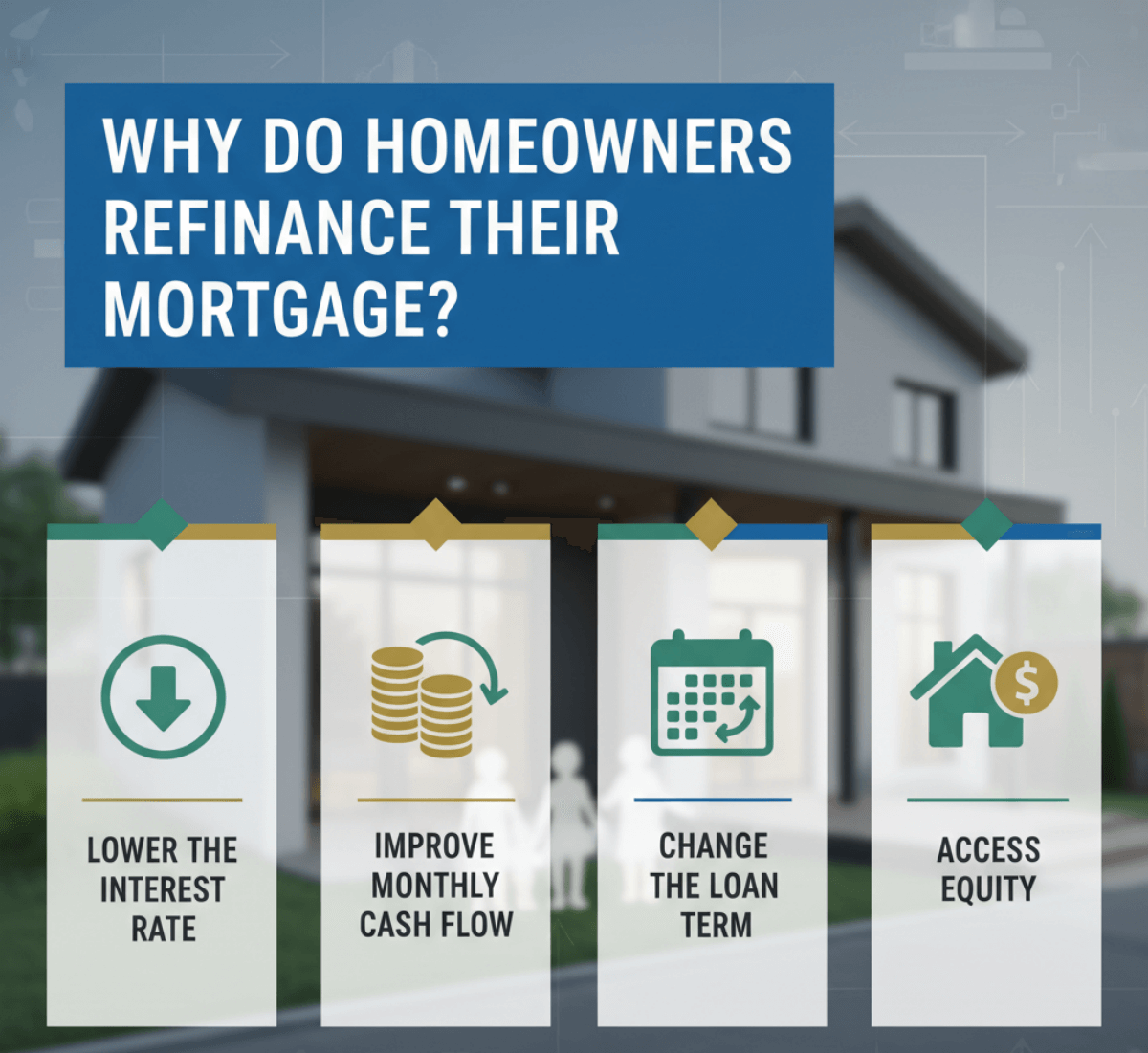
Why go through the hassle of paperwork again? Usually, it comes down to one of four major motivations, and it's rarely just about "saving money."
- Lower the Interest Rate: This is the big one. If you bought your home in 2023 or 2024 when rates were peaking, swapping that 7.5% rate for a 6% rate in today's market can save you significant interest over the life of the loan.
- Improve Monthly Cash Flow: Sometimes, life gets expensive. By refinancing to a lower rate, or extending your loan term back out to 30 years, you can drastically shrink your monthly obligation, freeing up cash for bills or savings.
- Change the Loan Term: I've seen many homeowners who want to be debt-free faster refinance from a 30-year to a 15-year mortgage. Your monthly payment might go up, but you'll pay way less interest to the bank in the long run.
- Access Equity: If your home's value has skyrocketed, you can "cash out" some of that profit to pay off high-interest credit cards or fund a renovation, effectively using your house as a low-interest piggy bank.
How Does Home Refinancing Work?
The mechanics can feel confusing since you're staying in the same house while the underlying debt changes completely. When you close on a refinance, your new lender wires a lump sum to your old lender, covering whatever balance remained on your original loan. The old lender marks the account "paid in full" and files a lien release with the county. That debt is gone for good.
At the same time, you sign a brand-new promissory note reflecting your new rate, whether that's 6.2% or whatever you locked in, along with your new payment schedule. One variation worth knowing about is an internal refinance, where you refinance with the same bank or lender that already holds your loan. It can sometimes move faster since the lender already has your file, though you'll still go through full underwriting and shouldn't assume it's automatically the cheapest option; shopping around is usually still worth the extra effort.
Behind the scenes, the new lender has to verify your home is still solid collateral through an appraisal and confirm you can still afford the payments through income documentation. Once everything closes, you start sending payments to the new address, and many borrowers get to skip one month of payments during the transition, which is a nice, if temporary, cash-flow bonus.
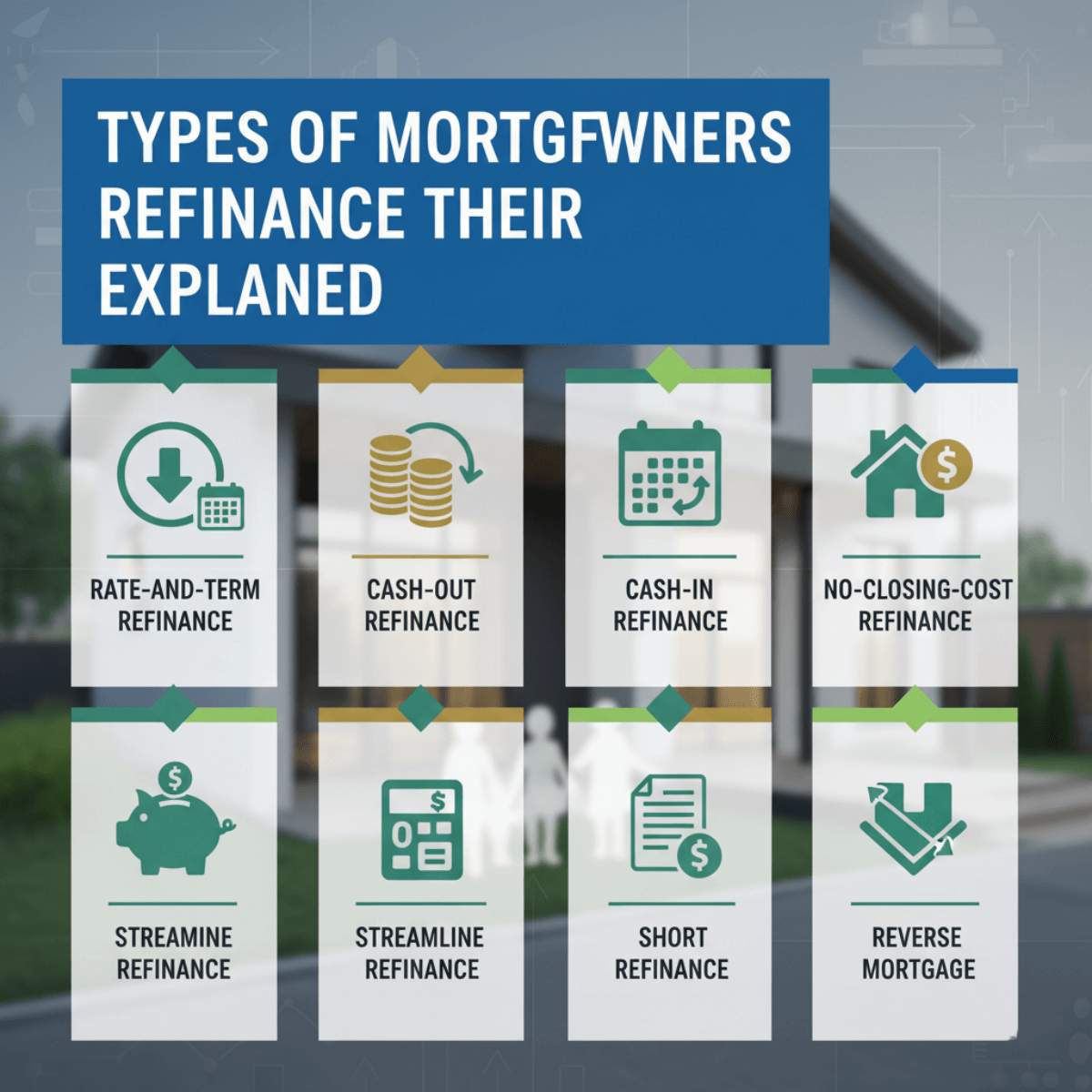
Types of Mortgage Refinance Explained
Not all refinances are built the same. The right strategy for you depends entirely on why you are making the switch.
Rate-and-Term Refinance
This is the "vanilla" option and the most common type I see. You aren't trying to pull cash out of your home. you are simply changing the interest rate or the term, like moving from 30 years to 15 years. The goal here is purely financial efficiency, spending less on interest or paying the house off sooner.
Cash-Out Refinance
Here, you take out a new loan that is bigger than what you currently owe. The difference is paid to you in tax-free cash at closing. For example, if you owe $200,000 but your home is worth $400,000, you might get a new loan for $260,000 and pocket the $60,000 difference. Just remember: you must usually leave at least 20% equity in the home.
Cash-In Refinance
This is the opposite of a cash-out. You bring a lump sum of cash to the closing table to pay down your loan balance. Why? Maybe you want to get your Loan-to-Value (LTV) ratio below 80% to finally get rid of that pesky Private Mortgage Insurance (PMI), or perhaps you want to qualify for a lower interest rate tier.
No-Closing-Cost Refinance
Let's be real: "No cost" is a marketing myth. The loan officers, appraisers, and title companies still need to get paid. In this scenario, the lender pays your closing costs for you, but in exchange, they charge you a slightly higher interest rate. You save money upfront, but you pay for it monthly. It's a trade-off, not a free lunch.
Streamline Refinance (FHA/VA/USDA)
If you already have a government-backed loan (like FHA or VA), you might qualify for a "Streamline." These are fantastic because they cut through the red tape, often requiring no appraisal and minimal income documentation. However, there are rules, like the "210-day wait period" for FHA loans, ensuring you've made enough on-time payments before applying.
Special or Less Common Refinance Options
Short Refinance: This one shows up mainly when a homeowner is underwater, meaning the home is worth less than what's owed. The lender agrees to a principal reduction, essentially forgiving part of the balance, in order to avoid a costlier foreclosure. It's uncommon outside of genuine financial hardship and typically requires lender approval on a case-by-case basis.
Reverse Mortgage: Designed for homeowners aged 62+, this allows you to convert equity into cash without making monthly mortgage payments. The loan is repaid when you move out or pass away.
Reverse Mortgage vs. Refinance: These two get confused often, but they're not the same product. A traditional refinance replaces your loan with a new one that still requires monthly payments. A reverse mortgage, available to homeowners 62 and older, lets you convert home equity into cash without making monthly payments at all; the loan gets repaid when you sell, move out, or pass away. If you already have a reverse mortgage, you can refinance it into a new reverse mortgage too, but that's a separate decision with its own set of rules.
Pros and Cons of Refinancing a Home Loan
Refinancing is a powerful tool, but like any power tool, you can hurt yourself if you don't use it correctly.
Advantages of Refinancing
The benefits can be transformative. If you drop your rate by just 1%, you could save tens of thousands of dollars in interest over the life of the loan. Refinancing can also stabilize your budget. If you are currently in an Adjustable-Rate Mortgage (ARM) that is about to spike, switching to a Fixed-Rate loan gives you peace of mind. Furthermore, consolidating high-interest credit card debt (often 20%+) into a mortgage (around 6-7%) via a cash-out refi can save huge amounts of monthly cash.
Disadvantages and Risks to Consider
The biggest downside is the cost. Refinancing isn't free. Closing costs typically run between 2% and 6% of the loan amount. If you refinance a $300,000 loan, you could pay up to $18,000 in fees. There is also the "clock reset" risk. If you've been paying your 30-year mortgage for 10 years and then refinance into a new 30-year loan, you are extending your debt sentence to 40 years total. This often means paying more total interest, even with a lower rate.
How to Refinance Your Mortgage?
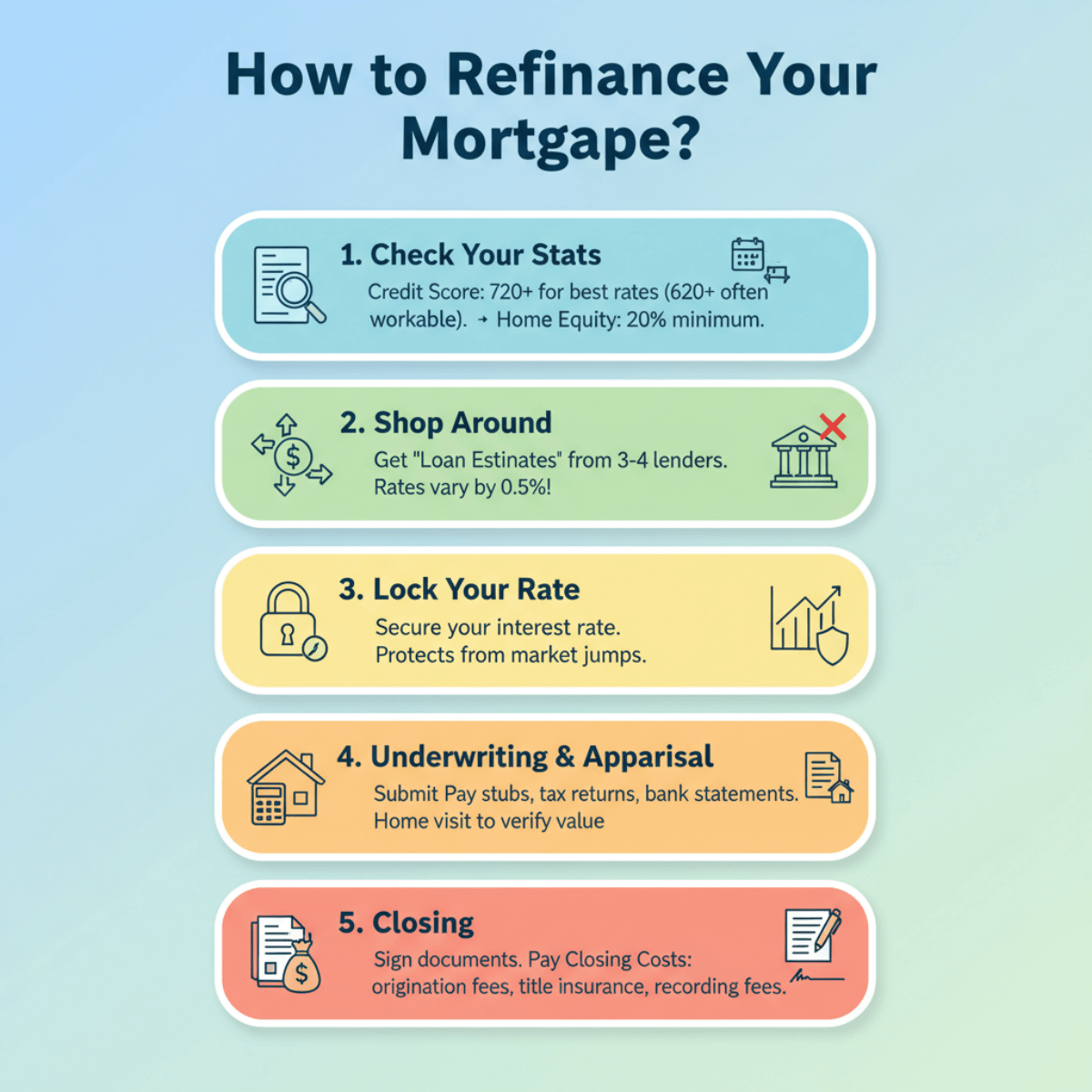
Ready to pull the trigger? Here is your actionable roadmap. This process generally takes 30 to 45 days from start to finish.
- Check Your Stats: Before applying, pull your credit report. In late 2025, lenders are looking for scores above 720 for the best rates, though 620+ is often workable. Also, estimate your home equity, you usually need at least 20% equity to get the best deal.
- Shop Around: Don't just sign with your current bank. Get "Loan Estimates" from 3-4 different lenders. I've seen rates vary by 0.5% between lenders on the same day. That's massive savings you shouldn't leave on the table.
- Lock Your Rate: Once you find a winner, "lock" the rate. This protects you if market rates jump up while your paperwork is being processed.
- Underwriting & Appraisal: You'll submit pay stubs, tax returns, and bank statements. An appraiser will visit your home to verify its value.
- Closing: You'll sign a stack of documents, which is similar to when you bought the house. You will also pay your Closing Costs, which cover origination fees, title insurance, and recording fees.
When Does Refinancing Make Sense and When It Doesn't
Deciding to refinance shouldn't be based on a gut feeling. It's a math problem. The magic number you need to find is your Break-Even Point.
Here is the formula I use:Total Closing Costs ÷ Monthly Savings = Months to Break Even.
Let's look at a real-world example. Say your refinance will cost you $5,000 in fees, butit lowers your monthly mortgage payment by $200.$5,000 ÷ $200 = 25 months.
- It Makes Sense IF: You plan to live in the home for more than 25 months. After month 25, that $200 savings is pure profit in your pocket.
- It Doesn't Make Sense IF: You plan to sell the house next year. You would spend $5,000 to save $2,400 (12 months x $200), leaving you with a net loss of $2,600.
Also, be careful if you are nearly finished paying off your loan. Refinancing a small balance with only 5 years left into a new 30-year term is rarely a smart financial move.
How Do Lenders Make Money on Refinancing?
It's a fair question, and one clients ask me often. Lenders typically earn through an origination fee, usually 0.5% to 1% of the loan amount, which covers processing and underwriting. Many also sell your loan on the secondary market shortly after closing and collect a premium for doing so. That's part of why some lenders can offer "no origination fee" refinances: they make up the difference through a slightly higher interest rate instead of an upfront charge. Neither approach is inherently better; it just shifts where the cost shows up.
Home Refinance FAQs
Does refinancing always save you money?
No. If you extend your loan term significantly or pay high closing costs for a very small rate reduction, you might end up paying more in total interest over the long run, even if your monthly payment drops.
Can you get cash when you refinance?
Yes, via a Cash-Out Refinance. However, you typically cannot withdraw 100% of your home's value. Lenders generally require you to keep 20% equity (80% Loan-to-Value ratio) in the property to protect their investment.
Does refinancing reset your mortgage term?
Yes, it usually does. If you take out a new 30-year loan, the clock starts at year zero. However, you can choose a shorter term (like 15, 20, or even a custom 22-year term) to avoid extending your debt timeline.
Is it better to refinance or make extra payments?
It depends on your goal. If you want to lower your required monthly obligation for safety, refinance. If your goal is strictly to pay off the house faster and save interest, making extra principal payments on your current loan is often cheaper since it costs $0 in fees.
Do I need to switch my homeowners insurance when I refinance?
No, you're not required to change insurance carriers just because you're refinancing. That said, it's a good moment to shop your policy for a better rate, especially since your new lender will require proof of coverage before closing anyway.
What is an internal refinance?
It simply means refinancing with the same lender or bank that currently services your loan, rather than switching to a new one. It can sometimes be quicker since the lender already has your history on file, but you should still compare their offer against outside lenders before assuming it's the best deal.
Final Thoughts: Is Refinancing a Smart Financial Move?
Refinancing is one of the most powerful levers you can pull to improve your financial health, but it demands precise timing and clear math. It's not just about chasing the lowest headline rate. It's about ensuring the closing costs don't eat up your savings and that the new loan aligns with your long-term life plans.
Every homeowner's situation, credit history, equity position, and future goals, is unique. Online calculators are great for a rough estimate, but they can't predict underwriting nuances. To ensure you're making the most profitable decision for your specific situation, I highly recommend speaking with a loan officer at Bluerate. Our experts can offer a free, no-obligation consultation to analyze your numbers and help you secure the best possible rate in today's shifting market.
People Also Read
- Full Guide: What is a non-QM Loan? Everything to Learn
- Mortgage Loan Officer Salary: How Much Do Loan Officers Make?
- What Does a Loan Officer Do? Duties, Pros, Cons, and Outlook

![[Tips for Loan Officers] How Can I Lower Borrower DTI?](https://cdn.prod.website-files.com/6731bc6e813a541b54c30b10/6aa3b89e281a639e7a5c6fca_lower-debt-to-income-ratio-banner.jpg)