Written by

Eric
Share this article

.svg)
Subscribe to updates
Last Checked and Updated on September, 2026
In my decade of structuring mortgages, I've learned one hard truth: max LTV is never a one-size-fits-all number. Whether you're working with a first-time homebuyer or a seasoned property investor, the maximum percentage you can borrow shifts drastically depending on the loan program, the transaction type, and even the number of units on the property.
Digging through hundreds of pages of investor guidelines to pin down these exact limits used to eat up my entire afternoon. These days, I lean on Zeitro Strata AI to pull up the answer in seconds instead of hours. Let's walk through what these limits actually look like today, from purchase loans to cash-out refinances.
Key Takeaways
- Max LTV limits vary heavily by loan program, ranging from 60% for Foreign National loans up to 100% for VA and USDA loans.
- Refinancing has its own set of rules — cash-out transactions almost always carry a lower LTV ceiling than a purchase or rate-and-term refinance on the same property.
- Pushing the LTV to its absolute limit directly affects your interest rate, your mortgage insurance requirement, and your approval odds.
- Top-producing loan officers use AI tools like Zeitro Strata to instantly verify specific lender guidelines instead of digging through PDFs by hand.
What is Max LTV?
So what does max LTV actually mean? Maximum loan-to-value is the highest percentage of a property's value that a lender will finance for a given program. Think of it as the ceiling on how much risk a lender is willing to carry on a single deal.
These caps aren't arbitrary. They're set by Fannie Mae, Freddie Mac, the FHA, the VA, and individual Non-QM investors, and they get revisited whenever housing risk shifts. The math behind the ratio itself is simple: take the loan amount, divide it by the appraised value or the purchase price (whichever is lower), then multiply by 100. A lower appraisal or a smaller down payment both push that number up, which is why appraisal risk matters so much on a file that's already near its limit.
One term that trips people up is CLTV, or combined loan-to-value. If a borrower has a second lien, a HELOC, or any other financing secured against the same property, the lender adds every balance together before dividing by the home's value. A related figure, HCLTV, counts the entire approved HELOC line rather than just the drawn balance. Lenders publish these thresholds together in what's usually called an LTV/CLTV eligibility matrix — a grid that cross-references loan purpose, property type, and credit score to land on your actual ceiling. It's worth checking both your LTV and your CLTV before assuming you qualify, since the combined number is often the one that decides the deal.
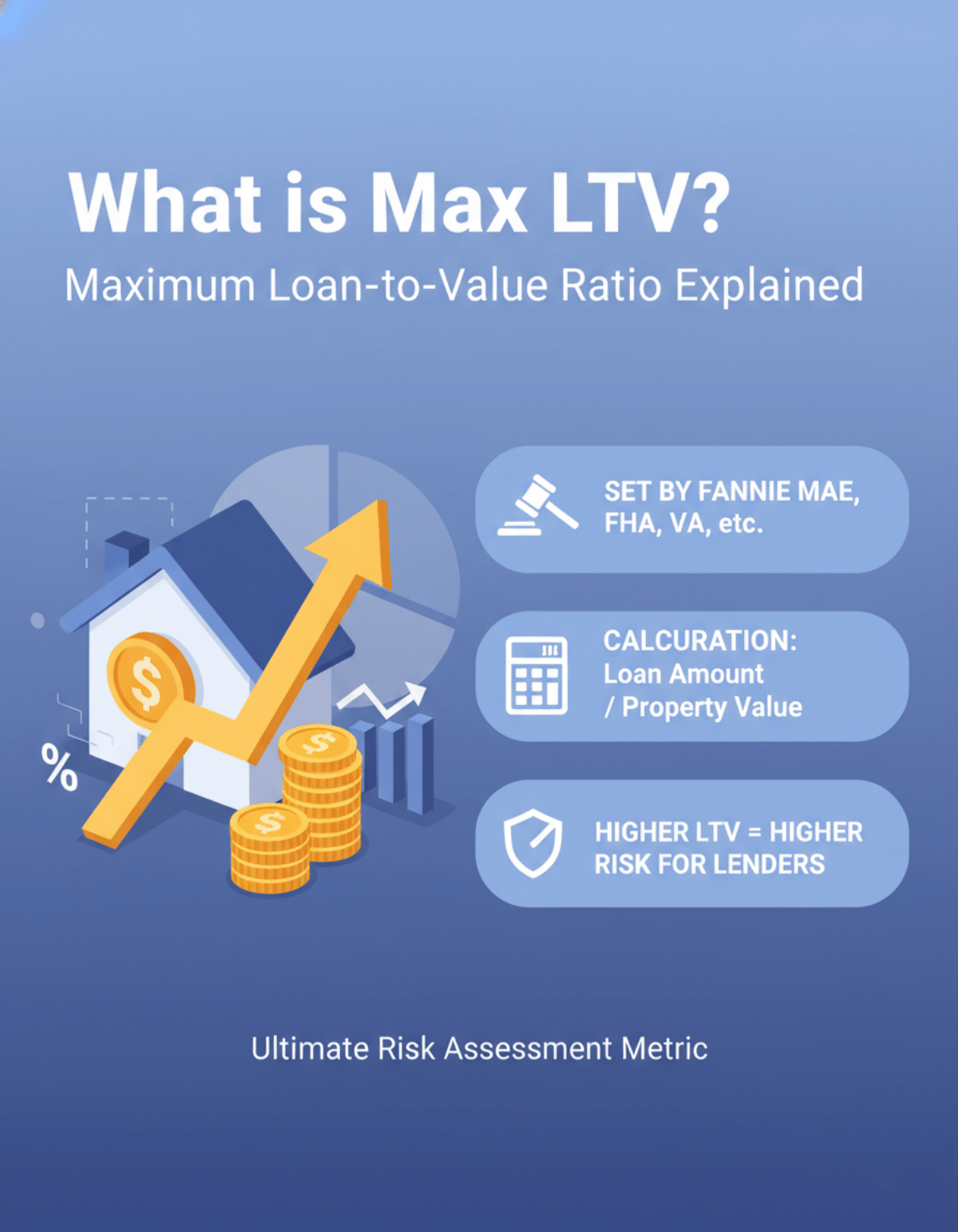
Maximum Loan-to-Value Ratios By Loan Types
Over the years I've structured countless deals, and keeping these thresholds straight in my head is half the job. Here's how the current max LTV ratios break down across the three categories I see most often.
These percentages reflect the highest LTV each program allows. Your actual approved LTV can land lower once credit score, DTI, property type, and lender overlays get factored in.
Government-Backed Loans
- VA Loan: 100% (a strong benefit reserved for eligible veterans and service members)
- USDA Loan: 100% (limited to approved rural properties)
- FHA Loan: 96.5% for borrowers with a 580+ credit score, dropping to 90% for scores between 500 and 579
Conventional Loans
- Conventional Loan: 97% on a one-unit primary residence, most often reached through the Conventional 97, HomeReady, or Home Possible programs
- 2-4 Unit Primary Residence: 95%
- High Balance Conforming Loan: up to 95% — high-balance loans (those above the standard baseline limit) don't qualify for the 97% option, even under HomeReady or Home Possible
Speaking of baselines, the 2026 conforming loan limit sits at $832,750 for most counties, with a high-cost ceiling of $1,249,125. Anything borrowed above your county's baseline is what pushes a loan into "high balance" territory in the first place.
Non-QM/Specialized Loans (Alternative Documentation)
- Jumbo Loan: 90%
- Bank Statement Loan: 85-90%
- Asset Depletion Loan: 80-90%
- ITIN Loan: 70-85%, depending on the lender, documentation quality, and borrower profile
- DSCR (Debt Service Coverage Ratio) Loan: typically 65-80%, varying by lender, property type, and underwriting model
- Bridge/Fix & Flip Loan: typically 70-75%, occasionally up to 80% for experienced flippers
- Foreign National Loan: 60-85%, depending on the lender, country of origin, and income documentation available (this is the U.S. equivalent of what's called a "buy-to-let" loan in markets like the UK)
Max LTV for Refinancing and Investment Properties
Here's a gap I run into constantly: loan officers who know their purchase LTV limits cold but blank on refinance numbers. A rate-and-term refinance and a cash-out refinance are not the same risk profile, so lenders cap them differently — and investment property tightens things further since there's no owner living in the home to protect the lender's position.
The table below covers the conventional and agency limits I reference most often for these scenarios:
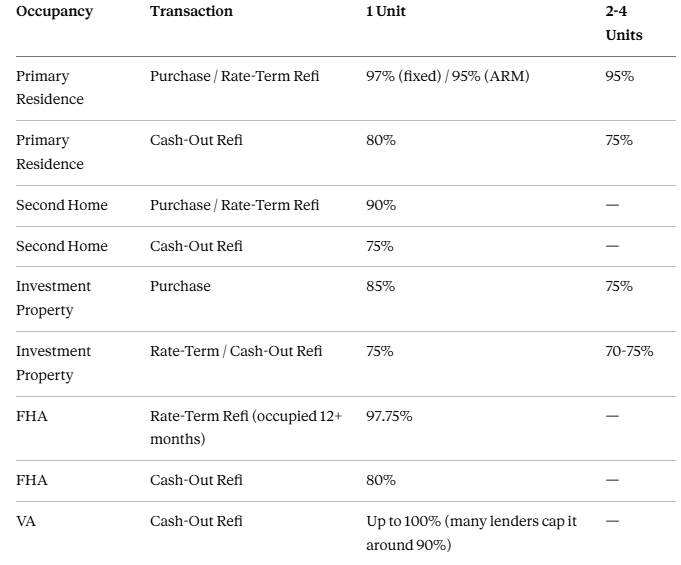
A few things worth flagging from this table. First, FHA cash-out used to go as high as 85% before HUD tightened it to 80% back in 2019, so don't trust older articles still quoting the higher number. Second, that 85% max LTV on an investment property purchase is exactly why so many borrowers turn to DSCR loans once they've maxed out their conventional financing on rental units — a DSCR loan qualifies off the property's rent rather than the borrower's personal income, which opens up a completely different underwriting path.
How Max LTV Affects Your Mortgage?
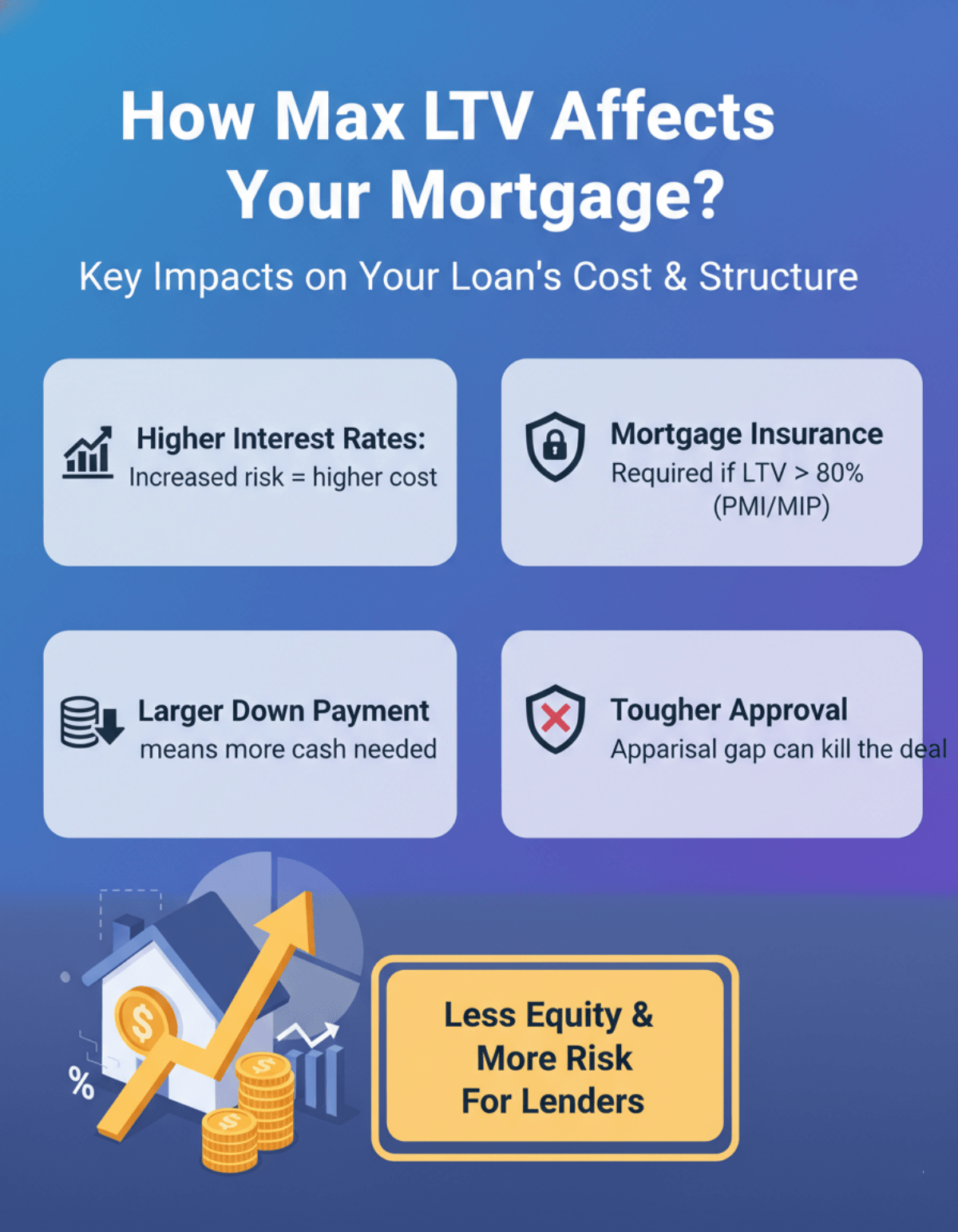
Hitting the maximum allowable LTV might help close a deal with minimal cash out of pocket, but it isn't without consequences. A high LTV fundamentally alters the cost and structure of the mortgage. Here is how pushing that limit impacts the bottom line:
- Interest Rates & LLPAs: Lenders apply Loan-Level Price Adjustments. Higher LTVs generally trigger higher interest rates due to increased default risk.
- Mortgage Insurance: Pushing past 80% LTV usually guarantees a PMI (Private Mortgage Insurance) or MIP requirement, increasing the monthly payment.
- Down Payment Pressure: A lower max LTV means the borrower must bring more cash to the closing table to bridge the gap.
- Approval Odds: Maxing out the ratio leaves zero room for error. If the appraisal comes in slightly short, the entire deal could fall apart.
Tip: Use Zeitro Strata to Verify Max LTV in Guidelines
I still remember burning 30 minutes doing a "Control-F" search through a 500-page PDF just to confirm a DSCR LTV cap for a Florida condo file. These days, my go-to is Zeitro Strata, an AI-powered mortgage guideline assistant built to erase that entire workflow.
Instead of manual digging, its DeepSearch cross-checks over 100 investors and 1,000+ guidelines, covering everything from AAA Lending to CMG Financial, across programs like Bank Statement, ITIN, and DSCR, in a matter of seconds. What sold me on it is the citations — every answer links back to the source, so I'm never quoting a number I can't defend to a client. If something still doesn't click, the "Explain" feature breaks it down further without making me start the search over.
Here is how I use it in three simple steps:
- Type your scenario: Ask a direct or vague question in English or Chinese (e.g., "What is the max LTV for a DSCR loan in Texas?").
- Apply customizable tags: Filter by loan-type, DSCR, or specific investors to narrow results to the exact programs you care about.
- Get instant answers: Receive a highly accurate response backed by direct guideline citations within seconds.

FAQs About Max LTV
Q1. Is a high LTV riskier?
Yes. From a lender's perspective, less borrower equity means more exposure if a foreclosure happens down the road. That elevated risk is exactly why high-LTV borrowers typically face stricter underwriting, higher rates, and mandatory mortgage insurance.
Q2. Can you get 100% LTV?
You can. VA loans offer 100% LTV for eligible military borrowers, and USDA loans provide the same for qualified rural properties, both with zero down payment required. Certain state-level down payment assistance programs can also effectively get a conventional borrower to 100% financing.
Q3. What does 80% LTV mean?
An 80% LTV means the borrower has put down 20% in cash, or holds 20% equity in the property. In conventional lending, this is the sweet spot everyone aims for, because it lets you skip Private Mortgage Insurance (PMI) entirely.
Q4. What's the difference between max LTV and max CLTV?
Max LTV only looks at your primary mortgage against the home's value. Max CLTV (combined loan-to-value) adds every other lien on the property — a HELOC, a second mortgage, a down payment assistance loan — into that same calculation. A borrower can be well under their program's LTV limit and still get declined because their CLTV, once every lien is stacked together, breaks the ceiling.
Q5. What is the maximum loan-to-value ratio for an FHA loan?
In practice, it's 96.5% for borrowers with a credit score of 580 or higher, and 90% for scores between 500 and 579. You'll sometimes see real estate finance textbooks round this to "approximately 97%" in multiple-choice questions — that's a rough approximation of the true 96.5% figure, not the number FHA actually uses in underwriting today.
Q6. How do you calculate max LTV?
The math is straightforward: take the loan amount you're requesting, divide it by the property's appraised value or purchase price (whichever is lower), then multiply by 100. If you want the full walkthrough with worked examples, here's how to calculate LTV ratio step by step.
Conclusion
Getting the max LTV right can make or break a deal, whether you're working within strict FHA limits or structuring a Non-QM foreign national file. Refinance transactions add another layer entirely, since a cash-out request almost never gets the same ceiling as a purchase on the same property type. As a mortgage professional, I'd rather spend that time talking to clients than scrolling through outdated PDFs looking for a number that may have changed six months ago.
That's why I keep coming back to Zeitro Strata. Their Explorer plan gives you 3 free AI queries a day, plus access to a pricing engine and 10 lifetime FNM/1003 exports. Stop guessing on your pre-approvals — try it for free and start giving your clients faster, more reliable answers today.
People Also Read
- What is Mortgage Eligibility Checker? Best Tool to Verify Guidelines
- Non-QM Loan Guidelines: How to Check and Verify with AI Accuracy
- How to Determine Mortgage Eligibility? Verify Guidelines in Seconds
- Top Loan Origination Systems: Close More Loans Quicker
- Best AI Mortgage Underwriting Software for Loan Professionals

![[Tips for Loan Officers] How Can I Lower Borrower DTI?](https://cdn.prod.website-files.com/6731bc6e813a541b54c30b10/6aa3b89e281a639e7a5c6fca_lower-debt-to-income-ratio-banner.jpg)