
Non-QM Loan Guidelines: How to Check and Verify with AI Accuracy

Blog

Non-QM Loan Guidelines: How to Check and Verify with AI Accuracy

What are Non-QM loan guidelines and how do you check them efficiently? Explore loan types, requirements, and close more Non-QM loans faster.
March 29, 2026
·
5 min read

Written by

Eric
Author from Zeitro

Share this article

Subscribe to updates

Thank you! Your submission has been received!
Oops! Something went wrong while submitting the form.

Non-QM loans are booming, but navigating their extremely fragmented guidelines is an absolute nightmare. I've spent over a decade as a loan professional, and nothing drains my energy faster than digging through a 300-page PDF from a private investor just to verify one specific detail for a borrower. The sheer lack of standardization leads to deal-killing mistakes, lost hours, and massive frustration.

Fortunately, the days of relying on endless scrolling and manual searches are officially over. Today, you can check Non-QM loan guidelines with 100% accuracy and verify complex borrower scenarios in seconds using AI tools like Zeitro Strata.

What are Non-QM Loans?

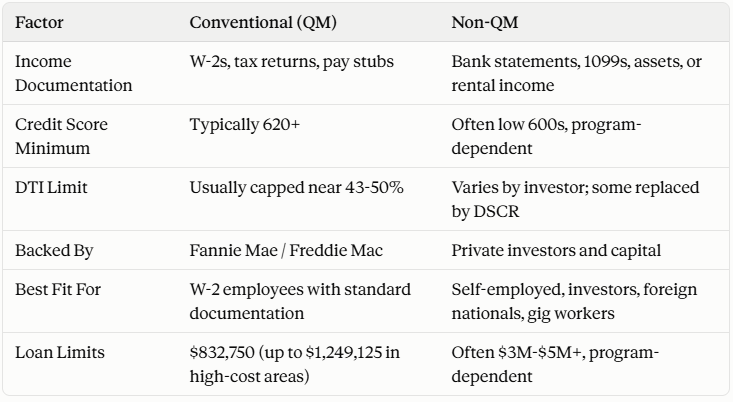
Put simply, a Non-Qualified Mortgage (Non-QM) is a loan that doesn't fit the strict "Qualified Mortgage" rules set by the CFPB. While traditional QM loans conform to standardized Fannie Mae and Freddie Mac criteria, Non-QM loans offer incredible flexibility. The biggest difference? Non-QM lending focuses on alternative income verification and the borrower's true ability to repay (ATR) rather than demanding standard W-2s or pristine credit histories.

They are perfect for high-quality borrowers, like self-employed individuals or real estate investors, who just happen to fall outside the traditional lending box.

Here are the most common Non-QM loan types:

  • Bank Statement Loans: Verifies income using 12 to 24 months of business or personal bank deposits.
  • DSCR (Debt Service Coverage Ratio) Loan: Uses the property's rental cash flow to qualify rather than personal income.
  • ITIN Loans: For borrowers who pay US taxes using an ITIN instead of a Social Security Number.
  • Asset Utilization: Allows borrowers to qualify based on liquid assets instead of monthly income.
  • Foreign National Loans: Designed for non-U.S. citizens purchasing property stateside.
  • 1099 Loans: Tailored for gig workers and independent contractors.
What are Non-QM Loans?

What are Non-QM Loan Guidelines?

Non-QM loan guidelines are the specific underwriting rules and requirements established by private investors and lenders rather than government agencies. Because these aren't backed by the GSEs, private capital sets the rules.

Unlike conventional loans where you have one clear rulebook, Non-QM guidelines are issued by individual lenders, such as AD Mortgage, AmWest, CMG Financial, First Colony, Greenbox, and dozens of others. If you want to check a rule, where do you go? Traditionally, you have to log into each respective lender's broker portal, download their massive PDF manuals, or try to decode a complex, multi-tab matrix spreadsheet. Because every investor's risk appetite is unique, their guidelines are completely fragmented, making working with these loans notoriously challenging.

Why Is It Difficult to Check Non-QM Guidelines?

Over my career, I've lost count of how many times a seemingly solid deal was derailed at the underwriting stage because of a single overlooked requirement. Checking these guidelines manually is a massive headache. Here is why:

  • No Universal Standard: If you have 100 different investors, you have 100 different sets of rules. One lender might allow a 50% DTI, while another caps it at 43% for the exact same scenario.
  • Constant Updates: Private investors frequently update their matrices and risk models without much fanfare. That downloaded PDF on your desktop? It might already be outdated, leading to fatal underwriting rejections.
  • Time-Consuming Manual Work: Using "Ctrl+F" to hunt through a dense, 300-page document for a niche guideline can easily waste 30 to 45 minutes per loan file. It's a completely inefficient use of your valuable time.
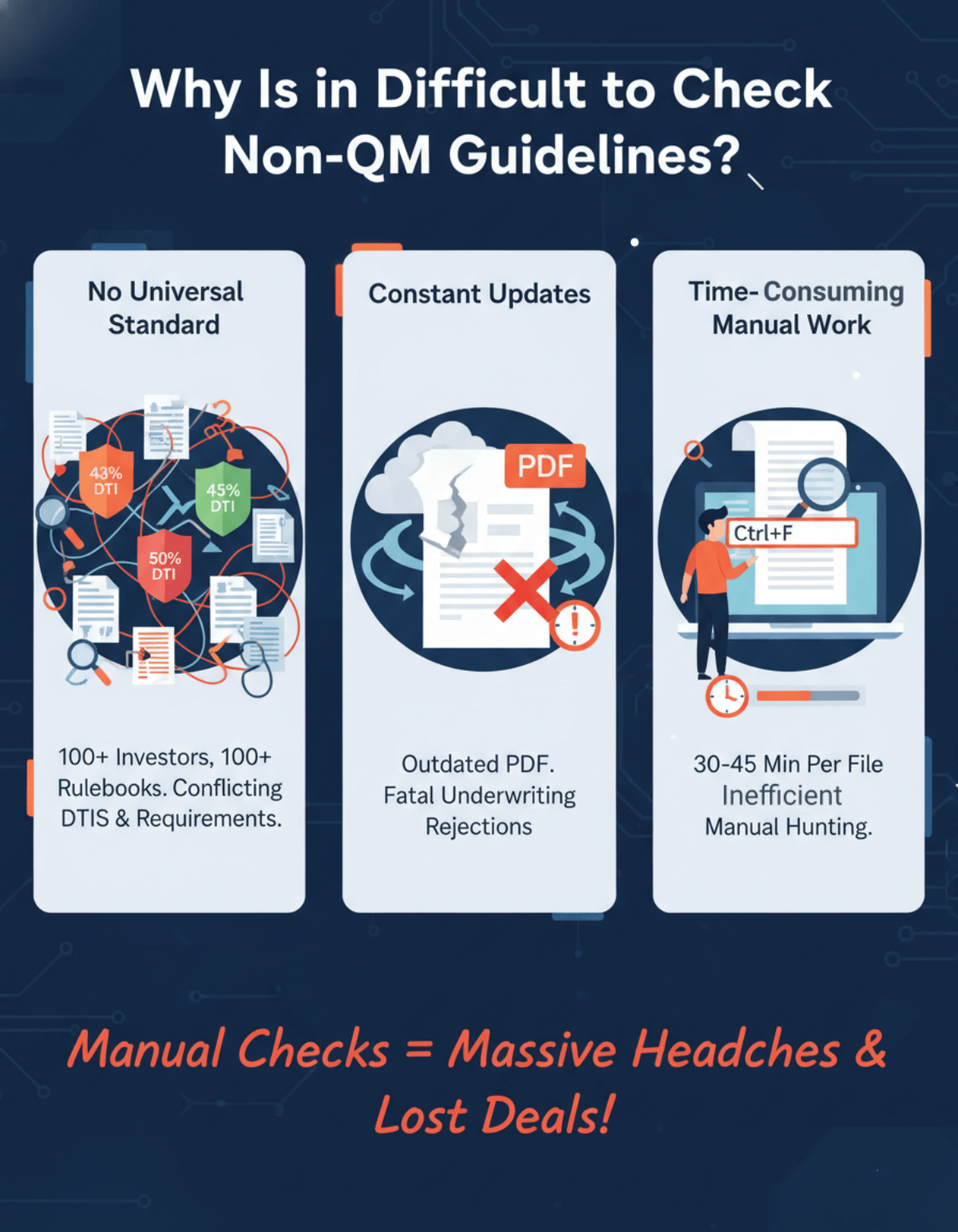
Why Is It Difficult to Check Non-QM Guidelines?

What are the Requirements for a Non-QM Loan?

Because there is no universal standard, it's crucial to remember that exact requirements completely depend on the specific investor and loan program you select. However, there are some general frameworks you can expect when structuring a deal:

  • Credit Score Flexibility: Non-QM programs are much more forgiving. You can often qualify borrowers with scores in the low 600s or even recent credit events, but lower scores usually require a larger down payment to offset the risk.
  • Income Verification: This is where Non-QM shines. Instead of tax returns and W-2s, underwriters will look at business bank statements, 1099s, or even the cash flow of an investment property (DSCR).
  • Reserves & Down Payments: Because investors take on slightly more risk, they typically require larger liquid cash reserves (often 3-6 months) and slightly higher down payments, generally starting around 10% to 20%, depending on the exact scenario.

Zeitro Strata: Quickly and Accurately Check Non-QM Guidelines

The days of manual PDF hunting are over. In my practice, the ultimate weapon for boosting efficiency has been an AI tool specifically designed for mortgage professionals: Zeitro Strata. It's a powerful, AI-powered Mortgage Guideline Assistant that transforms how you check and verify complex scenarios.

Zeitro Strata

Explore Features of Zeitro Strata

DeepSearch & Comprehensive Data: Zeitro Strata actively monitors and cross-checks over 300+ continuously updated guidelines from 100+ top lenders, including AD Mortgage, AmWest, Forward Lending, and Luxury. Whether you need info on DSCR, Bank Statement, or Jumbo loans, it's all in one place.

  • 100% Accuracy with Citations: The AI doesn't just guess. It provides exact source citations. You can trace every answer back to the actual guideline, giving you absolute confidence when quoting terms to your borrowers.
  • Massive Time Savings: It cuts manual lookup time from 30 minutes down to seconds. My team saves roughly 7+ hours per loan file, allowing us to deliver pre-qualifications 2.5x faster and close up to 30% more loans.
  • Flexible Scenarios & Multi-language: You can ask vague questions like "What is eligibility for..." or input highly specific borrower scenarios. Plus, it supports both English and Chinese queries seamlessly.

How to Use Zeitro Strata?

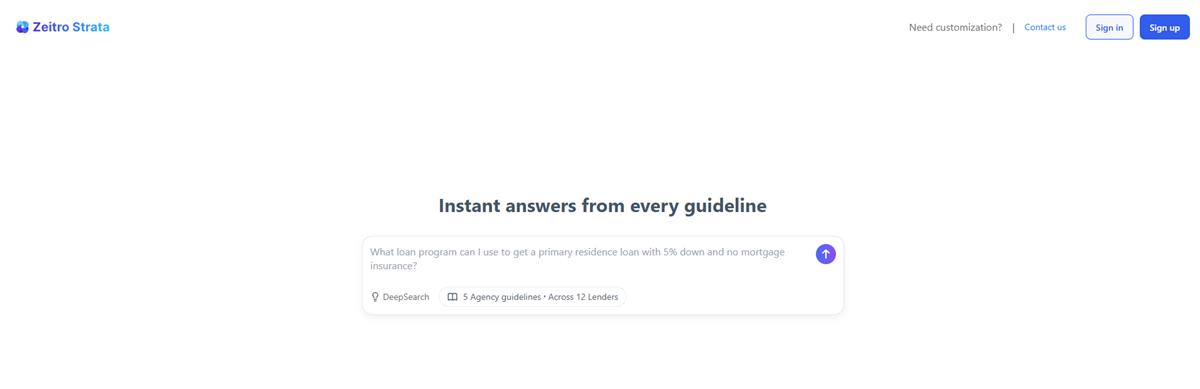
Step 1: Use customizable tags to instantly narrow your search parameters to specific loan types (like ITIN or DSCR) or specific lenders.

Step 2: Type in your exact borrower scenario.

Step 3: Within seconds, you get an accurate, professional answer backed by a citation link. If a nuance is tricky, just hit the "Explain" button to have the AI break it down further. You can even share the link directly with your team via email.
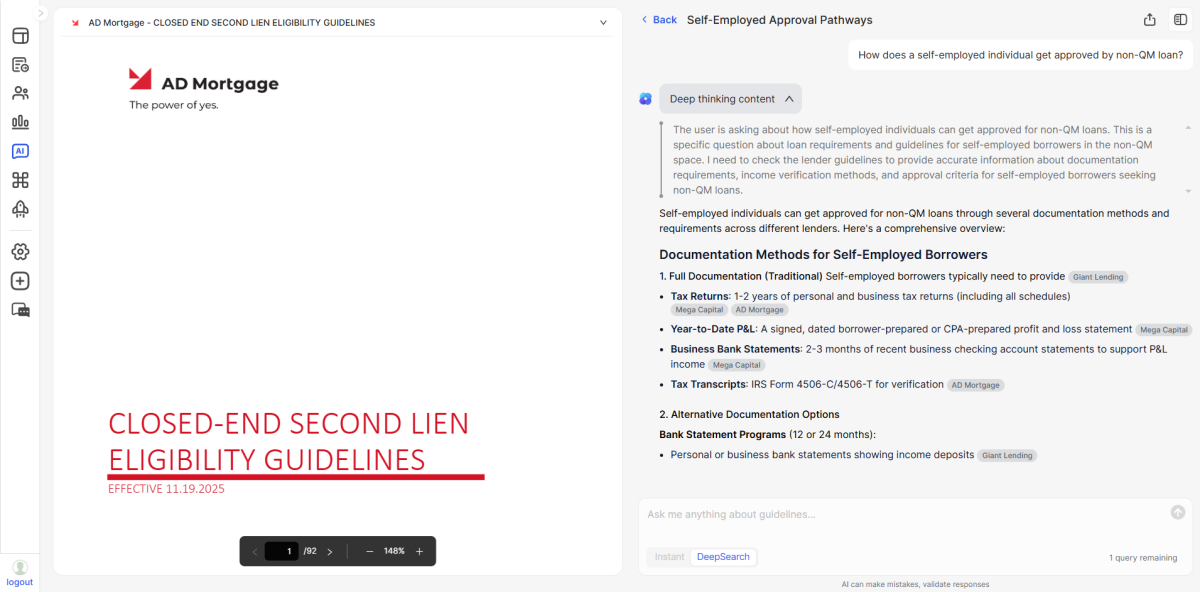
How to Use Zeitro Strata?

FAQs About Non-QM Underwriting Guidelines

Q1. What are the loan limits for non-QM loans?

Unlike conforming loans, which cap out at $832,750 (or $1,249,125 in high-cost areas for 2026), Non-QM limits are significantly higher. Many private investors offer Jumbo Non-QM products allowing loan limits up to $3 million, $5 million, or even more, depending strongly on LTV and credit score.

Q2. Can a non-QM loan be conforming?

No, a Non-QM loan cannot be conforming. By definition, conforming loans must adhere to the strict standards set by Fannie Mae and Freddie Mac. Non-QM loans exist specifically for borrowers whose financial profiles fall completely outside of these traditional agency guidelines.

Q3. Is a non-QM loan risky?

While they carry slightly more risk for the lender, they are not the "subprime" loans of the past. Non-QM loans are still strictly governed by Ability-to-Repay (ATR) rules. They simply use alternative, logical methods to verify a strong borrower's cash flow and financial health.

Q4. How long does it take to close a non-QM loan?

Traditionally, the manual back-and-forth could drag the process out to 30-45 days. However, by using AI-driven verification tools like Zeitro Strata to handle pre-qualifications and guideline checks accurately upfront, you can easily accelerate closing times by up to 20%.

Q5. Is a non-QM loan a hard money loan?

No. Hard money loans are short-term, asset-based loans typically used by real estate flippers. In contrast, Non-QM loans are designed as long-term residential mortgages that still evaluate the borrower's long-term capacity to repay the debt, just using non-traditional documentation.

Conclusion

Non-QM loans represent a massive growth opportunity for brokers and loan officers, especially as the gig economy expands and more borrowers seek alternative financing. However, the sheer complexity of investor guidelines has traditionally been the biggest roadblock to scaling your business. As we move through the current market, relying on outdated PDFs and manual document searches is no longer just inefficient. It's costing you deals.

It's time to stop wasting your day digging through manuals and start focusing on what really matters: building relationships and closing loans. If you want to deliver pre-qualifications 2.5x faster and drastically reduce human error, you need the right tech stack. I highly recommend heading over to Zeitro.com to try out Zeitro Strata. With their freemium model offering 3 free queries a day, you can instantly experience how AI transforms the way you verify guidelines!

People Also Read

Keep reading

AI Mortgage Underwriting Explained: Will You Be Replaced?
Blog

5 min read
Arrow icon on dark background
AI Mortgage Underwriting Explained: Will You Be Replaced?
Explore the rise of AI mortgage underwriting. Learn about its key features, pros and cons, and how lenders use machine learning to speed up approvals while staying compliant.

I remember the days when my desk was literally buried under stacks of tax returns, bank statements, and W-2s. The pressure to clear a pipeline while maintaining 100% accuracy was, frankly, exhausting. You're constantly worried about a missed decimal point or an overlooked line of credit. That's why the mortgage industry is sprinting toward AI underwriting.

It's not just a tech trend. It's a survival mechanism for an industry prone to burnout and human error. As a mortgage underwriter, I've watched these tools evolve from simple calculators to complex decision-makers. But the question remains: is the machine coming for my job, or is it just coming to help?

What is AI Mortgage Underwriting?

AI mortgage underwriting isn't exactly new, but its current "brainpower" is a massive leap forward. We've moved far beyond the basic Automated Underwriting Systems (AUS) like Fannie Mae's Desktop Underwriter (DU), which have been industry staples since the 1990s. Today, we are talking about machine learning, systems that learn from millions of past loan outcomes to predict future risk. Since the 2020 pandemic forced a digital-first shift, adoption has skyrocketed.

According to Fannie Mae's Mortgage Lender Sentiment Survey, a growing number of lenders are now using AI to automate the "stare and compare" work. The trend is moving away from simple "yes/no" logic toward predictive modeling that can evaluate a borrower's creditworthiness in seconds, even for those with non-traditional financial backgrounds.

What is AI Mortgage Underwriting?

Also Read:

Key Features of AI Mortgage Underwriting

In my daily workflow, these tools have shifted from "optional" to "essential." Here is how AI is actually functioning behind the scenes:

  • Intelligent Document Processing (IDP): This is a lifesaver. Using OCR and machine learning, the system "reads" paystubs and tax returns, extracting data with higher precision than a tired human eye.
  • Automated Risk Assessment: AI analyzes patterns humans might miss, such as subtle inconsistencies in bank statements that could signal "undisclosed debt" or fraud.
  • Faster Turnaround Times: While a traditional manual review might take me 48 hours to issue an initial approval, AI can do it in minutes, significantly lowering the "time-to-close."
  • Human-in-the-Loop: This is the safety net. The AI flags "grey area" files, and I step in to make the final call. It handles the easy files, so I can focus on the complex ones.
Key Features of AI Mortgage Underwriting

Pros and Cons of AI Mortgage Underwriting

From my side of the desk, the benefits are obvious, but the drawbacks keep me cautious. On the positive side, AI eliminates "Friday afternoon fatigue", those errors that happen when you're on your tenth file of the day. It also creates a much better borrower experience. In a competitive housing market, getting an approval in hours instead of weeks is a game-changer.

However, the "black box" nature of some algorithms is a real concern. If an AI denies a loan, we must be able to explain exactly why to satisfy the Equal Credit Opportunity Act (ECOA). Furthermore, there is the risk of "algorithmic bias." If the historical data used to train the AI contains past systemic biases, the machine might unintentionally repeat those patterns. High implementation costs also mean smaller credit unions may struggle to keep up with the tech giants.

Differences Between AI and Manual Mortgage Underwriting

The real difference lies in "nuance." AI is binary. It sees data as black and white. If a borrower has a unique situation, perhaps they are a self-employed freelancer with four different income streams, the AI might get confused and issue a hard "no."

That's where manual underwriting shines. I can look at the "story" behind the numbers. Humans offer empathy and situational judgment, we can understand that a one-time medical emergency five years ago shouldn't necessarily disqualify a borrower today. Manual underwriting is a craft, while AI is a high-speed factory. We need the factory for the bulk of standard, "clean" loans, but we still need the craftsman for the complex cases that don't fit a standard mold.

Differences Between AI and Manual Mortgage Underwriting

The Role of Compliance and Ethics in AI Underwriting

In the U.S., we operate under strict laws like the Equal Credit Opportunity Act (ECOA). The Consumer Financial Protection Bureau (CFPB) has made it clear that lenders cannot hide behind the "algorithm" when it comes to discriminatory outcomes. Lenders remain legally responsible for their AI decisions and are required to provide specific reasons for adverse actions under fair‑lending laws.

This is why "Explainable AI" (XAI) and model interpretability are becoming so critical in our industry, as regulators increasingly demand transparency in automated credit decisions. We have to be able to pull back the curtain and prove the decision was based on creditworthiness, not protected characteristics. As an underwriter, my role is increasingly becoming one of a "Compliance Auditor" for the AI.

FAQs About AI Mortgage Underwriting

Q1: How is AI used in loan underwriting?

It's used to verify identities, calculate income from complex tax returns, assess property valuations (AVMs), and flag potential fraud by comparing data against millions of historical records.

Q2: Will AI replace mortgage underwriters?

No. It will replace the tasks of data entry and basic verification. The role is shifting from "processor" to "risk strategist." We are moving toward what some call a "bionic underwriter" model, a metaphor for the partnership where technology handles the data and humans retain the final judgment.

Q3: Does AI improve loan approval rates?

Potentially, yes. By using "trended data" (such as patterns in bank account balances and transactions over time), AI can help "thin‑file" borrowers, those with limited traditional credit histories, get approved when a human might have rejected them for lack of data. Some models also incorporate alternative data like consistent rent or utility payments to further support these borrowers.

Q4: Is AI underwriting compliant with Fair Lending laws?

Only if monitored correctly. Federal regulators like the CFPB require lenders to ensure their AI models don't result in "disparate impact" against protected classes.

Q5: How can underwriters prepare for an AI-driven future?

The best thing you can do is "up-skill." Learn how to interpret data analytics and get comfortable with platforms like Fannie Mae's DU or Freddie Mac's LPA. Your value will be in your ability to manage the technology, not compete with it.

Conclusion

After years in the trenches, I've realized that AI isn't my replacement. It's my "co-pilot." It takes away the mind-numbing task of cross-referencing bank statements so I can focus on high-level risk strategy and helping borrowers with complex needs.

The mortgage underwriter of 2030 is unlikely to be a data entry clerk. They may instead be a "digital pilot" overseeing sophisticated AI systems. If you're in this industry, don't fear the tech. Instead, learn how the algorithms work. The future of lending is faster and smarter, and there's still plenty of room for those of us who know how to navigate the human side of homebuying.

Blog

5 min read
Arrow icon on dark background
2026: Best AI Mortgage Underwriting Software for Loan Professionals
Which AI mortgage software is best for 2026? I compare Zeitro, Ocrolus, and Candor to help you automate underwriting and eliminate manual errors fast.

As a mortgage professional who has navigated the shifting tides of the industry for years, I've seen 2026 become a true "make or break" year. The market is faster, guidelines are more complex (especially in the Non-QM space), and borrowers have zero patience for delays. If you're still manually digging through PDFs at 2 AM to verify a guideline, you're not just losing sleep. You're losing deals.

I've spent months testing the latest tech to see which tools actually deliver. Today, I'm sharing my top picks for the best AI mortgage underwriting software that helps us work smarter, not harder.

The Benefits of Using AI Mortgage Underwriting

The truth is, the "old way" of processing loans is becoming a liability. According to recent data from the Mortgage Bankers Association (MBA), the average cost to originate a loan has hovered around $11,000, even after years of technology investment, largely due to ongoing manual processes. AI changes that math immediately.

In my experience, moving to an AI-driven workflow isn't just about speed. It's about the peace of mind that comes with precision. When an AI agent handles the heavy lifting of data entry and guideline cross-referencing, I can focus on what I actually enjoy: building relationships and closing more files. Here's why I believe AI is now non-negotiable:

  • Extreme Speed: Move from application to a solid pre-qualification in minutes, not days.
  • Near-Perfect Accuracy: AI doesn't get tired or miss a line item in a bank statement, reducing DTI calculation errors.
  • 24/7 Guideline Access: Get instant answers on complex Fannie, Freddie, or Non-QM overlays without waiting for a help desk.
  • Reduced Burnout: Let the machine handle the "grunt work" while you focus on high-level strategy.
  • Audit-Ready Compliance: Every decision is backed by a digital paper trail, making SOC 2 compliance and audits a breeze.
The Benefits of Using AI Mortgage Underwriting

6 Top-Rated AI Mortgage Underwriting Software

Choosing the right tool depends on your volume and the types of loans you handle. Here are the six platforms that are leading the pack in 2026.

#1. Zeitro - Best for SMBs and Independent Mortgage Professionals

I've found Zeitro to be a game-changer for independent brokers and smaller teams who need "enterprise-level" power without the massive price tag. Founded by tech veterans from Google and Apple, Zeitro isn't just a document reader. It's a full AI Mortgage Agent. Their Zeitro Strata AI tool is particularly impressive. It lets you ask complex questions about both QM and Non-QM guidelines and gives you answers with full source transparency. It's like having a senior underwriter sitting right next to you, 24/7.

Zeitro

Pros:

  • Massive Time Savings: Saves about 7+ hours per loan file by automating guideline research.
  • Neutrality: They aren't tied to any specific lender, so the data is unbiased.
  • All-in-One POS: Includes a digital 1003, credit pulls, and an AI-driven DTI calculator.
  • GrowthHub: Helps you launch a branded site to capture leads and showcase live rates.
  • High Accuracy: Boasts an 85%+ income calculation accuracy, way higher than manual entry.
  • Flexible Access: You can actually try it for free with 3 queries a day.

Cons:

  • Primarily focused on the U.S. market.
  • Might have more features than a very basic, low-volume "hobbyist" broker needs.
  • The deep customization of the pricing engine takes a little time to set up.

#2. Candor - Best for Automated Decision Certainty

Candor is what I call a "logic engine." It doesn't just extract data. It thinks like a mortgage underwriter. It uses a patented "Expert System" to perform the same cognitive tasks a human does. It's perfect for mid-sized lenders who want to automate the "clear to close" process.

Candor

Pros:

  • Dynamic "Conditions" management that updates in real-time.
  • Reduces the need for multiple touches on a single file.
  • Very strong at handling conventional, government, and jumbo loans.

Cons:

  • The implementation process can be a bit heavy for very small shops.
  • Less focus on the front-end borrower experience compared to Zeitro.
  • Pricing is geared toward higher-volume institutions.

#3. Ocrolus - Best for Document Automation & Income Verification

If your biggest bottleneck is messy paperwork, Ocrolus is the gold standard. They specialize in taking unstructured data, like scanned bank statements or pay stubs, and turning it into clean, verified data. I've seen this drastically reduce fraud and human error in income verification.

Ocrolus

Pros:

  • Industry-leading OCR (Optical Character Recognition) accuracy.
  • Excellent fraud detection for bank statements.
  • Integrates seamlessly with almost every major LOS (Loan Origination System).

Cons:

  • While strong in document automation, it focuses more on data extraction and automated conditioning rather than a complete underwriting decision engine.
  • It pairs best with tools for full guideline checks.
  • Per-document pricing can add up if you have very paper-heavy files.

#4. Fundmore AI - Best for Cloud-Native Workflow Optimization

Fundmore is a sleek, modern platform that excels at workflow automation. It's built for the "modern" team that wants a beautiful UX and automated task lists. It's great for ensuring that nothing falls through the cracks during the loan lifecycle.

Fundmore

Pros:

  • Very intuitive user interface that requires minimal training.
  • Strong "automated checklist" features that keep borrowers on track.
  • Good API connectivity for tech-savvy teams.

Cons:

  • The guideline research features aren't as deep as Zeitro Strata AI.
  • Best suited for teams that already have a solid LOS in place.
  • Reporting features could be more robust.

#5. Turnkey-Lender - Best for Multi-Product Lenders

For shops that do more than just mortgages, like personal loans or commercial credit, Turnkey-Lender offers an end-to-end AI platform. It's an all-in-one "bank in a box" solution that uses AI for credit scoring and risk management.

Turnkey-Lender

Pros:

  • Handles multiple types of credit products on one platform.
  • Powerful proprietary AI scoring models.
  • Automates everything from origination to collections.

Cons:

  • Can feel "overbuilt" if you only focus on residential mortgages.
  • High cost of entry for small businesses.
  • The interface is a bit more complex due to the sheer number of features.

#6. Friday Harbor - Best for High-Volume Operation Efficiency

Friday Harbor targets the big players. Their AI is designed to sit on top of massive operations to find efficiencies that humans miss. It's about squeezing every bit of ROI out of a high-volume pipeline.

Pros:

  • Excellent at identifying "bottlenecks" in large underwriting teams.
  • Helps standardize decisions across hundreds of different underwriters.
  • Significant reduction in "cost per loan" for enterprise users.

Cons:

  • Not really built for the individual broker or small team.
  • The sales cycle and setup time are longer than other "plug-and-play" tools.
  • Limited focus on the Non-QM/Niche loan market.

AI Mortgage Underwriting vs. Manual Mortgage Underwriting

The difference between manual mortgage underwriting and AI-driven underwriting in 2026 is like comparing a typewriter to a MacBook. While manual work allows for "human intuition," it's simply too slow and prone to fatigue.

I've found that AI doesn't replace my intuition. It gives me better data to use. In the table below, you can see how the two stack up across the key metrics that affect our commissions and client satisfaction.

FAQs About AI Mortgage Underwriting

Q1. Is my borrower's data safe with AI?

Yes, provided you use enterprise-grade tools. Leading platforms like Zeitro are SOC 2 Type II certified, meaning they meet the highest security standards for data protection and privacy.

Q2. Will AI replace human loan officers?

I don't think so. Borrowers still want a human to guide them through the biggest purchase of their lives. AI just removes the boring, technical work so we can spend more time being advisors.

Q3. Can AI handle complex Non-QM or DSCR loans?

Absolutely. In fact, that's where tools like Zeitro Strata AI shine. They can parse through thousands of pages of niche lender overlays much faster than any human.

Q4. How much time does AI actually save?

On average, most professionals report saving 7 to 10 hours per loan file. That's an extra day of work every week you get back.

Q5. How hard is it to switch to an AI system?

Modern "AI-Native" tools are designed to be "plug-and-play." You can often start running guideline queries or pricing loans the same day you sign up.

Conclusion

If you want to stay relevant in 2026, you need to choose an AI partner that fits your specific business model. The competition is too fierce to rely on manual processes anymore. After testing the field, here is my final recommendation:

  • For the Individual Broker or SMB: Zeitro is the clear winner. It's the most versatile, handles Non-QM like a pro, and the 7-hour time savings per loan is a massive boost to your bottom line.
  • For High-Volume Document Cleanup: Ocrolus is your best bet to handle the paperwork mountain.
  • For Enterprise-Level Decisioning: Candor or Friday Harbor provide the robust logic needed for large teams.

My advice? Start small. Try a tool for your next complex pre-approval and see how much faster you get to the "yes." Your clients, and your sanity, will thank you.

People Also Read

How to Determine Mortgage Eligibility? Verify Guidelines in Seconds

Blog

5 min read
Arrow icon on dark background
How to Determine Mortgage Eligibility? Verify Guidelines in Seconds
Stop manual PDF research. Use Zeitro's AI to determine mortgage eligibility with full source transparency. The ultimate tool for brokers to close loans up to 20% faster.

If you're a loan officer or broker in today's market, you know the "guideline grind" all too well. We've moved into an era where Non-QM and niche products aren't just options. They are essential for survival. Non-QM securitizations surged significantly in 2025, with Q3 issuance hitting a record $20.9 billion, nearly double Q3 2024, according to industry reports. We are dealing with more complex scenarios than ever.

I've spent countless hours scrolling through 500-page PDFs just to find one overlay. It's a bottleneck that kills momentum. In this guide, I'll show you how we've finally moved past manual research to verify mortgage eligibility in seconds using AI-driven precision.

Why Do You Need to Determine Mortgage Eligibility?

In my experience, speed to lead is only half the battle. Speed to answer is what actually closes deals. Determining eligibility early isn't just about compliance. It's about protecting your most valuable asset: time. With average industry profits per loan fluctuating around $600–$1,200 in 2025, we can't afford to waste "green time" on files that will eventually be rejected by underwriting.

Accurate eligibility checks help us:

  • Build Instant Authority: When I can tell a self-employed borrower exactly why they qualify for a Bank Statement loan during the first call, I win their trust immediately.
  • Reduce Fallout: Misinterpreting a DSCR or ITIN guideline leads to dead files and frustrated Realtors.
  • Maximize Throughput: Top producers aren't smarter. They are more efficient. By filtering out non-starters in seconds, you focus only on high-probability closings.

Also Read: 2026: Best AI Mortgage Underwriting Software for Loan Professionals

Why Do You Need to Determine Mortgage Eligibility?

How to Determine Mortgage Eligibility Using Zeitro Strata?

When I first encountered Zeitro Strata, I realized the game had changed. It's an AI-native assistant designed specifically for our industry's complexity. It doesn't just "guess". It cross-checks over 300 guidelines from 100+ top investors like AAA Lending, Freedom Mortgage, and HomeXpress.

Zeitro Strata

Here is exactly how I use it to get answers in real-time:

  • Define Your Scope: I start by selecting the specific guidelines or investors I want to search. If I'm working on a tricky Non-QM case, I'll tag "Asset Utilization" or "Foreign National" to narrow the field.
  • Ask Your Scenario: I type in specific questions just like I'm talking to an AE. For example: "What is the max LTV for a 680 FICO borrower using 12-month bank statements for a primary residence?"
  • Review Cited Answers: Within seconds, Zeitro provides a precise answer. The best part? It includes Citations. I can click the source to see the exact paragraph in the lender's manual, ensuring I'm 100% compliant.
  • Deep Dive with "Explain": If a guideline is particularly dense, I use the "Explain" feature. It re-analyzes the source to break down the logic, which is a lifesaver for complex vesting or income-layering questions.

What Else Can Zeitro Do for You?

Beyond just verifying guidelines, I've found that the Zeitro ecosystem replaces several disconnected tools I used to pay for individually. It's a full-stack solution for the modern originator.

  • GrowthHub: I used this to launch a branded microsite. It's optimized for SEO, helping me capture organic leads by showcasing my expertise and live rates in a professional format.
  • Digital 1003 (POS): This is a game-changer for borrower experience. It's a mobile-friendly application that calculates DTI in real-time and exports data in FNM 3.4 format, which makes my processors very happy.
  • Pricing Engine: I can pull accurate quotes for both QM and Non-QM products in seconds. Being able to apply custom overlays directly in the engine means the quote I give is the quote they get.
Zeitro

FAQs About Determining Mortgage Eligibility

Q1. How accurate is the AI when reading these guidelines?

It's highly precise because it's built on "Source Transparency." Unlike general AI, Zeitro links every answer to a specific investor's PDF, so you can verify the source yourself in one click.

Q2. Does it support complex Non-QM products?

Yes, this is where it shines. It covers DSCR, ITIN, Bank Statements, P&L only, and even Asset Utilization across 100+ investors.

Q3. How often are the guidelines updated?

The system is updated continuously. As lenders release new announcements or update their manuals, the AI indexes that data to ensure you aren't looking at "stale" info.

Q4. Can I use it for free?

Yes, Zeitro offers 3 free queries per day, which is perfect for trying out a few tough scenarios before committing to a plan.

Q5. Is the data secure for my borrowers?

Absolutely. Zeitro is SOC 2 Type II certified, meaning they meet the highest enterprise-grade security standards for protecting financial data.

Conclusion

The mortgage landscape is shifting. In 2025, the "manual" loan officer is a dying breed. We are seeing a fundamental realignment toward technology that empowers us to do more with less. By integrating Zeitro Strata into my daily workflow, I've managed to save over 7 hours per loan file and increase my closing rate by 30%.

Whether you are navigating the nuances of a Foreign National file or just trying to get a quick answer on FHA overlays, the ability to verify eligibility in seconds is a massive competitive advantage. Don't let your "green time" be swallowed by PDF research. I highly recommend visiting Zeitro today to see how these AI tools can help you close faster and build a more resilient business.

Try Zeitro today and transform your loan origination workflow!

Get started free