
Written by

Eric
Share this article

.svg)
Subscribe to updates
Last Checked and Updated on September, 2026
In my years navigating the US mortgage landscape, I've watched plenty of solid borrowers get turned down by a computer simply because their financial life didn't fit into a tidy box. That's exactly where manual mortgage underwriting steps in.
If you've ever wondered what happens after the "automated system" says no, you're in the right place. In this guide, I'll walk through how this human-led review actually works, why it still matters so much in 2026, and how loan professionals like myself can handle it without losing our sanity.
What is Manual Mortgage Underwriting?
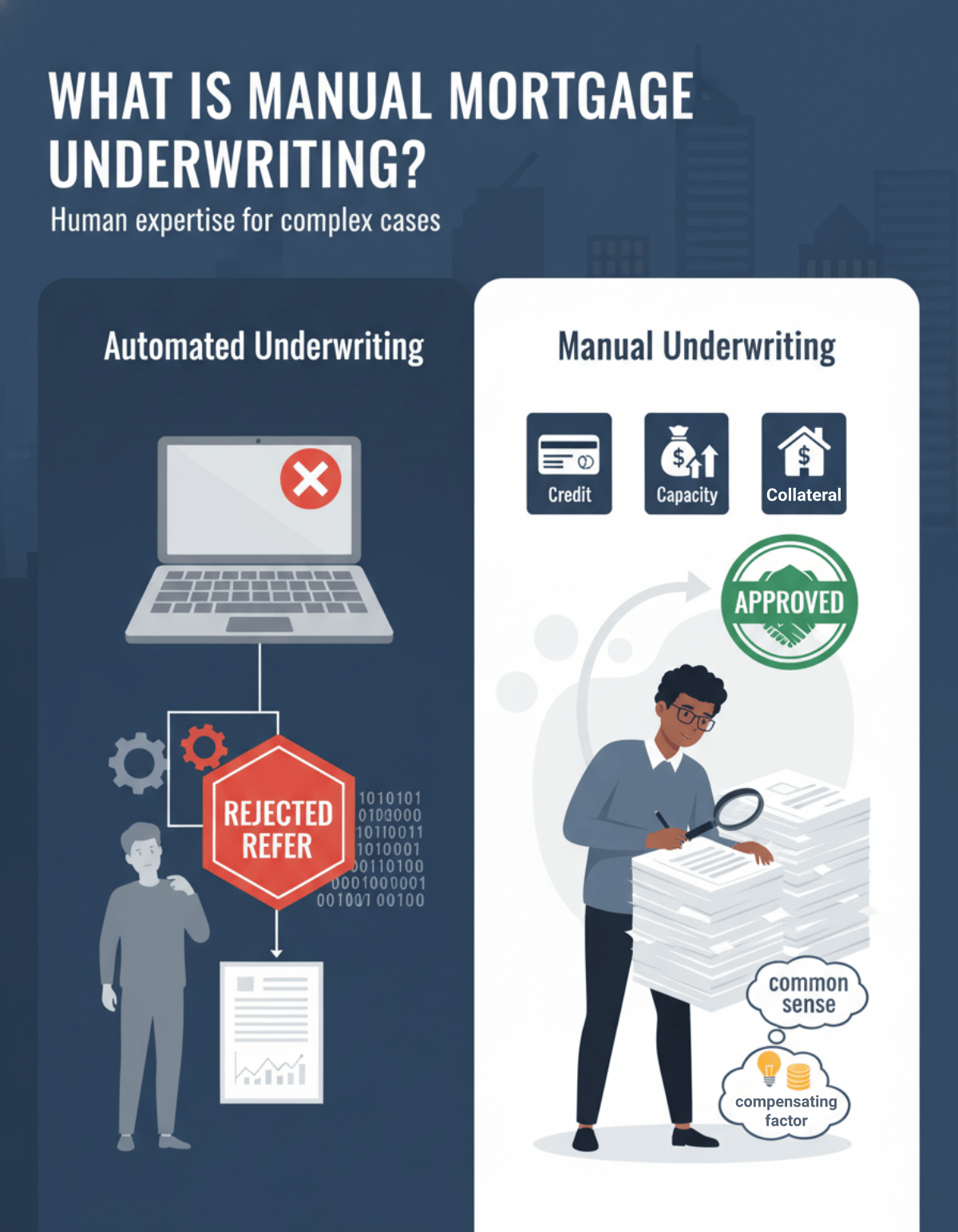
Manual underwriting means a human underwriter — not a piece of software like Fannie Mae's Desktop Underwriter (DU) or Freddie Mac's Loan Product Advisor (LPA) — personally reviews every line of a loan file. In the automated world, an algorithm renders a verdict in seconds. With manual underwriting, a trained professional digs into the borrower's "Three Cs": Credit, Capacity, and Collateral.
Regulators actually have a name for this approach. Under the Equal Credit Opportunity Act's Regulation B, any evaluation method that isn't a statistically validated credit scoring model is classified as a judgmental system — which is the formal term underneath what the industry casually calls "manual underwriting."
We need this path because automation is rigid. When a borrower has a thin credit file or a recent life event like a bankruptcy, the algorithm often defaults to a "Refer" result. Manual underwriting is the fallback that lets a real person apply common sense and weigh "compensating factors" to approve a loan a machine would otherwise pass on.
Requirements for Manual Underwriting in Mortgage
Getting through a manual file is genuinely more demanding than an automated one. From what I've seen on real files, you have to be far more meticulous with the paper trail. Here's what's typically required:
- Tighter DTI Ratios: Limits vary by loan program (more on that below), but they're generally lower than what an automated system can approve.
- Verification of Non-Traditional Credit: If a borrower has no FICO score, lenders document 12 months of on-time payments for things like rent, utilities, or even a cell phone bill.
- Cash Reserves: For FHA loans, one to two-unit properties typically need one month of PITI (principal, interest, taxes, and insurance) in reserve after closing, while three to four-unit properties need three months.
- A Detailed Letter of Explanation (LOX): This isn't optional. It's a narrative that explains any credit dings, employment gaps, or unusual deposits.
- Fully Sourced Assets: Every large deposit has to be sourced and seasoned. There's no skimming the fine print here.

Manual Underwriting DTI Limits by Loan Type
One thing that trips people up: DTI caps aren't the same across loan programs, and they shift depending on whether the file is manual or automated. Here's how the major programs compare:
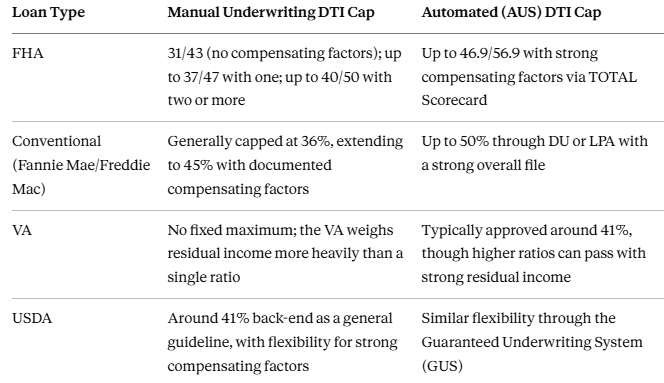
Every lender can layer its own overlays on top of these baseline numbers, so two lenders reviewing the same file manually can land on different answers.
Process of Manual Mortgage Underwriting
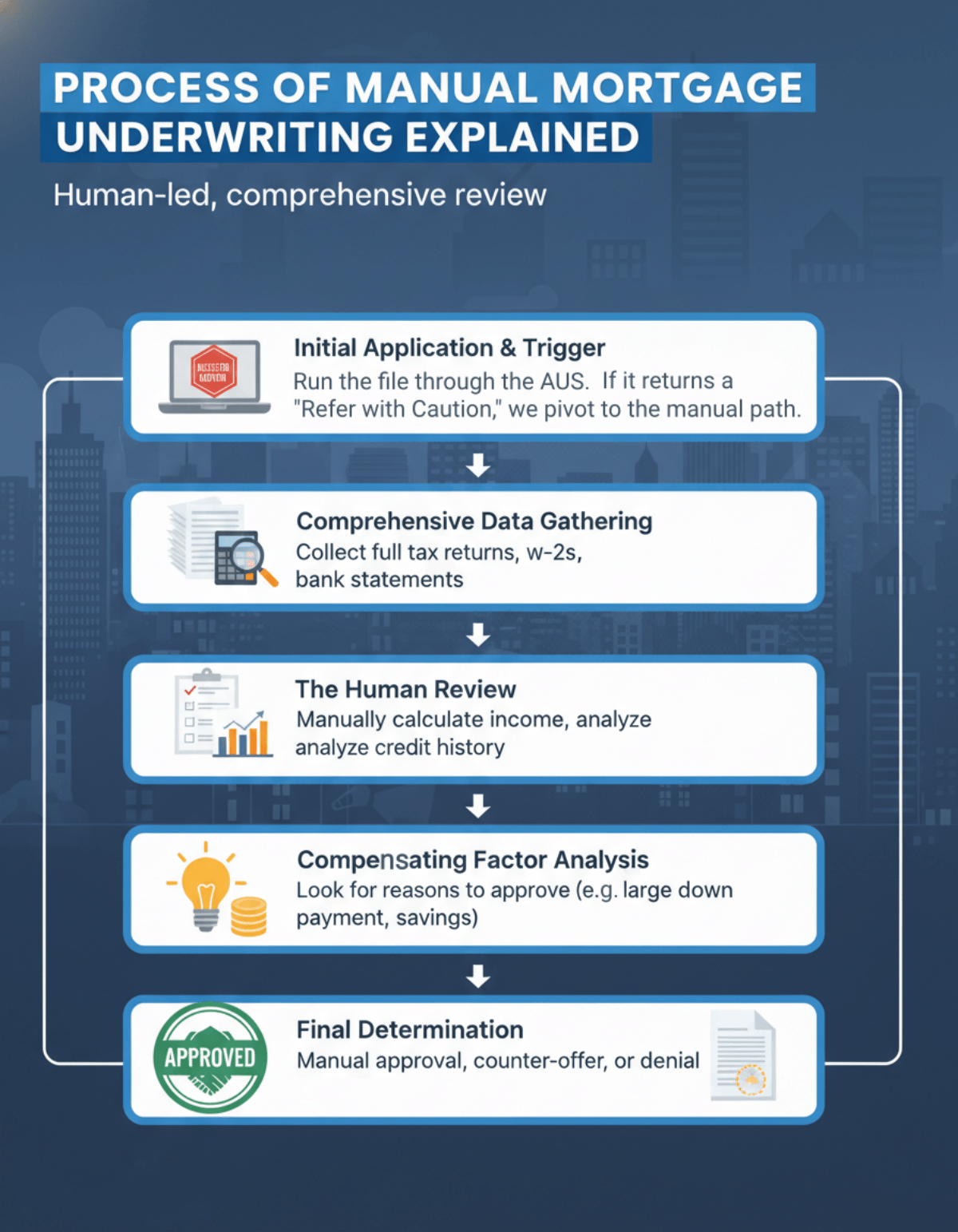
The process is a bit of a marathon, not a sprint. I usually describe it to my clients as a "forensic audit" of their financial life. Here is how it typically unfolds:
- Initial Application & Trigger: We run the file through the AUS. If it returns a "Refer with Caution," we pivot to the manual path.
- Comprehensive Data Gathering: I collect full tax returns, W-2s, and every page of bank statements. Nothing is left to chance.
- The Human Review: The underwriter manually calculates the qualifying income and analyzes credit history patterns.
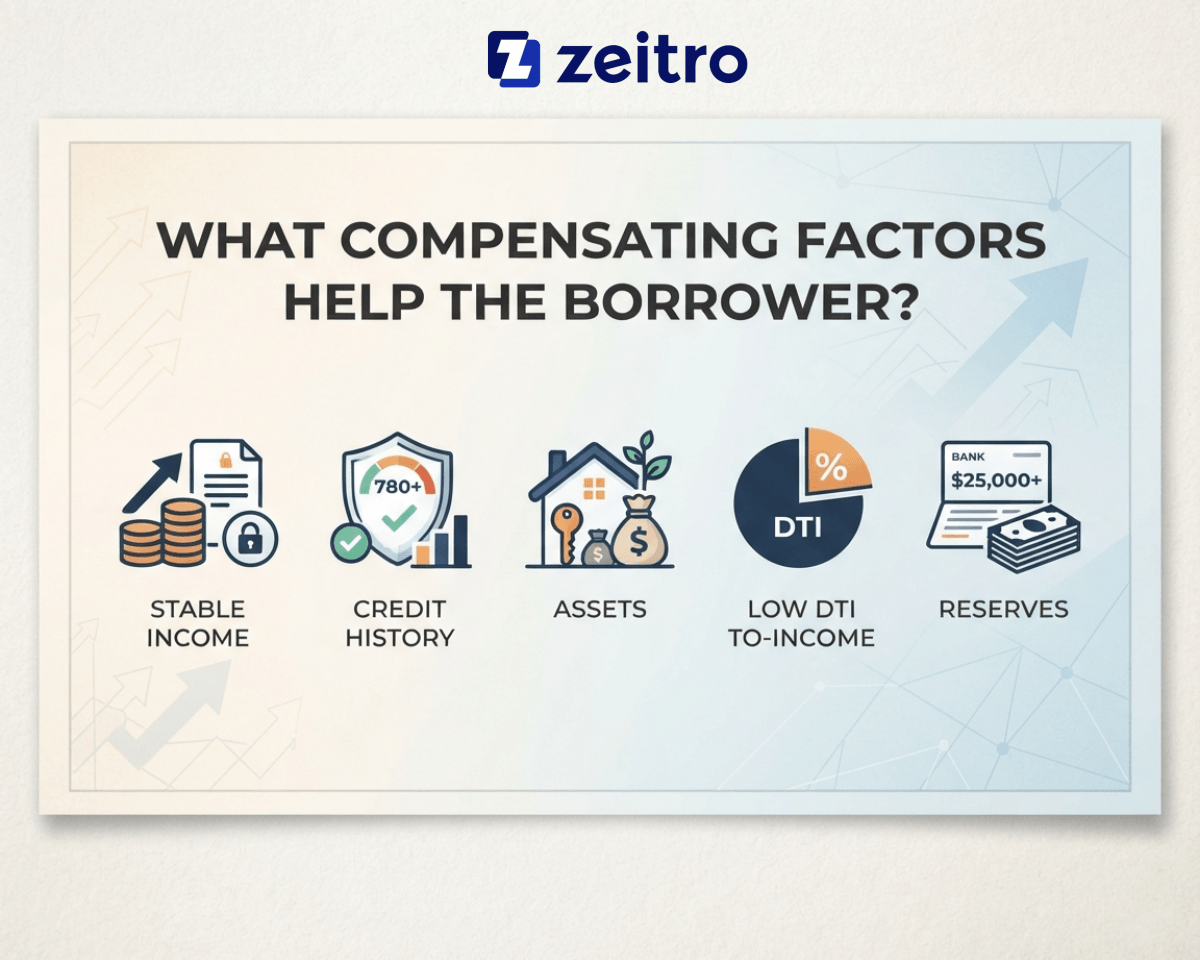
- Compensating Factor Analysis: This is the "secret sauce" where the underwriter looks for reasons to say "yes," like a large down payment or significant savings.
- Final Determination: The underwriter issues a manual approval, a counter-offer, or a denial based on their professional judgment.
When an AUS "Approval" Gets Downgraded to Manual
Here's a scenario that catches a lot of first-time buyers off guard: an automated system can approve a file, and then have that approval downgraded to manual review. This happens with FHA's TOTAL Scorecard when the underwriter discovers something the algorithm didn't know about — an undisclosed debt, a judgment, a recent bankruptcy that wasn't in the credit report the AUS pulled, or a CAIVRS hit flagging a prior default on a federal debt. Once that happens, the file must be manually underwritten to FHA's standard ratios, regardless of what the original automated result said.
Pros and Cons of Manual Mortgage Underwriting
Every tool has its place, and manual underwriting is no different. I've seen it save deals, but it also tests everyone's patience.
Benefits:
- Flexibility for "Non-QM" Borrowers: It's the best way to help self-employed individuals or those with unique income streams.
- Human Empathy: A human can understand that a medical emergency caused a one-time credit dip. A computer can't.
- Higher Approval Potential: It opens doors for borrowers who are creditworthy but don't meet "cookie-cutter" standards.
Drawbacks:
- Slow Turnaround: Let's be real. It takes much longer. We're talking days or weeks instead of minutes.
- Higher Scrutiny: The "condition list" can be miles long, which can frustrate borrowers.
- Subjectivity: One underwriter might be more conservative than another, leading to less predictable outcomes.
When is Manual Mortgage Underwriting Done?
In my daily workflow, I don't choose manual underwriting unless I have to. It's typically triggered in specific scenarios that 2026's diverse economy often presents:
- FHA "Refer" Status: When the automated system doesn't give an "Accept" on an FHA loan, manual is the only way forward.
- Credit Challenges: This includes borrowers coming out of a Chapter 13 bankruptcy or those with recent foreclosures.
- Non-Traditional Credit: For borrowers (often younger or new to the US) who simply don't have a credit score.
- High DTI with Compensating Factors: When the debt ratio exceeds standard limits, but the borrower has massive cash reserves.
- Complex Income: When a borrower has multiple businesses, and the AUS can't make sense of the 1040s.
Manual Underwriting vs. Automated Underwriting
Efficiency and Speed
The biggest gap is time. In the automated world, a conditional approval can land in about the time it takes to brew a cup of coffee. Manual underwriting, by contrast, is notoriously labor-intensive. Cross-referencing guideline requirements across different investors used to eat up 30 minutes of my day per question. That's why I now lean on Zeitro Strata AI — it cuts that lookup time from half an hour down to seconds by cross-checking 100+ investors at once. It gives the manual process something close to automated speed.
Accuracy and Compliance
With an automated system, the "black box" runs the math, but you don't always know why a file got flagged. With manual underwriting, human error is a real risk — it's easy to miss a specific lender overlay. Working with Zeitro has changed that for me because every answer comes with a citation. When I need to confirm a VA guideline or a Non-QM detail, I get a direct link back to the source instead of guessing. That means fewer errors slipping through and more confidence that a file meets current 2026 standards before it's submitted.
The Human Factor in Decision Making
Automated underwriting is binary — it's a yes or a no. Manual underwriting is closer to a conversation. Using Zeitro, I've been able to save roughly 7 hours per loan file on guideline research alone. That's time I can redirect toward talking with underwriters and explaining the story behind a borrower's numbers. Instead of getting buried in PDFs from lenders like AAA Lending or Greenbox, I let the AI handle the lookup work so I can focus on the part that actually needs a human touch.
Tips for Strengthening a Manual Underwriting File
If a file is heading toward manual review, a little preparation goes a long way:
- Build reserves before you apply. Even one extra month of PITI in the bank can function as a compensating factor.
- Write your LOX before you're asked. Getting ahead of a credit dip or income gap with a clear, honest explanation often speeds things up.
- Keep your paper trail boring. Avoid large, unexplained deposits in the months leading up to application — they almost always trigger a documentation request.
- Lean on a lender that specializes in manual files. Wholesale lenders and Non-QM shops tend to have underwriters far more comfortable making judgment calls than a large retail bank might be.
FAQs About Manual Mortgage Underwriting
Q1. Do lenders still do manual underwriting?
Yes, absolutely. While many large retail banks lean on automation for speed, wholesale lenders and Non-QM specialists regularly rely on manual underwriting to serve the roughly 15-25% of borrowers whose files don't fit standard automated criteria.
Q2. What are the benefits of manual underwriting for a mortgage?
The biggest benefit is opportunity. It allows borrowers with a higher DTI, a thin credit history, or complex income to still reach homeownership. It's a way of evaluating the whole person instead of reducing them to a single score.
Q3. What are the disadvantages of manual underwriting?
The extra paperwork is real. Expect more documentation requests and a longer timeline — often several extra business days to a couple of weeks compared with an automated approval — since a person, not an algorithm, is reviewing every detail.
Q4. Does manual underwriting cost more?
Not really, and this is one of the more persistent myths in the industry. Underwriting fees for manual and automated files typically land in a similar $400-$900 range, with the average difference between the two coming in under $50. What actually drives up cost is the complexity of the loan itself — a self-employed borrower with three income sources will generate more underwriting work than a straightforward W-2 file, regardless of which path it takes.
Q5. Is it true that you can't get a mortgage without a credit score?
False. FHA loans specifically allow for "non-traditional credit" underwriting, where 12 months of documented rent, utility, and insurance payments can substitute for a FICO score. It's harder to qualify without a credit history, but it's far from impossible.
Q6. Do VA and USDA loans use the same manual underwriting rules as FHA?
No. VA loans don't have a hard DTI ceiling at all — the VA puts more weight on residual income than any single ratio. USDA loans generally follow a back-end guideline near 41%, with room for flexibility when reserves or other compensating factors are strong. Both programs give underwriters more room to use judgment than FHA's tiered DTI structure does.
Conclusion
Manual mortgage underwriting remains a vital pillar of the industry in 2026. It's the bridge between a machine saying no and a family getting the keys to their first home. That said, professionals can't afford to work the old-fashioned way anymore. The "manual" part should describe the decision, not the drudgery of digging through 1,000+ guidelines by hand.
I've found that integrating tools like Zeitro lets me deliver pre-qualifications up to 2.5x faster, even on complex manual files. Whether you're a broker or a loan officer, the goal is the same: close loans faster without sacrificing accuracy. If you want to see how I save 7+ hours per file while staying fully compliant, it's worth checking out. It's the smartest way to make "manual" feel automatic.
People Also Read
- Best Mortgage Underwriter Software: AI & Guideline Verification
- How to Check Mortgage Eligibility? Quick and Accurate with Sources
- What is Mortgage Eligibility Checker? Best Tool to Verify Guidelines
- Best No Income Verification Mortgage Lenders
- AI Mortgage Underwriting Explained: Will You Be Replaced?
- [Guide] How to Calculate DTI Ratio for Mortgage?
- What Conditions Will Underwriting Ask for? Get to Know

![[Solved] What Red Flags Would a Mortgage Underwriter See?](https://cdn.prod.website-files.com/6731bc6e813a541b54c30b10/6aa24ca70b95e62dd7bbeefd_red-flags-mortgage-underwriting-banner.png)
![[Solved] Why is Loan Product Advisor (LPA) Rejecting Income?](https://cdn.prod.website-files.com/6731bc6e813a541b54c30b10/6aa11d2cb785a137b728997d_loan-product-advisor-reject-income-banner.jpg)