![[2026 Guide] How to Calculate DTI Ratio for Mortgage?](https://cdn.prod.website-files.com/6731bc6e813a541b54c30b10/69ccbafbc45f9a7b4a756616_how-to-calculate-dti-ratio-banner.png)
Written by

Eric
Share this article

.svg)
Subscribe to updates
Last Checked and Updated on September, 2026
Most homebuyers obsess over their credit score and forget about the number that actually decides how much house they can afford. When a loan officer pulls up your file, your credit score tells them how you've handled debt in the past. Your debt-to-income ratio tells them whether you can handle a new mortgage payment right now. If you want to walk into a loan officer's office prepared instead of anxious, learning how to calculate your DTI ratio before you apply is one of the smartest moves you can make.
I've sat across the desk from a lot of first-time buyers who assumed a 750 credit score would carry them through underwriting, only to get stuck because their debt load was too high relative to their paycheck. This guide walks through what DTI actually measures, the exact formula lenders use, which debts count and which don't, and where the real limits sit for each loan program in 2026 — not the outdated rule of thumb that's still floating around online.
What is the Mortgage DTI Ratio?
Your Debt-to-Income (DTI) ratio is the share of your gross monthly income that goes toward paying your monthly debts. Lenders actually look at two separate numbers here, not one.
The front-end ratio, sometimes called the housing ratio, covers only your future mortgage costs: principal, interest, property taxes, and homeowners insurance (PITI). The back-end ratio is broader and matters more to most lenders — it adds every other recurring debt on top of that housing payment.
Here's roughly how lenders tend to view back-end DTI:
- Under 20%: Excellent. You have plenty of breathing room in your budget.
- 36% or lower: A strong, competitive position for conventional financing.
- 37%–43%: Still workable for most loan programs, though you'll want solid credit or reserves to back it up.
- 44%–50%: Considered high-risk by most lenders, but FHA or VA loans may still approve you with strong compensating factors like a high credit score or significant savings.
One correction worth making up front: a lot of articles online still claim that 43% is a hard legal ceiling for every mortgage because of the Qualified Mortgage rule. That was true once, but it hasn't been the case since 2021 — more on that below.

The 28/36 Rule: Where It Comes From and Why It's Just a Starting Point
If you've heard someone mention "the 28/36 rule," this is what they're talking about. It's a decades-old budgeting guideline, not a law: your housing payment shouldn't exceed 28% of your gross monthly income, and your total debt load — housing plus everything else — shouldn't exceed 36%.
Say you earn $6,000 a month before taxes. Under the 28% front-end guideline, your total housing payment would top out around $1,680. Under the 36% back-end guideline, your combined housing and other debt payments would cap out near $2,160, leaving about $480 a month for a car payment, student loan, or credit card minimum.
Here's what most calculators built around this rule don't tell you: it's a conservative baseline, not what actually gets approved. FHA routinely approves borrowers well above 36%, VA loans skip the front-end ratio entirely, and conventional loans run through automated underwriting can stretch to 45% or even 50% with strong compensating factors. Treat 28/36 as a sanity check for your own budget, not the ceiling lenders will actually enforce.
DTI Limits by Loan Type in 2026
Every loan program grades your DTI differently, and this is where a lot of confusion happens. Here's a quick breakdown of how the major programs typically stack up:
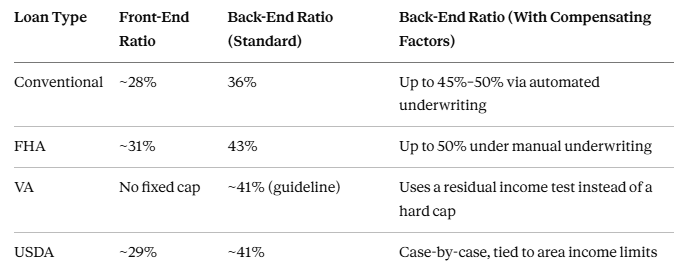
VA loans work a little differently than the rest. Instead of leaning on a fixed back-end number, the VA looks at your residual income — how much cash you'd actually have left each month after debts and housing — which is why a veteran with a higher DTI can still qualify if their remaining income clears the benchmark for their family size and region.
Every lender and investor also layers its own overlays on top of these baseline numbers, which is exactly the kind of detail that changes program to program. If you want the deeper, investor-by-investor breakdown, our Max DTI for Mortgage guide covers that in more depth.
What Counts Toward Your DTI Ratio (And What Doesn't)
Calculating DTI isn't as simple as adding up everything you spend in a month. Lenders follow specific, standardized rules about which income counts, which debts count, and which everyday expenses get ignored entirely.
Income to Include in Your DTI Calculation
The most common mistake I see is buyers running the math on their take-home pay. Your DTI is always based on gross monthly income — everything you earn before taxes, health insurance, or retirement contributions come out.
That means your base salary or hourly wages count, along with overtime, consistent bonuses, child support, alimony, and rental income. Self-employed income and side income count too, with one catch: lenders need proof that non-fixed earnings like commissions, freelance work, or annual bonuses are stable, which usually means producing two years of tax returns.
If pulling together and verifying all of that documentation sounds tedious, it is — Zeitro Strata AI can scan uploaded income documents and calculate a borrower's qualifying income automatically, which saves a lot of back-and-forth before you ever sit down with a lender.
Debts to Include in Your DTI Calculation
Only recurring debts that show up on your credit report get counted. That starts with your projected new housing payment — future principal, interest, taxes, and insurance — plus any car loans, student loans, personal loans, and legally required child support or alimony.
Credit cards trip people up the most. Lenders only count the minimum monthly payment, not your outstanding balance. If you owe $5,000 on a card but the statement shows a $75 minimum due, only that $75 counts toward your debt total.
Debts Excluded From Your DTI Calculation
Your everyday living costs stay out of the equation entirely, because lenders treat them as variable expenses rather than fixed, reportable debts.
Groceries, dining out, entertainment, utilities like water and electricity, health and auto insurance premiums, gym memberships, and subscription services without a binding loan contract — none of it factors into DTI. It all matters for your own household budget, just not for how an underwriter scores your file.
Method 1. Use Formula to Calculate DTI On Your Own
Doing the math by hand gives you the clearest picture of where you stand, and it's simpler than most people expect once your paperwork is in front of you. Here's the formula underwriters use:
DTI Ratio = (Total Monthly Debt Payments ÷ Gross Monthly Income) × 100
Step 1: Add up your monthly debt payments
Pull your credit report and loan statements. List your car payment, student loans, minimum credit card dues, and the estimated PITI for the home you're targeting. Skip your current rent if this mortgage will replace it.
Step 2: Figure out your gross monthly income
Check your pay stubs for pre-tax earnings. A $72,000 annual salary works out to $6,000 a month. Add any documented, qualifying side income on top of that.
Step 3: Divide debts by income and multiply by 100
Divide your total monthly debt from Step 1 by your gross income from Step 2, then multiply the result by 100. That's your DTI, expressed as a percentage.

Method 2. Use an Online DTI Ratio Calculator
If you'd rather skip the manual math, plenty of reputable calculators exist. Wells Fargo, Bankrate, and Chase all offer free tools where you plug in your income and debts and get an instant result.
The catch is the classic "garbage in, garbage out" problem. These tools only calculate what you type in, so if you forget to add estimated property taxes, HOA dues, or a student loan, the result comes back looking better than it actually is. A calculator is genuinely useful for a quick gut check on affordability — I use one with clients constantly — but it shouldn't replace a full manual review before you make an offer on a house.
A few things separate an accurate DTI calculator from a misleading one: it should use your gross income rather than take-home pay, factor in the full PITI payment rather than just principal and interest, and let you add every recurring debt individually rather than lumping them together. Tools built into a full pre-qualification workflow, like Zeitro's Digital 1003 application, calculate DTI automatically as part of the process instead of relying on you to remember every line item yourself.

Debt-to-Income Calculation Example
Let's walk through a real scenario with a prospective buyer named Sarah.
Sarah's annual salary is $72,000, which puts her gross monthly income at $6,000. Her monthly debts, pulled from her credit report, look like this:
- Car loan payment: $300
- Student loan payment: $200
- Credit card minimum payment: $100 (her balance is $4,000, but only the minimum due counts)
- Estimated new mortgage payment (PITI): $1,800
Total monthly debt: $2,400
Using the formula: $2,400 ÷ $6,000 = 0.40, or a 40% DTI ratio.
That puts Sarah comfortably within range for most conventional lenders and well inside what's typically considered workable for a Qualified Mortgage. With a ratio like that, she's in a solid position heading into underwriting, especially if her credit and reserves are in good shape too.
FAQs About Mortgage DTI Calculation
Q1. Does DTI use gross or net income?
Gross income. This is the single most common misconception among first-time buyers. Lenders always run the calculation on your pre-tax earnings, not the amount that actually lands in your bank account after deductions.
Q2. Will paying off credit cards lower my DTI ratio?
Yes. Paying off a card removes that minimum monthly payment from your debt total, which is one of the fastest ways to bring your ratio down before you apply.
Q3. Can I get a mortgage with a 50% DTI ratio?
Possibly. A 50% ratio is considered high-risk, but FHA and VA loans can still approve you if you bring strong compensating factors to the table, like an excellent credit score or meaningful cash reserves.
Q4. Is 43% still a hard limit for every mortgage?
No, and this trips up a lot of people who read older articles. The 43% DTI cap used to be baked into the CFPB's Qualified Mortgage rule, but that requirement was phased out starting in 2021 and replaced with a price-based test tied to the loan's APR instead. DTI still matters — lenders document and weigh it heavily — but 43% is no longer the legal line that determines QM status. Plenty of lenders still treat it as an internal comfort zone out of habit, which is part of why the number refuses to go away.
Q5. Does my DTI ratio directly affect my interest rate?
Not the way your credit score or down payment does. Fannie Mae and Freddie Mac briefly rolled out a pricing adjustment tied to DTI in 2023, but it was withdrawn before it ever took effect, and conventional loan pricing doesn't currently charge extra fees based on DTI alone. That said, a higher DTI can still push you toward a different loan program or pricing structure altogether, which affects your rate indirectly.
Q6. True or false: Lenders don't count your future housing payment in your DTI, only your other debts?
False. Your future mortgage payment — principal, interest, taxes, and insurance — is actually the core piece of your back-end DTI, not something separate from it. The front-end ratio measures housing costs alone, while the back-end ratio folds that same housing payment in alongside your other debts.
Q7. Are utility bills included in my DTI calculation?
No. Water, electricity, internet, and gas bills are treated as everyday living expenses, not fixed debts, so they never appear in the calculation.
Q8. Does my spouse's debt count on a joint mortgage application?
Yes. On a joint application, the underwriter combines both incomes and both debt loads into one shared household DTI.
Q9. What DTI do I need for a HELOC?
Home equity lines of credit generally follow similar back-end DTI limits as a first mortgage, often in the 43%–50% range depending on the lender, but they're also evaluated alongside your combined loan-to-value ratio across both mortgages. Requirements vary more by lender here than with a standard purchase loan.
Q10. What's the max DTI for an investment property?
Conventional investment property loans usually cap DTI more tightly than owner-occupied purchases, often closer to 45%. If your DTI is already stretched by a primary residence, a DSCR loan sidesteps personal DTI altogether and qualifies you based on the property's own rental income instead.
Final Word
Understanding your debt-to-income ratio is the single most practical step you can take before applying for a mortgage. Running the numbers yourself forces you to look honestly at your finances, and it means nothing catches you off guard once an underwriter starts reviewing your file.
An online calculator is a fine starting point, but pairing it with a manual review — and checking the actual DTI limits for the specific loan program you're targeting — will save you from surprises. If you want a faster way to check where you stand against real lender guidelines instead of guessing, Zeitro Strata AI cross-checks guidelines from 100+ investors and can calculate your income automatically from uploaded documents, all with citations back to the source so you know the answer is accurate.
Once you've got a clear picture of your DTI, reach out to a licensed loan officer to turn that number into an official pre-approval. Your next home is closer than the math might make it feel.
People Also Read
- Are Mortgage Rates Expected to Go Down in 2026? Expert Forecasts
- Full Guide: What is a non-QM Loan? Everything to Learn
- Guide: What is NMLS? Definitions, FAQs, More
- 1099 Form vs W2: What's the Difference? Details Here
- Why Have Mortgage Rates Risen When Oil Prices Increase?
- Ultimate Guide: How to Calculate LTV Ratio for Mortgage?


![[Tips for Loan Officers] How Can I Lower Borrower DTI?](https://cdn.prod.website-files.com/6731bc6e813a541b54c30b10/6aa3b89e281a639e7a5c6fca_lower-debt-to-income-ratio-banner.jpg)