Written by

Eric
Share this article

.svg)
Subscribe to updates
Last checked and updated on August, 2026.
Let's talk about tapping into your home's value during retirement. A reverse mortgage sounds like an easy fix for cash flow, but the eligibility rules trip up a lot of people. You can't just sign a paper and get a check. Lenders have strict criteria you have to meet first, and the paperwork gets complicated fast.
Instead of getting lost in confusing guidelines, both homeowners and loan officers can check reverse mortgage eligibility for free using smart platforms like Zeitro. Let's walk through exactly what it takes to qualify, what might get you rejected, and how to verify everything without the usual stress.
What is a Reverse Mortgage?
Generally speaking, a reverse mortgage is a loan built for older homeowners. Instead of you paying the bank every month, the lender pays you by converting part of your home equity into cash. The balance doesn't come due until you sell the property, move out for good, or pass away.
There isn't just one product on the market. You'll generally run into three types:
- Home Equity Conversion Mortgages (HECMs): Insured by the FHA and backed by the federal government. These are the most common option, and they follow the strictest rulebook.
- Proprietary reverse mortgages: Private loans, usually aimed at high-value homes that sit above FHA limits. Some of these programs accept borrowers as young as 55, though the tradeoff is often a higher rate and less favorable terms than a HECM.
- Single-purpose reverse mortgages: Offered by certain state or local agencies. They're cheaper, but the funds come with strings attached, like being earmarked strictly for property tax payments.
What are Reverse Mortgage Eligibility Requirements?
Assuming you qualify just because your mortgage is paid off is a huge mistake. The Federal Housing Administration sets a rigid baseline for HECMs, mostly to ensure borrowers don't end up in a worse financial spot down the road. I've seen applications stall out simply because people missed one minor detail.
Here is what you actually need to check off the list:
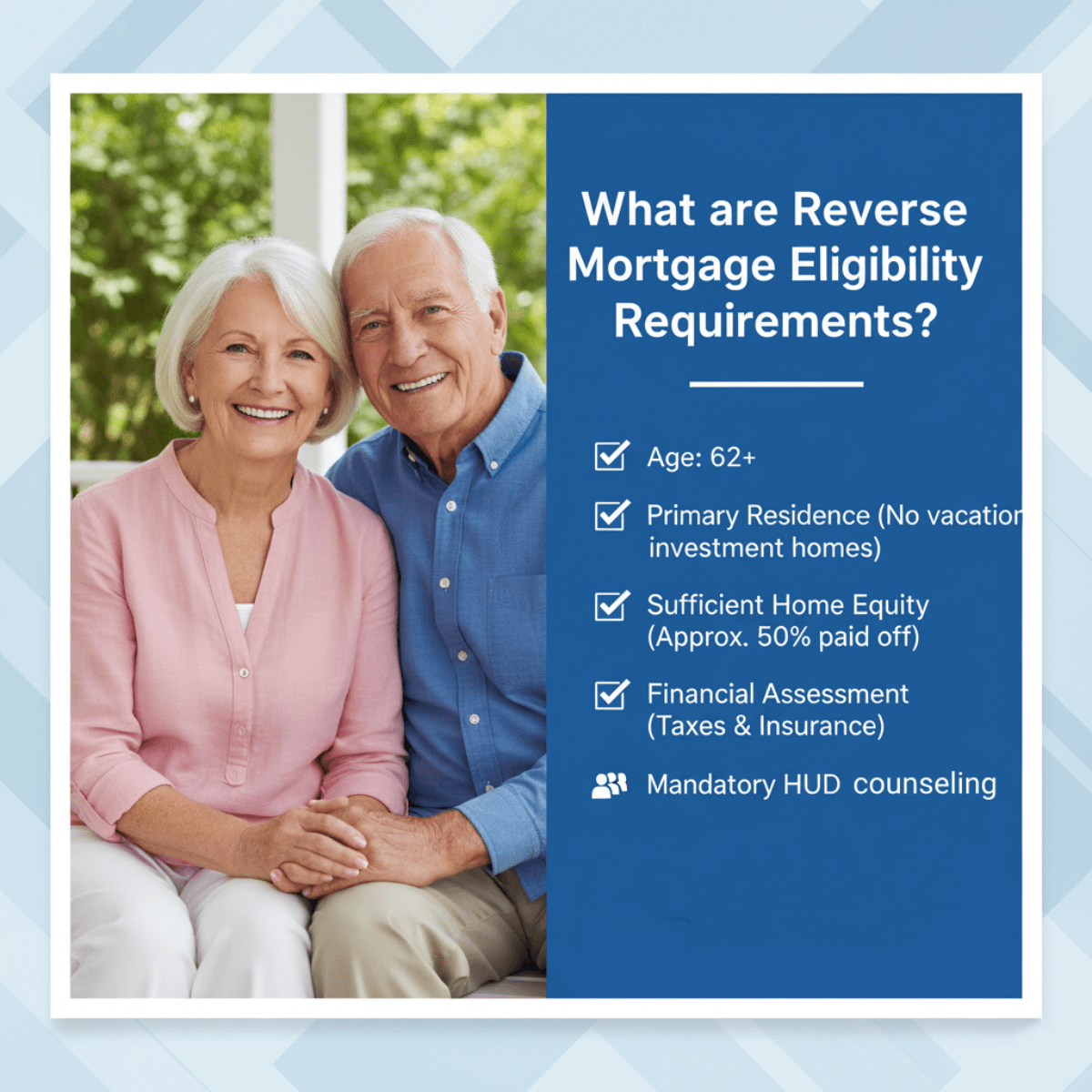
- Age: The youngest person on the title has to be at least 62. This rule applies specifically to HECMs; proprietary programs can dip lower, as noted above.
- Property type: The loan is built for your primary residence, not a vacation home or a rental you don't live in. Eligible types include single-family homes, 2-4 unit properties (as long as you occupy one unit), HUD-approved condos or units with single-unit approval, and manufactured homes built after June 15, 1976 that sit on a permanent foundation. Mobile homes on leased land typically won't make the cut.
- Equity: You don't need to own the home outright, but you'll usually need somewhere between 40% and 60% equity, depending on your age, current interest rates, and how much is left on your existing loan. Older borrowers tend to qualify with a bit less equity than younger ones.
- Financial assessment: Underwriters review your credit history and residual income — what's left over each month after your bills, not a traditional debt-to-income ratio like a forward mortgage uses. There's no hard minimum credit score, and a bumpy credit history won't automatically sink your application. It often just means the lender sets up a Life Expectancy Set-Aside (LESA), which reserves part of your loan proceeds to cover future property taxes and insurance on your behalf.
- HUD counseling: Before anything gets approved, you're required to sit down with a HUD-approved counselor. They'll walk you through how the loan affects your finances and your heirs, which is one of the better consumer protections built into this product.
For 2026, the FHA caps how much home value it will insure on a HECM at $1,249,125 — the tenth straight year that ceiling has climbed. Even if your home is worth more, your loan amount is based on whichever is lower: your appraised value or that federal limit.
What Disqualifies You from Getting a Reverse Mortgage?
Finding out you don't qualify after weeks of paperwork is genuinely frustrating, so I always tell clients to check the dealbreakers first. Lenders will hand out a quick denial if any of these show up.
You'll likely get turned down if:
- Age: You or a co-borrower hasn't hit 62 yet (unless you're going the proprietary route).
- Equity shortage: Your current mortgage balance is too high relative to your home's value.
- Residency issues: You spend more than half the year living somewhere else.
- Financial red flags: The lender doesn't think your income can cover property taxes and insurance, and a LESA still can't close the gap.
- Federal debt: You have unresolved delinquent federal debt on record, like unpaid income taxes or a defaulted student loan.

What About a Spouse Who Isn't 62 Yet?
This comes up constantly, so it's worth addressing directly. If your spouse hasn't reached 62, they can typically still be listed as an eligible non-borrowing spouse. That status protects their right to stay in the home if you pass away first, even though they're not a borrower on the loan itself. The tradeoff: your available loan amount will be lower, since the calculation leans on the younger spouse's age rather than yours.
The 60% Rule: A Detail Most People Miss
Here's one that surprises a lot of first-time applicants. Even if you qualify for a large loan amount, the FHA won't let you take it all at once. During the first 12 months, you can generally withdraw no more than 60% of your total available proceeds, known as your Principal Limit. The rest sits in a growing line of credit until year two.
There's an exception. If you're using the loan to pay off an existing mortgage that already eats up more than 60% of your limit, you can access an extra 10% at closing to cover it. This rule exists to stop borrowers from draining their equity too fast in the early years — a safeguard, not a penalty.
A Few Other Questions Worth Answering Upfront
Can a home held in a trust qualify? Usually, yes. As long as the trust meets HUD's requirements — meaning you're a beneficiary with lifetime occupancy rights — a trust-held property can still work for a HECM.
Will this affect Medicaid or SSI? Social Security and Medicare aren't touched by a reverse mortgage. But Medicaid and SSI are needs-based programs, so if loan proceeds pile up unspent in your bank account past month-end, they can count against you as a countable asset. Spreading out disbursements, rather than taking a lump sum, usually keeps this from becoming an issue.
What documents should I have ready? Most lenders will ask for a government-issued ID, proof of homeowners insurance, your most recent property tax statement, a current mortgage statement if you still have a balance, Social Security or pension award letters, and roughly two years of bank statements.
How long does the whole process take? Scheduling your counseling session usually takes a few days. From there, the application and appraisal stage runs about two to three weeks, with underwriting and closing bringing the full timeline to somewhere around 30 to 45 days for most borrowers.
Tip: How to Accurately and Quickly Verify Reverse Mortgage Eligibility?
If you work in the mortgage industry, you already know that manually checking FHA handbooks and investor overlays eats up your day. Guidelines shift, and trying to keep every credit and property restriction memorized in your head is close to impossible. Leaning on outdated PDFs is a risk I wouldn't take.
I started pointing loan professionals toward Zeitro Strata AI. It's an AI-native tool built specifically for the mortgage space, and it takes most of the manual guideline research off your plate.
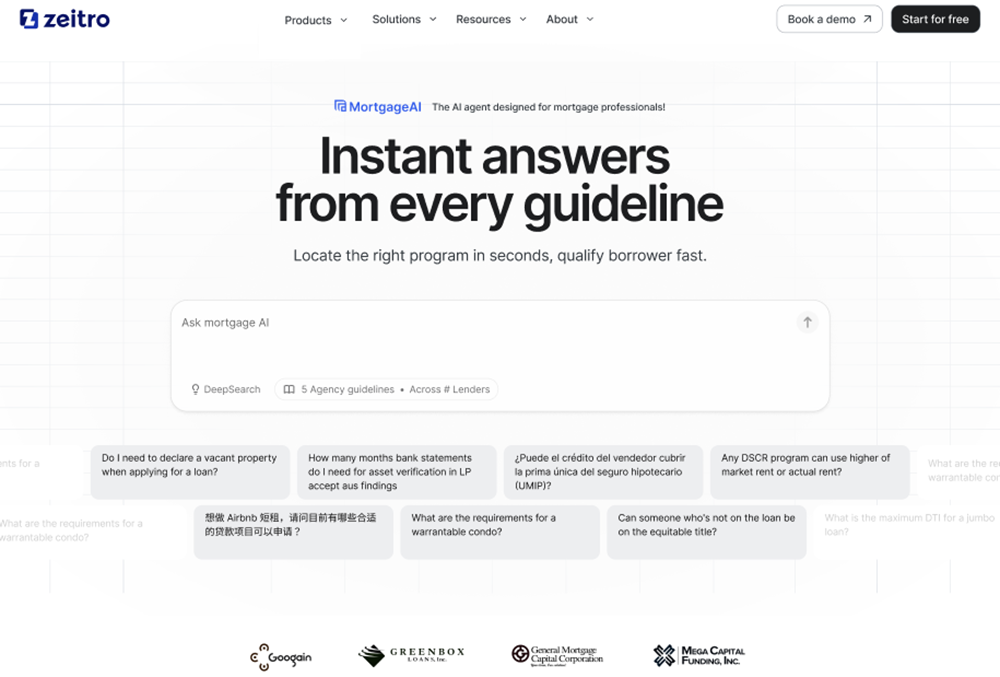
Here is what makes it stand out:
- Instant answers across the board: DeepSearch cross-checks over 100 investors and 1,000+ guidelines spanning conventional, non-QM, DSCR, and more. What used to be a 30-minute manual lookup shrinks down to a few seconds.
- Real source citations: It doesn't just spit out a guess. Every answer links back to the original guideline, so you can verify the data yourself before passing it along to a client.
- Handles messy questions: Borrowers rarely fit a textbook scenario. You can type in a vague situation or a highly specific edge case, in English or Chinese, and it still surfaces the right rule.
- Built-in "Explain" tool: If a piece of underwriting language still reads like legal jargon, the explain function breaks it down in plain terms.
- Free daily access: You can try it without committing to anything. The platform gives you free queries a day to test out your own scenarios.
FAQs About Reverse Mortgage Eligibility
Q1. Is there a credit score or income requirement for a reverse mortgage?
There's no hard credit score cutoff, and this trips up a lot of people who assume they'll automatically be denied for poor credit. Lenders run a full financial assessment instead, looking at your credit history and residual income to confirm you can cover ongoing property taxes and insurance. If your credit is rough, they may set up a set-aside account rather than deny you outright.
Q2. What is the 95% rule on a reverse mortgage?
It's a built-in safety net. Because HECMs are non-recourse loans, you or your heirs will never owe more than the loan balance or 95% of the home's appraised value at the time it's sold and settled, whichever number is lower.
Q3. What is the biggest problem with a reverse mortgage?
The upfront cost. Between closing costs, origination fees, and interest that compounds because you're not making monthly payments, your equity can shrink faster than most homeowners expect going in.
Q4. What is a better alternative to a reverse mortgage?
If your credit and income are solid, a Home Equity Line of Credit (HELOC) or a standard home equity loan usually costs less over time. Selling the house and downsizing to a smaller place is often the smarter financial move if you're not attached to staying long-term. And if you're short on equity right now, waiting a few years while paying down your current balance can put a HECM within reach later.
Q5. What is the best age to get a reverse mortgage?
Waiting generally works in your favor. Your maximum loan amount is tied to a Principal Limit Factor — a percentage set by your age and current interest rates. A 75-year-old will typically qualify for meaningfully more cash than a 62-year-old with an identical home value, since that factor climbs as you get older.
Q6. Can I lose my home with a reverse mortgage?
Yes, it's possible. You won't have a monthly mortgage bill, but you're still fully responsible for property taxes, insurance, and basic upkeep. Fall behind on those, and the lender can foreclose, just like with any other home loan.
Q7. Who owns your house if you have a reverse mortgage?
You do. A lot of people assume the bank takes over the deed, but that's a myth. You stay on title the entire time. The lender simply places a lien on the property, the same way it works with a standard mortgage.
Conclusion
Tapping into home equity can genuinely support a retirement plan, but the eligibility hurdles are real, and skipping past them tends to cost people time later. Understanding these rules upfront saves everyone a lot of wasted back-and-forth.
- If you're a broker or loan officer tired of digging through PDF guidelines, check out Zeitro. Their AI tools help pros deliver pre-qualifications 2.5 times faster and close 30% more loans. It's a genuine efficiency boost, not just a marketing line.
- If you're a homeowner trying to figure out whether you qualify, don't guess your way through it. Head to Bluerate to connect with loan officers who use these AI tools to give you accurate, free consultations and rate quotes built around your exact situation.
People Also Read
- Mortgage Guidelines: What Are They? How to Verify?
- Highest-Rated Reverse Mortgage Companies for You
- Best No Income Verification Mortgage Lenders
- Full Guide: What is a non-QM Loan? Everything to Learn
- How to Check Mortgage Eligibility? Quick and Accurate with Sources

![[Tips for Loan Officers] How Can I Lower Borrower DTI?](https://cdn.prod.website-files.com/6731bc6e813a541b54c30b10/6aa3b89e281a639e7a5c6fca_lower-debt-to-income-ratio-banner.jpg)