Written by

Eric
Share this article

.svg)
Subscribe to updates
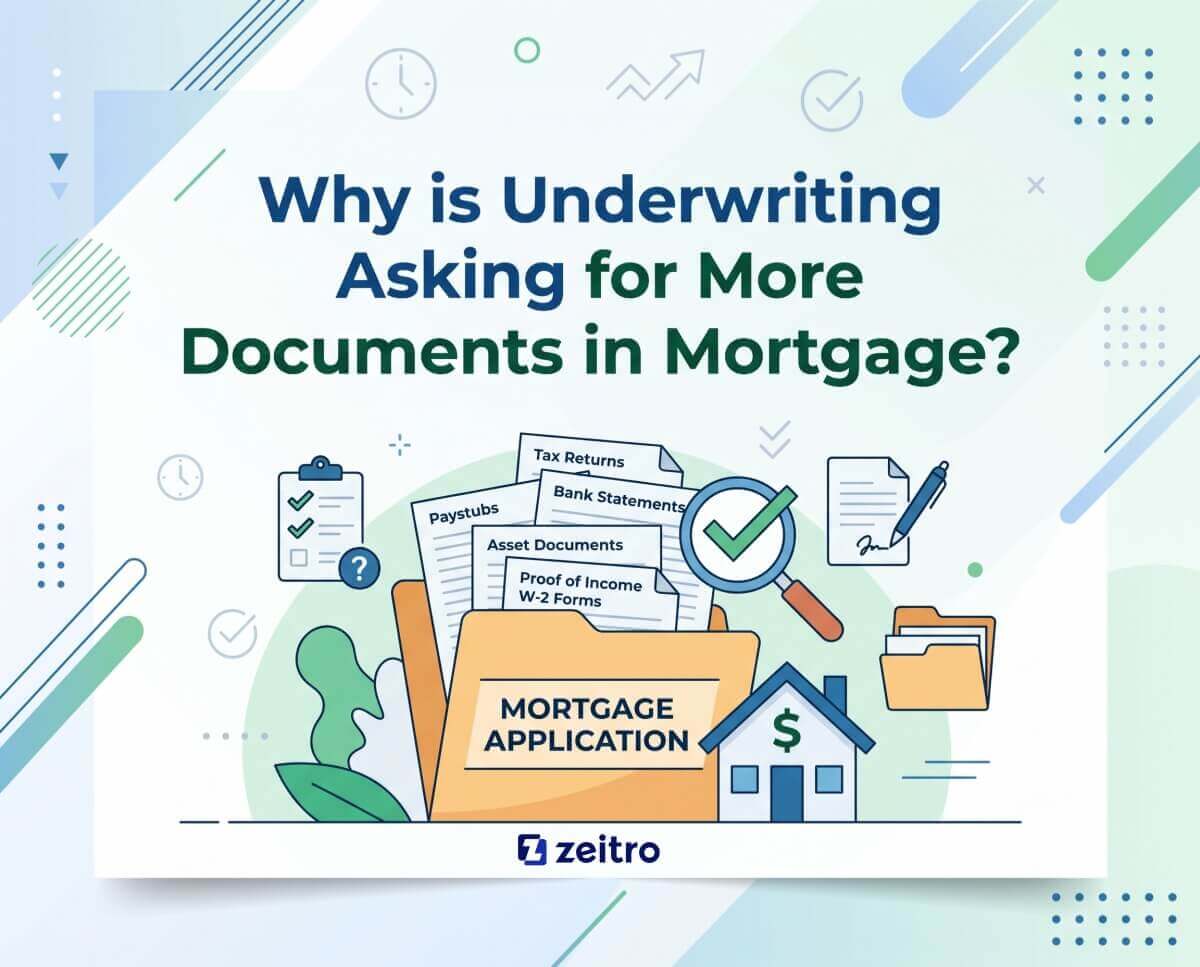
Few things feel more frustrating than handing over a mountain of paperwork, only to have your lender ask for even more. I always tell my clients: do not panic. These requests are not a sign of rejection or personal suspicion.
Underwriters must satisfy strict federal lending rules and investor guidelines before funding. Understanding why these requests happen helps you clear conditions quickly and reach closing day without unnecessary delays.
Key Takeaways
- Standard Compliance: Document requests verify your legal ability to repay and satisfy strict Fannie Mae and federal rules.
- Frequent Triggers: Large unsourced deposits, stale 60-day statements, and job gaps prompt the majority of follow-up requests.
- Automated System Updates: Minor data shifts force underwriters to rerun automated engines, generating fresh conditional items.
- Speed Matters: Submitting complete, unaltered files with signed explanation letters prevents costly closing postponements.
9 Reasons Why Mortgage Lender Keeps Asking for More Documents
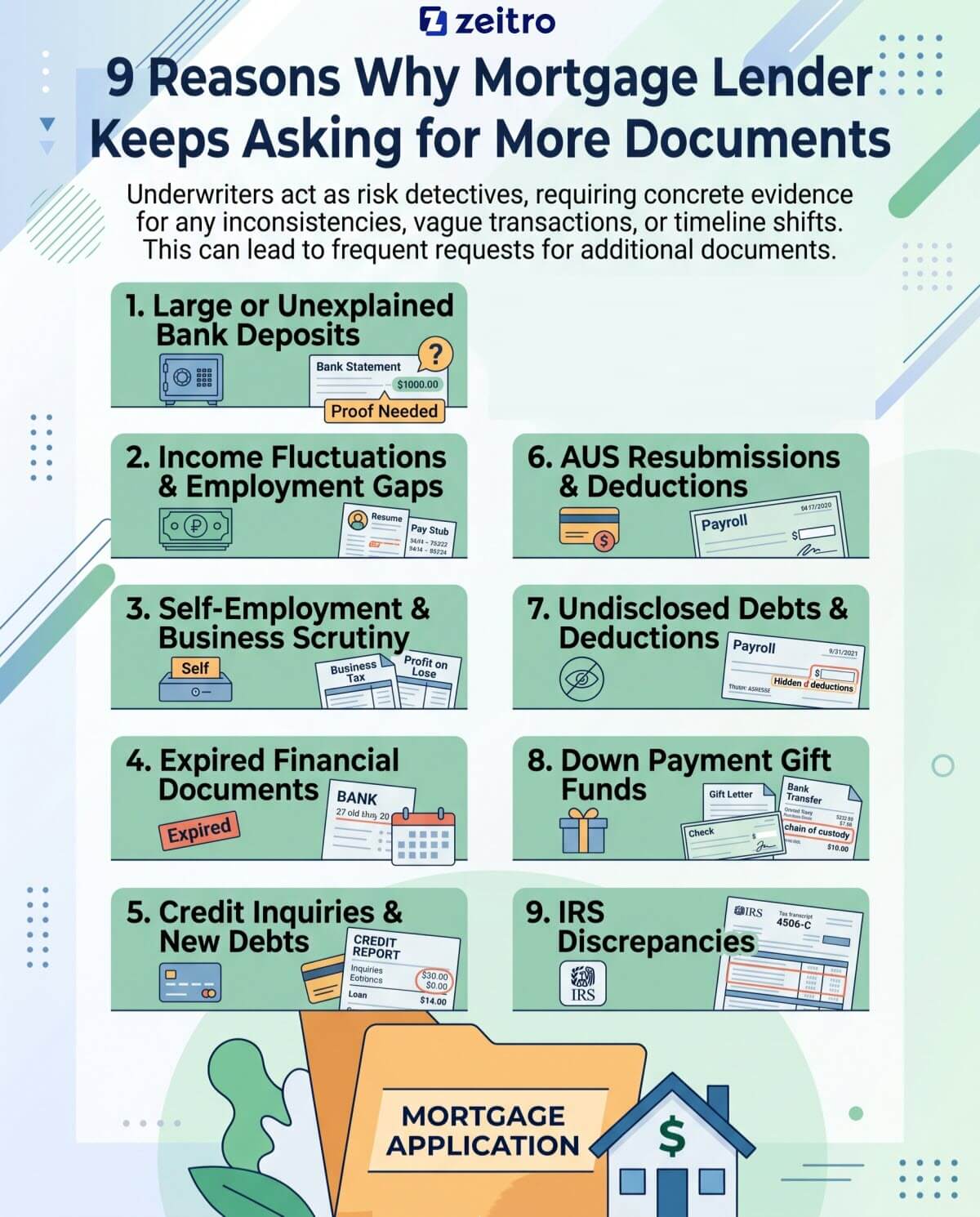
Whenever I walk borrowers through the mortgage journey, I explain that underwriters act as risk detectives. Under federal mandates and secondary market guidelines, any inconsistency, vague transaction, or timeline shift forces an underwriter to pause and request concrete supporting evidence.
1. Large or Unexplained Bank Deposits
Under Fannie Mae’s asset guidelines, a "large deposit" is generally defined as a single deposit that exceeds 50% of the borrower’s total monthly qualifying income when those funds are needed for the down payment, closing costs, or reserves. Lenders must source such deposits to confirm they are not borrowed or otherwise ineligible. Thresholds and sourcing rules can vary by loan program (e.g., FHA, VA, non-QM) and transaction type.
When unverified money lands in your checking account, I have to ensure those funds are not an undisclosed loan, illegal cash, or an ineligible gift. Mortgage regulations strictly forbid using borrowed funds for down payments without formal disclosure. If an underwriter cannot trace where the money originated, that cash cannot count toward your closing assets.
To clear this condition, you generally need to provide:
- A signed Letter of Explanation detailing the specific source of the funds
- A bill of sale or ownership transfer paper if you sold personal property
- Corresponding account statements showing the withdrawal trail from the source account
2. Income Fluctuations and Employment Gaps
Federal Ability-to-Repay standards require lenders to confirm that your income is stable, ongoing, and likely to continue for at least three years. If you recently changed jobs, took time off, or rely heavily on bonuses, overtime, or commissions, underwriters will examine your earnings under a microscope.
Under Fannie Mae and most conventional guidelines, any employment gap of 30 days or more within the past two years must be documented and explained in writing. While this does not automatically disqualify a borrower, underwriters will review the reason for the gap and confirm that current income is stable and likely to continue. Lenders must prove your compensation is consistent rather than an isolated spike.
You may need to turn over:
- A signed letter explaining the dates and circumstances behind any career gaps
- An official employment offer letter or written compensation agreement outlining your guaranteed base pay
- A written Verification of Employment completed directly by your employer’s payroll department
3. Self-Employment and Business Income Scrutiny
Working for yourself offers tremendous tax perks, but extensive write-offs complicate home financing. Underwriters evaluate your net profit, not your gross sales. If your Schedule C or corporate returns show sharp drops in profitability, or if business funds are used for your down payment, lenders must confirm that withdrawing those reserves will not cripple daily business operations. We also need concrete verification that your company is active, compliant, and properly licensed.
Anticipate requests for items such as:
- A current year-to-date profit and loss statement signed by your certified public accountant
- Two to three months of recent business bank statements showing steady operational cash flow
- A valid business license, state registration, or third-party directory listing confirming active operation
4. Expired Financial Documents Due to Processing Timelines
Real estate escrows and loan pipelines frequently take 30 to 60 days. Meanwhile, Fannie Mae and conventional guidelines enforce strict document shelf-life rules. Asset statements, credit pulls, and paystubs must typically be no older than 60 to 120 days at closing, and the most recent paystub must reflect earnings within 30 days of funding. When escrow drags on, your previously approved paperwork goes stale. Underwriters must refresh these records to verify you are still employed and your savings remain intact.
You will typically need to re-submit:
- Your most recent 30-day consecutive paystubs with current year-to-date totals
- Updated bank statements covering the latest one to two billing cycles
- Fresh investment or retirement account statements showing current liquid balances
5. Credit Inquiries, New Debts, and Disputed Accounts
Any hard inquiry on your credit report from the past 90 days creates concern that you opened a new credit line that has not yet reported to bureaus. Unaccounted obligations distort your debt-to-income ratio, which lenders must verify with complete accuracy. Furthermore, disputed trade lines present a major hurdle; credit bureaus suppress disputed accounts from credit scoring algorithms, meaning underwriters cannot rely on your calculated score until disputes are properly handled.
Underwriters will ask you to supply:
- A signed letter clarifying whether any recent credit inquiry resulted in new debt
- A statement showing current balance and minimum monthly payment for any newly opened card
- Depending on the loan program and automated underwriting findings, underwriters may require removal of dispute notations only if the dispute affects scoring or involves outstanding non-medical collections over $1,000. Medical disputes, zero-balance accounts, and disputes older than two years are often exempt. Borrowers should provide an updated credit report or bureau supplement showing the dispute remark has been retracted when required.
6. Automated Underwriting System (AUS) Resubmissions
Lenders process loan files through automated engines like Fannie Mae's Desktop Underwriter. When verified numbers vary slightly from initial estimates, such as an interest rate change, higher homeowner insurance premiums, or slightly lower qualified income, the file must be resubmitted. A rerun recalibrates risk tiers. Even minor variances can cause the automated system to trigger an entirely fresh batch of documentation conditions, including requests for additional cash reserves.
To satisfy these automated updates, you might be asked for:
- Additional bank or brokerage statements to satisfy higher post-closing reserve minimums
- A newly signed loan application reflecting updated interest rates and closing fees
- Direct documentation addressing specific validation alerts generated by the automated findings report
7. Undisclosed Debts and Paystub Deductions
Underwriters analyze every single deduction line on your paystubs. Line items labeled as wage garnishments, child support, alimony, or internal retirement loans immediately catch our attention. If you make court-ordered payments or repay a 401(k) loan that was omitted from your initial loan application, an underwriter must factor those obligations into your monthly ratios to guarantee your borrowing capacity meets legal guidelines.
Common files requested to clarify these deductions include:
- A complete, court-stamped divorce decree, separation agreement, or domestic support order
- A 401(k) loan summary document confirming the loan balance, term, and monthly repayment amount
- Documentation proving that an automatic wage garnishment has been fully satisfied or released
8. Down Payment Gift Funds and Chain-of-Custody Issues
Using monetary gifts from family is a common way to cover down payments, but money cannot just appear in your bank account unannounced. Underwriters have to establish a clear paper trail proving that the donor legitimately transferred the funds and does not expect repayment. If the transfer lacks a verifiable chain of custody, the lender cannot count those funds toward your closing settlement.
To clear gift fund conditions, you must deliver:
- A fully completed mortgage gift letter signed and dated by both donor and borrower
- The donor’s bank statement or wire transfer receipt showing the money leaving their account
- Your bank deposit receipt or escrow closing receipt confirming the funds were credited
9. IRS Tax Transcript Discrepancies and Form 4506-C Delays
During loan processing, lenders submit IRS Form 4506-C to pull official tax return transcripts directly from the federal government. This fraud prevention step verifies that the 1040 tax forms you provided match what was filed with the IRS. If your transcripts show back taxes owed, processing errors, or discrepancies from amended filings, underwriters must step in to gather supporting proof before signing off.
You may be instructed to produce:
- An approved IRS installment agreement alongside canceled checks showing consecutive timely monthly payments
- An accepted copy of your amended Form 1040-X along with IRS transcript showing the amendment code or e-file acknowledgment receipt. Lenders may also request proof that any additional tax owed was paid, such as bank statements showing cleared payments or an IRS installment agreement.
- Proof of payment cleared through your bank if you owed taxes on a recent filing
Regular Mortgage Documents to Prepare
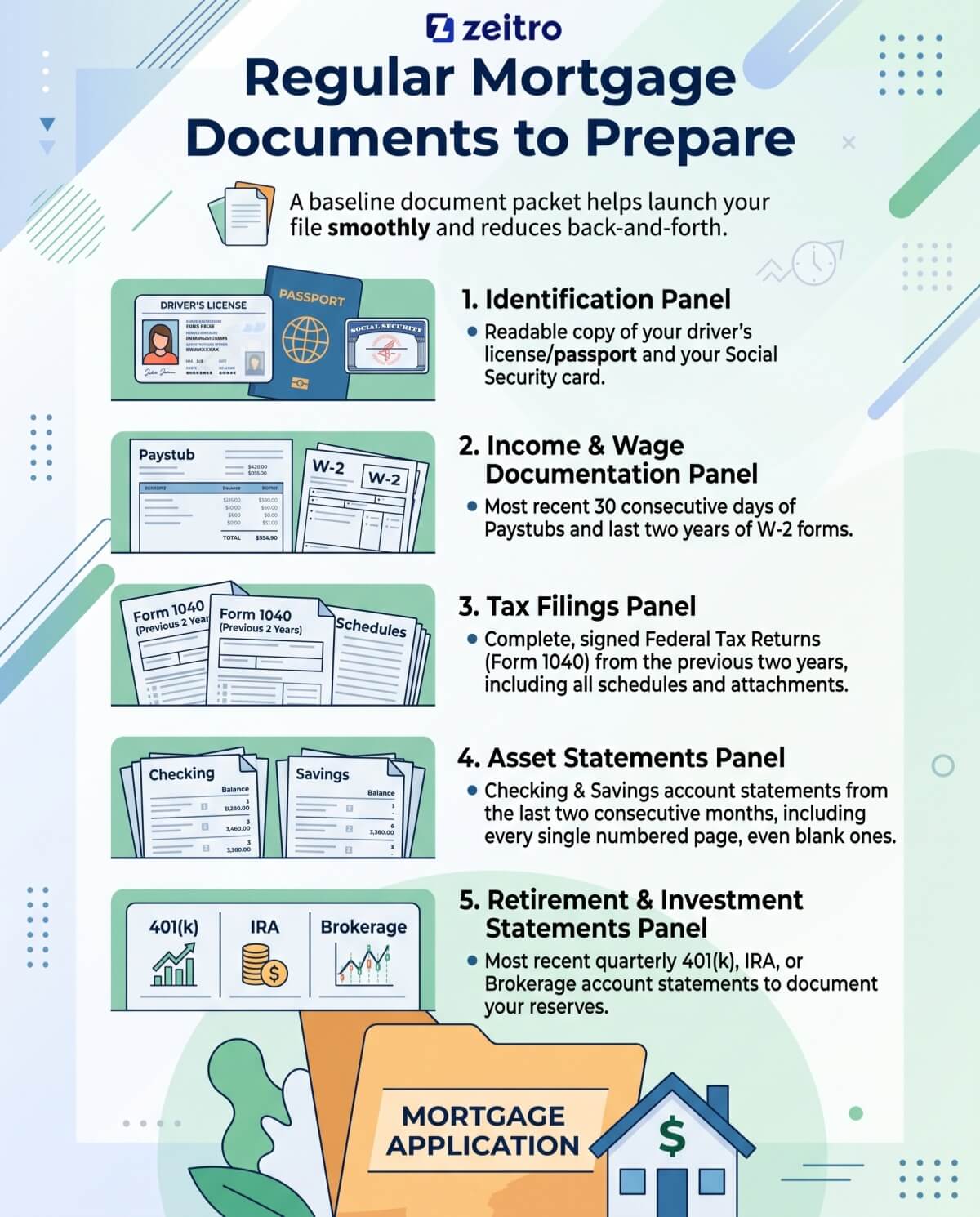
When I review a new mortgage application, I always recommend packaging your baseline documents upfront. This initial application packet establishes your identity, income history, and liquid assets, giving the processing team the baseline data needed to launch your file smoothly. Submitting pristine, unedited records from the start eliminates half the back-and-forth later on.
Make sure you assemble these standard baseline documents:
- Government-issued identification: A readable copy of your driver's license, passport, or permanent resident card alongside your Social Security card.
- Standard wage documentation: Your most recent 30 consecutive days of paystubs and your last two consecutive years of W-2 forms.
- Tax filings: Complete, signed federal tax returns (Form 1040) from the previous two years, including all schedules and attachments.
- Asset statements: The last two consecutive months of checking and savings account statements, including every single numbered page, even blank ones.
- Retirement and investment statements: Your most recent quarterly 401(k), IRA, or brokerage account statements to document your reserves.
What Additional Documents Do Underwriters Ask for?
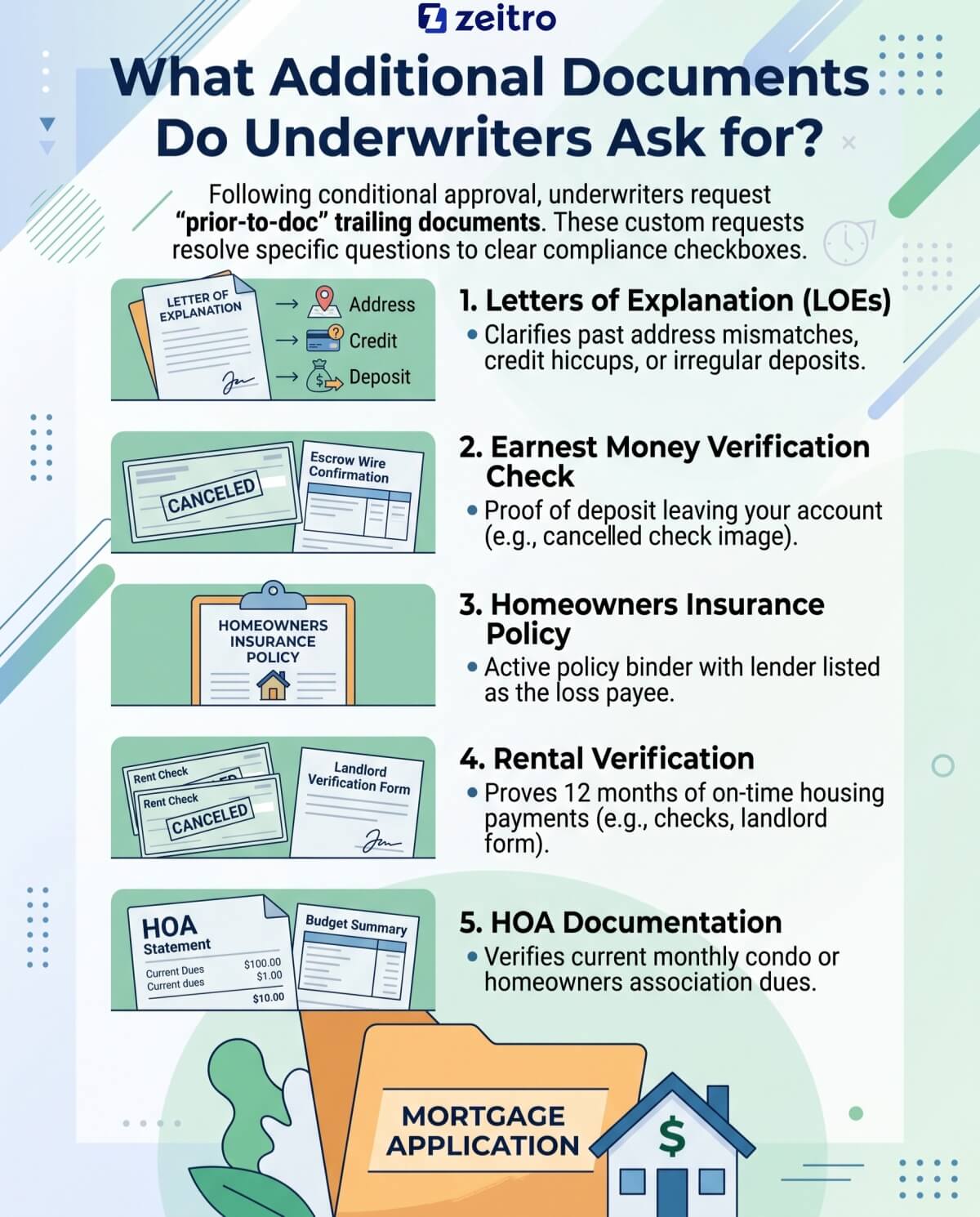
Once your loan receives conditional approval, the underwriter issues a list of "prior-to-doc" conditions. Unlike your initial paperwork, these trailing documents are custom requests designed to resolve specific questions that surfaced during the initial audit of your file. They do not mean your loan is in jeopardy; they simply clear outstanding compliance checkboxes before the lender can generate your final closing package.
Common supplemental records underwriters frequently request include:
- Detailed Letters of Explanation (LOEs): Signed explanations clarifying past address mismatches, credit hiccups, or irregular bank deposits.
- Earnest money verification: A canceled check image or escrow wire confirmation showing your earnest money deposit successfully left your account.
- Homeowners insurance policy: An active insurance binder showing comprehensive hazard coverage with the lender listed as the loss payee.
- Rental verification: Canceled rent checks or a landlord verification form proving 12 months of on-time housing payments.
- HOA documentation: A current statement confirming monthly condo or homeowners association dues are current and correctly budgeted.
What are Red Flags in Mortgage Underwriting?
There is a big difference between standard requests for paperwork and severe underwriting red flags. Routine requests clarify minor gaps, while red flags indicate potential misrepresentation, extreme debt risk, or inability to repay that can kill your loan immediately. Keeping your financial life stable throughout the process is critical.
The most damaging red flags that halt mortgage underwriting include:
- Unseasoned cash deposits: Stashing cash in your safe and depositing it into your bank account midway through the loan process.
- Abrupt employment changes: Quitting your job, switching from a salaried role to 1099 independent contracting, or taking extended unpaid leave during escrow.
- Taking on fresh credit obligations: Financing a car, purchasing furniture on credit, or opening store credit cards before closing.
- Altered or inconsistent documentation: Lenders use forensic tools to detect manipulated PDFs, mismatched metadata, or conflicting income figures across documents. Borrowers should submit original, unedited statements directly from financial institutions to avoid delays or fraud flags.
Final Word
When an underwriter keeps asking for more paperwork, remember they are simply verifying risk and satisfying federal mandates to protect all parties. You can speed up your journey by staying organized, remaining transparent with your loan officer, and turning in clear, unaltered files within 24 hours. Tackle each request as it arrives, and you will secure that final "Clear to Close" and reach your closing table smoothly.
People Also Read
- When are Bank Statements Required on a Mortgage?
- When are Profit and Loss Statements Required for a Mortgage?
- Checklist: What Tax Returns are Required for a Mortgage?
- What Income Documents are Needed for Underwriting? Learn Here
- What Documents Do I Need for a Self-Employed Borrower?
- What Documents are Required for Rental Income on Mortgage?

![[Tips for Loan Officers] How Can I Lower Borrower DTI?](https://cdn.prod.website-files.com/6731bc6e813a541b54c30b10/6aa3b89e281a639e7a5c6fca_lower-debt-to-income-ratio-banner.jpg)