

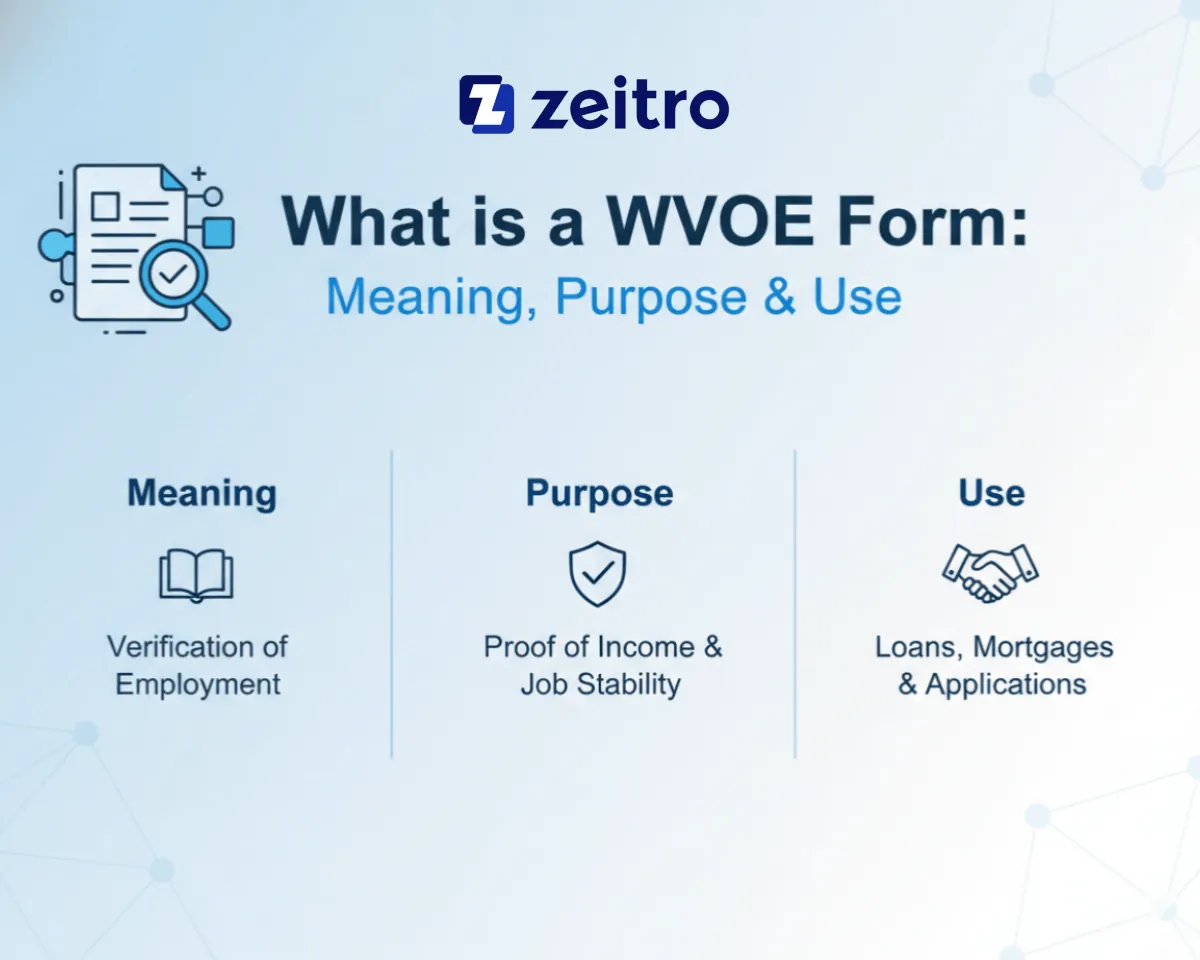
When you are buying your first home, the mountain of paperwork can feel endless. Just when you think your standard paystubs and W-2s are enough to prove you can afford a mortgage, your loan officer may ask for a WVOE. If you are going through the mortgage approval process right now, you might be wondering what this is.
A WVOE, or Written Verification of Employment, is commonly documented using Fannie Mae Form 1005, the Request for Verification of Employment. It is a crucial document lenders use to confirm your job history and income directly with your employer. Understanding how it works can make your loan approval much smoother.
Key Takeaways
- The Core Definition: A WVOE is an official document completed by your employer to verify your income and job status.
- Direct Routing for Security: For first mortgages, the lender must send the form directly to the employer and receive it back directly; for some second mortgages, the borrower may hand-carry it to the employer.
- Detailed Breakdown: It may verify base pay, year-to-date earnings, overtime, commissions, bonuses, and the probability of continued employment.
Meaning: What is a WVOE for a Mortgage?
So, what exactly does this form mean for your application? From an underwriting perspective, a WVOE serves as an independent, third-party cross-check of your financial reality.
You might be thinking, "I already handed over months of paystubs and tax returns. Why do they need this?" Lenders use the WVOE to help verify employment and income, which supports underwriting and repayment assessment.
While your W-2 shows what you made last year, the written verification proves what you are earning right now and clarifies complex income structures. It is essentially your lender's way of fact-checking your application before handing over hundreds of thousands of dollars.
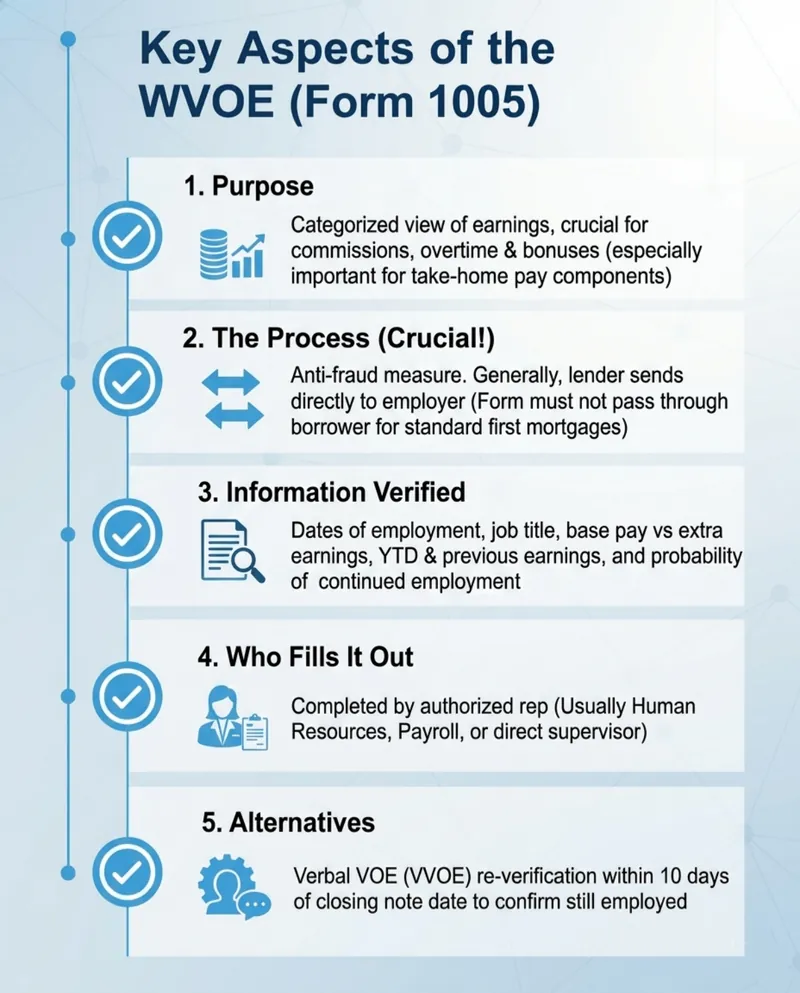
Key Aspects of the WVOE (Form 1005)
If you have never seen Fannie Mae Form 1005, it helps to know exactly what goes into it. Here is a breakdown of the core elements your lender is looking for:
- Purpose: It gives underwriters a clear, categorized view of your earnings. This is especially important if a chunk of your take-home pay comes from commissions, heavy overtime, or annual bonuses.
- The Process (Crucial!): This is a strict anti-fraud measure. For conventional first mortgages, the form should not pass through the borrower. However, second mortgages may allow the borrower to hand-carry the form to the employer. Even then, the employer must return the completed form directly to the lender.
- Information Verified: It digs deep. The document confirms your exact dates of employment, current job title, a breakdown of base pay vs. extra earnings, year-to-date (YTD) income, previous years' earnings, and your probability of continued employment. Some of these fields, such as probability of continued employment, are optional under Fannie Mae Selling Guide B3-3.2-01, so a blank there is not a problem on its own.
- Who Fills It Out: It must be completed by an authorized company representative—usually someone in Human Resources, the payroll department, or your direct supervisor.
- Alternatives: While written verifications offer historical depth, lenders also use a Verbal VOE (VVOE). A verbal re-verification is often completed within 10 days before the note date to confirm the borrower is still employed.
When is a WVOE Used?
Not every single mortgage application requires a physical Form 1005, but you will definitely encounter it in several specific scenarios:
- Variable Income Earners: If your paycheck fluctuates because you rely heavily on overtime, shift differentials, tips, or performance bonuses, lenders need the WVOE to calculate your qualifying average income.
- Incomplete Documentation: Sometimes, your standard W-2s or recent paystubs might be smudged, missing pages, or simply don't provide a comprehensive financial picture.
- Recent Job Changes: If you just switched companies or received a major promotion, lenders need this form to verify your new compensation structure and start date.
- Specific Loan Types: Some government-backed loans may require employment verification, but lenders can use written VOE, verbal re-verification, or approved third-party electronic verification, depending on program rules.
WVOE vs. VVOE and Other Verifications
VOE (or VOI, for income) is the umbrella term. The first three rows below are specific ways to verify a job; VOM is unrelated to employment.
| Term | What it is | When it shows up |
|---|---|---|
| WVOE | Written verification, usually Fannie Mae Form 1005, completed and signed by the employer | During underwriting |
| VVOE | Verbal verification: the lender contacts the employer, using contact details it found independently, to confirm the borrower still works there | Shortly before closing; Freddie Mac loans record it on Form 90 or a similar document |
| Electronic VOE | Pay and employment data from the employer's payroll records, via a service such as The Work Number | Instead of a paper form, when the employer participates |
| VOM / VOR | Verification of Mortgage or Rent: the borrower's housing payment history | When the lender needs proof of on-time housing payments |
Who Needs to Fill out a VOE Form?
Homebuyers often get confused about their responsibilities here. To clear this up: you and your employer have two very distinct roles, and blurring them can pause your loan.
- The Borrower (You): Your only job is to sign Part I of the form. Your signature acts as a legal authorization, giving your employer permission to release your private financial data to the lender.
- The Employer (HR/Payroll): They handle Part II (or Part III for a previous job). An authorized representative must calculate your income data, fill out the specific financial fields, and sign Part IV at the bottom to certify its accuracy.
Under no circumstances should you ever try to fill in your own income numbers.
What's on Form 1005, Part by Part
Form 1005 is one page with four parts:
| Part | Completed by | What it covers |
|---|---|---|
| Part I: Request | Lender (items 1–7), borrower (item 8) | Employer and lender details, the lender's certification that the form went straight to the employer, and the borrower's authorization |
| Part II: Present Employment | Employer | Hire date, position, base pay, and gross earnings for year to date and the past two years, split into base, overtime, commissions, and bonus |
| Part III: Previous Employment | Employer, for a past job | Dates employed, pay at termination, reason for leaving |
| Part IV: Authorized Signature | Employer | Signature, name, title, date, and phone number of the employer's representative |
The lender sends a separate form to each employer from the past two years. Freddie Mac has no written VOE form of its own; its Seller/Servicer Guide (Section 5302.2(c)) lists the required content, which a completed Form 1005 covers.
How Can I Get an Employment Verification Form?
You won't have to hunt down this PDF yourself. Here is exactly how the WVOE workflow happens:
- Authorization: Your lender will provide Form 1005. You just sign Part I to authorize the release of information.
- Lender Dispatch: The mortgage company securely emails, faxes, or mails the request directly to your employer's HR department.
- Employer Return: Once completed, your company sends the certified document straight back to the underwriter.
Today, many large companies use automated third-party verification systems like Equifax's The Work Number. If so, the physical paper process is completely replaced by instantaneous electronic data retrieval!
What Is a WVOE-Only Loan?
A "WVOE loan" (or WVOE-only loan) is not the same thing as the form. It is a non-QM program in which a W-2 employee qualifies with a completed Form 1005 alone, without paystubs, W-2s, or tax returns. These loans are not sold to Fannie Mae or Freddie Mac, so each lender sets its own rules. Common conditions in current non-QM guidelines:
- Two years with the same employer, confirmed on the WVOE.
- No family employers: borrowers employed by a relative or a family-owned business are not eligible.
- Deposit support: some lenders want recent personal bank statements showing payroll deposits that match the WVOE, often depending on the loan-to-value ratio.
Credit score minimums, loan-to-value limits, and loan amounts come from each lender's matrix and differ widely between non-QM lenders. Because a WVOE needs an employer's signature, it does not work for self-employed borrowers or 1099 contractors; they usually qualify through bank statement loans or profit and loss statements instead.
FAQs About WVOE Mortgage
Q1. What is a WVOE request?
A WVOE request is an official inquiry sent directly from a mortgage lender to a borrower's employer. Its purpose is to securely verify the applicant's job history, position, and detailed income breakdown to ensure they qualify for the home loan.
Q2. Is a WVOE different from a verbal VOE (VVOE)?
Yes. A WVOE is a detailed, written financial breakdown gathered early in underwriting. In contrast, a VVOE is usually just a quick, 5-minute phone call lenders make to your employer right before closing to ensure you are still actively employed.
Q3. Can a borrower fill out their own WVOE?
Absolutely not. You are only allowed to sign the authorization section. Filling in your own income figures or handling the completed document violates strict anti-fraud rules and can be considered mortgage fraud, instantly killing your loan approval.
Q4. How long does a WVOE stay valid?
Timing requirements vary by loan program. On conventional loans, a completed WVOE can be no more than four months old on the note date for Fannie Mae (Selling Guide B1-1-03) and no more than 120 calendar days for Freddie Mac (Seller/Servicer Guide Section 5102.4). The final verbal check runs on a shorter clock: generally no more than 10 business days before the note date (Fannie Mae B3-3.1-04; Freddie Mac Section 5302.2(d)), and both agencies also accept one obtained after closing but before the loan is delivered to them. FHA guidance (HUD Handbook 4000.1) requires employment re-verification within 10 days before the note date, and certain third-party electronic data must be current within 30 days. If your closing gets significantly delayed, the underwriter will likely need to request a fresh verification.
Q5. What happens if my employer refuses to fill out the WVOE?
If your HR department is unresponsive, don't panic. Lenders can usually pivot to alternative documentation. They might ask you for additional tax transcripts, extensive bank statements, or pull electronic data through third-party services like The Work Number to satisfy the requirement.
Q6. What red flags do underwriters look for on a WVOE?
Underwriters compare the form against the rest of the file. Common red flags include white-out or other alterations, income figures that are suspiciously round or don't match paystubs, W-2s, or bank deposits, an employer address that is a residence or a P.O. box, and an employer phone number that traces back to the borrower. That is why lenders look up the employer's contact details themselves instead of taking them from the borrower.
Final Word
Buying a house comes with a lot of paperwork, but the Written Verification of Employment is just a standard safety measure. It protects everyone involved by confirming you can comfortably handle the new monthly payments.
If there is one practical tip to take away, it's this: give your HR department a quick heads-up early on. Tell them a mortgage company will be reaching out for a verification request. When they know to watch out for that specific email or fax, they'll handle it much faster, keeping your home closing perfectly on schedule!
For more info, you might as well consult a nearby loan officer for free.