Written by

Eric
Share this article

.svg)
Subscribe to updates
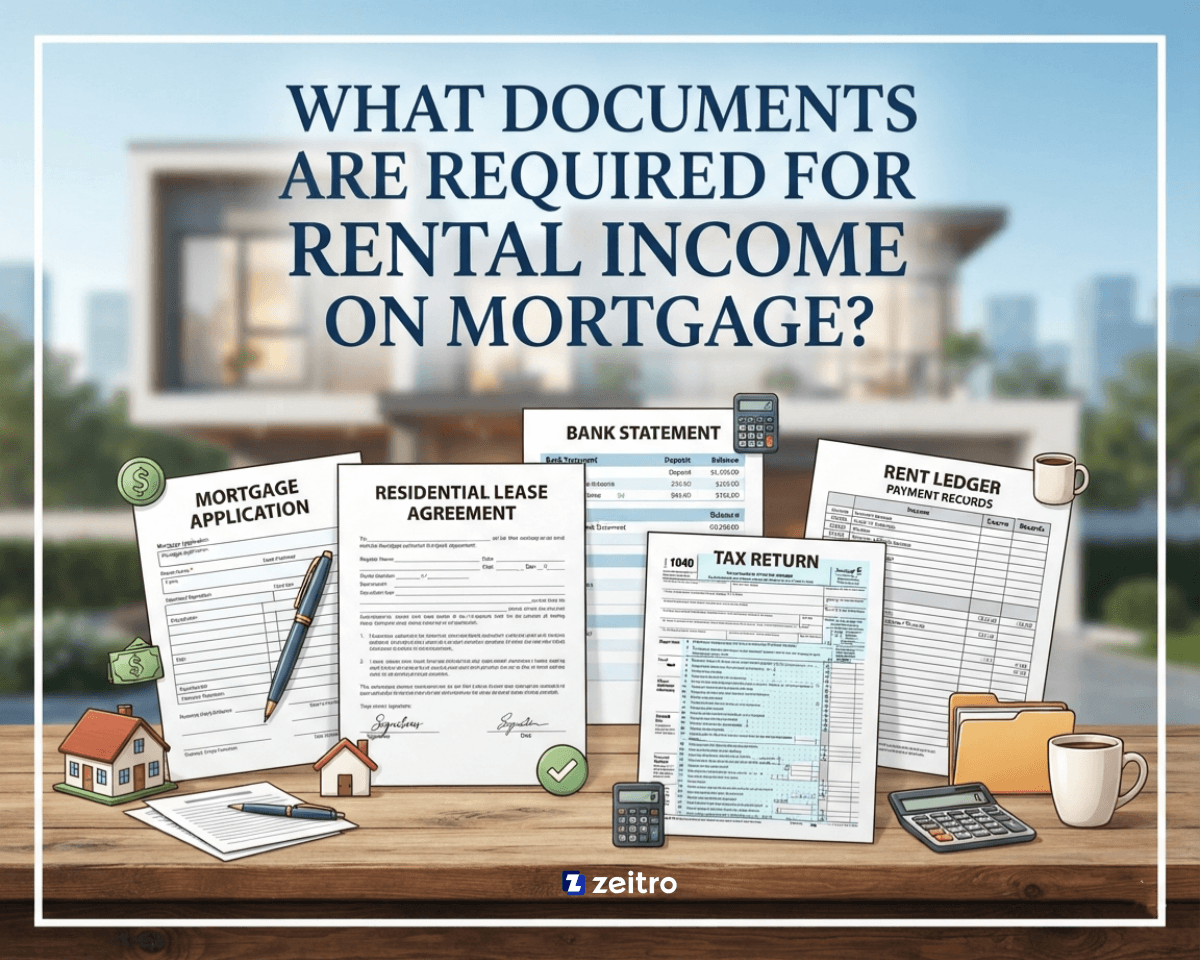
Whenever clients ask me how to use rental cash flow to qualify for a home loan, my first advice is always the same: get your paperwork ready early. Lenders look closely at your personal finances and the property's earning track record to balance your debt-to-income ratio. Here is the exact paperwork I ask my borrowers to gather before heading into underwriting.
Key Takeaways
- Conventional Loan Standard: For established rentals, agency guidelines (Fannie Mae/Freddie Mac) generally require your most recent federal tax return with Schedule E to document rental history. For newly acquired or newly converted rentals, lenders may accept a fully executed lease plus an appraiser's rent schedule (Form 1007 for single-family or Form 1025 for 2–4 units), and they will typically capture the calculation on Fannie Mae Form 1038.
- The 75% Calculation Rule: Underwriters on conventional and agency loans typically apply a 25% vacancy and maintenance factor to gross rent when calculating qualifying cash flow. DSCR and non‑QM programs may use different assumptions.
- DSCR Alternative: With an investor DSCR loan, qualification is based primarily on the property's rental income versus its debt service. Personal tax returns and W‑2s are generally not used to calculate qualifying income, though lenders may still request them for identity, fraud, or compliance verification.
- Short-Term Rentals: For conventional loans backed by Fannie Mae or Freddie Mac, short‑term rental (Airbnb/VRBO) income typically must be reported on your tax returns (Schedule E or Schedule C) with a two‑year history to be used for qualification. Some DSCR and non‑QM programs may accept 12 months of platform earnings statements and operating data, and local short‑term rental permits are required where mandated by municipal ordinance.
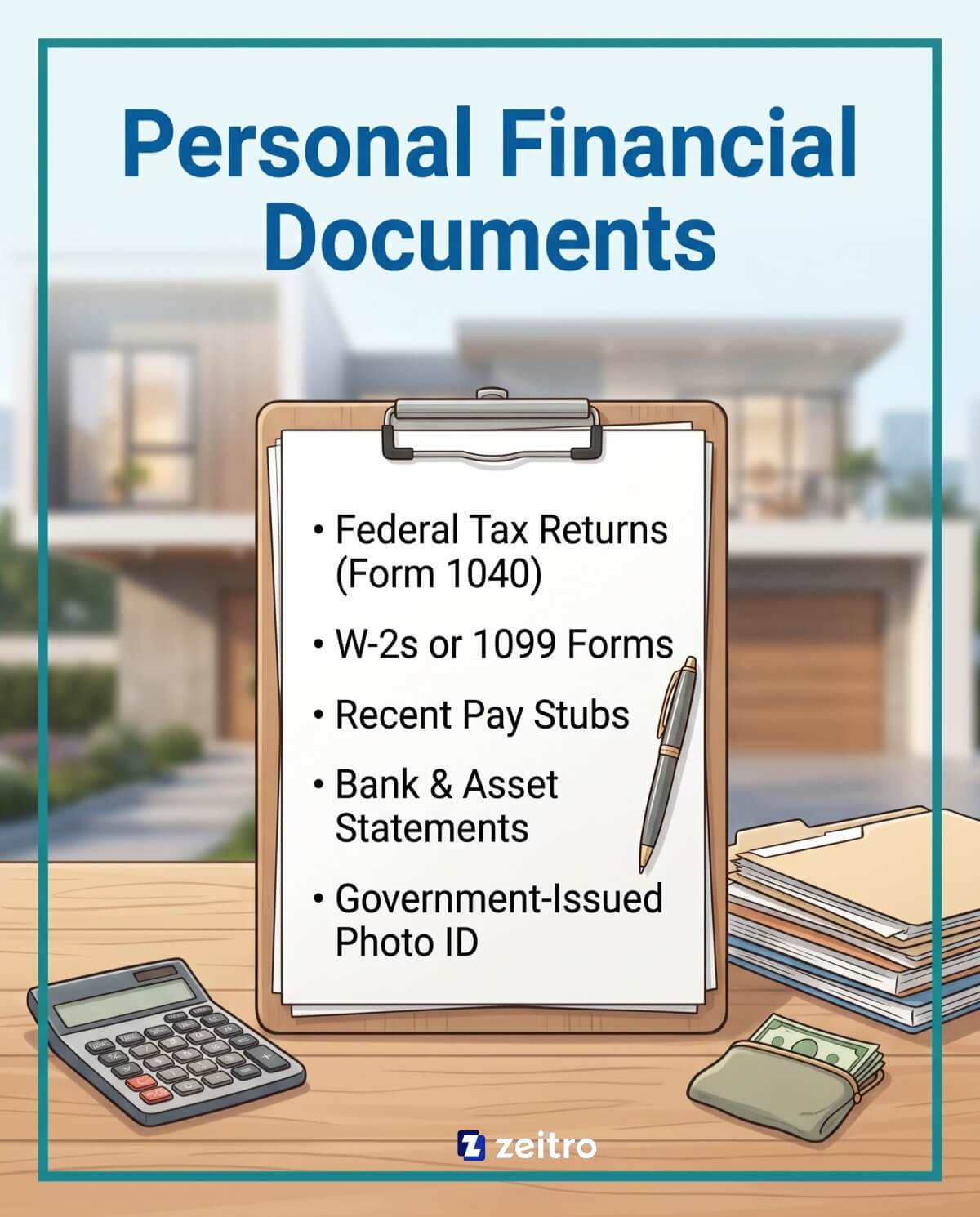
Personal Financial Documents
When you apply for a conventional, FHA, or VA mortgage, an underwriter must verify your baseline financial strength before factoring in any rental earnings. I always instruct my borrowers to supply these core items upfront:
- Federal Tax Returns (Form 1040): Your signed federal returns for the most recent one to two years. The underwriter will review Schedule E to verify historical rents, expenses, and depreciation. If the property is held in a partnership or an LLC taxed as a partnership, lenders may also request the corresponding business return (e.g., Form 1065 with Form 8825) and any related K‑1s.
- W-2s or 1099 Forms: The past two years of statements to substantiate regular employment or contract wages.
- Recent Pay Stubs: Your most recent consecutive pay stubs covering the last 30 to 60 days.
- Bank & Asset Statements: Two to three months of complete statements for all checking, savings, and investment accounts to prove liquid down payment funds and required lender reserves.
- Government-Issued Photo ID: A current driver's license or passport to satisfy identity requirements.
If you choose a specialized Debt Service Coverage Ratio (DSCR) program on an investment purchase, lenders generally skip your personal tax filings and W-2s entirely.
Rental Income & Property Documents
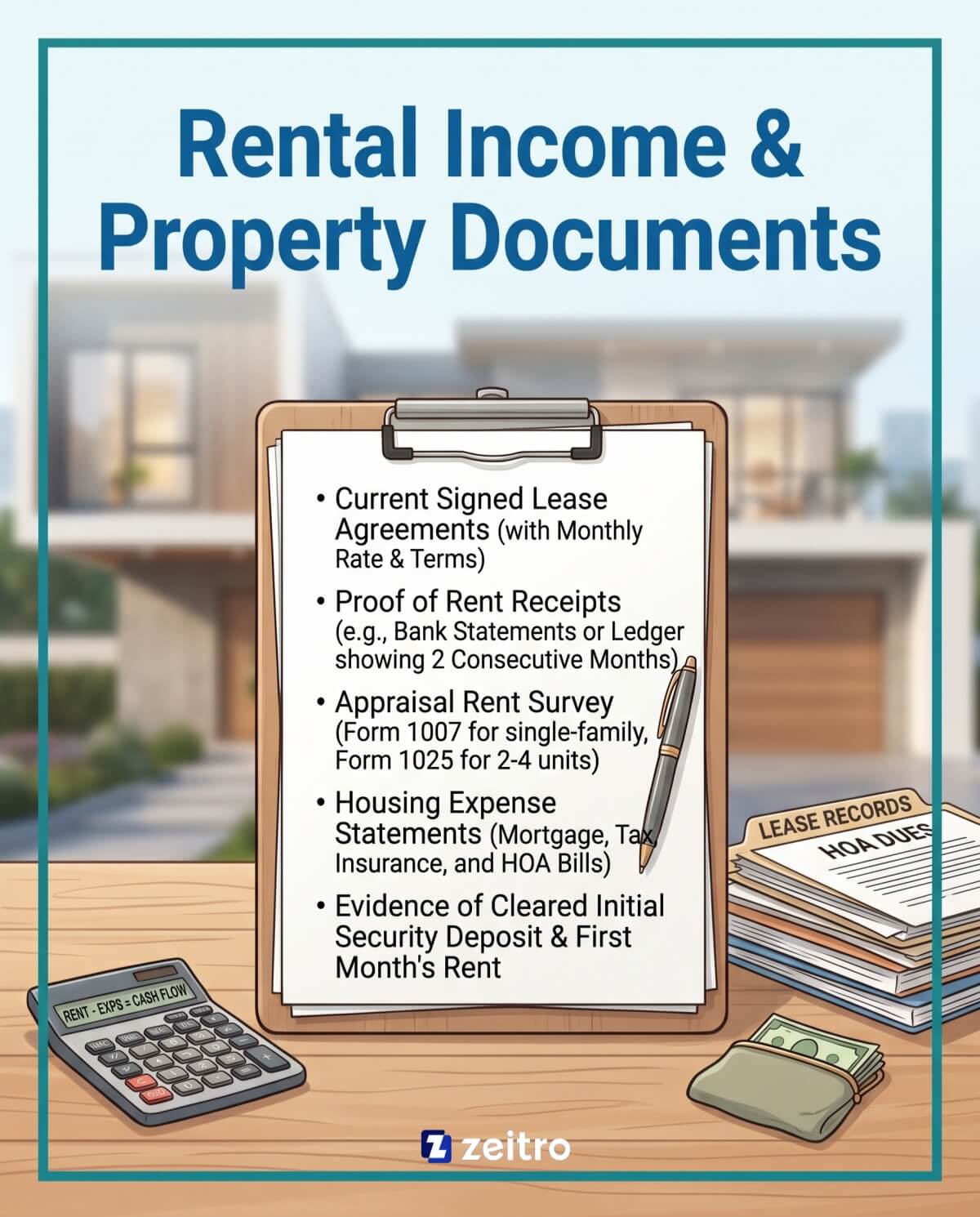
Beyond personal income, lenders must verify the cash flow performance and obligations of every property you own. To document the subject home or existing portfolio units, you will need to provide:
- Signed Lease Agreements: Current, fully executed rental contracts that clearly state the monthly lease rate, expiration date, and tenant names.
- Proof of Rent Receipts: Bank statements, canceled checks, or electronic ledger transfers (for example, ACH, Zelle, or other platforms) proving two consecutive months of rent payments. For newly signed leases, provide proof that the initial security deposit and first month's rent cleared.
- Appraisal Rent Survey: Fannie Mae Form 1007 for single-family residences or Form 1025 for 2-to-4 unit buildings. The appraiser uses this schedule to confirm fair market rent.
- Housing Expense Statements: Your latest mortgage statements, property tax assessments, homeowners hazard insurance policies, and HOA dues statements for all owned real estate.
Underwriters verify that the lease terms match the money actually entering your accounts so the figures hold up during final loan audits.
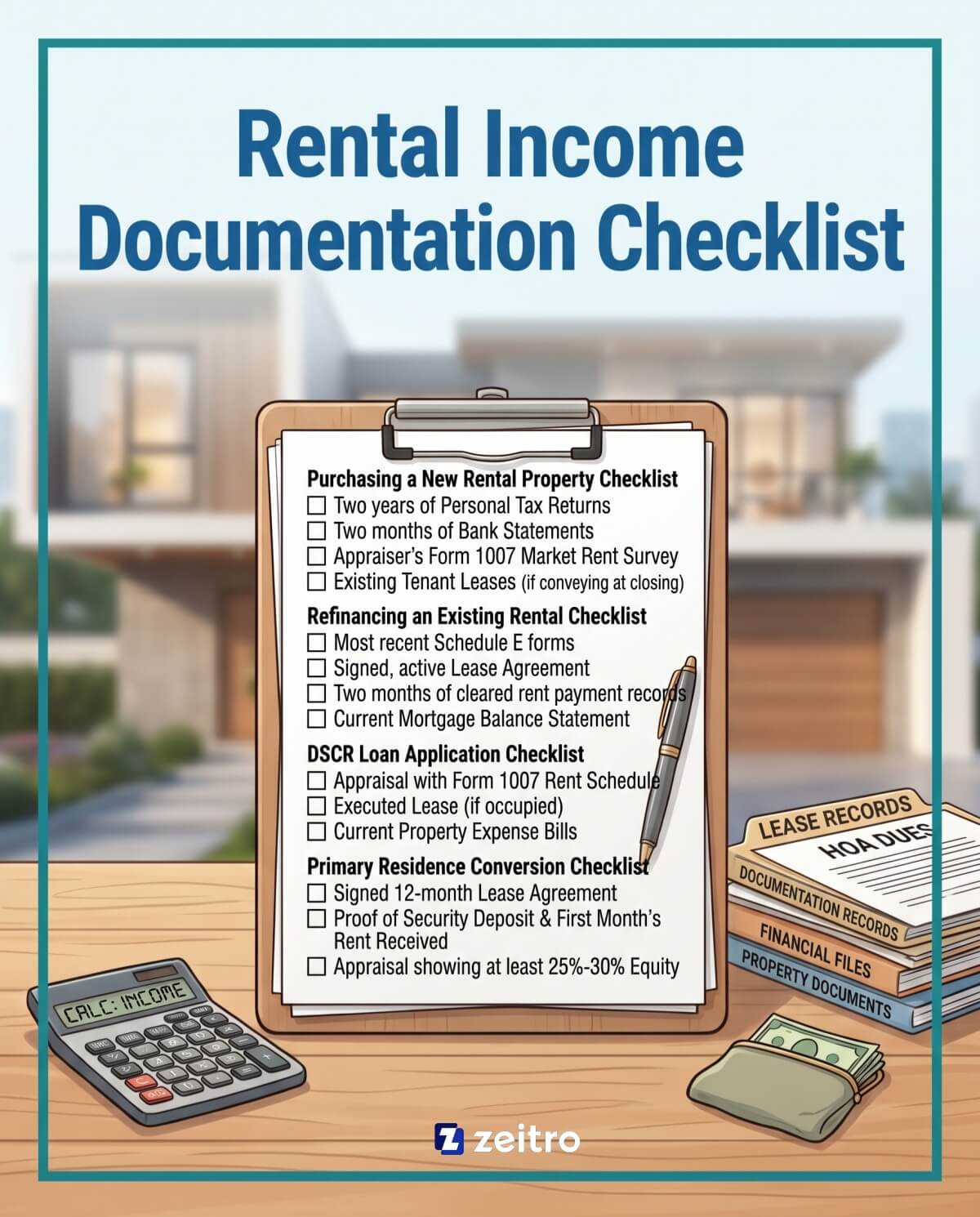
Rental Income Documentation Checklist
Because documentation rules shift based on your transaction type, I put together this practical checklist so you can assemble the right records without guessing:
- Purchasing a New Rental Property: Two years of personal tax returns, two months of bank statements, the appraiser's Form 1007 market rent survey, and existing tenant leases if they convey at closing.
- Refinancing an Existing Rental: Your most recent Schedule E tax forms, a signed active lease, two months of cleared rent payment records, and your current mortgage balance statement.
- Applying for a DSCR Loan: An appraisal with Form 1007 rent schedule, an executed lease (if occupied), and current property expense bills—no personal tax returns or pay stubs required.
- Departing a Primary Home to Rent It Out: A signed 12‑month lease agreement, proof of the security deposit and first month's rent received, and an appraisal showing at least 25%–30% equity in the home, as required by agency guidelines to use that rental income in qualification.
Using the right checklist for your scenario prevents unnecessary back-and-forth requests from your processing team.
FAQs About Mortgage Rental Income Documents
Q1. What documents are required to show rental income to Fannie Mae?
Fannie Mae requires your most recent federal tax return with Schedule E if you have an established rental track record. If the property was acquired recently or placed in service mid-year, an executed lease agreement can be used instead. Additionally, Fannie Mae requires a comparable rent schedule to verify market‑rate rents, typically Form 1007 for single‑family properties or Form 1025 for 2–4 unit properties, completed by a licensed appraiser as part of the appraisal process.
Q2. What are the FHA rental income guidelines?
FHA guidelines generally allow you to use 75% of the gross lease income or appraised market rent to offset the property's full monthly housing payment (PITIA). When converting a primary residence to a rental, FHA typically requires at least 25% equity in the departing home (verified by an appraisal) and, in many cases, a documented employment relocation (for example, moving more than 100 miles) for that prospective rent to be used in qualification.
Q3. How to calculate rental income for a mortgage?
Lenders evaluate rental income through two main methods:
- The Lease Method: Multiply gross monthly rent by 75% (to account for a 25% vacancy and maintenance buffer), then subtract your total monthly mortgage payment (PITIA).
- The Schedule E Method: Start with the net rental income reported on Schedule E, add back non‑cash expenses such as depreciation, and then adjust for the property's monthly housing payment (PITIA) according to the lender's worksheet (for example, Fannie Mae Form 1038). The resulting monthly figure is compared against your housing debt in the DTI calculation.
- Use Zeitro DSCR & Rental Income Calculator for Mortgage: Just upload documents and the online tool will analyze and calculate the rental income for you.
Q4. Can you use short-term rental (Airbnb/VRBO) income to qualify for a mortgage?
Yes, but short-term rentals require specific validation. Conventional underwriters generally want to see a full two-year operating history reported on Schedule E. For DSCR and Non-QM loan programs, lenders often accept a 12-month earnings statement provided directly by Airbnb, VRBO, or a professional management company, along with a valid municipal short-term rental permit where locally required.
Q5. Do you need a 2-year landlord history to use rental income for a mortgage?
No, a two‑year landlord track record is not always required. For the subject investment property you are purchasing, Fannie Mae and Freddie Mac allow lenders to use fair market rent from an appraiser's rent schedule (Form 1007 for single‑family or Form 1025 for 2–4 units) to help qualify the new mortgage, subject to standard DTI, reserve, and down payment requirements. DSCR programs also skip the landlord history requirement entirely, qualifying the loan based solely on the property's revenue potential.
Conclusion
Documenting rental income comes down to creating a clear, verified trail of property cash flow. Whether you are using Schedule E write-offs, active leases, or a DSCR rent schedule, having these records organized ahead of time speeds up your underwriting review.
I recommend having your loan officer pre‑screen your tax filings and leases before you submit your application to help reduce back‑and‑forth requests and keep the underwriting process moving efficiently.
People Also Read
- Ultimate Guide: How to Get a 1099 Form Online?
- Best Non-QM Mortgage Lenders: Which to Choose?
- Best DSCR Loan Lenders: Which to Choose from?
- DSCR Loan Requirements: Ratio, Credit Score, and More
- Can Rental Income Offset a Mortgage? Lender Rules & Requirements
- How Do Underwriters Treat Rental Losses? An Ultimate Guide
- Can Projected Rental Income be Used for a Mortgage?

![[Tips for Loan Officers] How Can I Lower Borrower DTI?](https://cdn.prod.website-files.com/6731bc6e813a541b54c30b10/6aa3b89e281a639e7a5c6fca_lower-debt-to-income-ratio-banner.jpg)