Written by

Eric
Share this article

.svg)
Subscribe to updates
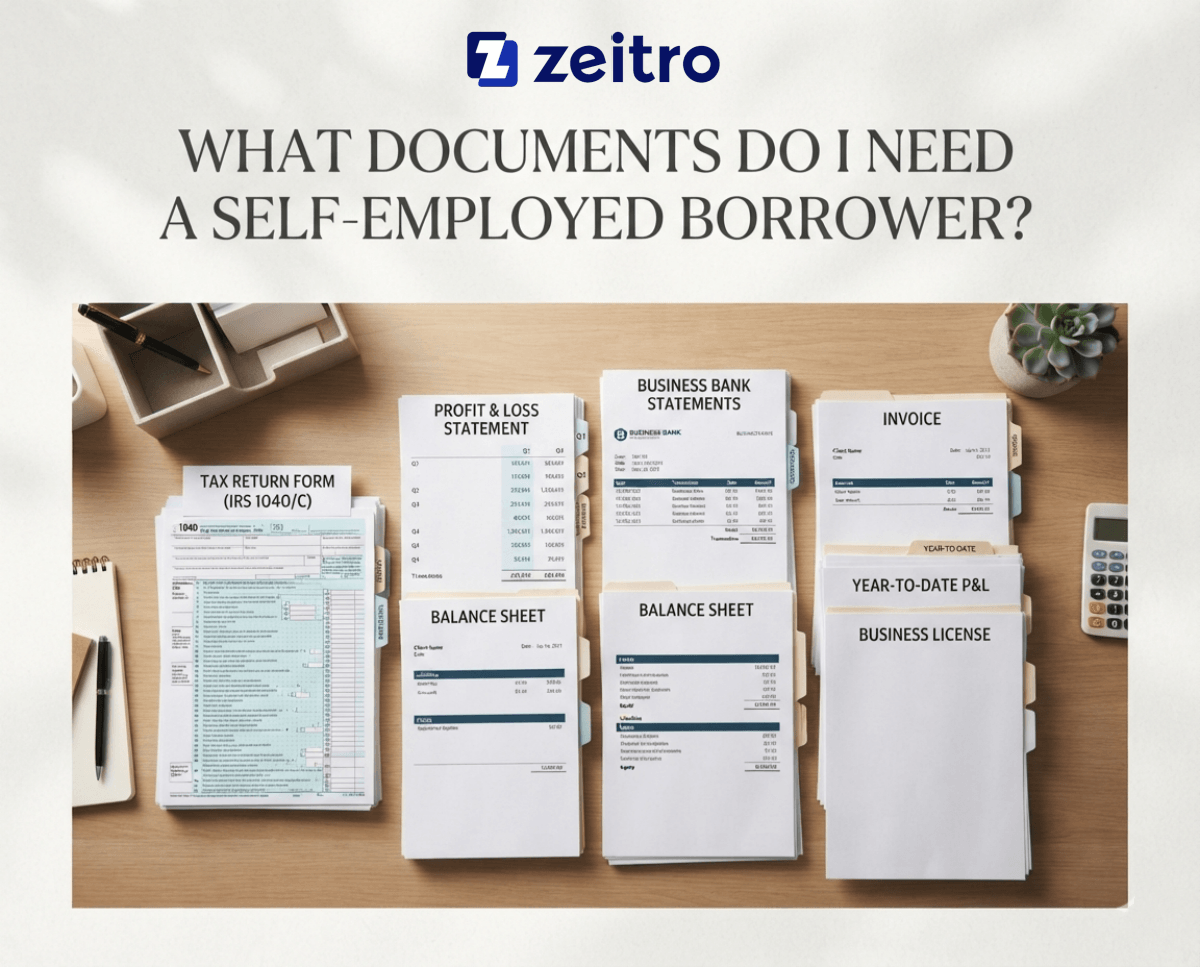
Whenever self-employed clients ask me what paperwork they need for a home loan, I tell them the truth: lenders look past top-line revenue to evaluate actual taxable profit and stability. For standard qualification, you need two years of complete tax returns, fresh business financials, and proof your company is active. If your tax deductions are heavy, alternative loan programs can help verify your cash flow instead.
Key Takeaways
- Two full years of personal and business tax returns form the baseline for traditional underwriting.
- Owning 25% or more of a partnership, S corporation, or LLC taxed as a partnership/S-corp generally triggers the requirement to provide the business's federal tax returns (Forms 1065 or 1120‑S) and all related Schedule K‑1s.
- Year-to-date profit and loss statements bridge the gap between your last tax filing and today.
- Active business standing requires independent proof, such as state registrations or CPA letters.
- Bank statement and 1099 loan programs offer alternative paths if extensive write-offs reduce your net income.
Regular Documents Required for Self-Employed on a Mortgage
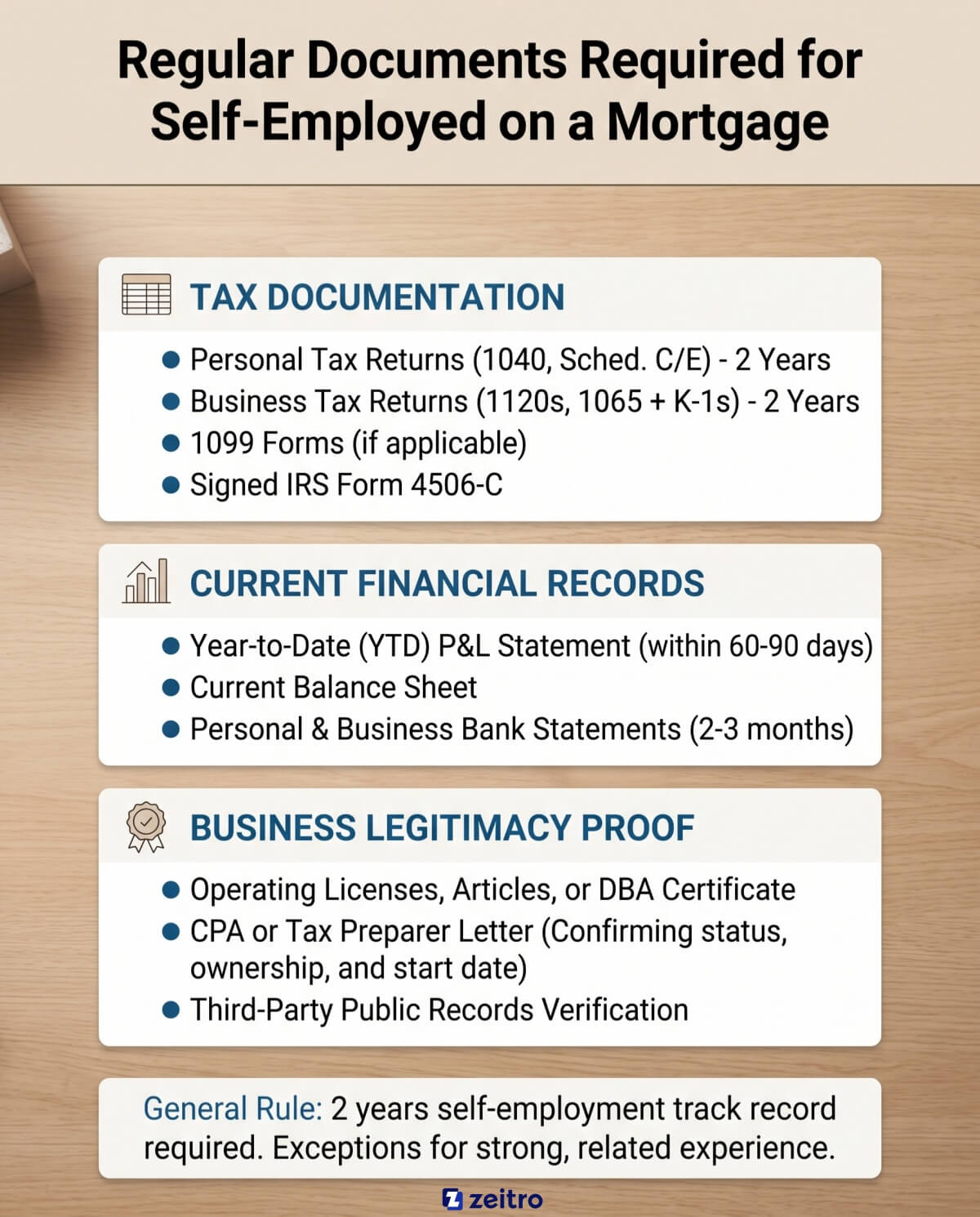
When I evaluate a traditional full-documentation mortgage file, underwriters follow a clear framework. You will need to gather paperwork across three core pillars: taxes, ongoing finances, and legal business existence.
Tax Documentation
- Personal Tax Returns (Form 1040): Provide signed copies from the last two tax years, including every schedule. Schedule C shows sole proprietorship earnings, while Schedule E covers rental properties and partnerships.
- Business Tax Returns (Forms 1120, 1120-S, or 1065): If you own 25% or more of an entity, underwriters require the last two years of corporate filings along with all Schedule K-1 forms.
- 1099 Forms (if applicable): Independent contractors may be asked to provide their last two years of 1099‑NEC or 1099‑MISC forms as supplemental income documentation, but the primary verification remains your filed personal and business tax returns.
- IRS Form 4506-C: You will sign this authorization so your lender can order official tax transcripts directly from the IRS.
Underwriter Tip: Write-offs lower your taxable income, but underwriters often add back non-cash expenses—such as depreciation and amortization—when calculating your qualifying income using Fannie Mae Form 1084 (Self-Employed Income Analysis).
Current Financial Records
- Year-to-Date (YTD) Profit and Loss Statement: A current P&L shows your earnings from January 1 to the present. Lenders typically require this statement to be dated within 60 days of closing, though some may accept up to 90 days, to confirm that revenue has remained steady since your last tax return.
- Current Balance Sheet: This document summarizes your company's assets, liabilities, and retained equity. It is commonly required for larger jumbo loans and corporate owners.
- Bank Statements (2 to 3 Months): Submit full statements for both personal and business accounts to verify down payment reserves.
Watch-out: If you withdraw money from a business account for closing costs, I must run a cash flow analysis to prove the withdrawal will not hurt daily business operations.
Business Legitimacy Proof
- Operating Licenses and Registrations: Provide your active municipal business license, Articles of Organization, or Doing Business As (DBA) certificate.
- CPA or Tax Preparer Letter: A brief written statement from your licensed accountant confirming that your business is active and operational, your ownership percentage, and the date you began self-employment. Some lenders may also ask the letter to confirm that you have maintained ownership for at least two consecutive years.
- Third-Party Verification: Lenders may check public records on your Secretary of State website to confirm your business registration and status. In certain professions or loan programs, they may also request proof of professional liability insurance, but this is not a universal requirement.
Rule of Thumb: Lenders generally require a two-year self-employment track record. In some cases, borrowers with at least one year of self-employment and a minimum of two years of prior experience in the same or a related field (documented with W‑2s, tax returns, and a CPA letter) may qualify with 12 to 23 months of self-employment history.
Extra Documents Needed by Loan Types
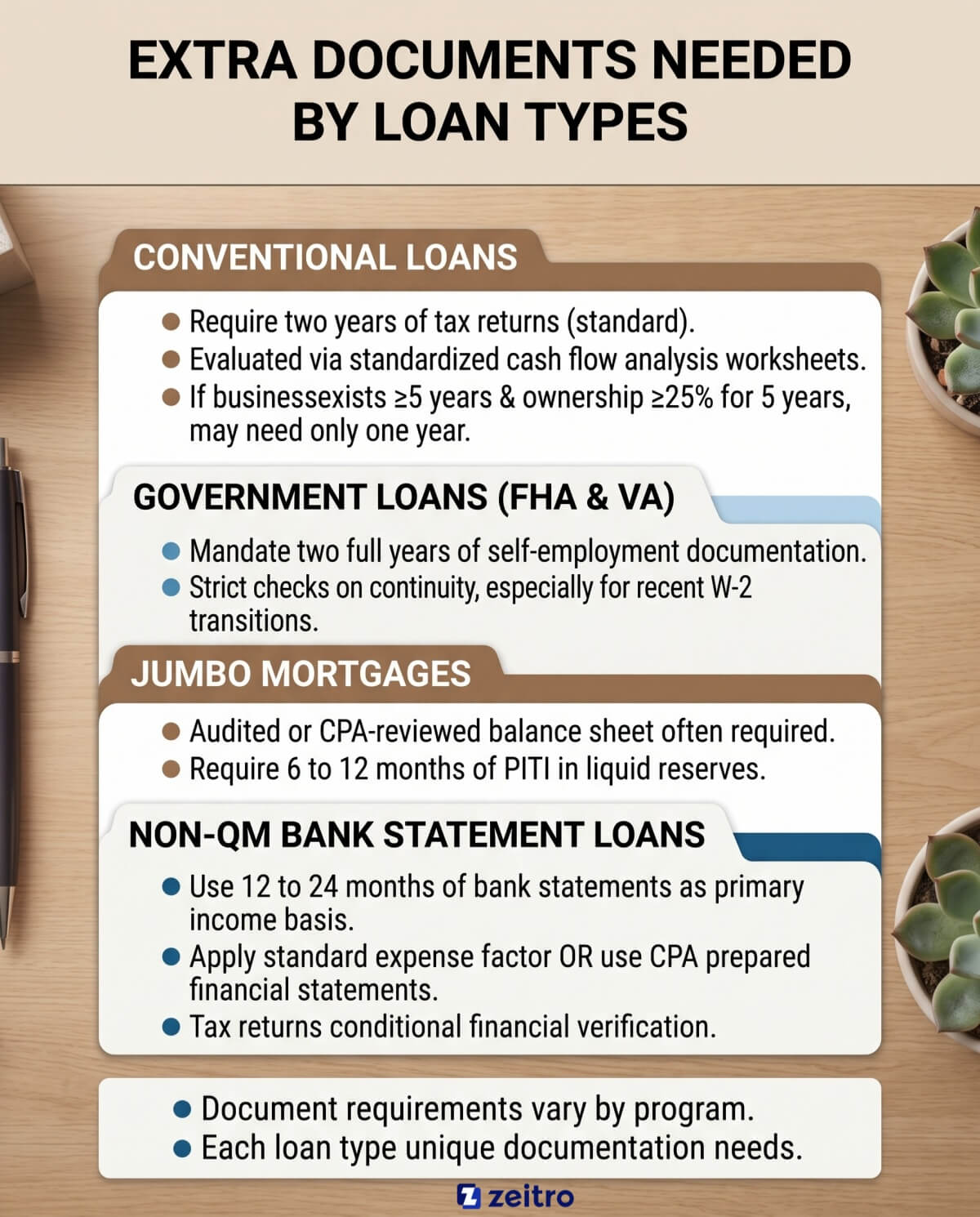
Loan programs handle self-employment differently. Depending on which financing route we choose, expect these additional requirements:
- Conventional Loans (Fannie Mae & Freddie Mac): Require two years of tax returns, evaluated through standardized cash flow analysis worksheets. If the business has been in existence for at least five years and you have owned 25% or more of the business for the past five consecutive years, lenders may be allowed to use only one year of personal and business tax returns instead of two.
- Government Loans (FHA & VA): Mandate two full years of self-employment documentation with strict continuity checks, especially if you recently transitioned from a W-2 role.
- Jumbo Mortgages: Often demand an audited or CPA-reviewed balance sheet alongside 6 to 12 months of principal, interest, taxes, and insurance (PITI) in liquid reserves.
- Non-QM Bank Statement Loans: Use 12 to 24 months of business (and sometimes personal) bank statements as the primary basis for calculating qualifying income, rather than relying on taxable income from tax returns. Lenders typically apply an expense factor (commonly around 50%) to deposits, or use CPA-prepared financial statements to determine actual business expenses. Tax returns may still be required for overall financial verification.
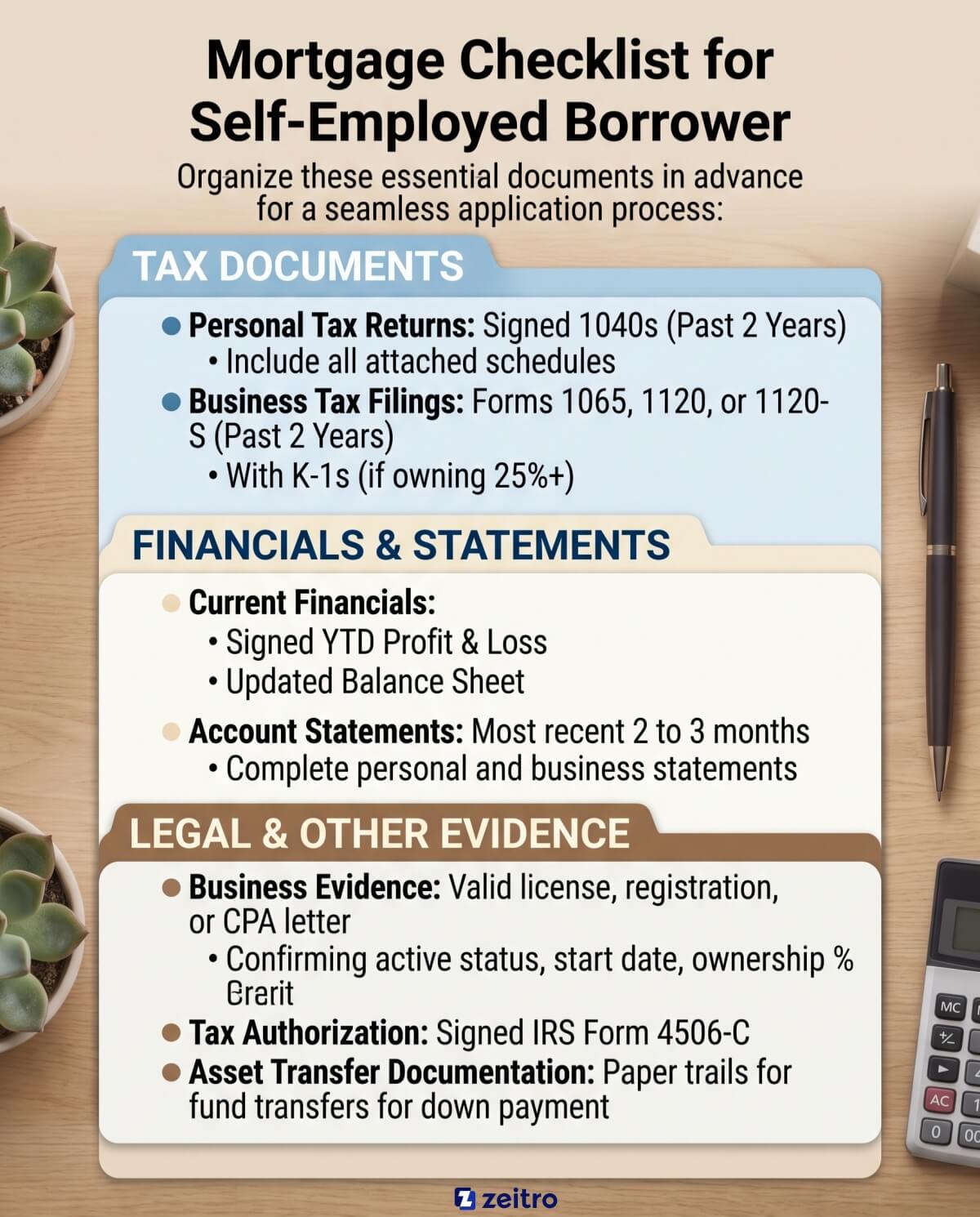
Mortgage Checklist for Self-Employed Borrower
Before submitting your loan application, gather these core items into a single digital folder to prevent processing delays:
- Personal Tax Returns: Signed Form 1040s from the past two years, including all attached schedules.
- Business Tax Filings: Two years of Forms 1065, 1120, or 1120-S with K-1s (if owning 25%+).
- Current Financial Statements: A signed year-to-date P&L and an updated balance sheet.
- Account Statements: The most recent 2 to 3 months of complete personal and business bank statements.
- Business Evidence: A valid business license, state registration printout, or a CPA verification letter confirming that your business is active and indicating your start date and ownership percentage.
- Tax Authorization: A completed and signed IRS Form 4506-C.
- Asset Transfer Documentation: Paper trails for any transfers between business and personal accounts meant for your down payment.
Final Word
Securing a mortgage while self-employed takes a little extra organization, but with proper planning it does not have to prevent you from buying a home. A key step is often preparing three to six months in advance so your tax records, write-offs, and bank accounts are well organized.
Connect with your loan officer and accountant before filing taxes to pick the right strategy, whether that means standard full-documentation or a flexible bank statement loan.
People Also Read
- Income Verification Documents: A Complete Guide for Employees and Self-Employed
- How to Calculate Income If Borrower Has Multiple Businesses?
- How to Determine Mortgage Eligibility? Verify Guidelines in Seconds
- Mortgage Interest Deduction: Limits, PMI & New Rules

![[Tips for Loan Officers] How Can I Lower Borrower DTI?](https://cdn.prod.website-files.com/6731bc6e813a541b54c30b10/6aa3b89e281a639e7a5c6fca_lower-debt-to-income-ratio-banner.jpg)