![[Solved] What Percentage of Income Should Go to Mortgage?](https://cdn.prod.website-files.com/6731bc6e813a541b54c30b10/69fb04673c68d49bdec77637_what-percentage-of-income-should-go-to-mortgage-banner.png)
Written by

Eric
Share this article

.svg)
Subscribe to updates
Last Checked and Updated on August, 2026
I stumbled onto this question a while back while scrolling through r/RealEstate, where someone asked the thing that keeps half of America up at night: "What percentage of my monthly income should actually go toward my mortgage?" The replies were all over the place — some people swore by rigid formulas, others said "just wing it." Lenders don't wing it, though. They lean on a handful of tested affordability rules, and once you understand them, budgeting for a home stops feeling like guesswork.
Key Takeaways
- The 28/36 rule remains the benchmark most lenders start with, though modern underwriting software often stretches well past it.
- Where you live matters more than any formula. Buyers in expensive metros routinely exceed the "textbook" limits just to compete.
- Never budget off principal and interest alone. Property taxes, insurance, and HOA dues can quietly add hundreds to your real monthly cost.
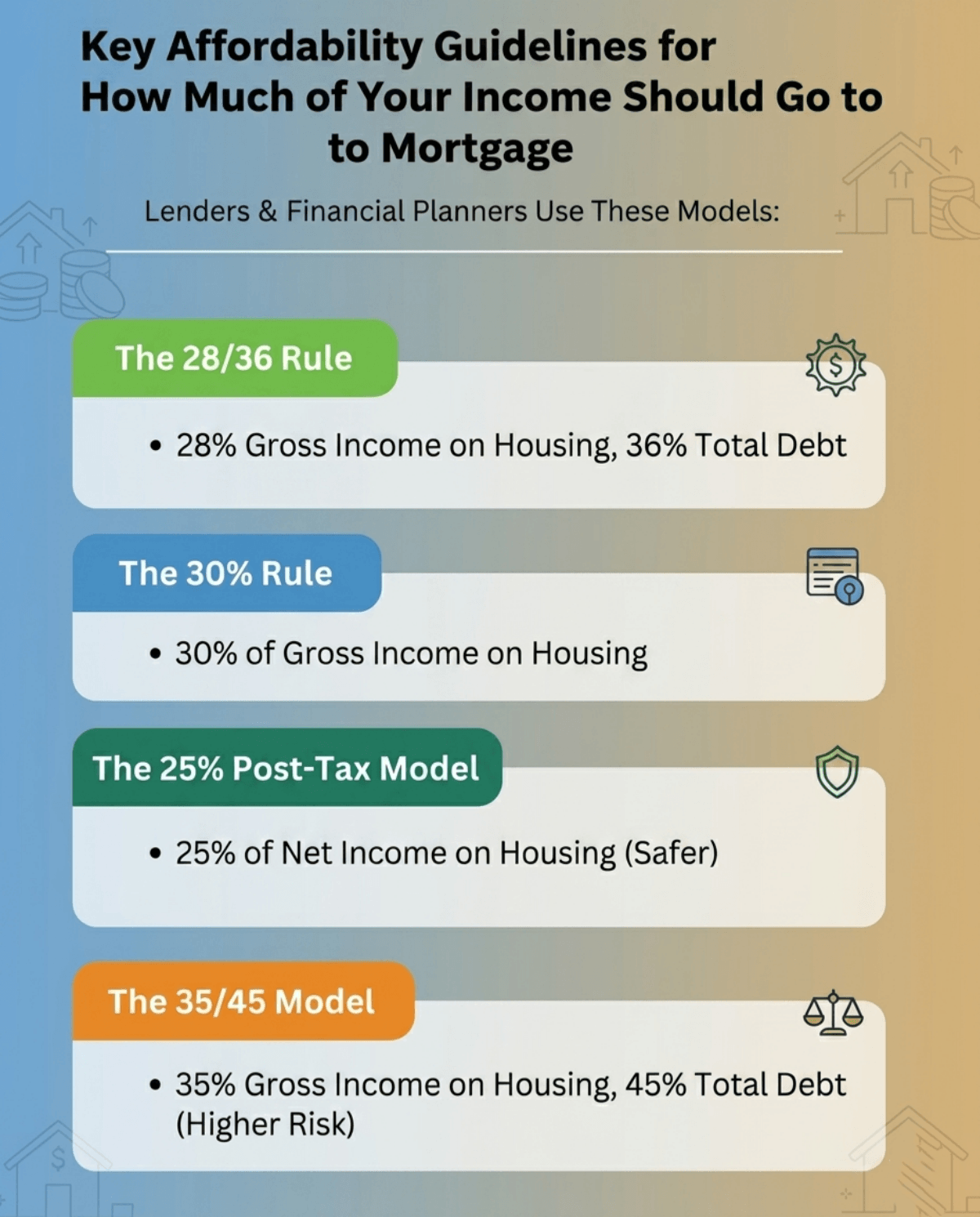
Key Affordability Guidelines for How Much of Your Income Should Go to Mortgage
When I bought my first home, my loan officer walked me through a few different formulas before we landed on a number I was actually comfortable with. Here are the four you're most likely to run into:
- The 28/36 Rule: The classic banking standard. Housing costs shouldn't top 28% of your gross (pre-tax) monthly income, and your total debt load — mortgage, car payments, credit cards, everything — shouldn't exceed 36%.
- The 30% Rule: A simpler cousin of the 28/36 rule. Keep housing at or under 30% of gross income. Easy to remember, though it can feel outdated in today's pricier markets.
- The 25% Post-Tax Model: My personal favorite, and one many fee-only financial planners push hard. Cap your mortgage at 25% of your net (take-home) pay. It's more conservative, but it leaves real breathing room for saving and investing.
- The 35/45 Model: Built for higher earners or borrowers with unusual debt profiles. It allows up to 35% of gross income toward housing and 45% toward total debt — workable, but it leaves less cushion if your income ever dips.
One thing worth knowing: that 36% ceiling isn't as firm as it used to be. Most conventional loans today run through automated underwriting systems like Fannie Mae's Desktop Underwriter, which can approve borrowers with a total debt-to-income ratio as high as 45%, and sometimes 50%, if your credit score and cash reserves are strong. FHA loans can be even more flexible. So while 28/36 is a great starting point for budgeting, don't assume it's a hard wall on what you'll actually qualify for.
Quick Income Breakdown Examples
To make this crystal clear, let's assume a baseline scenario. Imagine a homebuyer with an annual salary of $100,000. That breaks down to roughly $8,333 in monthly gross income, or about $6,200 in monthly net take-home pay after taxes and basic deductions.
Here is how the maximum monthly mortgage payment shakes out depending on the financial framework you choose:
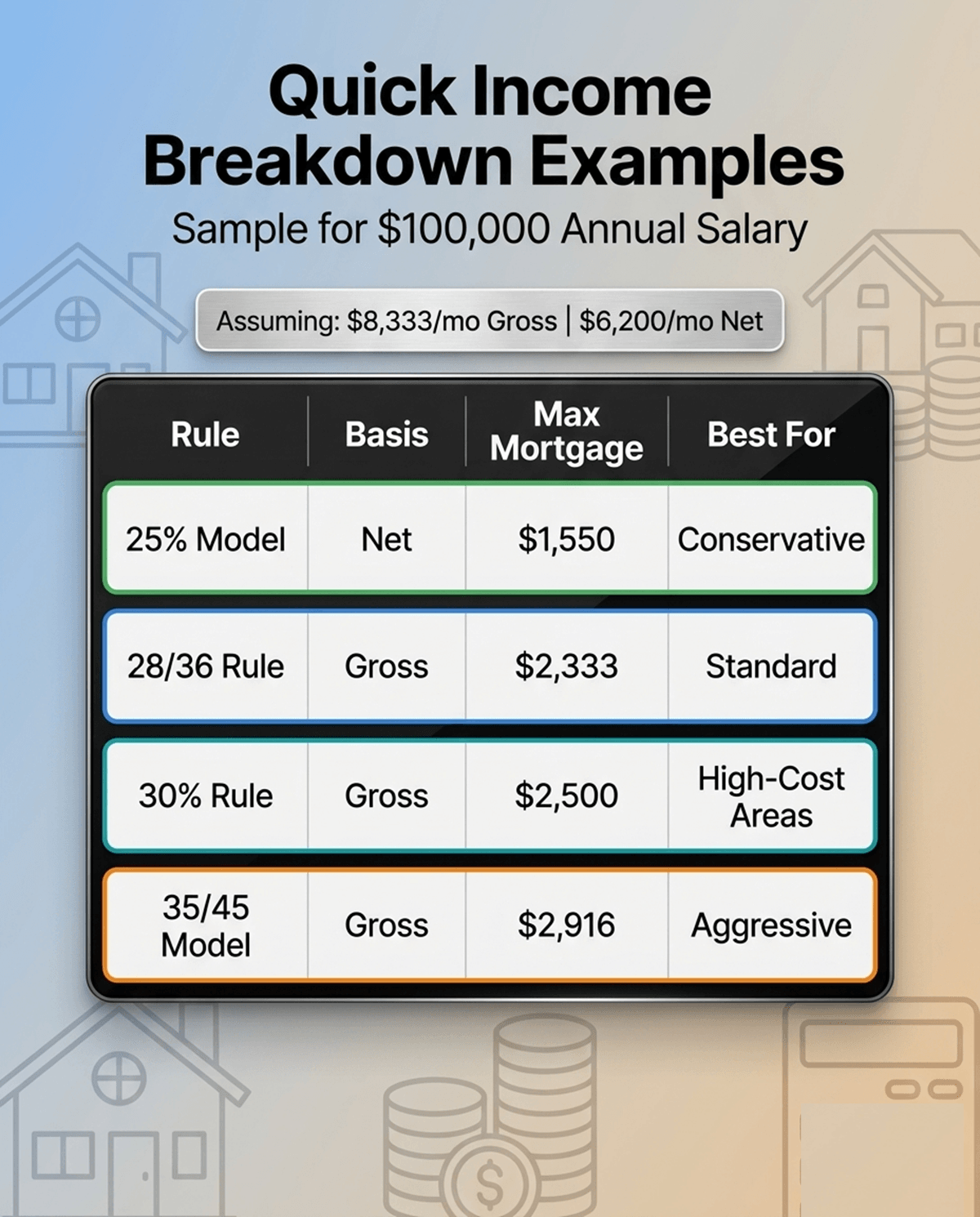
Notice how much the number swings depending on which model you use — nearly $1,400 a month between the most conservative and most generous approach. That gap is exactly why picking the right rule for your situation matters more than memorizing any single percentage.
Also Read:
- How to Calculate Self-Employed Income for a Mortgage?
- How to Calculate Employment Income for a Mortgage?
- Mortgage Income Requirements 2026: Learn Before You Apply
- Income Needed for Mortgage: Methods, Examples & Requirements
- [Solved] What Debt-to-Income Ratio is Needed for a Mortgage?
Factors That Impact Your Percentage
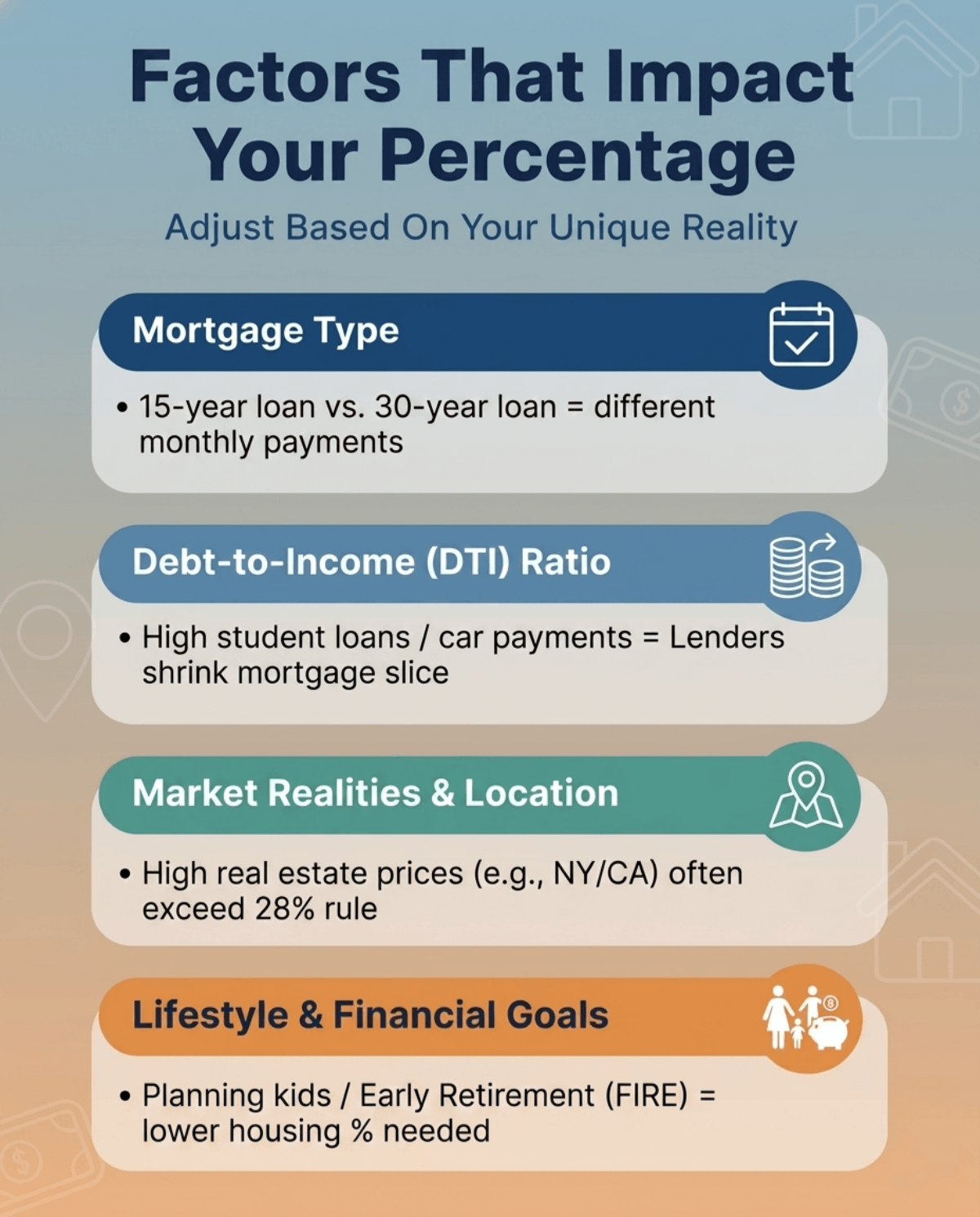
These formulas are a starting point, not gospel. A few things will push your real-world number up or down:
- Mortgage Type: A 15-year fixed loan carries a noticeably higher monthly payment than a 30-year fixed for the same loan amount, which shifts your percentage significantly.
- Debt-to-Income (DTI) Ratio: Heavy student loans or a car payment eat into the room lenders will give your housing payment, no matter how much you earn.
- Market Realities & Location: A $2,500 payment might be 28% of income in Columbus, Ohio, but the same paycheck in San Francisco or New York often means stretching to 35%–40% just to land a starter home. Location changes the math more than almost anything else on this list.
- Lifestyle & Financial Goals: If you're planning for kids, chasing early retirement, or just prefer a fatter savings cushion, aiming below the standard percentages gives you more room to breathe.
Also Read:
- [Tutorial] How to Estimate What Mortgage You Can Afford?
- Best First-Time Home Buyer Programs: Get the Right Choice
- 10 First-Time Home Buyer Tips: What to Know
- Max LTV: Check Maximum Loan-to-Value Ratios By Loan Types
- Max DTI for Mortgage: Requirements By Loan Types
What Costs Make up Your Mortgage Payment?
One of the biggest rookie mistakes I see is assuming your mortgage payment is just the money you borrowed. Your "true" monthly obligation is actually composed of several layers, often summarized as PITI:
- P (Principal): The actual chunk of the loan balance you are paying down.
- I (Interest): The cost of borrowing the money from the bank.
- T (Taxes): Local property taxes, which can increase annually due to inflation.
- I (Insurance): Homeowners insurance to protect your property.
- PMI (Private Mortgage Insurance): A mandatory extra fee if your down payment was less than 20%.
- HOA Fees: Homeowners Association dues for community upkeep.
Remember, while your principal and interest might be locked in, property taxes, insurance, and HOA fees will almost certainly rise over time.
Also Read:
- Ultimate Guide: How to Calculate Monthly Mortgage Payment?
- How to Calculate Mortgage Interest: Manually & Automatically
- Mortgage Rates Impact Affordability: The Lower, The Better
Tips to Lower Your Monthly Mortgage Payments
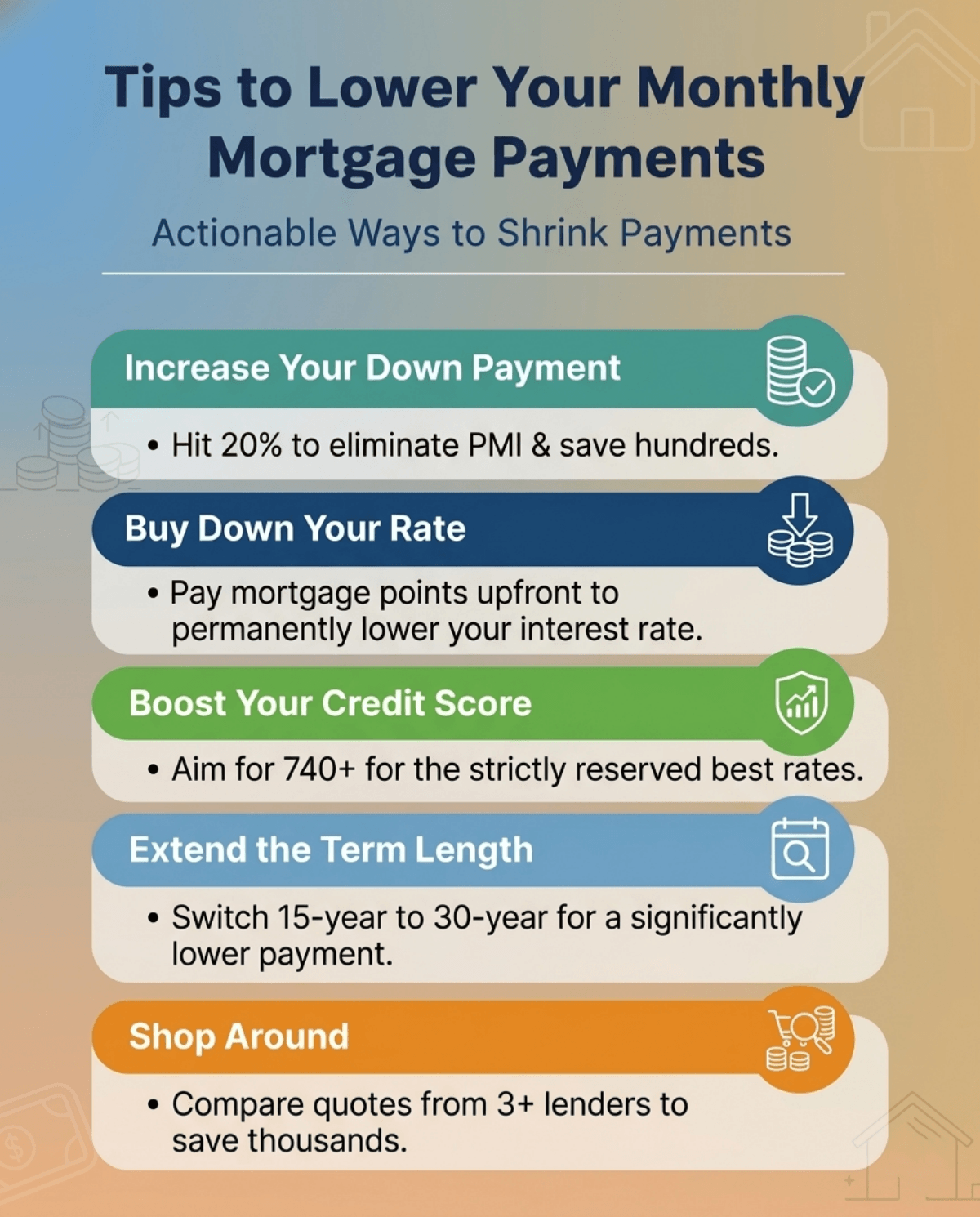
If your numbers are running tight, a few practical moves can bring that payment down:
- Increase your down payment: Reaching 20% wipes out PMI entirely, which can save well over $100 a month on a typical loan.
- Buy down your rate: Paying for mortgage points upfront permanently lowers your interest rate — worth running the math on if you plan to stay put for years.
- Boost your credit score: Lenders reserve their sharpest rates for borrowers with scores of 740 and above.
- Extend the term length: Moving from a 15-year to a 30-year loan drops your monthly payment noticeably, even though you'll pay more interest over the life of the loan.
- Shop around: Comparing quotes from a few different lenders before committing can save you thousands over the life of the loan — I've seen quotes on the same day for the same borrower vary by nearly half a point.
FAQs About Income Going to Mortgage
Q1. Can I afford a $500K house with a $100K salary?
It's tight but not impossible. At today's rates — the 30-year fixed has been hovering in the 6.6%-6.8% range through August 2026 — a $500,000 home with 20% down would run roughly $3,200-$3,400 a month in PITI. On a $100K gross salary, that's close to 38%-40% of your income, well past the traditional 28% guideline, though it could still work under a more flexible automated underwriting approval.
Q2. Is it okay to spend 50% of income on a mortgage?
Most financial advisors would say no. Putting half your paycheck toward housing leaves almost no cushion for a job loss, medical bill, or surprise repair — the classic definition of being "house poor."
Q3. Is the 28/36 rule realistic?
It depends heavily on where you live. In lower-cost regions, it's very achievable. In expensive coastal cities, plenty of buyers end up closer to 35%-40% just to get into a starter home.
Q4. What is the 3-7-3 rule in mortgage?
This one isn't about affordability at all — it's a federal disclosure timeline. Lenders must send you a Loan Estimate within 3 business days of your application, wait at least 7 business days before closing, and deliver the final Closing Disclosure at least 3 business days before you sign.
Q5. What is the 3-3-3 rule for buying a house?
Don't confuse this with the 3-7-3 rule above — it's a completely different concept. The 3-3-3 rule is a budgeting guideline: look for a home priced at no more than three times your annual income, put down at least 3%, and keep your total monthly housing payment under 30% of your gross income. It's less about legal requirements and more about avoiding financial overreach.
Q6. Do these percentage rules apply to gross or net income?
Most banking models, including 28/36, use gross (pre-tax) income. If you want a more conservative read on affordability, run the numbers against your net (take-home) pay instead — after federal and state taxes plus FICA deductions — since that's the money you actually see hit your bank account.
Conclusion
There's no single percentage that fits every household. As a general rule, aim to keep your mortgage payment at or below 28%-30% of gross income, or closer to 25% of take-home pay if you want more of a safety net. The 28/36 rule is a solid starting point, but your real number should be whatever lets you sleep at night — qualifying for a large loan doesn't mean you have to use all of it.
Before you start touring homes, run your own numbers through a mortgage calculator to see your true monthly PITI, including your local property tax rate. Or better yet, talk with a mortgage broker who can map out your specific financial picture. A home should make your life better, not stretch it thin every month.

![[Solved] What Red Flags Would a Mortgage Underwriter See?](https://cdn.prod.website-files.com/6731bc6e813a541b54c30b10/6aa24ca70b95e62dd7bbeefd_red-flags-mortgage-underwriting-banner.png)