Written by

Eric
Author from Zeitro

Share this article

Subscribe to updates

Thank you! Your submission has been received!
Oops! Something went wrong while submitting the form.

If you've been in the mortgage game as long as I have, you know that origination is where the battle is won or lost. We used to drown in paperwork, chasing stips and manually calculating DTIs until our eyes blurred. But heading into 2026, the landscape has shifted entirely. It's no longer just about digitizing paper. It's about leverage.

I've spent years testing different platforms, looking for that "holy grail" that actually saves time rather than just shifting the workload. We need tools that don't just store data but actively help us structure deals. Whether you are a solo broker or part of a massive retail lender, the software you choose today dictates your closing volume tomorrow. In this guide, I'm breaking down the top contenders that are actually worth your time and money this year.

People Also Read:

What is Loan Origination Software?

At its core, Loan Origination Software (LOS) is the operating system for your mortgage business. It isn't simply a digital filing cabinet for 1003 forms. it is the central engine that manages the entire lifecycle of a loan—from the moment a borrower applies (or leads enter your funnel) to the final funding and closing table.

For us Loan Officers, a modern LOS serves as the command center. It handles application processing, underwriting, compliance checks, pricing, and document management. In the past, an LOS was a static database where you entered data and hoped for the best. Today, specifically in 2026, the definition has evolved. The best platforms now integrate Artificial Intelligence to automate income calculations, verify guidelines instantly, and even communicate with borrowers. It bridges the gap between the borrower's experience and the lender's back-office requirements. If your software isn't actively reducing the time you spend on manual data entry or guideline research, it's not a true modern LOS. It's just a database.

6 Top Loan Origination Software to Choose from

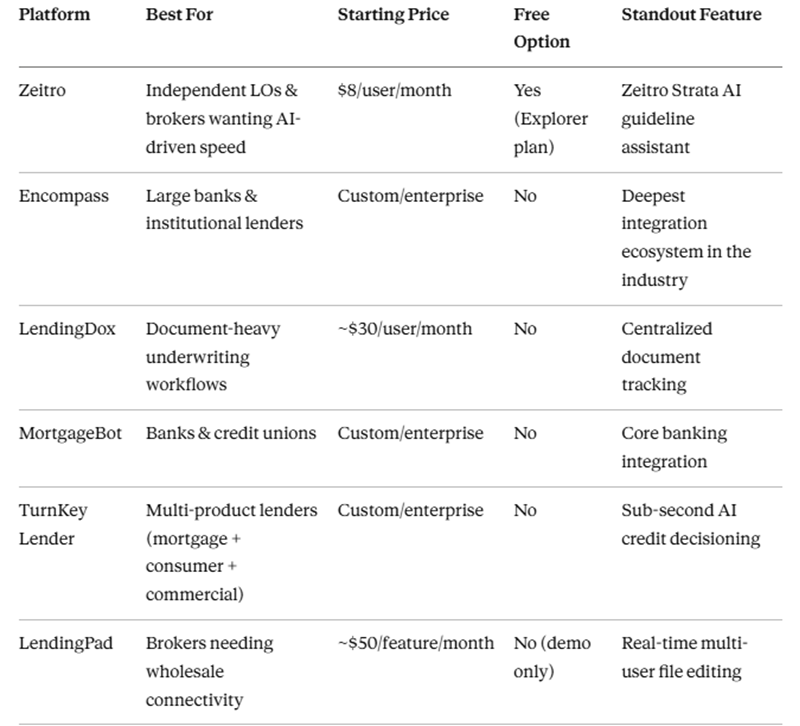
Having tested the waters with various systems, I've narrowed down the list to six platforms that stand out for different reasons. Here is my breakdown of the best tools available right now.

#1. Zeitro - Best for Efficiency Improvement

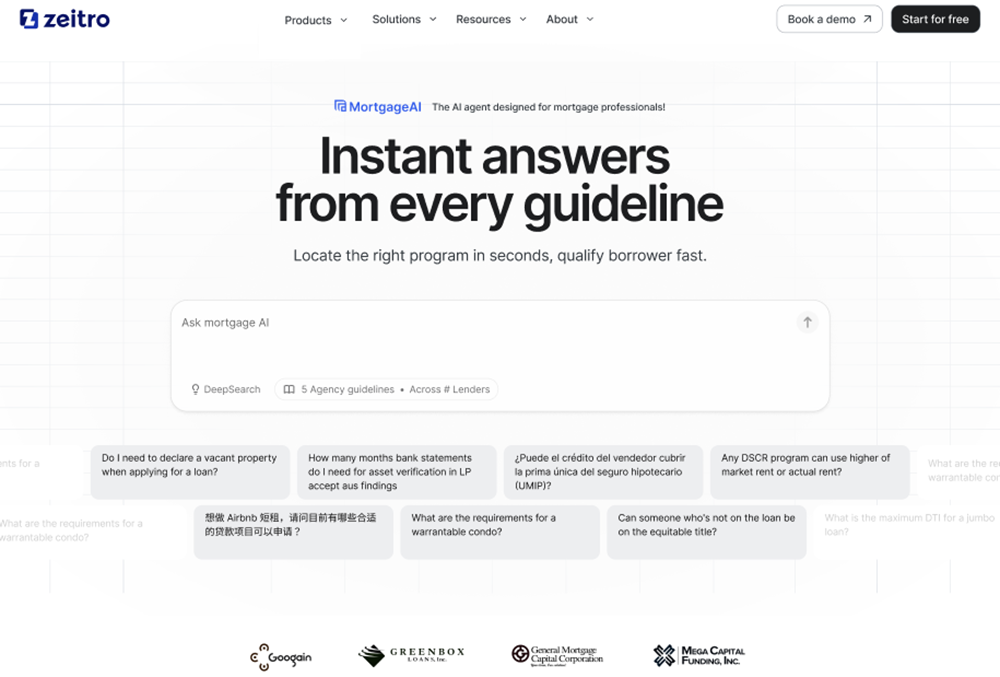
From my perspective, Zeitro has completely redefined what I expect from an origination platform. While many legacy systems feel clunky and outdated, Zeitro operates as a true AI SaaS tool specifically built to tackle the biggest pain point we all face: time. They position themselves as an AI Mortgage Platform, and honestly, the claim holds up. The biggest selling point here is the sheer speed of pre-qualification.

Using their "Scenario AI" and "GuidelineGPT," I've been able to navigate complex borrower scenarios—like Non-QM or tricky self-employed income—in seconds rather than digging through PDF guidelines for hours. The platform claims to deliver 2.5x faster pre-qualifications and save over 7 hours per loan file. In a commission-based industry, that time savings directly translates to closing more deals. It's not just a repository for data. It actively helps you structure the loan with built-in pricing engines and automated conditions. For independent LOs and brokers who don't have a massive support staff, Zeitro acts like a digital underwriter sitting right next to you.

Zeitro Best Loan Origination Software

Explore More Features About Zeitro

  • GuidelineGPT: Instant answers for FHA, VA, USDA, Fannie, Freddie, and Non-QM eligibility without keyword guesswork.
  • Scenario AI: Deep search capabilities to handle complex loan scenarios and edge cases instantly.
  • AI Tools: Automated income calculations (85%+ accuracy), document review, and condition collection.
  • Borrower Tools: Real-time rate quote tools and affordability calculators that you can embed on your personal site.
  • Digital 1003: A seamless POS that allows borrowers to finish applications in under 5 minutes.

Pros and Cons of Zeitro

Pros:

    • Significantly reduces manual guideline research (saves 7+ hours/loan).
    • Generous "Explorer" Free tier makes it accessible for anyone to try.
    • High accuracy in AI income calculation (90%+ application completion rates).
    • One system covers all loan types (QM, Non-QM, DSCR, Hard Money).

Cons:

    • As a newer AI-first platform, it may require a mindset shift for LOs used to legacy "data-entry" style software.
    • The free plan has daily limits on AI queries (though the paid tiers are very affordable).

#2. Encompass - Best for Big Lenders and Institutions

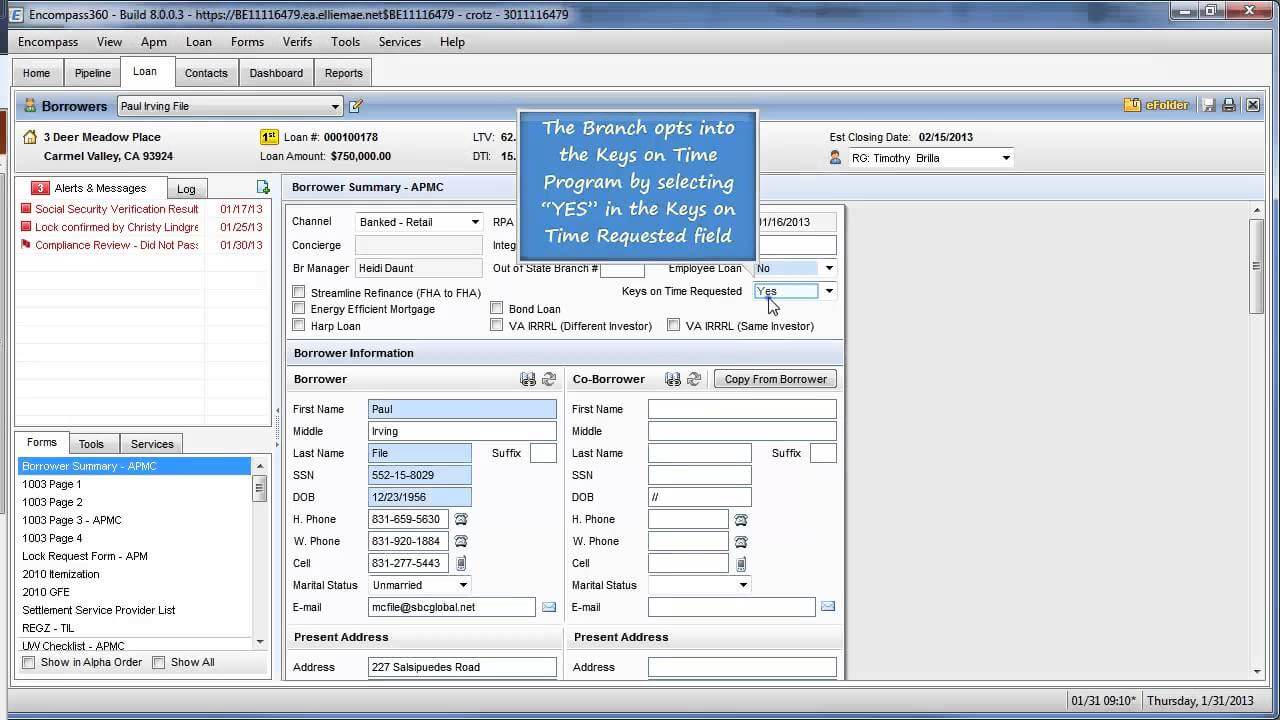
If you have worked for a large bank or a major independent mortgage banker, you have almost certainly logged into Encompass by ICE Mortgage Technology. It is the heavyweight champion of the industry in terms of market share and sheer ecosystem size. Encompass is designed to be an end-to-end solution that handles absolutely everything, from lead generation to secondary market delivery.

For large institutions, Encompass is the "safe" choice because it connects with arguably the largest network of lenders, investors, and service providers in the country. Its strength lies in its configurability for compliance and workflow enforcement across massive teams. However, as an individual LO, I sometimes find it to be overkill. It is a beast of a system that requires significant training to master. It ensures that every box is checked for compliance, which protects the lender, but the interface can feel dense. That said, if your goal is to have a system that integrates with literally every other vendor in the mortgage space, Encompass is the standard.

Encompass - Best for Big Lenders and Institutions

Explore More Features About Encompass

  • ICE PPE: A robust product and pricing engine integrated directly into the workflow.
  • Encompass eClose: A single source workflow for digital closings, reducing time at the signing table.
  • TPO Connect: specifically optimizes how third-party originators receive and manage loans.
  • Compliance: Automatic updates to stay compliant with changing state and federal regulations.

Pros and Cons of Encompass

Pros:

    • Unmatched ecosystem of integrations and partners.
    • Extremely robust compliance and secondary marketing features.
    • Scalable for massive organizations with hundreds of users.

Cons:

    • Can be slow and "heavy" to operate compared to web-based competitors.
    • Implementation takes a long time and usually requires dedicated admins.
    • Pricing is generally opaque and geared towards enterprise contracts.

#3. LendingDox - Best for Underwriting

LendingDox captures my attention because it focuses intensely on the part of the job that gives most Loan Officers headaches: document management and underwriting organization. While it markets itself as an LOS and POS, its superpower is really in how it streamlines the paper trail. It integrates tightly with CRMs like Shape, creating a bridge between sales and processing.

For teams that struggle with "stips" and chasing borrowers for updated bank statements, LendingDox offers a very clean, centralized location to store and track documents. It emphasizes security with SOC 2 compliance, which is critical when you are handling sensitive borrower data. I find it to be particularly strong for the processing and underwriting side of the house. It automates requests and reminders, so you don't have to manually email a client three times to get that missing W2. It's less about the "sales" flash and more about the operational rigor of getting a file cleared to close.

Explore More Features About LendingDox

  • Centralized Document Suite: Upload, organize, and manage all loan docs in one secure portal.
  • Real-Time Tracking: Automated notifications for new documents or those requiring attention.
  • Automated Workflows: Triggers for document requests and reminders to reduce manual follow-up.
  • Seamless Integration: bidirectional sync with other LOS platforms and CRMs.

Pros and Cons of LendingDox

Pros:

    • Very affordable pricing structure (around $30/month per user).
    • Excellent for reducing operational friction in document collection.
    • No long-term contracts or per-loan fees, which is rare.

Cons:

    • Feels more like a specialized document engine than a full-suite AI origination platform like Zeitro.
    • Heavily reliant on integrations to get the full "all-in-one" experience.

#4. MortgageBot - Best for Banks and Credit Unions

Finastra's MortgageBot is a staple in the banking world. I see this platform used most often by community banks and credit unions that need to bridge the gap between their retail banking operations and their mortgage wing. It is a cloud-native platform, which gives it a leg up over older on-premise solutions, and it supports retail, wholesale, and correspondent lending effectively.

The user experience here is designed to be "all-in-one," covering everything from the point of sale (POS) to closing and servicing. For an LO working in a bank branch, MortgageBot is great because it integrates well with core banking systems. It handles the full gamut of loan types, including construction and home equity, which are often bread-and-butter products for credit unions. It claims to reduce the application process time by 40% compared to manual methods, and while the interface isn't as flashy as some fintech startups, it is reliable and compliant, which bank compliance officers love.

Explore More Features About MortgageBot

  • PowerSearch: An integrated pricing and eligibility engine.
  • Direct POS Integration: Borrowers can apply online and data flows directly into the LOS.
  • Compliance Reporter: Built-in tools to scrutinize files for state and federal defects.
  • Multi-Channel Support: Handles retail, wholesale, and correspondent channels in one system.

Pros and Cons of MortgageBot

Pros:

    • Strong integration with wider banking core systems.
    • Cloud-native architecture makes it accessible from anywhere.
    • Excellent support for niche bank products like HELOCs and construction loans.

Cons:

    • The user interface (UI) can feel utilitarian and less modern than newer competitors.I
    • nnovation cycles can be slower due to the size of the parent company (Finastra).

#5. TurnKey Lender - Best for Automation

TurnKey Lender is a bit of a different animal. It isn't just for mortgages. it's a global digital lending automation platform that covers everything from BNPL (Buy Now Pay Later) to commercial lending and mortgages. Because of this broad focus, their decision engine is incredibly powerful. They utilize proprietary AI to automate credit decisions, often claiming to process applications in under one second.

For a mortgage lender looking to diversify or one that focuses on high-volume, standardized loans, TurnKey offers incredible efficiency. The system is designed to be "end-to-end" with very little human intervention required for straightforward files. I find it fascinating for its "Decision Rules," which you can configure extensively. If you are running a lending operation that wants to scale into different types of finance—like bridging loans or SME lending—alongside mortgages, this is the top pick. However, for a pure residential mortgage broker, the breadth of features might feel overwhelming.

Explore More Features About TurnKey Lender

  • AI Credit Decisioning: Machine learning for instant, accurate risk assessment.
  • Configurable Application Flow: Drag-and-drop customization for the borrower journey.
  • Debt Collection Module: Built-in tools for servicing and collections (rare in standard mortgage LOS).
  • Global Compliance: tailored for multiple jurisdictions and lending types.

Pros and Cons of TurnKey Lender

Pros:

    • Incredible automation speed for credit decisions.
    • Versatile: handles consumer, commercial, and mortgage loans in one spot.
    • Modern, white-label ready interface for borrowers.

Cons:

    • Can be "overkill" for a standard independent mortgage broker.
    • Implementation can be complex due to the sheer number of configuration options.

#6. LendingPad - Best for Real-time Collaboration

LendingPad has gained a massive following among brokers in recent years, and for good reason. It positions itself as the modern, cloud-native alternative to the older giants. The best way I describe LendingPad to other LOs is that it's like the "Google Docs" of loan software. It allows multiple users—processors, LOs, and underwriters—to work in the same file at the same time without locking each other out.

This real-time collaboration is a game-changer for remote teams. The interface is clean, web-based, and very fast. It doesn't require installing heavy software on your laptop, so you can originate a loan from a Chromebook if you want to. It has distinct editions for Brokers, Lenders, and Institutions. For the average broker shop, the "Broker Edition" connects seamlessly with wholesale lenders, allowing you to push files to major wholesalers with a single click. It cuts out a lot of the friction in the broker channel.

Explore More Features About LendingPad

  • Multi-User Editing: Real-time updates and file sharing across departments.
  • Direct Wholesale Integration: Seamless connection to manage pricing and lock loans with wholesalers.
  • Cloud-Based: access from anywhere with an internet connection. no server maintenance.
  • Built-in POS: Includes a complementary point-of-sale system for borrowers.

Pros and Cons of LendingPad

Pros:

    • Extremely fast setup and implementation time.
    • Modern, intuitive interface that requires very little training.
    • Excellent for brokers due to deep integration with wholesale lenders.

Cons:

    • Reporting capabilities are sometimes considered less granular than Encompass.
    • Customization options are good but less infinite than enterprise-level systems.

How to Choose the Best Loan Origination Software?

Selecting an LOS is a commitment. switching platforms costs time and creates downtime. To get it right for 2026, you need to look beyond the brochureware and evaluate how the software fits your specific workflow.

Identify Your Need

First, define your business model. Are you a Broker who needs speed and wholesale connectivity? Then systems like LendingPad or Zeitro shine. Are you a large Bank needing deep compliance and core integration? MortgageBot or Encompass might be your lane. If you are handling complex, non-standard deals, you need the AI analysis capabilities of a platform like Zeitro. Don't buy an enterprise battleship if you just need a speed boat.

Consider Core Features

Look for features that actually move the needle. In 2026, AI is non-negotiable. You need automated document recognition (OCR) and intelligent guideline search. If the software still requires you to manually type in data from a W2, it is obsolete. Also, look for a built-in Pricing Engine and a smooth Point of Sale (POS). Having these integrated saves you from paying for three different subscriptions.

Evaluate Integration Capabilities

Your LOS cannot live in a vacuum. It needs to talk to your CRM (like Salesforce or Jungo), your credit report vendors, and your AMC (Appraisal Management Company). Check the "marketplace" or API documentation of the LOS. For example, Zeitro and LendingDox emphasize seamless export and integration capabilities (like FNM 3.2/3.4 exports) which ensure you aren't double-entering data into lender portals.

Compare Pricing

Pricing models vary wildly. Some legacy platforms charge high setup fees plus a "per loan file" fee that eats into your margin. Others, like Zeitro, offer a subscription model or even a freemium tier, which is unheard of in the enterprise space. LendingDox is also affordable at ~$30/user. Calculate your total cost of ownership based on your monthly volume. High per-file fees punish you for being successful. flat user fees are generally better for scaling.

FAQs About Best Loan Origination Software

Q1. What is loan origination software used for?

Loan Origination Software (LOS) is used to manage the steps of generating a mortgage or loan. It handles the application (1003), credit checks, eligibility verification, underwriting, document management, and preparation for closing. It is the central database where the loan file "lives."

Q2. What are the benefits of loan origination systems?

The main benefits are efficiency and compliance. A good LOS automates manual tasks (like calculating income), ensures you collect the right documents, prevents you from offering loans that don't meet guidelines (compliance), and speeds up the time from application to funding.

Q3. Which is the best loan origination software for small lenders?

For small lenders or independent brokers, Zeitro and LendingPad are excellent choices. They are cloud-based, require minimal IT setup, offer affordable pricing, and include powerful features like AI processing and wholesale integrations that level the playing field against big banks.

Q4. What is TMO software?

TMO generally stands for Total Mortgage Office or similar terminology referring to software that encompasses the entire front, middle, and back office of a mortgage operation. It implies a system that handles CRM (Customer Relationship Management), LOS (Origination), and sometimes Servicing in one ecosystem.

Conclusion

The mortgage industry is unforgiving to those who refuse to adapt. In 2026, the difference between a struggling LO and a top producer often comes down to the tech stack they utilize. While giants like Encompass serve the big banks well, and LendingPad offers great collaboration for brokers, the industry is clearly moving toward AI-driven efficiency.

That is why I personally lean towards Zeitro. It addresses the actual bottlenecks of our job—guideline research, income calculation, and speed-to-prequal—better than any legacy tool I've seen. It's not just about managing the loan. it's about closing it faster. With features like GuidelineGPT and Scenario AI, Zeitro acts like a force multiplier for your expertise. If you are ready to save 7+ hours per loan file and modernize your workflow, I highly recommend checking out Zeitro's free Explorer plan to see the difference for yourself.

Keep reading

What is a DSCR Loan? Meaning, Requirements, Pros, Cons

Blog

5 min read
Arrow icon on dark background
What is a DSCR Loan? Meaning, Requirements, Pros, Cons
What is a DSCR loan? Learn how to buy investment properties without personal income verification. Get the full guide on requirements, pros, and cons here.

Have you ever found the perfect rental property, crunched the numbers, and realized it was a home run, only to be blocked by a mountain of paperwork from a traditional bank? I've been there. Nothing kills the excitement of a deal faster than a loan officer digging through two years of my personal tax returns and complaining about my Debt-to-Income (DTI) ratio.

But what if I told you there is a way to get a mortgage where the lender doesn't care about your personal income? They only care if the property makes money.

This is the "secret weapon" for scaling a real estate portfolio: The DSCR Loan. In this guide, I'm going to break down exactly what a DSCR loan is, how it works, and whether the trade-offs are worth it for your investment strategy.

What is a DSCR Loan?

To understand the loan, we first have to understand the metric. DSCR stands for Debt Service Coverage Ratio. In the world of commercial real estate and finance, this is a measurement used to determine if a property has enough cash flow to pay its own debts.

A DSCR Loan, therefore, is a type of Non-QM loan designed specifically for real estate investors. Unlike a conventional mortgage that relies heavily on your personal W-2 income or tax returns, a DSCR lender focuses almost entirely on the income potential of the property itself.

The Key Difference:

  • Traditional Loans: The lender asks, "Can YOU afford to pay this mortgage with your salary?" They look at your DTI, pay stubs, and employment history.
  • DSCR Loans: The lender asks, "Can THE PROPERTY pay this mortgage with its rent?" They look at the property's cash flow.

These loans are strictly for investment properties (business purpose loans). You generally cannot use a DSCR loan to buy a primary residence that you intend to live in yourself.

What is a DSCR Loan?

Who is a DSCR Loan for?

DSCR loans are not for everyone, but for specific groups of people, they are a game-changer. Based on market trends and my experience, this loan product is perfectly designed for:

  • Real Estate Investors hitting the "Fannie Mae Limit": If you already have 4-10 financed properties, traditional banks often cut you off. Fannie Mae limits borrowers to 10 financed 1-4 unit properties total, including primary residence. Some lenders overlay stricter limits like 4-10. DSCR lenders usually have no limit on the number of loans you can hold.
  • Self-Employed & Business Owners: If you are a freelancer or business owner, you likely maximize your tax write-offs to reduce your taxable income. While this saves you on taxes, it makes you look "poor" on paper to a traditional bank. A DSCR loan ignores your tax returns completely.
  • Short-Term Rental Hosts (Airbnb/VRBO): Many investors use DSCR loans because they consider the projected rental income, which is often higher for short-term rentals than long-term leases.
  • Retirees: Investors who have significant assets but no active monthly employment income.
Who is a DSCR Loan for?

How Does a DSCR Loan Work?

The mechanics of a DSCR loan are surprisingly simple. The lender acts more like a business partner evaluating a project than a bank evaluating a person.

The lender calculates the DSCR Ratio to see if the property is a safe bet. Here is the formula lenders use:

DSCR = Monthly Gross Rental Income / Monthly Debt (PITIA)

  • Rental Income: This is determined by a signed lease agreement or, more commonly, by an appraisal report (Form 1007 Rent Schedule) that estimates the fair market rent.
  • PITIA: This stands for Principal, Interest, Taxes, Insurance, and HOA fees (if applicable).

Understanding the Score:

  • Ratio > 1.0: The property generates more money than it costs. (e.g., A ratio of 1.25 means the property makes 25% more than the mortgage payment). This is the gold standard.
  • Ratio = 1.0: The property breaks even.
  • Ratio < 1.0: The property is losing money (negative cash flow). Believe it or not, some lenders will still fund these "No-Ratio" deals, but they will require a larger down payment and charge a higher interest rate to offset the risk.
How Does a DSCR Loan Work?

Example of DSCR Loan

Let's put this into a real-world scenario so you can see the math in action.

Imagine you want to buy a single-family rental property for $400,000. You plan to put $80,000 down as a down payment.

First, the lender looks at the costs. Let's assume your total monthly payment (Principal, Interest, Taxes, Insurance) comes out to $2,500.

Next, the appraiser assesses the local rental market and determines that this house can rent for $3,000 per month.

Here is the calculation:$3,000 (Rent) ÷ $2,500 (Debt) = 1.20 DSCR

Because 1.20 is greater than 1.0, the property is cash-flow positive. Most lenders would consider this a strong loan application and would likely approve it without asking for a single pay stub from you.

What are Pros and Cons of DSCR Loan?

While DSCR loans offer incredible flexibility, they are not perfect. In the spirit of transparency, here is what you need to weigh before signing the papers.

The Benefits

  • No Income Verification: No W-2s, no tax returns, and no employment history checks.
  • Scale Faster: Since these loans don't weigh heavily on your personal Debt-to-Income (DTI) ratio, you can keep buying properties as long as you have the down payment.
  • LLC Protection: Unlike conventional loans, most DSCR lenders allow (and sometimes prefer) you to close the loan in the name of an LLC, which provides better asset protection.
  • Faster Closing: With less paperwork to review, these loans can often close in 2-3 weeks.

The Drawbacks

  • Higher Interest Rates: You pay for the convenience. DSCR rates are typically 0.5% to 1.5% higher than a standard conventional mortgage.
  • Higher Down Payments: Don't expect 3% or 5% down. Most DSCR lenders require typically 20-25% down (75-80% LTV), up to 80% LTV (20% down) for strong credit (720+), higher if DSCR <1.0 or lower credit.
  • Prepayment Penalties: This is a big one. Many DSCR loans come with a "Prepayment Penalty", usually for the first 1-3 years). This means if you sell the house or refinance too quickly, you pay a fee. Please always check this clause!

What are the Requirements of DSCR Loan?

Even though this is a "no-doc" loan, you can't just walk in with zero credentials. Lenders still need to manage their risk. Based on current US lending standards, here is what you generally need to qualify:

  • Credit Score: While income doesn't matter, your credit history does. Most lenders require a minimum FICO score, typically 620-680, varying by lender. Some accept 620, others 640-700 for best rates. A score of 700+ will get you significantly better interest rates.
  • Down Payment (LTV): The standard requirement is 20% down (80% Loan-to-Value). If your credit score is lower or the DSCR ratio is under 1.0, the lender might ask for 25% or even 30% down.
  • Cash Reserves: Lenders want to ensure you can pay the mortgage even if the property sits vacant for a month or two. You typically need to show 3 to 6 months of liquid cash reserves (enough to cover the PITIA payments) in your bank account.
  • 1007 Appraisal: You will need to pay for a specific appraisal that includes a "Rent Schedule" to officially determine the market rent.

Is It Hard to Qualify for a DSCR Loan?

Honestly, compared to the grueling process of a conventional mortgage, qualifying for a DSCR loan is significantly easier. You strip away the most stressful variables like your job, your tax write-offs, and your personal debts—and focus entirely on the asset. If the property is a good deal, the loan is usually approved.

However, because these are specialized Non-QM products, you cannot just walk into a big bank like Chase or Wells Fargo to get one. You need to work with specialized lenders who understand this niche. To get the best terms, you should shop around and find the best DSCR lenders who are currently offering the most competitive rates for your specific situation.

Conclusion

A DSCR loan is a powerful tool in a real estate investor's toolkit. It unlocks the ability to buy properties based on their potential rather than your personal history. For self-employed individuals or investors looking to scale beyond a few properties, it offers a freedom that traditional financing simply cannot match.

However, it's not "free money." You must be comfortable with a slightly higher interest rate and a larger down payment. But if the numbers work and the cash flow is positive, the premium is often a small price to pay for the speed and flexibility to close the deal.

People Also Read

Best DSCR Loan Lenders in 2026: Which to Choose from?

Blog

5 min read
Arrow icon on dark background
Best DSCR Loan Lenders in 2026: Which to Choose from?
Looking for the best DSCR lenders in 2026? I compared rates, closing speeds, and terms from top DSCR lenders. Find your perfect match.

As a loan officer who navigates the non-QM market daily, I hear the same frustration from real estate investors constantly. You go to a forum like Reddit, and the thread is filled with horror stories: a lender promised a 6.5% rate, dragged the process out for 45 days, and then killed the deal—or worse, changed the terms—three days before closing.

Finding the "best" DSCR (Debt Service Coverage Ratio) lender in 2026 isn't just about scanning a rate sheet for the lowest number. It is about certainty of execution. In this high-rate environment, a cheap rate is useless if the lender can't fund. Based on current guidelines, closing speeds, and underwriting consistency, I have analyzed the top players in the market to help you avoid the "bait and switch."

People Also Read:

Who is the Number One DSCR Lender?

If any loan officer tells you there is a single "Number One" lender for everyone, run the other way. That's not how the secondary mortgage market works. Every lender has a specific "buy box" (risk appetite). A lender that is aggressive on Airbnb properties might have terrible pricing for a standard long-term rental.

Instead of a ranking, here is a quick "Cheat Sheet" based on where these lenders are winning right now in 2026:

  • Best for "No Income/No Ratio" (CDFI): Change Wholesale
  • Best for Short-Term Rentals (Airbnb/VRBO): Visio Lending
  • Best for Fix-and-Flip Transition: RCN Capital
  • Best for Speed & Technology: Kiavi
  • Best for Complex Credit Profiles: Angel Oak Mortgage Solutions
  • Best for Customer Service & Exceptions: Lendsure

6 Best DSCR Lenders to Consider In 2026

The following list isn't just based on marketing brochures. It is based on track records, funding reliability, and how they handle the underwriting process when things get complicated.

1. Change Wholesale

Change Wholesale is arguably the most unique lender on this list because of their status as a CDFI (Community Development Financial Institution). While most lenders are fighting over DSCR ratios, Change operates with a different playbook. CDFIs like Change Wholesale (part of Change Lending, a certified CDFI) are exempt from CFPB's Ability-to-Repay/Qualified Mortgage (ATR/QM) rule (12 CFR § 1026.43), allowing lighter documentation for certain loans, though they still assess repayment ability under CDFI principles.

This makes them a powerhouse for investors who might have plenty of cash flow but messy paperwork that would scare off a traditional bank. Note that as a wholesale lender, you generally need to access them through an approved mortgage broker.

Highlights:

  • Product Type: Community Investor & DSCR.
  • LTV: Up to 80% on purchases (depending on FICO).
  • Loan Amounts: Can handle Jumbo loans up to $3M+.
  • Documentation: Extremely light doc requirements due to CDFI status.
Change Wholesale

Pros & Cons:

  • Pros: They can close loans that literally no one else can touch due to regulatory exemptions. Excellent for investors focusing on underserved markets.
  • Cons: Their customer service can be "volume-based" (slower response times during peak periods). You cannot apply directly. You need a broker.

2. RCN Capital

If you have been in the investing game for a while, you know RCN Capital. They are a nationwide direct private lender that has successfully bridged the gap between "Hard Money" and long-term rental loans. In 2026, they remain a top choice for investors who are finishing a rehab project and want to seamlessly refinance into a 30-year fixed DSCR loan without changing lenders.

They are reliable, heavily capitalized, and their guidelines are very clear—they rarely issue a denial at the last minute if the file was set up correctly.

Highlights:

  • Term: 30-Year Fixed, ARM, and Interest-Only options.
  • Property Types: 1-4 Units, Condos, and Townhomes.
  • Min FICO: Generally looking for 620+.
  • Foreign Nationals: Allowed (with specific LTV restrictions).
RCN Capital

Pros & Cons:

  • Pros: They are a direct lender (balance sheet lender), meaning they have full control over their funds. Great reputation for "Flip-to-Rent" scenarios.
  • Cons: They are strict on property condition. If your rental is in disrepair, you might need a bridge loan first.

3. Kiavi

Kiavi (formerly LendingHome) is the fintech answer to mortgage lending. If you hate phone calls and prefer uploading documents to a slick online portal, Kiavi is your best bet. They use algorithmic underwriting to speed up the process.

For experienced investors with standard single-family homes, Kiavi is incredibly fast. They rely heavily on data, often using internal valuation models that can be quicker and sometimes more generous than traditional appraisals in specific markets.

Highlights:

  • Speed: Closing timeline can be as short as 10-15 days.
  • Leverage: Competitive LTVs for experienced investors.
  • Process: 100% Online dashboard tracking.
  • Appraisals: Often utilize advanced data analytics to streamline valuation.
Kiavi

Pros & Cons:

  • Pros: User experience is unmatched. Low fees compared to traditional hard money lenders.
  • Cons: They are very "in the box." If your deal has hair on it (complex ownership structure, unique rural property), their algorithm might just say "No."

4. Angel Oak Mortgage Solutions

Angel Oak is effectively the grandfather of the modern Non-QM market. When everyone else pulled out of the market during past volatilities, Angel Oak kept lending. They specialize in the "story" behind the borrower. If you had a foreclosure four years ago or a bankruptcy that is just settled, Angel Oak has a manual underwriting team that actually reads the explanation letters rather than just looking at a credit score.

Highlights:

  • Credit Tolerance: Angel Oak's DSCR (Investor Cash Flow) programs typically require minimum FICO scores of 700 for most cases (lower middle score), with higher thresholds like 700+ for LTV ≤80%. Lower scores may apply in select non-DSCR Non-QM programs, not standard DSCR.
  • Loan Limits: High balance options available for luxury rentals.
  • Vesting: Full LLC and Corporation vesting allowed.
  • Experience: One of the largest Non-QM securitization issuers in the US.
Angel Oak Mortgage Solutions

Pros & Cons:

  • Pros: Deep expertise. If a deal is complex, their account executives know how to structure it to make it work.
  • Cons: Because they are a large institution, their turn times (underwriting speed) can sometimes lag behind smaller, nimbler shops.

5. Visio Lending

Visio Lending positions itself specifically as a landlord-focused lender. They were one of the first to aggressively market the DSCR program specifically for Short-Term Rentals (STRs). While many banks struggle to calculate income for an Airbnb property (often wrongly using long-term rental estimates), Visio understands how to use AirDNA data or actual 12-month remittance history to justify the income.

Highlights:

  • STR Focus: Specialized underwriting for vacation rentals.
  • No DTI: They do not look at personal debt-to-income ratio.
  • Doc Prep: streamlined closing process for entities (LLCs).
  • Cash-Out: Aggressive cash-out options for portfolio expansion.
Visio Lending

Pros & Cons:

  • Pros: They understand the vacation rental market better than most.
  • Cons: Their fee structure can sometimes be higher (points/fees) compared to a generic bank, but you pay for the specialized underwriting.

6. Lendsure

Lendsure is famous for one thing: Pre-flighting. Before you spend $600 on an appraisal, Lendsure's underwriters will review your scenario to give you a thumbs up or down. This saves investors thousands of dollars in wasted fees. They also have a very strong "exception" policy.

If your DSCR ratio is 0.9 (meaning the rent doesn't quite cover the mortgage) but you have a 780 FICO score and huge cash reserves, Lendsure is the type of lender that might make an exception and fund the deal anyway.

Highlights:

  • DSCR Ratio: LendSure's standard DSCR minimum is >1.0 for 1-4 units (calculated as gross rents / PITIA). Ratios under 1.0 indicate insufficient cash flow to cover debt service, though exceptions may exist for strong profiles like high FICO/reserves, often at higher rates. "No Ratio" likely refers to alternative quals, not sub-1.0 standard.
  • Property Types: Experienced in Condotels and non-warrantable condos.
  • Customer Service: High-touch, dedicated account executives.
  • Terms: 40-Year Interest Only options (to help cash flow).
Lendsure

Pros & Cons:

  • Pros: Great for "edge cases" where you barely miss the guidelines of other lenders. Excellent communication.
  • Cons: Interest rates for their "exception" programs will naturally be higher than standard DSCR loans.

How to Choose a Top DSCR Loan Lender?

Choosing the best DSCR lender is not like shopping for a pair of shoes. It's about matching your financial profile to the lender's guidelines. When I compare lenders on a pricing engine like Loansifter, here are the critical factors I look at beyond just the interest rate:

  • Prepayment Penalties (PPP): This is the "gotcha" clause. Most DSCR loans come with a "5/4/3/2/1" penalty structure (5% penalty if sold in year 1, 4% in year 2, etc.). Ask if the lender offers a "Stepdown" or a buyout option. A lower rate often means a harsher penalty.
  • DSCR Ratio Requirement: Can the lender handle a ratio below 1.0? If your rent is $2,000 but the mortgage is $2,200, lenders like Lendsure or Change might still do the deal with a larger down payment, whereas others will instant-deny.
  • Seasoning Periods: If you just bought a house cash and want to do a "Cash-Out Refinance," how long do you have to wait? Some lenders require 6 months on title (Seasoning). Others, like RCN or Kiavi, might allow "Delayed Financing" immediately.
  • Closing Speed: In a competitive market, can they close in 21 days? If you are buying a property off the MLS, a slow lender will cost you the deal.
  • Credit Tiers: Understand that a 760 FICO score gets a wildly different rate than a 660 FICO. If your score is lower, focus on lenders like Angel Oak who specialize in that tier, rather than wasting time with a strict fintech lender.
How to Choose a Top DSCR Loan Lender

Final Word

In 2026, the "best" lender is the one that actually gets you to the closing table. As an investor, you should stop viewing the interest rate as the only metric. In the DSCR world, Cash Flow is King, but Liquidity is Queen.

My advice? Don't try to navigate this alone. Many of the wholesale lenders mentioned above offer their best pricing exclusively through mortgage brokers. Find a loan officer who has access to multiple outlets, someone who can run your scenario through RCN, Angel Oak, and Change simultaneously to see who offers the best combination of leverage and rate.

How to obtain an NMLS license in 2026?

Blog

5 min read
Arrow icon on dark background
2026 Guide: How to Get NMLS License? All the Details
How to obtain an NMLS license in 2026? Access the ultimate guide covering PE education, the SAFE exam, fees, and background checks. Start your MLO career here.

I remember when I first decided to look into becoming a Mortgage Loan Originator (MLO). I searched Google for a simple roadmap, but 90% of the results were just ads trying to sell me a $300 course or confusing government jargon that didn't make sense. It was frustrating.

That is why I am writing this guide. I want to cut through the noise. This is the exact, no-nonsense roadmap to obtaining your NMLS license in 2026. Whether you are looking to work for a mortgage broker or a direct lender, the core process is federal, but the execution requires attention to detail. This guide is not selling you a course. It is designed to help you navigate the NMLS Resource Center, pass the "beast" of an exam, and actually get your license active so you can start your career.

People Also Read

What is an NMLS License?

First, let's clear up a common misconception. The NMLS (Nationwide Multistate Licensing System) is just the database, and it doesn't actually "issue" the license. Your specific state government, like the DRE or DFPI in California, or the DFS in New York, issues the license through this system.

If you want to originate loans for a non-bank lender like a mortgage broker, you are required by the federal SAFE Act to be state-licensed. This is different from working at a big bank like Chase or Wells Fargo, where you only need to be "registered."

When you start this process, you will be assigned an NMLS Unique Identifier (NMLS ID). Think of this like a "Social Security Number" for your mortgage career. It stays with you for life, regardless of which company you work for or which state you move to. It allows consumers to look you up and verify your history, which is a key part of maintaining public trust in our industry.

What is an NMLS License?

Step-by-Step Guide: How to Obtain NMLS License?

Getting licensed involves a mix of federal mandates and state-specific rules. It can feel overwhelming, so I have broken it down into a logical 7-step roadmap.

The Roadmap at a Glance:

  1. Account: Create NMLS Login & Get ID
  2. Education: Complete 20-Hour Pre-License Course
  3. Testing: Pass the SAFE MLO Exam
  4. Application: Submit Form MU4
  5. Clearance: Background Checks (Fingerprints/Credit)
  6. Sponsorship: Find an Employer
  7. State Rules: Complete specific state requirements
Step-by-Step Guide: How to Obtain NMLS License?

STEP 1. Create an NMLS Account & Get Your ID

Your journey begins at the NMLS Resource Center. You need to request an account to get into the system. When you visit the site, look for the "Log in to NMLS" button and select "Request an Account."

You will be filing as an Individual. The system will ask for your personal information to generate your account. Once you complete this, you will immediately receive your NMLS ID number. Write this number down. You will need it for everything: signing up for classes, scheduling your exam, and eventually printing it on your business cards.

During this setup, ensure your name matches your government ID exactly. If your driver's license says "Jonathan" but you register as "John," you will be turned away at the testing center later.

STEP 2. Complete Pre-License Education (PE)

Before you can even touch the exam, federal law requires you to complete 20 hours of Pre-Licensure Education (PE). You cannot just read a book. You must take a course from an NMLS-Approved Course Provider.

The 20 hours are strictly structured:

  • 3 Hours: Federal Law
  • 3 Hours: Ethics (Fraud, Consumer Protection)
  • 2 Hours: Non-Traditional Mortgage Lending
  • 12 Hours: Electives

Most people take this online. You can choose "Online Instructor-Led", similar to a Zoom class, or "Online Self-Study." Be warned: NMLS requires a security measure called BioSig ID. You will have to draw a password with your mouse every time you log in to prove it is really you taking the course. It's annoying, but mandatory for compliance.

STEP 3. Pass the SAFE MLO Exam

This is the biggest hurdle. The SAFE MLO Test with Uniform State Content (UST) is not easy. It consists of 125 multiple-choice questions (115 scored, 10 unscored experimental), and you are given 190 minutes to finish." You need a score of 75% to pass.

Do not underestimate this test. The questions are designed to be tricky, often using double negatives or asking for the "BEST" answer among four "correct" looking options. It covers federal laws (TILA, RESPA, ECOA), ethics, and general mortgage knowledge.

What if I fail? Don't panic. You can retake it after waiting 30 days for the first three attempts. After failing a third time, you must wait 180 days before a fourth attempt. Study hard so you don't get stuck in that 6-month penalty box.

STEP 4. Apply for Your License

Once you pass your exam, you need to formally ask the state for your license. This is done by filing Form MU4 (Individual Form) inside the NMLS portal.

Log in, go to the "Filing" tab, and pay the fees. The fees usually include an NMLS processing fee around $30, a credit report fee, and the specific application fee for your state. For example, if you are applying in California via the DRE or DFPI, the state fee will be added here.

Once you submit the MU4, your license status will likely show as "Pending-Incomplete" or "Pending-Review." This is normal. It just means the state regulators are now looking at your file.

STEP 5. Complete Background Checks

Technically, you often initiate this step while filing your MU4, but it is a distinct requirement. You must authorize a Criminal Background Check (CBC) and a Credit Report.

  • Fingerprints: You cannot just go to a local police station. You must schedule an appointment through the NMLS-approved vendor Fieldprint, which links directly to the NMLS system, to send your prints to the FBI.
  • Credit Report: Regulators aren't necessarily looking for a perfect 800 credit score. They are looking for "financial responsibility." If you have current tax liens, government debt, or recent foreclosures, you might have to provide a detailed letter of explanation.
  • Disqualifiers: A felony conviction involving fraud, dishonesty, or money laundering at any time is an automatic ban. Other felonies within the last 7 years are also usually disqualifiers.

STEP 6. Find an Employer

Here is the catch that trips up many new LOs: You can pass the test and pay the fees, but your license will not become "Active" until a licensed employer sponsors you.

Until you are hired, your status will sit as "Approved - Inactive." You need to interview with Mortgage Brokers or Lenders. Once you accept an offer, their compliance manager will log into NMLS and request "Sponsorship" of your license. Once the state approves that relationship, your license flips to "Active," and you can officially start originating loans.

Also Read: Best Mortgage Companies for New Loan Officers in 2026

STEP 7. Meet State-Specific Rules

While the "Uniform State Test" (UST) covers most states, some regulators have extra homework.

For instance, to obtain a DRE MLO endorsement in California, you must hold an active DRE real estate license. Under the DFPI for CRMLA or CFL, you obtain a separate individual MLO license without needing a real estate license, but you might need specific education. Other states like Texas or Florida may have their own specific education modules (e.g., a 2-hour state law course) that must be taken in addition to the standard 20-hour PE. Always check the State Licensing Requirements Checklist on the NMLS website for your specific target state.

How Long Does It Take to Get NMLS License?

Realistically, you should budget 4 to 8 weeks for the entire process.The 20-hour course can be done in a week if you treat it like a full-time job. Studying for the exam typically takes another 2 weeks. Once you pass, the background check and state review can take anywhere from a few days to a month, depending on how backed up the FBI or state regulators are. If you have a "clean" history (no criminal hits, clear credit), the approval is usually faster.

How Long Does It Take to Get NMLS License?

How Hard Is It to Get NMLS?

I won't lie to you. The exam is difficult. The first-time pass rate for the SAFE MLO test is around 58%. It is generally considered harder than the Real Estate Agent exam because it is less about common sense and more about memorizing specific federal regulations and timelines (e.g., "How many days does a lender have to send a Loan Estimate?"). However, the process itself isn't "hard" technically. It's just bureaucratic. If you follow the steps and actually study for the test, it is 100% achievable.

FAQs About Getting an NMLS License

Q1. How much does it cost to take the NMLS?

National Exam fee (typically $110), NMLS processing fee ($30), Credit Report ($15), FBI Background Check (around $36.25), plus 20-hour course ($200–$400) and state fees. Total often $600–$1,000, depending on state.

Q2. How long does it take to study for NMLS?

Most successful candidates spend 2 to 4 weeks preparing. I recommend taking the exam immediately after your course while the laws are fresh in your mind.

Q3. Can I take a NMLS test online?

Yes. You can take the test online from home through the approved remote proctoring service, such as ProProctor by PSI, with strict security like room inspections via webcam. However, the security is intense. They will inspect your room via webcam, and you cannot have paper, pens, or even a watch near you.

Q4. What is the NMLS exam pass rate?

The national pass rate for first-time test takers is typically in the mid-50% range. It drops to the mid-40% range for subsequent attempts, which highlights the importance of studying correctly the first time.

Q5. Is getting a mortgage loan officer license worth it?

If you are self-driven, absolutely. The income potential is uncapped (commission-based), and with interest rates predicted to stabilize in 2026, demand for refinancing and purchases is expected to rise.

Q6. How many times can I take the NMLS test?

You can take it 3 times, with a 30-day wait between each attempt. If you fail the 3rd time, you must wait 180 days before you can book a 4th attempt.

Final Word

Obtaining your NMLS license is the barrier to entry for a lucrative career in financial services. It protects consumers and ensures you know the laws. My advice? Do not rush the education part. The laws you learn in that 20-hour course are the same ones that will keep you out of trouble when you start signing loans.

If you are ready to start, head over to the NMLS Resource Center today and create your account. The process might seem long, but ticking off that first box is the most important step you will take. Good luck!

Try Zeitro today and transform your loan origination workflow!

Get started free