DSCR Mortgage Guidelines Explained: What and How to Verify?

Blog

DSCR Mortgage Guidelines Explained: What and How to Verify?

Stop manually checking PDFs. Master 2026 DSCR mortgage guidelines and learn how to verify lender eligibility in seconds.
February 25, 2026
·
5 min read

Written by

Eric
Author from Zeitro

Share this article

Subscribe to updates

Thank you! Your submission has been received!
Oops! Something went wrong while submitting the form.

Over my decade in the mortgage industry, I've watched real estate investment loans skyrocket. But here's the reality: every lender's Debt Service Coverage Ratio (DSCR) approval standards are vastly different. Spending hours manually digging through massive PDF matrices to see if a deal pencils out is a major pain point that kills pipeline momentum. Fortunately, mortgage tech has caught up.

Using Zeitro's Scenario AI, loan officers can now use a simple chat interface to quickly verify different lenders' DSCR mortgage guidelines. You can finally ditch the manual document hunting and drastically boost your workflow efficiency. Let's break down what these guidelines look like today.

What are DSCR Mortgage Guidelines?

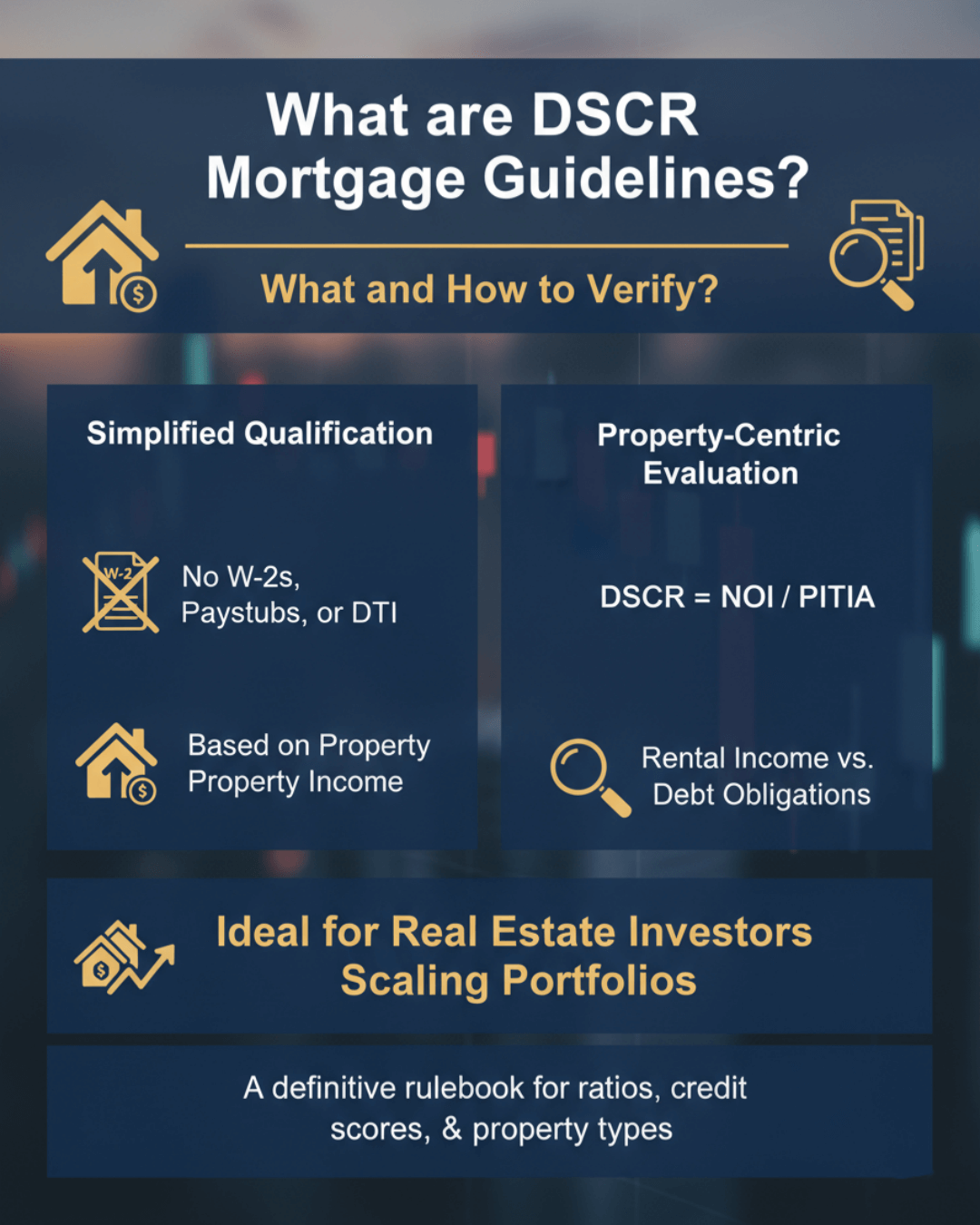
When we talk about DSCR mortgage guidelines, we are looking at a specific subset of Non-QM underwriting rules. Generally, a Debt Service Coverage Ratio loan does not rely on a borrower's personal income for qualification. In most programs, there are no W‑2s, no paystubs, and no DTI ratios to calculate.

Instead, these guidelines dictate how a lender evaluates the property itself. The primary focus is whether the property's rental income can comfortably cover the monthly debt obligations. Lenders calculate this by dividing the Net Operating Income (NOI) by the annual Debt Service (PITIA).

The primary target audience for these products is real estate investors looking to scale their portfolios without the headache of traditional personal income verification. Think of these guidelines as the definitive rulebook detailing exactly what ratios, credit scores, and property types are acceptable to get your client's deal funded.

What are DSCR Mortgage Guidelines?

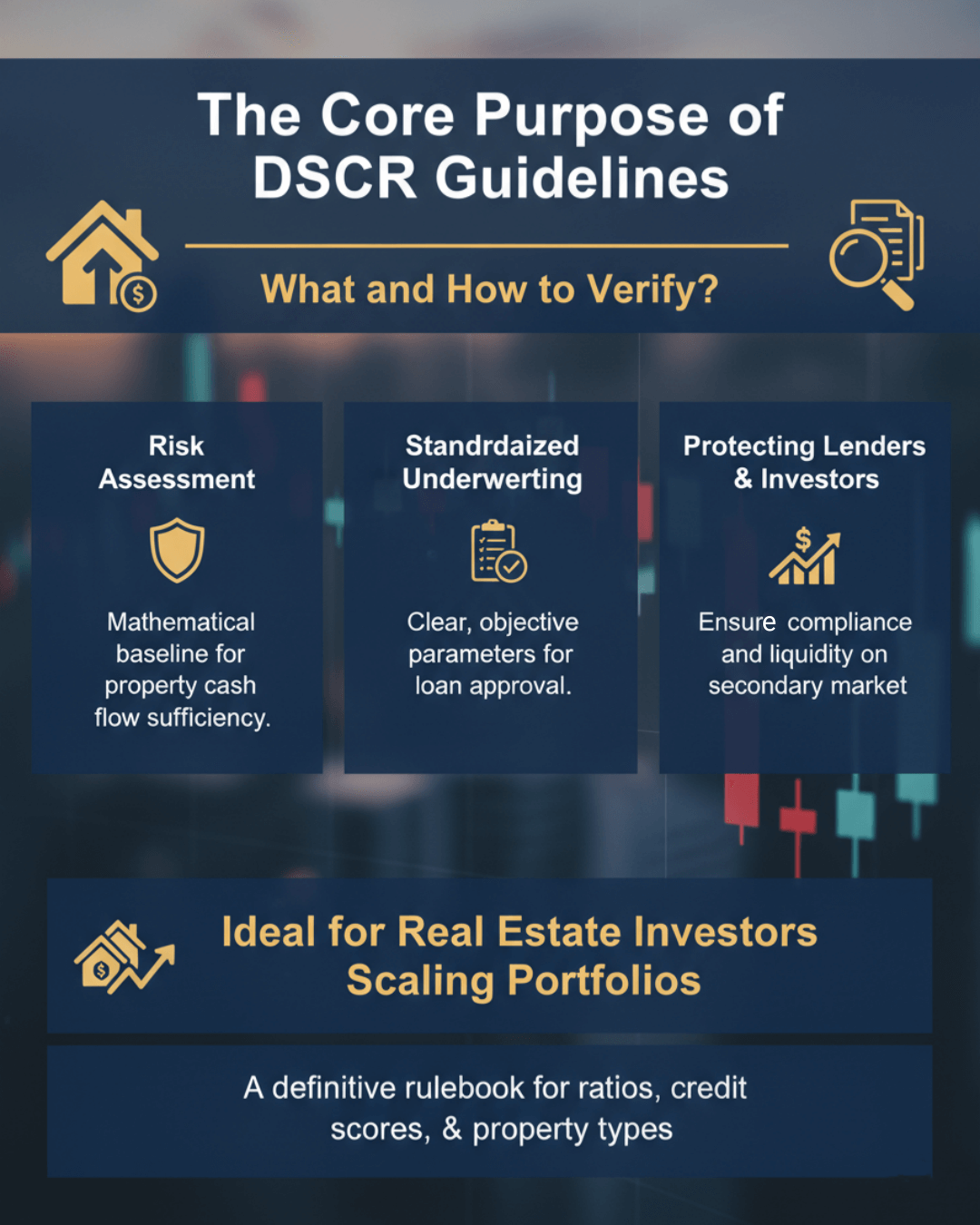
The Core Purpose of DSCR Guidelines

You might wonder why these matrices are so dense. As someone who has structured hundreds of these loans, I can tell you that DSCR guidelines serve a few crucial functions:

  • Risk Assessment: They provide a mathematical baseline to help lenders determine if a property's cash flow is truly sufficient to cover the monthly mortgage payment.
  • Standardized Underwriting: They give underwriters clear, objective parameters to approve or deny a file, which takes the guesswork out of Non-QM loans.
  • Protecting Lenders & Investors: Because these loans are heavily securitized, strict guidelines ensure the originated mortgages maintain compliance and liquidity on the secondary market.

Without these rulebooks, accurately pricing risk in the Non-QM space would be impossible.
The Core Purpose of DSCR Guidelines

DSCR Loan Requirements in 2026

If you are structuring deals right now, you need to know the baseline numbers. Based on current 2026 market data, here is what most DSCR lenders are looking for:

  • DSCR Ratio: The sweet spot is typically a 1.20 to 1.25 ratio or higher for stronger pricing. A 1.0 ratio (where rent exactly equals the mortgage payment) is a common floor, and while some lenders allow a 0.75 ratio or even "No Ratio" products, those usually come with significant pricing hits.
  • Down Payment/LTV: For purchases, a maximum 80% LTV (20% down) is typical in 2026, with some programs requiring 25% down for better pricing. For cash‑out refinances, lenders commonly cap leverage at 70% to 75% LTV.
  • Credit Score (FICO): Minimum qualifying scores typically fall in the 620 to 640 range, depending on the lender. To get your client a more competitive rate, you generally want at least a 680+, with the best terms often reserved for 740+ borrowers
  • Reserves: Plan on showing 3 to 6 months of PITIA reserves. If the DSCR falls below 1.0 or it's a short-term rental, underwriters will often demand 6 to 12 months of liquid reserves.

However, this is just the industry average. Specific DSCR loan requirements across major lenders, like AAA Lending or AD Mortgage, vary wildly and update constantly. This is exactly why checking guidelines quickly is vital to your success.

Tip: How to Quickly Check DSCR Mortgage Eligibility?

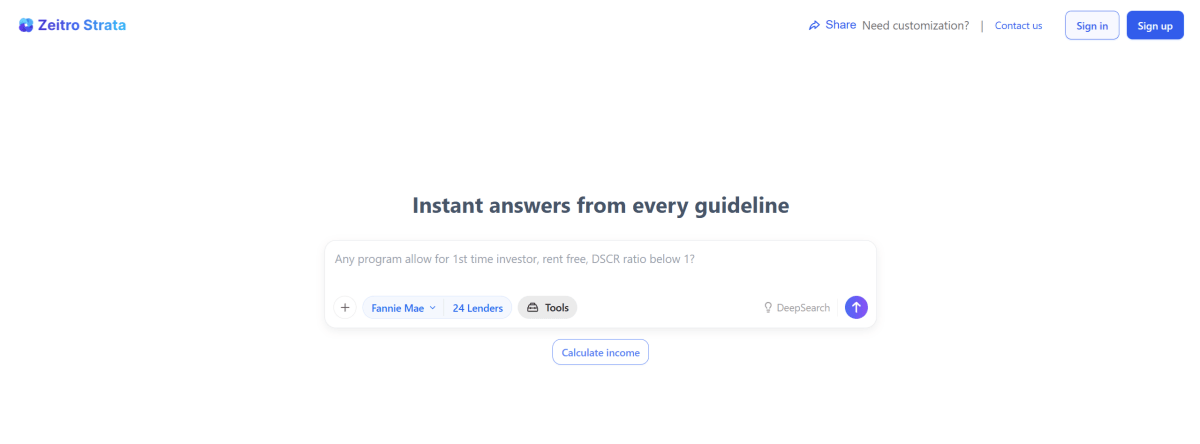
Let's be honest: memorizing the nuances of 20 different lending matrices is impossible. Whenever I have a tricky Non-QM scenario, my go-to move is using Zeitro's Scenario AI. It's an AI-powered mortgage guideline assistant specifically built for our industry, and it absolutely shines when handling Non-QM products.

The platform covers 15 major wholesale lenders (including AmWest, Forward Lending, and HomeXpress) and houses over 300 up-to-date guidelines, including 42 specific DSCR matrices that are continuously refreshed. Instead of CTRL+Fing through massive PDFs, here is how Scenario AI transforms your workflow:

  • Instant & Accurate Answers: Ask anything from a vague "what is" question to a highly specific prequalify scenario, and it extracts the exact answer in seconds.
  • Verifiable Citations: It doesn't just guess. It provides direct citations back to the source text, ensuring 100% accuracy and reducing underwriting errors.
  • Custom DeepSearch: Select a single lender or check multiple lenders simultaneously to compare eligibility on the fly.
  • "Explain" Feature: If a specific reserve requirement is confusing, use the explain tool to run a secondary query for instant clarification based on your selected parameters.
  • Multi-language & LOS Integration: It supports both English and Chinese input, and integrates seamlessly with your LOS for a frictionless process.
  • High ROI & Cost-Effective: Starting at just $8 a month and offering 3 free queries daily, it saves LOs and processors hours of reading time, significantly speeding up closings.

FAQs About DSCR Mortgage Guidelines

Q1. Do all DSCR loans require 20% down?

Not all DSCR loans require exactly 20% down, but 20% to 25% is the typical range for most lenders in 2026. Some niche programs may allow as little as 15% down for borrowers with top‑tier credit (often 740+ FICO) and strong DSCR, but these usually come with noticeably higher rates and tighter terms.

Q2. What is the DSCR 1% rule?

In some investor conversations, people use a shorthand where a "1.0 DSCR" means the property's gross monthly rental income covers 100% of the monthly housing expense. For example, if the rent is 2,000 dollars, the PITIA should not exceed 2,000 dollars.

Q3. What is the downside to a DSCR loan?

While convenient, DSCR loans have a few trade-offs. First, the interest rates are typically 1% to 2% higher than conventional loans. Second, they require larger down payments. Finally, most DSCR loans carry prepayment penalties if you refinance or sell within the first few years, and programs that waive or shorten prepay periods usually charge higher rates or fees.

Q4. Do I have to have an LLC for a DSCR loan?

It isn't strictly required by all lenders, but I highly recommend it. Lenders actually prefer to close these loans in the name of a business entity, like an LLC or Corporation, because it offers better personal asset protection for the real estate investor.

Q5. Do DSCR loans have closing costs?

Yes, they absolutely do. Just like conventional mortgages, you will see standard third-party fees for appraisals and title work. Additionally, DSCR loans often include lender origination points. Expect total closing costs to run anywhere from 2% to 5% of the total loan amount.

Final Word

DSCR loans remain one of the most powerful tools in 2026 for real estate investors looking to scale their portfolios quickly. However, successfully funding these deals means you have to master the intricate and constantly changing guidelines of multiple lenders. Don't let manual document searches slow down your pipeline.

I highly encourage my fellow loan officers and brokers to leverage technology to close loans faster. Stop wasting time flipping through PDFs and register for Zeitro's Scenario AI. With 3 free queries every single day, you can experience firsthand what it's like to get precise, citation-backed answers in a matter of seconds. Embrace AI, increase your client satisfaction, and watch your ROI grow.

People Also Read

Keep reading

Check ITIN Mortgage Guidelines: How to Verify Eligibility in Seconds?

Blog

5 min read
Arrow icon on dark background
Check ITIN Mortgage Guidelines: How to Verify Eligibility in Seconds?
Every lender's ITIN mortgage guidelines differ. Quickly check eligibility, compare Non-QM lenders, and close deals faster in seconds.

In the Non-QM space, ITIN loans present a fantastic opportunity, but let's be honest, they can be a massive headache to process. Unlike the limited ITIN options under Fannie Mae or Freddie Mac, which follow their standardized guidelines, Non-QM ITIN loans from most lenders have no universal rulebook.

Every lender has its own quirks, making manual guideline checks painfully slow and prone to errors. I used to spend hours digging through massive PDFs just to pre-qualify a single client.

That's why I want to introduce you to Zeitro's Scenario AI. This chat-based assistant lets you verify complex mortgage guidelines across multiple lenders in literal seconds, completely transforming how we work and boosting efficiency.

What are ITIN Mortgage Guidelines?

So, what exactly are we dealing with here? ITIN mortgage guidelines are specific lending criteria designed for non-U.S. citizens or individuals who don't have a Social Security Number (SSN) but do file taxes using an ITIN. This demographic typically includes new immigrants, foreign nationals, and expatriates striving for homeownership.

Most ITIN loans are Non-Qualified Mortgages (Non-QM) not backed by federal agencies like the FHA or purchased by government-sponsored enterprises like Fannie Mae or Freddie Mac. This brings us to the biggest challenge: each lender's ITIN guidelines are entirely unique. One institution might accept 12 months of bank statements for income verification, while another strictly demands two full years of tax returns. Some are perfectly fine with alternative credit histories, whereas others require a hard FICO score. This lack of standardization means you can't just memorize a single set of rules. You have to verify the exact criteria for every single deal.

What are ITIN Mortgage Guidelines?

Why Do You Need to Verify Mortgage Guidelines?

Since every institution makes up its own risk matrices, skipping a thorough guideline check is a recipe for disaster. I've seen too many deals fall apart at the last minute because a minor detail was overlooked. Here is why meticulous verification is non-negotiable:

  • Prevent Denials: Catching a lender-specific nuance early stops a loan from being rejected in underwriting.
  • Save Valuable Time: You need to stop blindly scrolling through hundreds of pages of PDF manuals just to answer a simple eligibility question.
  • Protect Your Commission: A smooth, fast close means you get paid faster, maintaining a high ROI for your business.
  • Ensure Accuracy: Manual searches often lead to human error. Double-checking ensures your borrower is actually matched with the right program from day one.

Who Needs to Check ITIN Mortgage Guidelines?

You might think checking guidelines is strictly an underwriter's job, but in reality, anyone touching a Non-QM file needs quick access to accurate information.

  • Loan Officers & Brokers: You need fast answers to accurately pre-qualify clients and match them with the right wholesale lender without keeping them waiting.
  • Account Executives: When brokers call you with weird scenario questions, you must provide instant, correct answers to win their business.
  • Loan Processors: You must verify that every piece of alternative documentation perfectly aligns with the target lender's stipulations before submitting the file.
  • Underwriters: You are the final gatekeeper. Having a quick way to cross-reference rules ensures compliance and a confident final sign-off.

ITIN Mortgage Requirements in 2026

As we navigate the 2026 housing market, ITIN loans are becoming more accessible, but the criteria remain stringent. Generally, you can expect higher down payments, typically ranging from 10% to 20%, and sometimes up to 25% depending on the borrower's risk profile. Since many applicants lack a standard FICO score, lenders often rely on alternative credit, like 12 months of canceled rent checks or utility bills. For income verification, 12 to 24 months of personal or business bank statements are frequently used instead of traditional W-2s.

However, I must emphasize a crucial point: these are just general baselines. A maximum DTI or required reserve amount today might change tomorrow, and it is entirely lender-specific. One bank might cap LTV at 80%, while a portfolio lender pushes it to 85%. This constant shifting is exactly why relying on memory or outdated cheat sheets is dangerous. You need a real-time, dynamic tool to navigate these moving targets.

ITIN Mortgage Requirements in 2026

Zeitro Scenario AI: The Smart Way to Verify ITIN Mortgage Guidelines

Instead of wrestling with outdated PDFs, I highly recommend using Zeitro Scenario AI. It is an AI-powered mortgage guideline assistant built specifically to handle the complexities of Non-QM loans like ITIN, DSCR, and Bank Statement programs. The platform currently covers nearly 300 guidelines from major U.S. lenders, including AD Mortgage, AmWest, and AAA Lending, and the database is constantly expanding.

What makes it a game-changer for mortgage professionals? Let me break down the top features:

  • Lightning-Fast & Accurate: You can ask anything from broad questions like "What is an ITIN loan?" to hyper-specific eligibility scenarios. It searches through massive guideline databases in seconds, giving you precise answers so you can pre-qualify clients on the spot.
  • Verifiable Citations: As loan officers, we naturally distrust AI hallucinations. Zeitro solves this by providing direct citations. Every answer links back to the original source document, giving you 100% confidence that the information is factual and actionable.
  • Explain Function: If a specific rule seems confusing, you don't have to start over. You can use the Explain feature to run a secondary query, diving deeper into the selected context for instant clarification.
  • Cost-Effective & Multilingual: At just $8 a month, it's incredibly affordable. Plus, it supports multiple languages, including Chinese and English, which is perfect for serving diverse immigrant communities.
  • LOS Integration & High ROI: By integrating directly with your Loan Origination System (LOS), it cuts out tedious manual labor, minimizes human error, and speeds up the entire loan lifecycle. Faster approvals mean happier clients and a better bottom line.
Zeitro Scenario AI: The Smart Way to Verify ITIN Mortgage Guidelines

FAQs About ITIN Mortgage Guidelines

Q1: Can a borrower get an ITIN loan without a traditional credit score?

Yes, many lenders accept alternative credit history, such as proof of consistent rent or utility payments. However, the exact acceptable documentation varies by institution, so you must verify the specific guidelines.

Q2: Are ITIN loan requirements the same across every lender?

Absolutely not. Because ITIN loans fall under the Non-QM umbrella, every lender creates their own risk matrices. Down payment, LTV limits, and DTI ratios will differ wildly from one bank to another.

Q3: Does Zeitro Scenario AI only handle ITIN loans?

No, it is a comprehensive tool. It covers over 300 different guidelines, including DSCR, Bank Statement, WVOE, Conventional, FHA, and more.

Q4: How reliable is an AI tool for checking complex mortgage rules?

Zeitro is exceptionally reliable because it doesn't just guess. It provides exact citations and source links to the original lender PDFs, ensuring you always have verifiable proof for your loan structuring.

Conclusion

In the 2026 mortgage market, speed and accuracy are what win deals. While Non-QM products like ITIN loans offer a massive opportunity to tap into underserved markets, the sheer volume of conflicting, ever-changing guidelines can slow you down. You simply cannot afford to lose hours cross-referencing PDFs or risking a denial due to an outdated requirement.

It is time to ditch the manual searches and let technology do the heavy lifting. I highly encourage you to give Zeitro Scenario AI a try. It will dramatically boost your underwriting efficiency and give you the confidence to structure complex deals flawlessly. Since they offer 3 free queries every day, there's no risk in testing it out. Head over to Zeitro's website today and see how fast you can verify your next loan scenario!

People Also Read

Blog

5 min read
Arrow icon on dark background
Don't Miss: Quickly Verify Second Home Mortgage Guidelines
Stop wasting hours on PDFs. Learn the latest second home mortgage guidelines and discover how a loan officer can instantly verify lender requirements.

If you've spent any time working as a loan officer or underwriter, you know the drill. A borrower wants to finance a vacation property, and suddenly, you're buried in PDF matrices trying to figure out if their scenario fits the latest second home mortgage guidelines. Sifting through varying lender requirements for LTVs, reserves, and distance rules is a massive time-sink.

I used to lose hours cross-referencing these details across different portals. Now, I rely on Zeitro's Scenario AI. This chat-based assistant instantly verifies guidelines across multiple lenders, giving you accurate, source-backed answers in seconds. Let's break down the core requirements and see how this tool changes the game for our pipelines.

What Are the Second Home Mortgage Guidelines?

Second home mortgage guidelines are the specific underwriting rules lenders use to qualify a borrower purchasing a property they intend to occupy for a portion of the year. As mortgage professionals, we know that pricing and risk profiles for these loans sit squarely between primary homes and investment properties.

The core difference comes down to intent and occupancy. A primary residence is where the borrower lives the majority of the year, while an investment property is purchased strictly for rental income. A second home, often a vacation house, must be occupied by the borrower for some part of the year. Crucially, you cannot use projected rental income to qualify the borrower. Furthermore, the property must be suitable for year-round occupancy per Fannie Mae guidelines. Understanding these boundaries is critical before moving a file to processing.

What Are the Second Home Mortgage Guidelines?

Key Requirements for Second Home Mortgage Guidelines

Qualifying a borrower for a vacation property isn't as straightforward as a primary residence purchase. While Conventional (QM) standards like Fannie Mae provide a baseline, Non-QM lenders have their own overlays. Here are the core metrics you must verify:

  • Down Payment (LTV limits): Expect a minimum 10% down payment for conventional loans. However, to secure better pricing or when utilizing Non-QM products (like Bank Statement loans), 15% to 20% is frequently required.
  • Credit Score: The absolute floor is generally 620 for agency loans, but realistically, many lenders look for a 680+ FICO to offer competitive pricing on secondary properties.
  • Debt-to-Income (DTI) Ratio: Most underwriters will cap the DTI at 45%, factoring in the PITI of both the primary residence and the new second home.
  • Reserves: This is where many deals fall apart. Lenders typically demand 2 to 6 months of PITI reserves.

Keep in mind, these requirements fluctuate drastically depending on the specific lender.

Considerations for Second Home Mortgages

Beyond the basic financial metrics, underwriters look closely at the "story" of the loan. If the scenario doesn't make logical sense, the file will get kicked back. Here are the critical underwriting hurdles to watch out for:

  • The Distance Rule: Lenders often apply overlays requiring a minimum distance of 50 to 100 miles from the primary residence, though this is flexible for properties in resort or waterfront areas and focuses on logical personal use rather than a strict agency rule.
  • No Rental Income for Qualifying: Unlike DSCR or investment loans, you cannot use potential short-term rental (Airbnb/VRBO) income to offset the DTI. The borrower must qualify carrying both housing expenses entirely on their standard income.
  • Tax Implications: Borrowers often ask about tax deductions. While we aren't CPAs, it's worth noting that using the home for more than 14 days (or 10% of the days it's rented) affects its IRS classification.
Considerations for Second Home Mortgages

Why You Should Check Second Home Mortgage Guidelines First?

Nothing kills your referral relationships faster than issuing a pre-approval, only to have the underwriter deny the file two weeks later because of a hidden reserve overlay or a distance rule violation. I always verify the exact second home mortgage guidelines before taking the application fee.

By checking the specific lender matrices upfront, you prevent late-stage denials, save your processor a massive headache, and deliver a smooth experience for your borrower. However, doing this manually is practically impossible today. With dozens of wholesale lenders constantly updating their policies, searching through clunky PDFs is soul-crushing. You need a smarter way to instantly query these rules.

How to Quickly Check Second Home Mortgage Guidelines?

This is exactly why I integrated Zeitro's Scenario AI into my daily workflow. It is an AI-powered mortgage guideline assistant designed specifically for loan officers, account executives, and underwriters. Currently covering nearly 300 guidelines from over top-tier lenders, it's built to handle both QM and the notoriously complex Non-QM landscape, including 8 dedicated second home matrices.

Instead of hitting Ctrl+F in a 200-page document, you simply ask the AI.

Here is why it has become an indispensable tool:

  • High Accuracy with Citations: Scenario AI doesn't just guess. It pulls exact data and provides direct citations, allowing you to trace the answer back to the source document. No AI hallucinations, just hard facts.
  • Unmatched Speed & Flexibility: Whether you have a vague eligibility question or a highly specific prequalify scenario, it instantly searches the vast guideline database and delivers precise answers in seconds.
  • Advanced "Explain" Function: If a specific reserve requirement seems confusing, the "Explain" feature allows you to run a secondary deep-dive query on that specific scope for immediate clarification.
  • Boost Efficiency & ROI: By integrating seamlessly with your LOS, it drastically reduces manual labor, speeds up your loan cycle, and ultimately boosts your bottom line.
  • Cost-Effective: You can test it out with 3 free queries every single day, and the premium plans start at an incredibly low $8/month.
How to Quickly Check Mortgage Guidelines?

FAQs About Second Home Mortgage Guidelines

Can I use rental income to qualify for a second home mortgage?

Typically, no. This is the primary distinction between a second home and an investment property. The borrower must qualify for the loan using their own standard income streams, without relying on projected short-term or long-term rental income.

What is the distance requirement for a second home?

Historically, lenders looked for a 50 to 100-mile distance from the primary residence. Today, it's more about "logical sense." If it's a waterfront property or in a resort town, the distance rule can sometimes be waived, but it remains a key underwriting focus.

Are Non-QM loans available for second homes?

Absolutely. Many borrowers use Non-QM products like Bank Statement loans or Asset Utilization to finance vacation homes. Tools like Scenario AI can instantly show you which wholesale lenders offer the best terms for secondary properties.

How accurate is AI when checking mortgage guidelines?

Extremely accurate, provided you use an industry-specific tool. Scenario AI, for instance, provides direct citations and source links for every answer, ensuring your pre-approvals are based on verifiable, up-to-date lender data.

Can I try Scenario AI for free?

Yes. Zeitro offers 3 free queries per day, allowing loan officers and processors to test its accuracy on real loan scenarios before committing to the entry-level $8/month subscription.

Final Word

Structuring a second home mortgage requires absolute precision. Between the strict LTVs, reserve mandates, and occupancy logic, there is zero room for guesswork. A single missed overlay can derail a closing, costing you both commission and client trust.

As mortgage professionals, our time is best spent building relationships and originating loans, not acting as librarians for hundreds of ever-changing lender PDFs. Stop wasting hours doing manual research. I highly recommend heading over to Zeitro to register for your free account. Take advantage of your 3 free daily queries with Scenario AI today, and experience firsthand how fast and reliable guideline verification can actually be. Your pipeline will thank you.

People Also Read

Mortgage Guidelines 2026: What Are They? How to Verify?

Blog

5 min read
Arrow icon on dark background
Mortgage Guidelines 2026: What Are They? How to Verify?
What are mortgage guidelines? Stop reading long lender PDFs. Learn the key types and discover how to verify lender rules in seconds.

If you've been in the mortgage industry as long as I have, over 15 years now, you know that keeping up with lending rules is a full-time job. In 2026, the mortgage market is shifting faster than ever. Between the new conforming loan limit hitting $832,750 and the explosive growth of Non-QM products, manually digging through hundreds of PDF matrices is a surefire way to kill a deal.

Today, top-producing Loan Officers are ditching the old way. Instead, they are turning to tools like Zeitro's Scenario AI. By simply using a chat interface, you can instantly verify guidelines across different lenders, saving hours of research and rescuing dying deals.

What are Mortgage Guidelines?

Think of mortgage guidelines as the absolute "rulebook" or the DNA of a loan approval. In simple terms, these are the strict criteria established by government-sponsored enterprises (like Fannie Mae and Freddie Mac), government agencies (such as the FHA), and private investors in the secondary market.

These rules dictate the minimum standards a borrower must meet for a loan to be approved and ultimately funded. They cover everything from acceptable credit profiles and income verification methods to property types and reserve requirements.

When I train new Loan Processors, I always tell them: Guidelines aren't suggestions. They are boundaries. If a file doesn't fit the box perfectly, you need a documented exception, or the deal simply won't close. As the market evolves into 2026, understanding this foundational rulebook is the only way to determine whether you can actually get your client to the closing table.

What are Mortgage Guidelines?

Types of Mortgage Guidelines (QM vs. Non-QM & More)

The mortgage landscape isn't one-size-fits-all. Because we serve vastly different borrower profiles, the guidelines are broken down into specific categories. Generally, they are split between Qualified Mortgage (QM) and Non-Qualified Mortgage (Non-QM) loans. With Non-QM expected to capture a massive share of originations in 2026, it is vital to understand these diverse niches.

Here are the most common types of guidelines you'll encounter today:

  • Conventional: The gold standard backed by Fannie Mae and Freddie Mac. Great for W-2 borrowers with strong credit.
  • FHA (Federal Housing Administration): Perfect for first-time buyers or those with lower credit scores, offering low down payments.
  • VA (Veterans Affairs): Designed for eligible military members, focusing heavily on residual income rather than strict debt ratios.
  • Jumbo: For loan amounts exceeding the 2026 baseline limit of $832,750. These carry strict investor-specific rules.
  • Bank Statement (Non-QM): A lifesaver for self-employed borrowers, qualifying them based on 12 to 24 months of business deposits rather than tax returns.
  • DSCR (Debt Service Coverage Ratio): Specifically for real estate investors. Qualification is based on the property's rental cash flow rather than personal income.
  • Asset Utilization (Non-QM): Allows high-net-worth individuals to use their liquid assets to calculate a monthly income equivalent.
  • Foreign National (Non-QM): Tailored for non-U.S. citizens buying property here, requiring alternative credit verification.
  • ITIN (Non-QM): Designed for tax-paying immigrants without a standard Social Security Number.
  • WVOE (Written Verification of Employment): A niche option relying solely on an employer's written verification rather than traditional pay stubs.

Why are Mortgage Guidelines Important?

You might wonder why lenders are so obsessed with these rules. From a Loan Officer or Broker's perspective, strict adherence to guidelines is about protecting your pipeline and your paycheck. Here is why they matter:

  • Risk Mitigation: Guidelines ensure that the borrower actually has the ability to repay the loan, drastically lowering the risk of default.
  • Compliance & Legal Protection: Following the rules keeps originators compliant with federal regulations, avoiding hefty fines.
  • Marketability: Most lenders don't hold loans. They sell them. If a loan doesn't meet the investor's guidelines, it cannot be legally sold in the secondary market.
  • Preventing Buybacks: This is every lender's worst nightmare. If you close a loan that violates a guideline, the investor can force your company to buy the unsalable loan back.
Why are Mortgage Guidelines Important?

Key Mortgage Qualification Guidelines

No matter which loan type you are structuring, Underwriters will always scrutinize a few core qualification metrics. I like to call these the "Big Five."

  • Credit Score (FICO): The ultimate indicator of creditworthiness. While FHA might accept a 580, a Jumbo investor might demand a 700+.
  • LTV (Loan-to-Value Ratio): This measures how much equity is in the deal. Higher LTVs equal higher risk.
  • DTI (Debt-to-Income Ratio): Your borrower's monthly debt compared to their gross income. Conventional loans usually cap around 45-50%, while Non-QM loans might offer more flexibility.
  • Reserves: The liquid cash a borrower has left after closing. Essential for investment properties and Jumbo loans to cover months of mortgage payments if things go south.
  • Employment & Income History: Standard rules require a two-year history, but how it's calculated varies wildly between W-2 and self-employed files.

The tricky part? These baseline metrics look completely different depending on the specific lender and loan program.

How to Quickly Check & Verify Mortgage Guidelines in 2026?

Back in the day, when I had a tricky file, I would spend hours hitting "Control-F" on massive PDF matrices or waiting a full day for an Account Executive (AE) to reply to my email. With nearly 100 lenders updating their policies daily, that traditional method is completely dead in 2026.

To stay competitive, I now rely on Zeitro's Scenario AI, what I consider the ultimate AI-powered mortgage guideline assistant. It is built specifically for our industry and is an absolute game-changer, especially when navigating complex Non-QM scenarios.

Here is why top-producing originators are making the switch:

  • Comprehensive & Constantly Updated Coverage: It covers over 300 unique guidelines across major wholesale lenders, including powerhouses like AD Mortgage, Freedom Mortgage, and CMG Financial. Whether it's QM or Non-QM, the database is always current.
  • Instant Answers with Citations: You can ask vague questions like "What is DSCR?" or highly specific ones like "Eligibility for ITIN with 10% down." Within seconds, it delivers precise answers. Better yet, it provides direct citations linking back to the source document, giving you 100% confidence to quote your borrower.
  • Customizable DeepSearch & 'Explain' Feature: You can narrow your search to specific lenders. If you don't fully understand an underwriting caveat, you can use the "Explain" function to have the AI break down the jargon into plain English based on your selected parameters.
  • Cost-Effective Efficiency Booster: It drastically reduces the manual labor for Loan Officers and Processors. By accelerating the loan structuring process and minimizing human error, it directly boosts your ROI.
  • Unmatched Market Value: It integrates smoothly with LOS (Loan Origination Systems), supports multiple languages (you can type in English or Chinese), and operates at lightning speed. And the cost? It starts at a ridiculously low $8 per month.
Quickly Check & Verify Mortgage Guidelines

FAQs About Mortgage Guidelines

Q1: How often do mortgage guidelines change?

Guidelines change frequently, often driven by macroeconomic factors, interest rate fluctuations, and investor risk appetite. Fannie Mae and Freddie Mac release updates regularly, while private Non-QM investors might tweak their matrices weekly. Using an automated tool is essential to track these silent updates.

Q2: What is an underwriting exception?

An exception occurs when a borrower falls slightly short of a specific guideline (like being 1% over the DTI limit) but has strong "compensating factors," such as massive cash reserves. Understanding the underlying rules helps you successfully argue for an exception with your Underwriter.

Q3: Can AI accurately verify non-QM guidelines?

Yes. While early generic AI suffered from "hallucinations," purpose-built tools like Scenario AI pull directly from the lenders' primary source documents. Because they provide exact citations to the original matrices, the accuracy is exceptionally high, making them safe for real-world loan structuring.

Conclusion

In the highly competitive 2026 mortgage market, speed and accuracy are everything. The originators who can instantly digest and apply complex guidelines are the ones closing the most deals and earning the trust of their referral partners. You simply cannot afford to lose a borrower to a competitor just because you were stuck reading a 100-page PDF or waiting for an AE to call you back.

It's time to modernize your workflow. I highly recommend trying out Zeitro's Scenario AI today. You can experience the platform absolutely risk-free since they offer 3 free queries every single day. Test it on your hardest Non-QM file and watch it instantly pull the exact answer with a citation. Do yourself, and your processing team, a favor: share the link or send them an email about this tool. Embrace the AI advantage, protect your margins, and let's close more loans this year.

People Also Read

Try Zeitro today and transform your loan origination workflow!

Get started free