Written by

Eric
Share this article

.svg)
Subscribe to updates
Last checked and updated on August, 2026
If you're a mortgage professional like me, you know the headache of qualifying a high-net-worth client who doesn't have a standard W-2. Asset utilization mortgages are the fix — they let us turn liquid wealth into qualifying income instead of chasing pay stubs that don't exist.
The catch is that every lender writes its own asset utilization mortgage guidelines. Divisors, eligible asset types, LTV caps — they all shift from one investor to the next, and digging through hundreds of pages of PDFs to confirm the details eats up an entire afternoon. That's exactly why I lean on Zeitro Strata AI (formerly known as Scenario AI) to pull up multiple lenders' rules in one chat window instead of ten browser tabs.
What Are Asset Utilization Mortgage Guidelines?
Asset utilization mortgage guidelines are the specific rules a lender uses to convert a borrower's liquid assets — savings, brokerage accounts, retirement funds — into a monthly qualifying income figure, in place of traditional paycheck income. You may also hear the same concept called asset depletion or an asset qualifier loan, depending on which lender or investor you're working with.
As loan officers and brokers, this product usually shows up for wealthy retirees, high-net-worth individuals, and self-employed entrepreneurs who write off most of their income on paper. Standard agency underwriting tends to reject these borrowers because their documented DTI looks too high, even though their balance sheet says otherwise. Asset utilization solves that by spreading the borrower's wealth over a set period to create a compliant income stream. It's a strong strategy for saving a deal — as long as you know exactly whose rulebook fits your borrower's portfolio.

Asset Utilization vs. Asset Depletion: Are They the Same Thing?
Short answer: in most conversations, yes. Fannie Mae and Freddie Mac officially call their version "asset depletion," while the Non-QM market tends to use "asset utilization" or "asset dissipation" for essentially the same math — turning a pile of assets into a monthly income number.
Where it gets confusing is that individual lenders sometimes attach different rules to each label. I've seen investors treat "asset depletion" as the conservative, longer-divisor version (say, 84 or 120 months) and reserve "asset utilization" for a richer program that requires a larger post-closing asset cushion, sometimes 125% of the loan amount with a $1 million floor. Neither naming convention is universal, so don't assume — always confirm which calculation a specific lender means before you quote a borrower.
Why Do You Need to Check Asset Utilization Mortgage Guidelines?
You might think once you grasp the basic concept, you can apply it everywhere. I learned the hard way that this simply isn't true. Checking asset utilization mortgage guidelines is critical because non-QM lenders write their own distinct rules. Placing a file with the wrong investor means a delayed closing or a flat-out denial.
Here is why you must verify the details upfront:
- Lender Variations: Formulas vary wildly. Some lenders divide total assets by 60 months, while others stretch it to 84 or 120.
- Eligible Assets: What counts as liquidity? One lender might accept 100% of stocks, while others typically discount to 70-80% (common for mutual funds/stocks).
- LTV Caps: Maximum Loan-to-Value limits differ across the board for these non-QM products.
Relying on memory is too risky. We need precise, up-to-date verification.
Asset Utilization Loan Requirements 2026
Asset Utilization Loan Requirements in 2026
The Non-QM market is still healthy heading into the second half of 2026, but investors have gotten stricter about documentation. Here's what to expect on a typical file:
- Minimum qualifying assets: Most programs want $150,000 to $1,000,000 in eligible assets (or roughly 1.5x the loan amount), on top of post-closing reserves — commonly 6 to 12 months of PITIA (principal, interest, taxes, insurance, and association dues, if applicable).
- Credit score: Expect a floor somewhere between 660 and 680 for most Non-QM asset utilization programs, though a handful of investors will go as low as 620 with compensating factors. This varies enough between lenders that it's worth confirming before you set expectations with a client.
- Acceptable asset types: Checking, savings, and money market balances generally qualify at 100%. Fully vested stocks and bonds are standard too, usually with a modest discount.
- Calculation method: After subtracting the down payment and closing costs, the net eligible assets get divided by an amortization term — frequently 60 months for Non-QM programs — to produce the monthly qualifying income.
- Asset seasoning: Funds generally need to sit in the account for about 60 days before they're considered "seasoned" and usable in the calculation. A large deposit that just landed last week usually won't count until it's documented.
- Age-based discounts on retirement funds: For 401(k)s and IRAs, many lenders allow full face value once the borrower is past 59½. Below that age, expect a heavier discount — commonly around 50% — to account for early withdrawal penalties.
One thing worth flagging clearly: that 59½ threshold is a completely separate rule from the "age 62" standard you'll see attached to Fannie Mae's program. The 59½ rule decides how much of a retirement account counts toward your asset pool. Age 62 decides your maximum LTV under Fannie Mae's guidelines. I've watched loan officers mix the two up and misquote a borrower's leverage — worth double-checking every time.

Fannie Mae vs. Freddie Mac: How Agency Asset Depletion Actually Compares
Because "asset depletion" and "asset utilization" get used loosely, it helps to see how the two government-sponsored enterprises structure their own agency versions side by side.
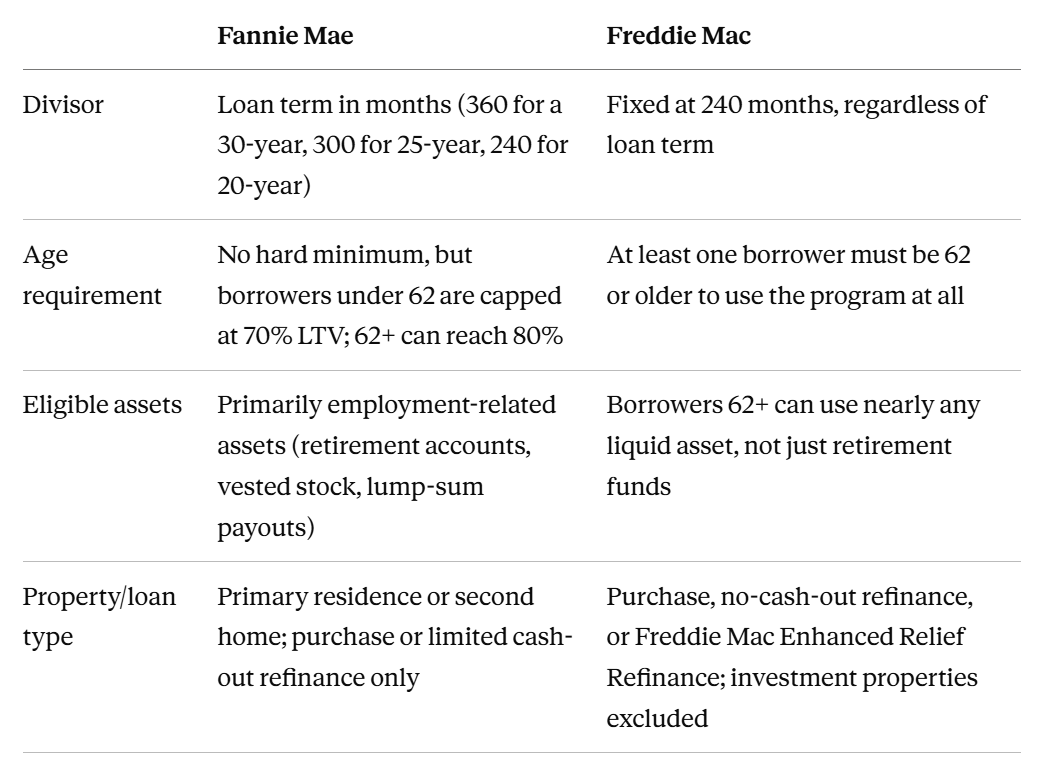
The practical takeaway: because Freddie Mac's divisor is fixed and shorter, it often produces a higher monthly income figure than Fannie Mae's on the same asset pool — but only for borrowers who clear the 62-and-older bar. Below that age, agency asset depletion basically isn't an option at all, which is exactly the gap Non-QM asset utilization programs exist to fill.
How Does Asset Verification Work for a Mortgage?
Guidelines tell you the rules, but verification is how an underwriter actually confirms the numbers are real. In practice, the process looks like this:
- Gather statements. Underwriters typically want the two most recent, consecutive statements for every account you're using — bank, brokerage, or retirement. An asset statement is simply the official document your institution issues each month or quarter, showing the account holder's name, account number, statement period, and ending balance. Submit every page, including blank ones; a missing page is one of the fastest ways to trigger a stipulation.
- Explain large deposits. Any single deposit that exceeds roughly 10% of your total eligible assets usually needs its own paper trail — a bill of sale, a gift letter, or a transfer confirmation — to prove it wasn't borrowed or gifted in a way that disqualifies it.
- Confirm seasoning. As mentioned above, funds generally need to have sat in the account for about 60 days before they count toward the depletion calculation.
- Verify ownership. If an account is jointly held, the lender needs to confirm how ownership is split, since that affects how much of the balance actually counts for your borrower.
- Issue a Verification of Deposit (VOD) or use a third-party service. Many lenders now accept automated account verification tools instead of a manual VOD form, which speeds up the file significantly.
Zeitro Strata AI: Verify Asset Utilization Mortgage Guidelines in Seconds
Manually cross-referencing all of the above used to eat hours out of my week. These days I run it through Zeitro Strata AI, the AI-powered mortgage guideline assistant Zeitro built specifically for the QM and Non-QM space. The rebrand from Scenario AI happened back in March 2026, so you might still see the old name floating around — same tool, same team, just a new name that better reflects how much the platform has grown.
The database now spans more than 1,000 continuously updated guidelines from over 100 investors, including names like AAA Lending, AD Mortgage, AmWest, and First Colony Mortgage, with dedicated coverage for asset utilization alongside DSCR, bank statement, and conventional programs. Instead of searching Google or scrolling a PDF, it pulls answers straight from the lenders' actual matrices, with a citation attached so I can trace every number back to its source before I speak to an underwriter.
Here's a quick example of why the divisor matters so much: say a retired borrower has $1.5 million in eligible assets after subtracting closing costs. A Non-QM lender using a 60-month divisor gets you to $25,000 a month in qualifying income. Freddie Mac's fixed 240-month formula on the same balance produces about $6,250 a month. Fannie Mae's 360-month agency method comes in lowest, around $4,167 a month. Same borrower, same assets — three very different outcomes depending entirely on which lender's math you're using. That's the kind of detail I want confirmed in seconds, not guessed at.
A few other things that have made this part of my daily workflow:
- Fast and citation-backed: Instead of hitting Ctrl+F through a massive PDF, I get precise answers with a direct source link I can hand to underwriting.
- Broad, current coverage: The database updates continuously, spanning everything from DSCR loans and bank statement programs to conventional and asset utilization guidelines.
- Handles vague and specific questions equally well: A broad "what is" question or a hyper-specific eligibility scenario both come back with usable answers.
- Affordable for solo brokers and teams alike: The Explorer plan is free and includes 3 queries a day, which is plenty to test-drive a tricky scenario. Paid access starts at $8 a month per user, or $35 a month for a company plan covering up to 30 seats.
Common Pitfalls to Watch For
Even with a good tool in hand, structuring the file intelligently still falls on the loan officer. A few mistakes I've seen trip up otherwise solid applications:
- Double-dipping. You can't use the same pool of money for both qualifying income and funds to close. Always subtract the down payment and closing costs before running the depletion math.
- Underestimating liabilities. Margin loans or any borrowing against the asset accounts needs to come off the eligible balance before you calculate income.
- Overlooking early-withdrawal penalties. Skipping the haircut on retirement accounts for borrowers under 59½ will inflate your DTI on paper and cause problems later in underwriting.
- Assuming illiquid assets count. Private equity stakes, physical gold, and similar holdings almost never qualify. Stick to what can actually be turned into cash without a long delay.
FAQs About Asset Utilization Mortgage Guidelines
Can I combine asset utilization with other income sources?
Yes. Many Non-QM lenders let you stack asset-based income on top of W-2, bank statement, or DSCR income. Always confirm the specific lender's matrix first, since not every investor allows stacking the same way.
Are cryptocurrency holdings accepted for asset utilization?
Most traditional lenders still exclude crypto outright. A handful of niche Non-QM investors will consider it once it's liquidated into U.S. dollars and seasoned like any other deposit. I check Zeitro Strata AI to see which wholesale lenders currently permit it before I even bring it up with a client.
What credit score do I need for an asset utilization loan?I
t depends heavily on the lender, but a working range is 660-680 for most Non-QM programs, with a few going as low as 620 if other parts of the file are strong.
What's the difference between asset depletion and asset utilization?
They usually describe the same underlying math — converting assets into a monthly income figure — but individual lenders sometimes attach different divisors or asset thresholds to each label. Confirm which calculation a specific investor means rather than assuming.
How does asset verification differ from the guideline itself?
The guideline tells you the rules (which assets qualify, what divisor applies). Verification is the documentation step — recent statements, large-deposit letters, and seasoning proof — that confirms those assets are real and usable.
How accurate is Zeitro Strata AI when guidelines change?
The database updates continuously and every answer comes with a direct source citation, so you're always working from the current version of a lender's rules rather than a cached PDF from six months ago.
Conclusion
Asset utilization mortgage guidelines are one of the most effective ways to get a high-net-worth client approved without a traditional paycheck. But because every lender treats divisors, age thresholds, and eligible assets differently — and because Fannie Mae and Freddie Mac each run their own separate version of the math — guessing simply isn't an option. Manually checking each variable is a real drain on your day.
That's why I keep Zeitro Strata AI open while I'm structuring these files. It removes the guesswork, cuts down on messy underwriting conditions, and hands you a cited, accurate answer in seconds instead of half an hour. You don't have to take my word for it — the Explorer plan gives you 3 free queries a day to test it on your toughest scenario. Head over to Zeitro Strata AI to register and start tightening up your asset utilization files today.
People Also Read
- How to Get a DSCR Loan? Step-by-Step for Real Estate Investors
- DSCR Loan Requirements: Ratio, Credit Score, and More
- DSCR Mortgage Guidelines Explained: What and How to Verify?
- Foreign National Mortgage Guidelines: Verify Eligibility Fast
- Jumbo Mortgage Guidelines: Check Eligibility Quickly and Accurately
- Check ITIN Mortgage Guidelines: How to Verify Eligibility in Seconds?

![[Tips for Loan Officers] How Can I Lower Borrower DTI?](https://cdn.prod.website-files.com/6731bc6e813a541b54c30b10/6aa3b89e281a639e7a5c6fca_lower-debt-to-income-ratio-banner.jpg)