Written by

Eric
Share this article

.svg)
Subscribe to updates
Last Checked and Updated on September, 2026
I still remember my first few weeks as a junior mortgage underwriter. I had a stack of 1003 applications on one side of my desk, tax transcripts on the other, and a running fear that I'd miss something a senior underwriter would catch in two seconds. Guidelines don't sit still for long in this industry, and the pressure to get it right the first time never really lets up.
If that sounds familiar, you're not alone. The fastest way out of that panic is solid, structured training. I spent weeks digging through the programs underwriters actually talk about — not just the ones with the flashiest ads — so you can pick one that fits where you are right now and start clearing conditions with less second-guessing.
Key Takeaways
- Guidelines shift constantly: Working off last year's rules is how buybacks happen. Ongoing training keeps you compliant — and employed.
- Certifications open doors: NAMU and MBA Education both offer credentials hiring managers actually look for, and NAMU even has an entry-level tier if you're brand new to the desk.
- You don't have to pay upfront: Fannie Mae's own Learning Center is free and remains one of the strongest starting points for conventional-loan basics.
- Tools matter as much as courses: Once you've got the fundamentals down, something like Zeitro can shave real hours off your week by handling the guideline lookups and manual data entry for you.
Why Do You Need to Take Mortgage Underwriting Training?
It's tempting to think you'll pick this up purely on the job. Plenty of people try. The problem is that agency rules update on their own schedule, and relying on what you learned last year is a quiet way to invite compliance trouble. A structured course closes that gap fast:
- Real compliance understanding: You start seeing the reasoning behind federal rules instead of just memorizing a checklist, which makes every file review sturdier.
- Sharper risk instincts: Catching a red flag on a self-employed borrower's tax return stops being a guessing game and starts being second nature.
- Better pay, more leverage: Underwriters holding a recognized credential simply negotiate from a stronger position when it's time to move up.
- Fewer 2 a.m. worries: Knowing the guidelines cold means clearing conditions faster — and actually sleeping once you're done for the day.
Top Mortgage Underwriter Training Programs
Plenty of courses promise to teach underwriting; far fewer actually simulate the judgment calls you'll make on a live file. I picked these based on curriculum depth, how respected the credential is among lenders, and whether the material would hold up on a real desk.
NAMU (National Association of Mortgage Underwriters)
NAMU is the name hiring managers recognize on sight. Its Official Underwriter Boot Camp bundles seven on-demand webinars covering everything from FHA/VA basics to fraud detection and tax return analysis — including a Due Diligence class built specifically around manual underwriting, a skill a lot of AUS-only underwriters never really develop.
NAMU also runs an actual career ladder rather than a single badge. Most people start with the entry-level Certified Mortgage Underwriter (NAMU-CMU) designation, then work toward the flagship Certified Master Mortgage Underwriter (NAMU-CMMU) once they've handled a real pipeline. If government loans are your focus, NAMU's Certified FHA Manual Underwriter (NAMU-CFMU) credential and its dedicated DE Underwriter Prep Package both build directly toward FHA Direct Endorsement authority — worth having if you ever want to sign off on FHA loans without a second underwriter's review. There's a standalone Non-QM Underwriting course too, useful if that side of the business keeps growing where you work.
Most underwriters finish the core boot camp in two to three weeks, then keep a full year of 24/7 access for whenever a tricky file needs a refresher. The complete boot camp, including the CMMU exam, runs $995 flat. Individual classes cost less on their own, usually $99 to $495 depending on the topic. It isn't cheap, but hiring managers notice a NAMU credential on a resume — and NAMU publishes plenty of graduate reviews on its site if you want proof beyond my opinion.

Fannie Mae
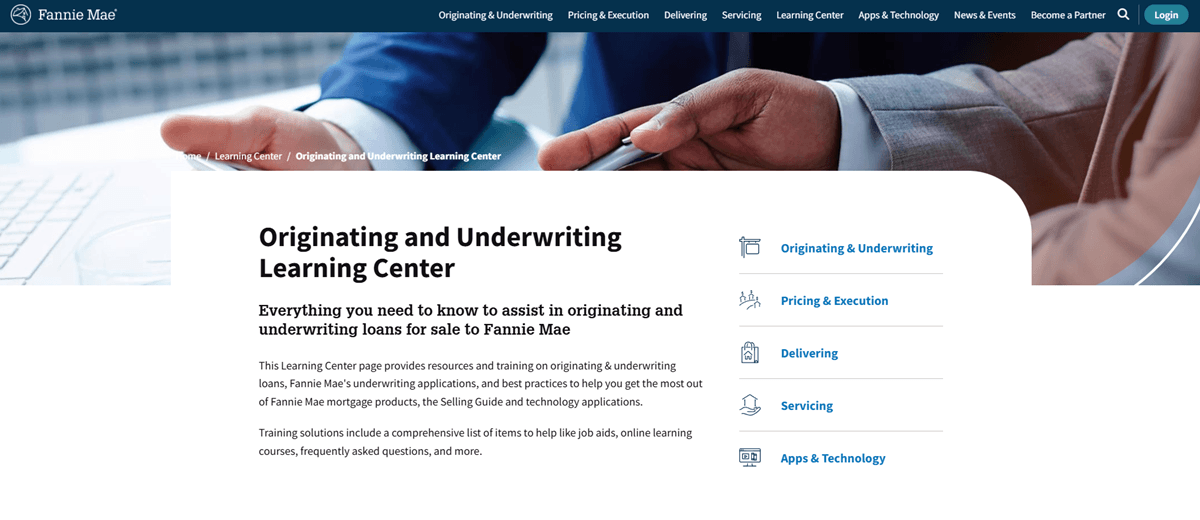
You can't really talk about underwriting without starting at the source. The Fannie Mae Originating and Underwriting Learning Center is Fannie's own platform, and it's packed with policy updates and direct guidance on what the secondary market actually buys. Every person touching a file — new hire or fifteen-year veteran — should have this bookmarked.
You'll find modules on running Desktop Underwriter (DU), calculating variable income, and interpreting the Selling Guide line by line. Time commitment is entirely up to you; some days it's a ten-minute job aid, other days it's an hour of interactive eLearning. Best part: it's completely free. Since Fannie sets the rules most conventional loans follow anyway, this is the cheapest foundation you'll ever build.
CampusUnderwriter
One thing worth clearing up first: CampusUnderwriter (also shown as CampusMortgage) is actually NAMU's own training division — the same team that records the boot camp webinars above. If you've already bought the full NAMU package, you don't need these again. Where CampusUnderwriter really earns its keep is for underwriters who just want to patch one weak spot without committing to a full certification track.
Their catalog reads like an à la carte menu: deep dives into calculating tricky Debt-to-Income ratios, reviewing complicated appraisals, or getting comfortable with USDA rural housing rules. A typical webinar runs a few hours, and you keep access to the recordings and materials for a full year. Single classes usually land between $99.99 and $395, with bundled packages available if you're patching more than one gap at once.
MBA Education
The Mortgage Bankers Association (MBA) carries real weight in housing advocacy, and its single-family loan production courses are respected inside major banks and lenders nationwide. This path fits people eyeing management roles, corporate underwriting teams, or just a wider view of the whole loan lifecycle.
The Certified Residential Underwriter (CRU) credential is built in three stages — Level I, Level II, then Level III — each sold as its own package with its own coursework and proctored exam, so you can pace yourself instead of tackling everything at once. Level II alone runs roughly ten hours of coursework. Once you've earned the CRU, keeping it active means logging two continuing-education points every two years, not unlike how state MLO licenses require ongoing renewal.
Pricing depends heavily on membership. Many core courses come free for MBA members, while the full multi-level track can run anywhere from around $550 to well over $1,100 for non-members, depending on how many levels you need.
OnCourse Learning
OnCourse Learning is a major provider of regulatory and compliance training across the financial sector. Their mortgage-specific catalog is strictly designed to keep lending staff out of trouble with state and federal regulators. I usually recommend this for underwriters working at regional banks, credit unions, or institutions that require structured, compliance-heavy continuing education to check off corporate HR requirements. Their underwriting modules are very procedural.
They walk you through evaluating a borrower's overall financial health, properly structuring a file for final approval, and spotting the common underwriting mistakes that lead to costly buybacks. These courses are entirely online and self-paced.
A comprehensive underwriting or pre‑licensing track often requires around 20 hours of online study. For a standard 20-hour comprehensive course, expect to pay around b. Costs scale down if your lending institution buys licenses in bulk for the whole underwriting department.
Coursera
You might not expect a tech-focused platform like Coursera to teach mortgage principles, but they partner with universities to offer surprisingly relevant content. Their "Mortgage for Underwriters" material offers a slightly different flavor, mixing traditional credit risk assessment with modern technological trends.
This is an awesome choice for tech-curious beginners or mid-level underwriters who want a fast, affordable look at how the industry is shifting toward predictive analytics and automated workflows. The curriculum is very forward-thinking. Alongside standard modules on credit reports and compliance, you'll learn about machine learning applications in risk analysis and how AI is changing underwriting desks.
It is highly flexible and bite‑sized, with many learners reporting that they complete the video lectures and readings in about 3 hours. It is also extremely budget-friendly. Access depends on your monthly Coursera subscription (usually around $39 to $59 a month), letting you explore this and thousands of other courses without a massive upfront commitment.

Comparison of Best Mortgage Underwriter Training
If you are juggling a packed pipeline today and just want the quick breakdown, I've organized this comparison table for you. Picking the right program depends entirely on where you are in your career. Are you trying to land your first junior role, or do you need a heavyweight certification to secure a promotion? Check out the stats below to make a fast decision.

My advice? Start reading Fannie Mae's guides for free to build your baseline, then ask your employer to sponsor your NAMU certification once you're established.
Bonus Tip: Leverage AI to Supercharge Your Underwriting Career
Once training's behind you, reality sets in fast. Staring at hundreds of pages of bank statements and W-2s to hand-calculate income will burn anyone out eventually. This is where the right tech genuinely changes your day-to-day.
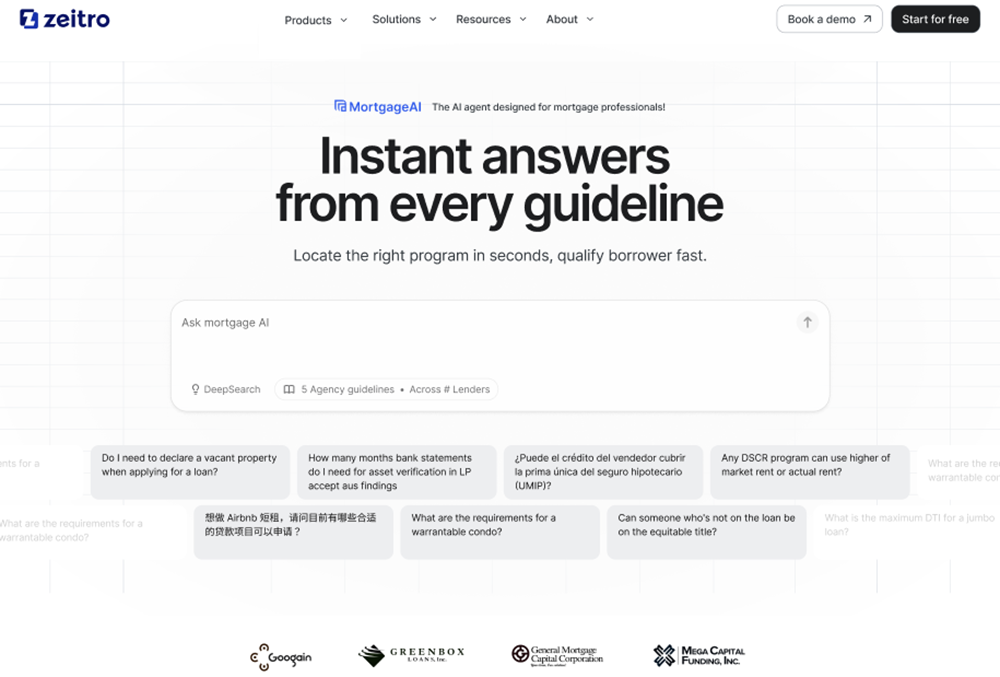
Top underwriters aren't just grinding harder — they're using tools like Zeitro to cut the busywork out entirely. Zeitro is an AI agent built specifically for U.S. mortgage professionals. It won't replace your judgment on a file, but it can help you clear conditions up to 20% faster and save more than 7 hours per loan on average. Here's how it fits into the workflow:
- Zeitro Strata AI: Instead of digging through a 1,000-page guideline PDF, just ask this assistant your QM or Non-QM guideline question in plain language and get a sourced, accurate answer in seconds.
- GrowthHub: If you're a broker or loan officer, this builds a branded microsite to showcase your expertise, display live rates, and pull in organic borrower leads through Bluerate.
- Digital 1003 (POS): Automates the application side end to end — pulling financial data, calculating DTI with AI, and exporting FNM 3.4 files so borrowers can pre-qualify in about five minutes.
- Pricing Engine: A fast rate-quote tool for both conventional and Non-QM products, with custom overlay adjustments so you can price a loan instantly.
FAQs About Mortgage Underwriter Training
Q1. What are the 4 C's of mortgage underwriting?
The 4 C's are Capacity, Capital, Collateral, and Credit. Capacity measures a borrower's ability to repay using their DTI ratio. Capital looks at their down payment and cash reserves. Collateral checks the property's value through an appraisal. Credit reviews past payment history to predict how reliable they'll be going forward.
Q2. How long does it take to become a certified mortgage underwriter?
Anywhere from a few weeks to several months, depending on your background and the program you pick. NAMU's boot camp, for instance, typically takes two to three weeks of focused study to complete. Actually getting comfortable making live lending decisions on a real desk, though, takes months of practice no course can shortcut. Check out how to become a mortgage underwriter for the full path.
Q3. What certifications should I get for underwriting?
I'd start with the entry-level Certified Mortgage Underwriter (NAMU-CMU) if you're new, then work up to either the Certified Master Mortgage Underwriter (NAMU-CMMU) or the MBA's Certified Residential Underwriter (CRU) once you've got some files behind you. If government loans make up a big chunk of your pipeline, NAMU's DE Underwriter Prep Package and Certified FHA Manual Underwriter (CFMU) credential — or VA LAPP/SAR authority — are close to mandatory for moving up and boosting your pay.
Q4. Is there free mortgage underwriting training available?
Yes. The Fannie Mae Originating and Underwriting Learning Center is completely free and covers conventional lending rules in real depth. YouTube has decent walkthroughs too. Just know that free resources build your knowledge but won't hand you the formal certificate employers ask for on a resume.
Q5. What is the salary of a mortgage underwriter?
The average U.S. mortgage underwriter salary lands somewhere between $65,000 and $90,000 a year, based on current job-market data from sources like Indeed and Salary.com. That number moves fast with experience, though — senior underwriters, or anyone holding a specialized credential like FHA-DE authority, regularly clear $100,000 in high-volume markets or Non-QM lending. See our full breakdown of mortgage underwriter salary trends for more detail.
Conclusion
Stepping into underwriting doesn't have to mean constant guesswork. A solid online training program is still the fastest way to build technical skill and stop second-guessing your own conditions. Whether that means investing in a NAMU credential to strengthen your resume or spending tonight working through Fannie Mae's free modules, the important part is just to start.
Pick the program from the table above that actually matches where you are right now. And once those foundational guidelines are locked in, don't hesitate to bring in modern AI tools like Zeitro to cut out the repetitive data entry. Your pipeline — and your sanity — will thank you.
People Also Read
- AI Mortgage Underwriting Explained: Will You Be Replaced?
- Best AI Mortgage Underwriting Software for Loan Professionals
- Mortgage Underwriting Automation: What Is It? How Does It Work?
- Best Mortgage Underwriter Software: AI & Guideline Verification
- How to Check Mortgage Eligibility? Quick and Accurate with Sources
- Best Mortgage Loan Processor Training for Beginners
- 30 Mortgage Underwriter Interview Questions to Prepare First

![[Tips for Loan Officers] How Can I Lower Borrower DTI?](https://cdn.prod.website-files.com/6731bc6e813a541b54c30b10/6aa3b89e281a639e7a5c6fca_lower-debt-to-income-ratio-banner.jpg)