Written by

Eric
Share this article

.svg)
Subscribe to updates
Last Checked and Updated on August, 2026
Navigating the mortgage industry can feel like a maze, especially when you're aiming for the role of a mortgage underwriter, the professional who ultimately decides whether a loan gets approved. Plenty of talented people still break into this field through grit and on-the-job learning. But the hiring bar has moved. Proving your expertise on paper isn't a nice-to-have anymore. It's often the deciding factor between two similar resumes.
Whether you're just starting out or trying to climb the ladder at a top-tier lender, picking the right certification is one of the most strategic moves you can make. Below, I'll walk through the mortgage underwriter certifications that actually carry weight in the U.S. market, where they fit in your career path, and what separates a real credential from a checkbox exercise.
Key Takeaways
- Not mandatory, but rarely optional in practice. Certifications aren't a legal requirement the way an MLO license is, but they're frequently the tie-breaker in hiring decisions.
- NAMU vs. MBA. NAMU offers focused, specialized tracks. The MBA's Certified Residential Underwriter (CRU) designation carries more long-term prestige for executive-level roles.
- Certification, license, and federal authorization are three different things. Mixing them up is one of the most common mistakes newcomers make, and it's worth untangling before you spend money on a course.
- Pairing credentials with technology matters now. Underwriters who combine a solid certification with AI tools like Zeitro are simply faster and more accurate than those relying on manual guideline checks alone.
Do You Need a License to Become a Mortgage Underwriter?
Short answer: no, not in the way most people assume.
Mortgage Loan Originators (MLOs) must hold an NMLS license under the SAFE Act. Underwriters typically don't, since they work in a back-office role rather than originating loans. That said, if an underwriter also handles origination-type duties, such as receiving production-based compensation, some states or lenders may still require an NMLS-MLO license under local rules.
Here's where it gets confusing for a lot of newcomers: there isn't a single "mortgage underwriter license" issued by any state or federal agency. What exists instead are three separate layers of credentialing, and each one answers a different question.
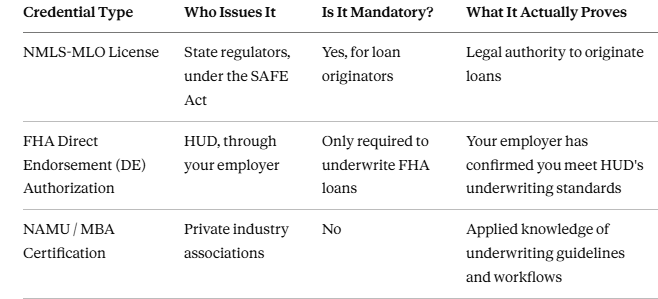
None of this means certifications don't matter. From what I've seen reviewing job postings at regional and national lenders, resumes without any credential often sit at the bottom of the pile. A certification works like a trust signal. It tells a hiring manager you already understand FHA and VA guidelines, TRID, and HMDA, without needing months of hand-holding to get up to speed.
FHA Direct Endorsement (DE) vs. NAMU Certification: Don't Confuse the Two
This distinction trips people up constantly, so it's worth a dedicated section.
- Direct Endorsement (DE) authorization is the closest thing to an official government credential an underwriter can have. It's granted through HUD, and it allows a lender to underwrite and close FHA-insured loans without prior FHA review. But here's the part most articles skip: since 1996, the FHA hasn't approved individual underwriters directly. Instead, your employer certifies that you meet the qualifications outlined in the FHA Single Family Housing Policy Handbook 4000.1, and registers you through HUD's Underwriter Registry. There's no standardized national exam or single training path required by HUD itself. Your lender decides how you demonstrate that knowledge.
- NAMU-CFMU (Certified FHA Manual Underwriter), by contrast, is a private training and certification program. It's not issued by HUD, and it doesn't replace DE authorization. What it does is give you a structured way to build (and prove) the FHA knowledge your employer will eventually rely on when nominating you for DE status. Think of it as preparation, not the credential itself.
I'd put it this way: NAMU-CFMU gets you ready. DE authorization is what your employer actually grants once they trust you with FHA files.
Top Mortgage Underwriter Certifications to Know
The certifications below come from the two most recognized bodies in U.S. mortgage underwriter education: the National Association of Mortgage Underwriters (NAMU) and the Mortgage Bankers Association (MBA).
Also Read:
- Best Mortgage Underwriter Training Online: Improve Your Expertise
- 30 Mortgage Underwriter Interview Questions to Prepare First

NAMU-CMU (Certified Mortgage Underwriter)
I often recommend the CMU as the "Foundational Step." It covers the bread and butter of underwriting, including tax return analysis, credit report navigation, and basic appraisal reviews. It's a moderate difficulty level designed to ensure you won't make "rookie mistakes" that lead to buy-backs.
- Suitable for: Entry-level professionals or Loan Officers looking to transition into underwriting.
- Requirements: You must complete a series of online training modules and pass the final exam with a score of 75% or higher. There is no strict "years of experience" requirement, making it the perfect entry point for those wanting to prove they have the technical knowledge to handle a file.
NAMU-CMMU (Certified Master Mortgage Underwriter)
CMMU is the "Heavyweight" title within NAMU. It signals that you've moved beyond basic checklists and can handle complex scenarios, such as self-employed borrowers with multiple business entities. In my view, having "Master" in your title significantly increases your leverage during salary negotiations.
- Suitable for: Senior underwriters and those aiming for management or team lead positions.
- Requirements: This requires more rigorous testing than the CMU. You'll need to demonstrate a deep understanding of advanced underwriting concepts. This exam is typically recommended for candidates with at least 2–3 years of field experience, as it involves more nuanced case studies.
NAMU-CAMU (Certified Ambassador Mortgage Underwriter)
The CAMU is less about "how to underwrite" and more about "how to lead." It represents the highest level of NAMU recognition. It's perfect for professionals who want to train others or open their own contract underwriting firm.
- Suitable for: Industry veterans, consultants, and those who want to be recognized as "Thought Leaders."
- Requirements: This certification requires an extensive background in the industry. It's often the culmination of holding other NAMU certifications and showing a commitment to continuing education and ethical standards in the mortgage space.
NAMU-CFMU (Certified FHA Mortgage Underwriter)
FHA loans have very specific, often rigid guidelines (HUD 4000.1). Being a CFMU means you are an expert in these government nuances. Given that FHA loans are a staple for first‑time homebuyers in the U.S., this certification can make your skill set more resilient during economic downturns.
- Suitable for: Underwriters working in retail or wholesale lending where government-backed loans are a priority.
- Requirements: The curriculum focuses exclusively on FHA-specific guidelines, mortgage insurance premiums, and property requirements. You must pass a specialized exam that tests your ability to interpret HUD handbooks accurately.
NAMU-CMRC (Certified Mortgage Regulatory Compliance)
With the CFPB constantly updating rules, compliance is the biggest headache for lenders. I've found that underwriters who understand the legal side, TILA, RESPA, and Fair Lending, are the most valued. The CMRC certificate proves you can keep a lender out of legal trouble.
- Suitable for: Compliance officers, QC specialists, and senior underwriters.
- Requirements: You'll study federal regulations and audit procedures. The exam is detail-oriented and requires a high level of precision, reflecting the nature of compliance work itself.
NAMU-CMQCS (Certified Mortgage Quality Control Specialist)
CMQCS focuses on the "Post-Closing" and "Pre-Funding" audit side. It's for people who love finding the "needle in the haystack." If you prefer auditing files for errors rather than live production, this is your niche.
- Suitable for: Quality Control (QC) staff and Risk Management professionals.
- Requirements: Candidates must master audit workflows and learn how to report findings to management. It requires passing a focused exam on quality assurance protocols.
NAMU-CCUP (Certified Commercial Underwriting Professional)
Commercial underwriting is a different beast entirely. You're looking at Debt Service Coverage Ratios (DSCR) and rent rolls instead of just W-2s. This CCUP certification is the bridge for residential pros wanting to enter the commercial space.
- Suitable for: Those looking to leave residential lending for the high-stakes world of Commercial Real Estate (CRE).
- Requirements: This is a high-difficulty certification. It requires learning complex financial statement analysis and commercial property valuation methods.
A Quick Note on NAMU-CHS (Certified HELOC Specialist)
Worth mentioning: with home equity products seeing renewed demand as homeowners look for alternatives to refinancing at today's rates, NAMU also offers a Certified HELOC Specialist (CHS) track. It's newer and narrower in scope than the certifications above, but if HELOC volume is growing at your shop, it's worth a look.
MBA-CRU (Certified Residential Underwriter)
If NAMU represents specialized, focused training, the MBA's CRU designation is the closest thing to an industry gold standard. It's widely recognized, and in my experience, it carries real weight if you're eyeing a VP-level or leadership role at a large national lender.
- Suitable for: Career-focused professionals aiming for the highest level of industry recognition.
- Requirements: A multi-level program (Levels I, II, and III) combining professional experience, coursework points, and a comprehensive final exam. Expect this to take a year or more from start to finish. Professionals who already meet MBA's minimum experience thresholds may qualify for a coursework exemption at Levels I and II, so it's worth checking your eligibility before enrolling in the full curriculum.
How to Maintain Your Certification and Stay Compliant?
Earning the certificate is the easy part. Keeping it active is what actually matters, because Fannie Mae, Freddie Mac, and HUD guidelines shift constantly, and a credential that reflects outdated rules doesn't help anyone.
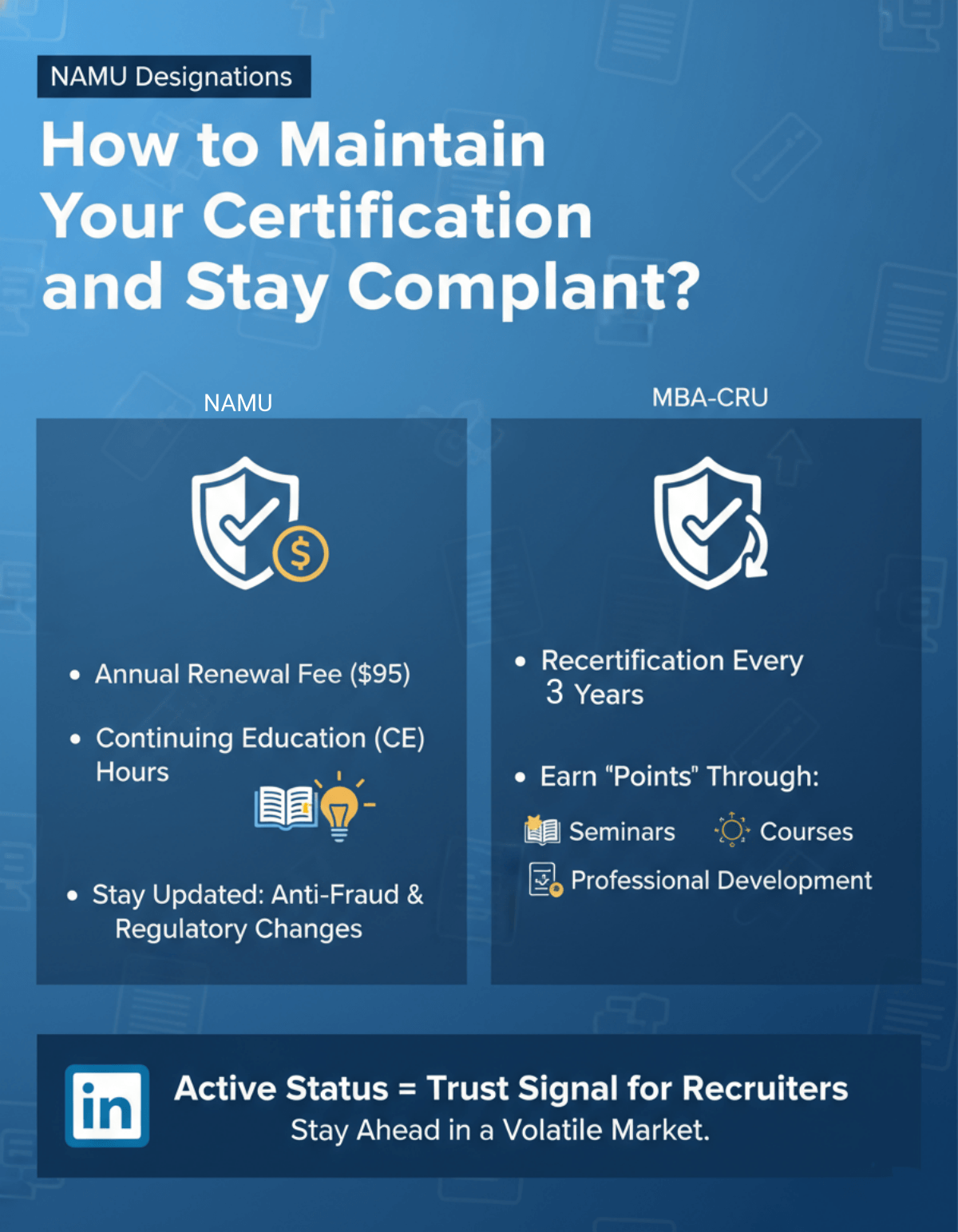
- For NAMU designations, renewal generally involves a recurring fee and a fresh, timed proctored exam covering any updated material. NAMU also typically expects a set number of continuing education hours to keep your status current. Exact pricing changes over time, so it's worth checking NAMU's official site for the current renewal cost before budgeting for it.
- The MBA-CRU works on a different cycle. Designees need to complete two continuing education points every two years, which can come from MBA coursework or from attending MBA conferences and events.
An "Active" certification status on your resume or LinkedIn profile sends a clear signal to recruiters: you're not coasting on knowledge from three years ago, you're actively keeping pace with a market that doesn't sit still.
Choosing the Right Path: Which Certification is Best for Your Career?
Picking a certification shouldn't feel like guesswork.
- New to the field? Start with NAMU-CMU to build a solid foundation.
- Targeting a major national lender? The MBA-CRU carries the most historical weight.
- Want to specialize in government-backed lending? NAMU-CFMU is the smarter, more targeted play.
Think about where you want to be in three years. Do you want to manage a team, or become the technical specialist everyone else turns to with questions? Let that answer guide which credential you chase first.
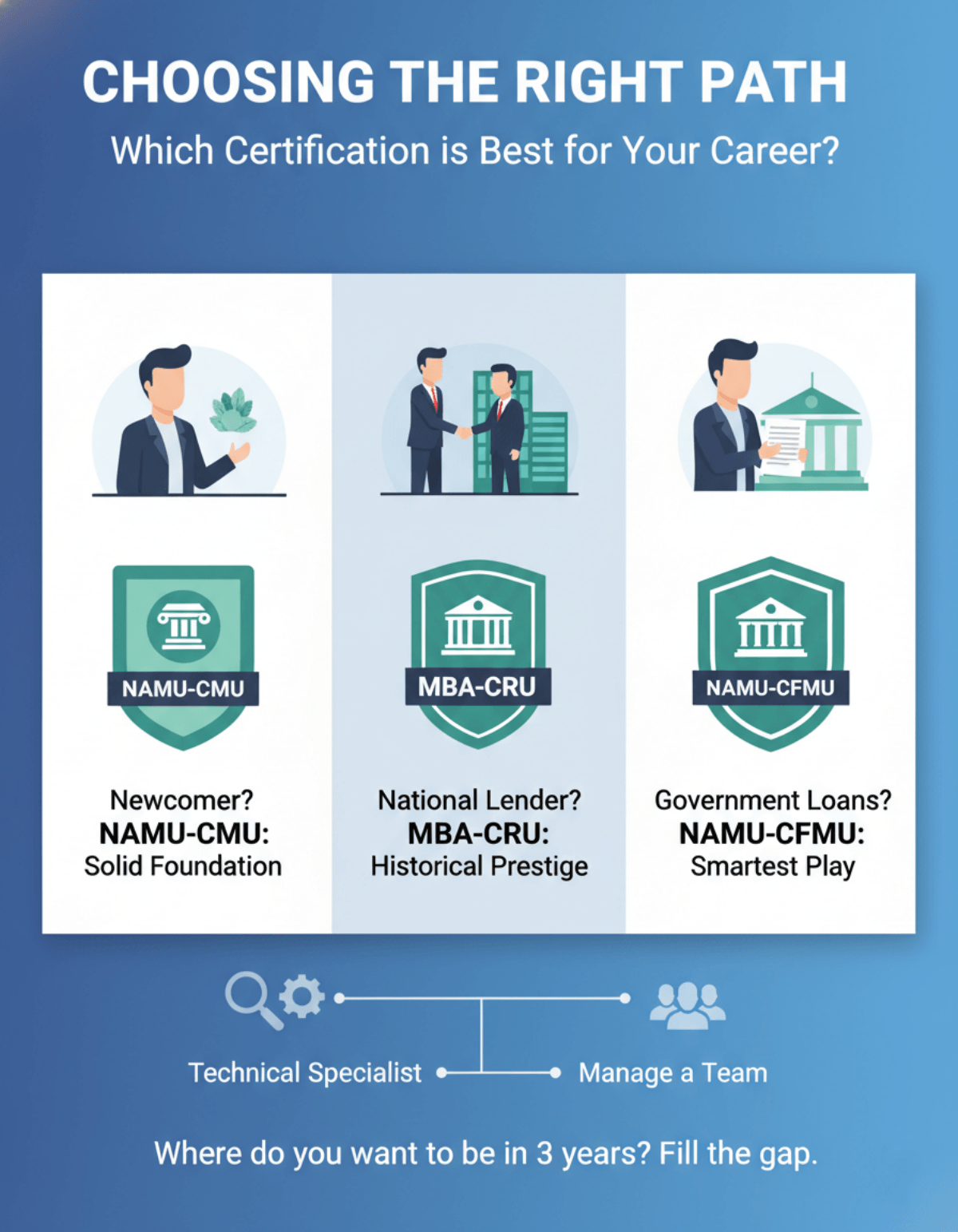
Think about where you want to be in three years. Do you want to manage a team or be a technical specialist? Pick the credential that fills that specific gap in your resume.
Zeitro: The Missing Piece Beyond Certifications
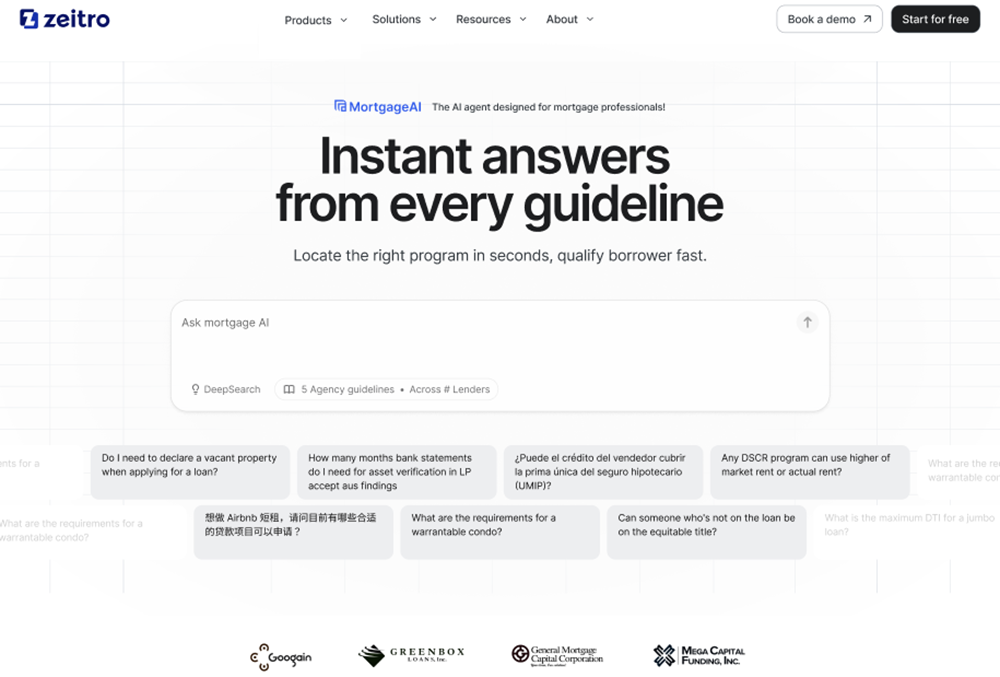
Even with the right certification in hand, the sheer volume of data in modern lending can be overwhelming. Professional knowledge only gets you halfway there. The other half is speed, and that's where Zeitro comes in, an AI-powered platform built specifically for U.S. mortgage professionals who need to apply the rules fast, not just know them.
Zeitro Strata AI is genuinely useful for verifying complex Non-QM guidelines. Instead of digging through a 500-page PDF, you can ask a direct question and get a sourced answer in seconds. Beyond guideline lookups, Zeitro's Digital 1003 and Pricing Engine automate much of the manual work around applications and DTI calculations, cutting hours off the time it takes to move a file forward. Pair that with the GrowthHub to build a branded presence that showcases your expertise, and you're positioned as more than "the person who checks boxes." You become the underwriter lenders actively want on their team.
FAQs About Best Mortgage Underwriter Certifications
Q1. .Can I become an underwriter without a degree?
Yes. Some large banks prefer a finance-related degree, but plenty of lenders weigh hands-on experience and certifications like the NAMU-CMU just as heavily, sometimes more so than a diploma alone.
Also Read: [No Experience] How to Become a Mortgage Underwriter
Q2. Do I need a license to work as a mortgage underwriter?
Not in the traditional sense. Underwriters don't carry an NMLS-MLO license the way loan originators do. If you're underwriting FHA loans specifically, your employer will need to register you for Direct Endorsement authorization through HUD, which is different from any state-issued license or private certification.
Q3. Which certifications should I get for underwriting?
Start with the NAMU-CMU for general residential work. If you want a specialty, look at NAMU-CFMU for FHA lending or the MBA-CRU for a longer-term, prestige-focused career path.
Q4. Is NAMU certification worth it?
Generally, yes, with one caveat worth knowing upfront: NAMU certifications are professional development credentials from a private industry association, not a government-issued license. That doesn't make them less useful. They remain among the most accessible and widely recognized training options for underwriters, and they often lead to faster job offers or a pay bump. Just go in with accurate expectations about what the credential does and doesn't represent.
Q5. How long does it take to become a certified underwriter?
NAMU coursework can typically be finished in a few weeks at a self-paced schedule. The MBA-CRU is a longer commitment, usually six to twelve months depending on how quickly you move through the levels.
Q6. Do mortgage underwriters make good money?
Yes, and the range varies quite a bit depending on experience and location. Entry-level underwriters often start somewhere in the $55,000 to $65,000 range, while experienced, certified underwriters using modern tools regularly land in the $85,000 to $95,000-plus range nationally. For a full breakdown by experience level and data source, see our detailed Mortgage Underwriter Salary guide.
Conclusion
Building a strong career as a mortgage underwriter in today's market takes a mix of formal credentials and modern technical fluency. You can technically start without a certification, but professionals who invest in their education early tend to see faster promotions and a noticeably higher salary ceiling over time.
Just don't stop at the certificate. The industry has moved past manual PDF-checking, and it's not going back. Pair a respected credential like the MBA-CRU or NAMU-CMU with an AI-powered tool like Zeitro, and you position yourself as the kind of underwriter lenders fight to keep, someone who knows the rules and knows how to move fast within them.
People Also Read
- AI Mortgage Underwriting Explained: Will You Be Replaced?
- Best AI Mortgage Underwriting Software for Loan Professionals
- Mortgage Underwriting Automation: What Is It? How Does It Work?
- Best Mortgage Underwriter Software: AI & Guideline Verification
- How to Check Mortgage Eligibility? Quick and Accurate with Sources

![[Tips for Loan Officers] How Can I Lower Borrower DTI?](https://cdn.prod.website-files.com/6731bc6e813a541b54c30b10/6aa3b89e281a639e7a5c6fca_lower-debt-to-income-ratio-banner.jpg)