Written by

Eric
Share this article

.svg)
Subscribe to updates
Last checked and updated on September, 2026
Anyone who's originated even a handful of loans knows the drill: the mortgage process kicks off with the 1003, and that one form can make or break how smoothly everything else goes. I've watched borrowers stare blankly at page six wondering what "REO" even means, and I've spent more Friday nights than I'd like to admit re-keying the same data a borrower already gave me over the phone.
The good news is that 2026 doesn't have to look like that anymore. This guide walks through the three real ways loan professionals generate a 1003 today, what each one actually costs you in time and accuracy, and where AI-driven origination has genuinely changed the game.
Key Takeaways
- The 1003 Form — officially the Uniform Residential Loan Application (URLA) — is still the single document every U.S. residential mortgage runs through.
- You can produce it three ways: through an AI-powered point-of-sale platform, inside a traditional lender portal or LOS, or by hand with a downloaded PDF.
- Loan officers who've switched to an AI POS system like Zeitro are seeing borrowers complete the application in as little as five minutes, with far less manual guideline research standing between application and approval.
What is a 1003 Form?
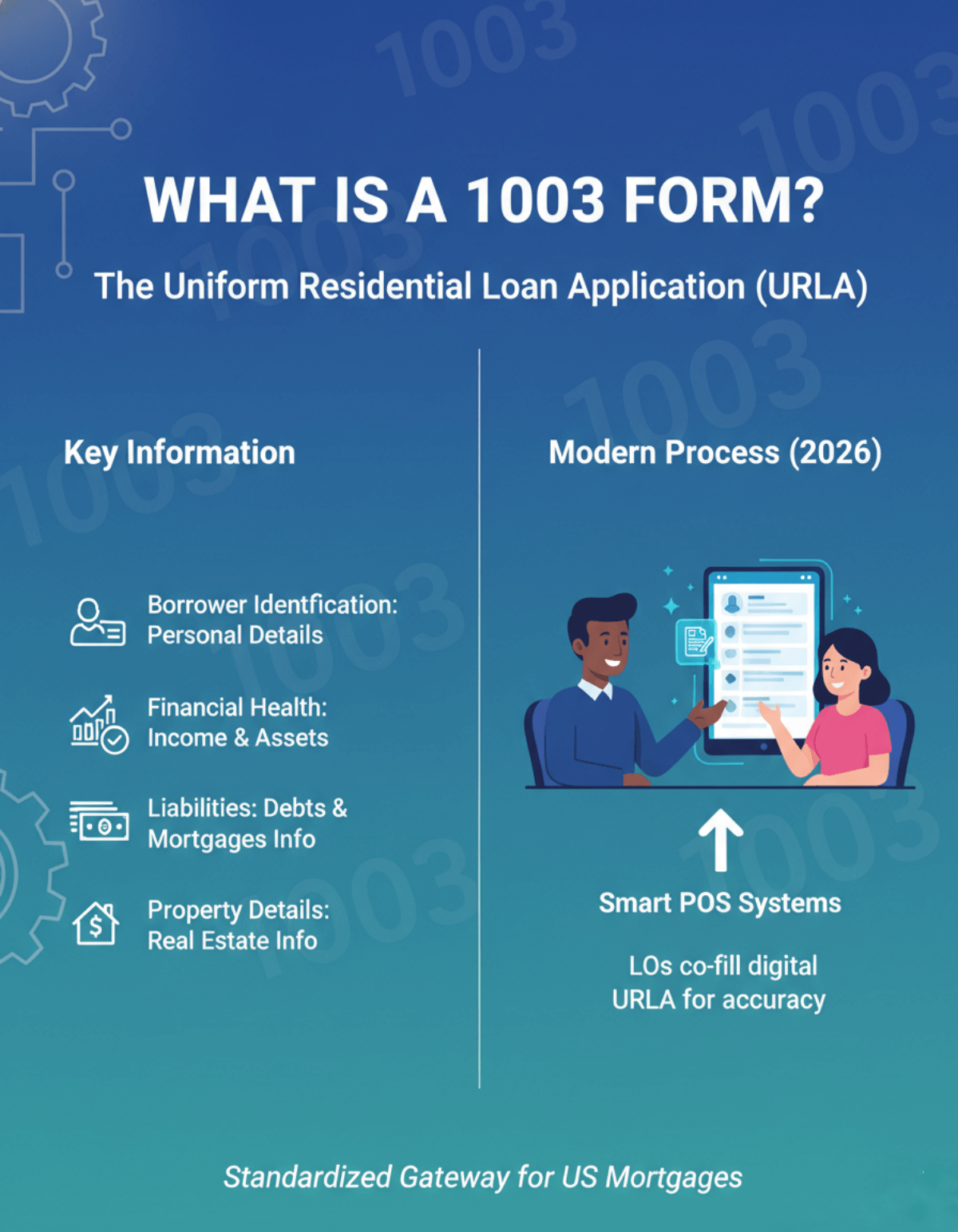
If you're newer to originations, the acronym soup can be confusing at first. The 1003 form is the Uniform Residential Loan Application, and Fannie Mae and Freddie Mac both require it — Freddie Mac just calls its version Form 65. Same document, same fields, two names.
The form exists to answer one question for the lender: can this person repay the loan? It does that by pulling together the borrower's identity, income and employment history, assets, existing debts, and details about the property itself. If you want the full section-by-section breakdown, our complete URLA guide covers every part of the form in depth — this article focuses specifically on how to actually get one filled out and submitted.
Who Has to Fill Out the 1003 — and Who Reviews It Afterward?
Legally, the borrower owns this form. They're the one certifying, under penalty of perjury, that everything on it is accurate — and they sign it to prove it.
In practice, though, I almost never see a loan officer just hand someone a blank URLA and walk away. Most of us guide the borrower through a digital intake tool instead, filling gaps in together so nothing gets missed before it ever reaches underwriting.
Once submitted, the 1003 doesn't go straight to a decision. A loan processor typically reviews it first for completeness and consistency, then it's run through an automated underwriting system — Desktop Underwriter for Fannie Mae loans, Loan Product Advisor for Freddie Mac loans. A human underwriter makes the final call, especially on anything the automated system flags for a closer look.
How to Generate a 1003 Form? (3 Proven Methods)
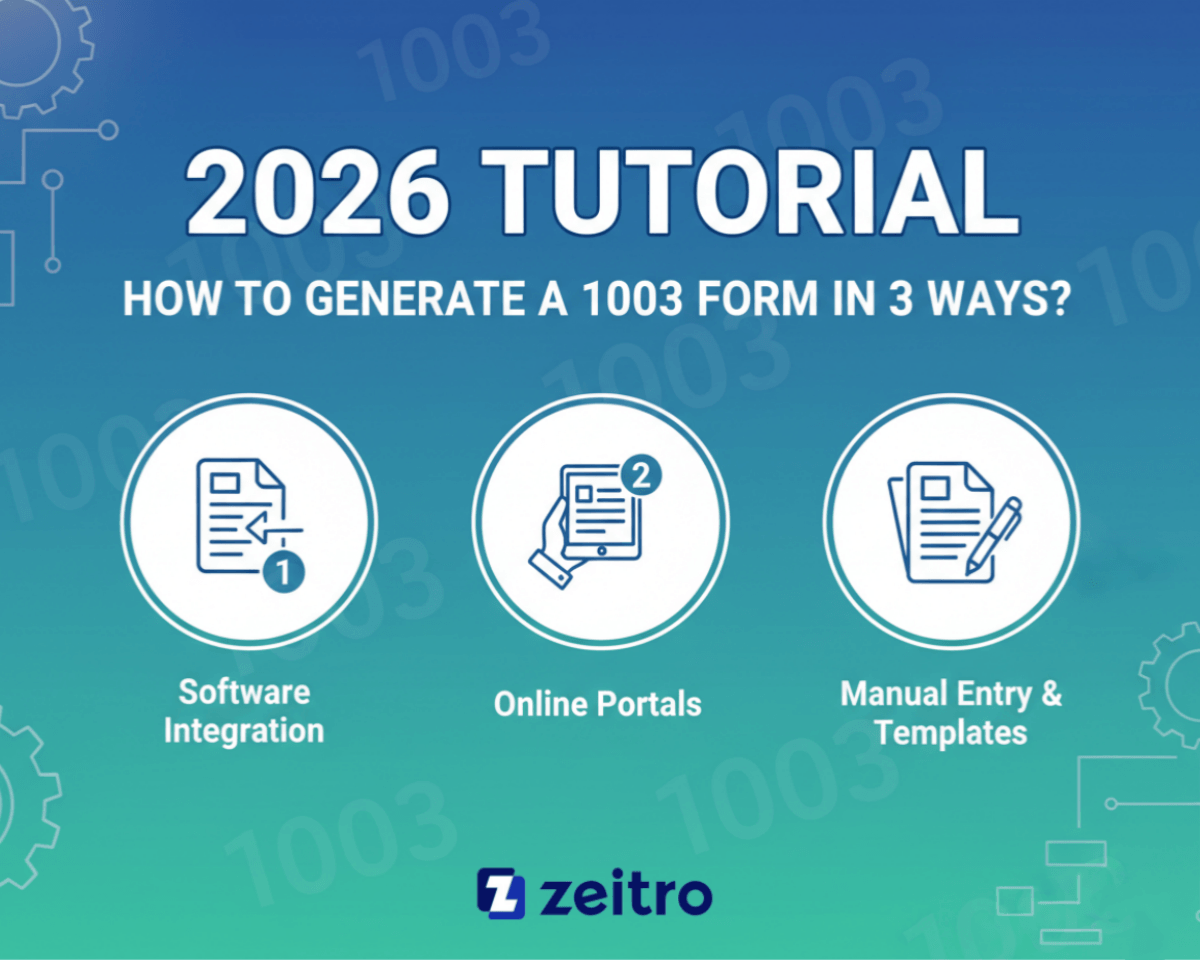
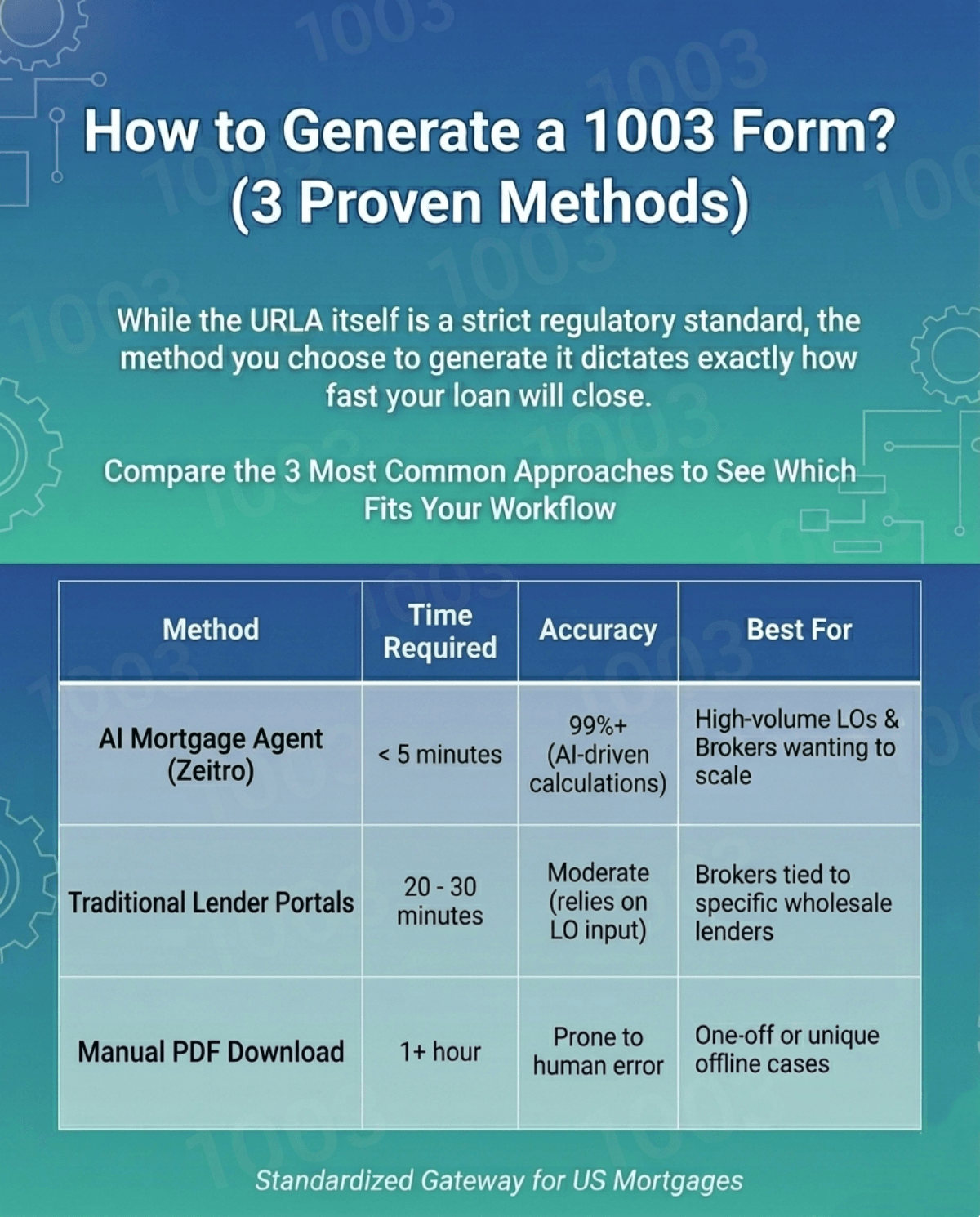
While the URLA itself is a strict regulatory standard, the method you choose to generate it dictates exactly how fast your loan will close. Let's break down the three most common approaches today to see which one fits your workflow.
Method 1: Using an AI Mortgage Agent (Zeitro)
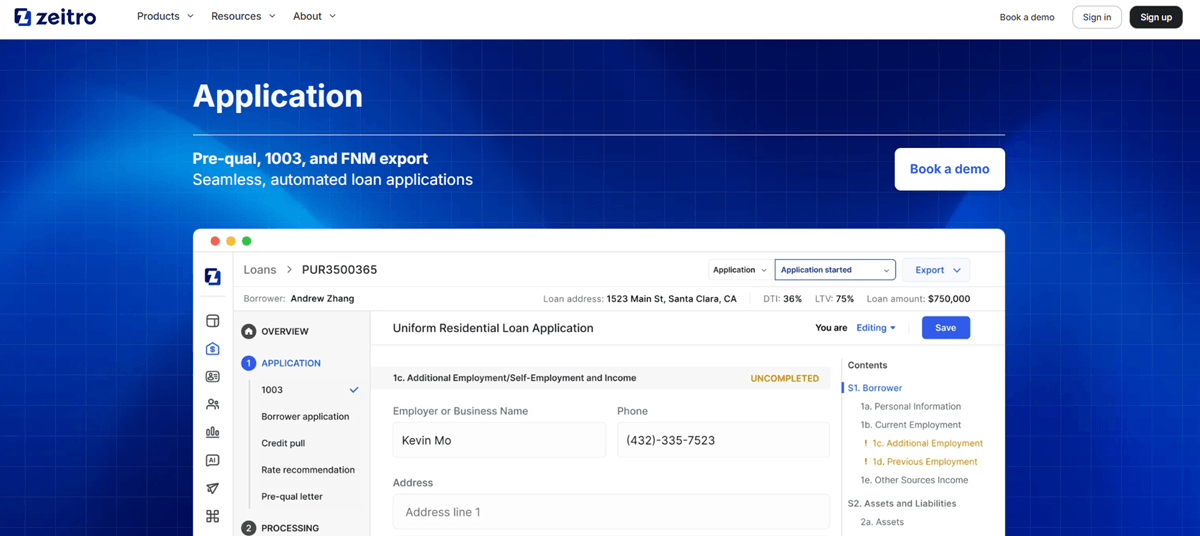
This is where the industry is heading, and honestly, I don't think I could go back. I moved my own workflow onto Zeitro's Application System last year, and it changed how my whole team spends its day. The platform pairs self-serve pre-qualification with digital 1003 generation, then exports the finished data as a clean MISMO 3.4 file — the industry data standard that replaced the older flat-file format lenders used before the 2021 URLA redesign.
The features that matter most day-to-day are the ones that quietly remove friction: instant credit pulls, live DTI calculations, and automatic support for everything from conventional and FHA loans to Non-QM and DSCR products. Borrowers using this kind of setup are wrapping up applications in around five minutes, and loan officers are cutting out most of the manual guideline lookups that used to eat 20-plus hours a month.
There's also a question I hear constantly from brokerages running leads through multiple channels: if applications come in through a website, a phone call, and an in-person meeting, how do you get all of that into one clean PDF without three separate data-entry sessions? This is exactly the gap AI POS platforms were built to close — every channel feeds the same borrower profile, and the system auto-populates the 1003 and its MISMO export once, regardless of where the data originated.
Method 2: PDF Download and Manual Completion
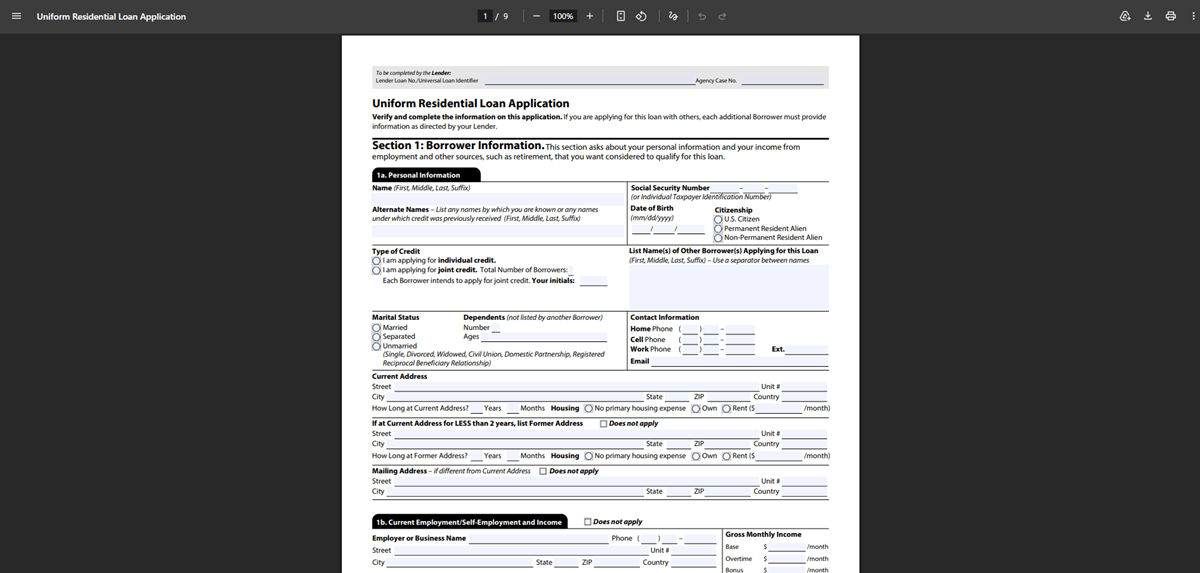
For loan officers who still prefer paper, Fannie Mae publishes an interactive URLA PDF you can download directly from its site. From there, the usual path is emailing it to the borrower, having them print or type their answers, and then keying that same information into your LOS by hand.
I won't sugarcoat it — this method has real drawbacks. Manual entry invites typos and mismatched figures, which tends to surface later as an underwriting delay nobody wanted. There's no live DTI check, no automatic credit pull, and handing a first-time buyer a nine-page PDF in 2026 is a rough way to start their homebuying experience.
Method 3: Traditional Lender Portals & LOS
Plenty of brokers land somewhere in the middle, generating the 1003 inside a wholesale lender's own portal or a standard Loan Origination System. Big players like UWM and Rocket Pro TPO both offer this kind of built-in application builder.
It's a step up from a blank PDF, no question. But you're still usually the one typing in whatever the borrower told you over the phone or sent through a string of emails — these portals rarely offer the kind of borrower self-serve intake that AI-driven platforms like Zeitro do. You end up spending time on data entry that could go toward actually advising the client.
FAQs About Generating a 1003 Form
Q1. What is MISMO 3.4, and why does it matter for the 1003 form?
MISMO 3.4 is the data standard that Fannie Mae and Freddie Mac adopted alongside the 2021 URLA redesign, replacing the older flat-file format the industry used before then. It lets a completed 1003 export as a structured file that plugs directly into a lender's system, so nobody has to retype a borrower's financial profile by hand.
Q2. Can a borrower complete a 1003 form entirely online?
Yes. Paper packets used to be the norm, but modern point-of-sale platforms — Zeitro included — let borrowers self-serve through a guided online questionnaire that builds a compliant 1003 as they go.
Q3. Is there a difference between the Fannie Mae 1003 and the Freddie Mac Form 65?
No. They're the identical Uniform Residential Loan Application; the two GSEs simply gave it different names when they jointly mandated its use.
Q4. Do I need to pull credit before starting a 1003?
Not to begin one, no. But you can't finish the liabilities section accurately without a hard credit pull, since that's where existing debts get pulled in. AI-driven platforms typically handle this pull automatically and drop the results straight into the form.
Q5. How many pages is the 1003, and does a co-borrower need to fill out all of them?
The standard borrower section runs nine pages. A co-borrower doesn't repeat the whole thing — they complete a separate, shorter Additional Borrower form (four pages) that covers their personal and income details while referencing the primary applicant's form for shared assets, liabilities, and property information.
Q6. Is there a new version of the 1003 form for 2026?
Not a redesign, no — the form in use today is still the version Fannie Mae and Freddie Mac rolled out in 2021. What's actually new in 2026 is how the form gets filled out, with AI-driven intake replacing a lot of the manual process that used to surround it.
Q7. What's a "fees worksheet," and is it part of the 1003?
It's not officially part of the URLA. A fees worksheet is an internal document some lenders and LOS platforms generate alongside the 1003 to itemize estimated costs during processing — it's separate from the Loan Estimate, which is the disclosure borrowers actually receive under federal rules.
Q8. What are the most common mistakes people make on a 1003?
The ones I see most often: leaving off a debt they're planning to pay off anyway, underreporting income because they forgot a side gig or bonus, and switching jobs or bank accounts mid-application without telling their loan officer. Any of these can trigger a processing delay, which is exactly the kind of error a guided digital intake tool is built to catch before it happens.
Q9. How long does filling out a 1003 actually take?
By hand, budget 30 to 60 minutes just gathering documents and typing answers. Through an AI-driven mortgage platform, most borrowers are done in under five minutes.
Conclusion
The 1003 isn't going anywhere — it's still the legal backbone of every U.S. residential mortgage. But how you generate it is where the real competitive gap is opening up in 2026. Sticking with a blank PDF or a clunky lender portal doesn't just cost you time; it costs you deals that a faster competitor closes first.
If you're ready to cut hours of manual work out of your week and give borrowers an application experience that doesn't feel like homework, Zeitro's Application System is worth a look.
People Also Read
- Best Loan Origination Software for LOs/Brokers
- Best Mortgage CRM for Brokers, Lenders, MLOs
- Best AI Mortgage Underwriting Software for Loan Professionals
- Max LTV: Check Maximum Loan-to-Value Ratios By Loan Types
- Max DTI for Mortgage: Requirements By Loan Types
- [Tutorial] How to Estimate What Mortgage You Can Afford?

![[Tips for Loan Officers] How Can I Lower Borrower DTI?](https://cdn.prod.website-files.com/6731bc6e813a541b54c30b10/6aa3b89e281a639e7a5c6fca_lower-debt-to-income-ratio-banner.jpg)