
Written by

Eric
Share this article

.svg)
Subscribe to updates
Just three days ago, on August 3, 2026, Fannie Mae and Freddie Mac officially rolled out the most radical overhaul of condominium mortgage underwriting I have seen in my fifteen years as a loan originator. The agencies have retired the fast-track Limited Review and Streamlined Review processes for almost all established condominium projects. These review types remain available only for loan applications received before August 3, 2026.
If you originate, underwrite, or process conventional loans, this shift directly impacts your pipeline. From this week forward, evaluating building eligibility is just as critical as underwriting your borrower's credit score and income.
Key Takeaways
- Limited Review is officially retired: Almost every established condo development over 10 units now requires a full, comprehensive project review.
- Project approval rivals borrower credit: A buyer with an 800 FICO score will still get denied if their HOA budget or insurance fails agency criteria.
- Small buildings get a break: Projects with 10 or fewer units gain expanded review waivers.
- HOA reserves in the spotlight: A tighter reserve mandate takes effect early next year, making immediate document collection critical.
- Pipeline management must adapt: Expect longer processing times and plan for upfront HOA due diligence.
What Changed on August 3, 2026?
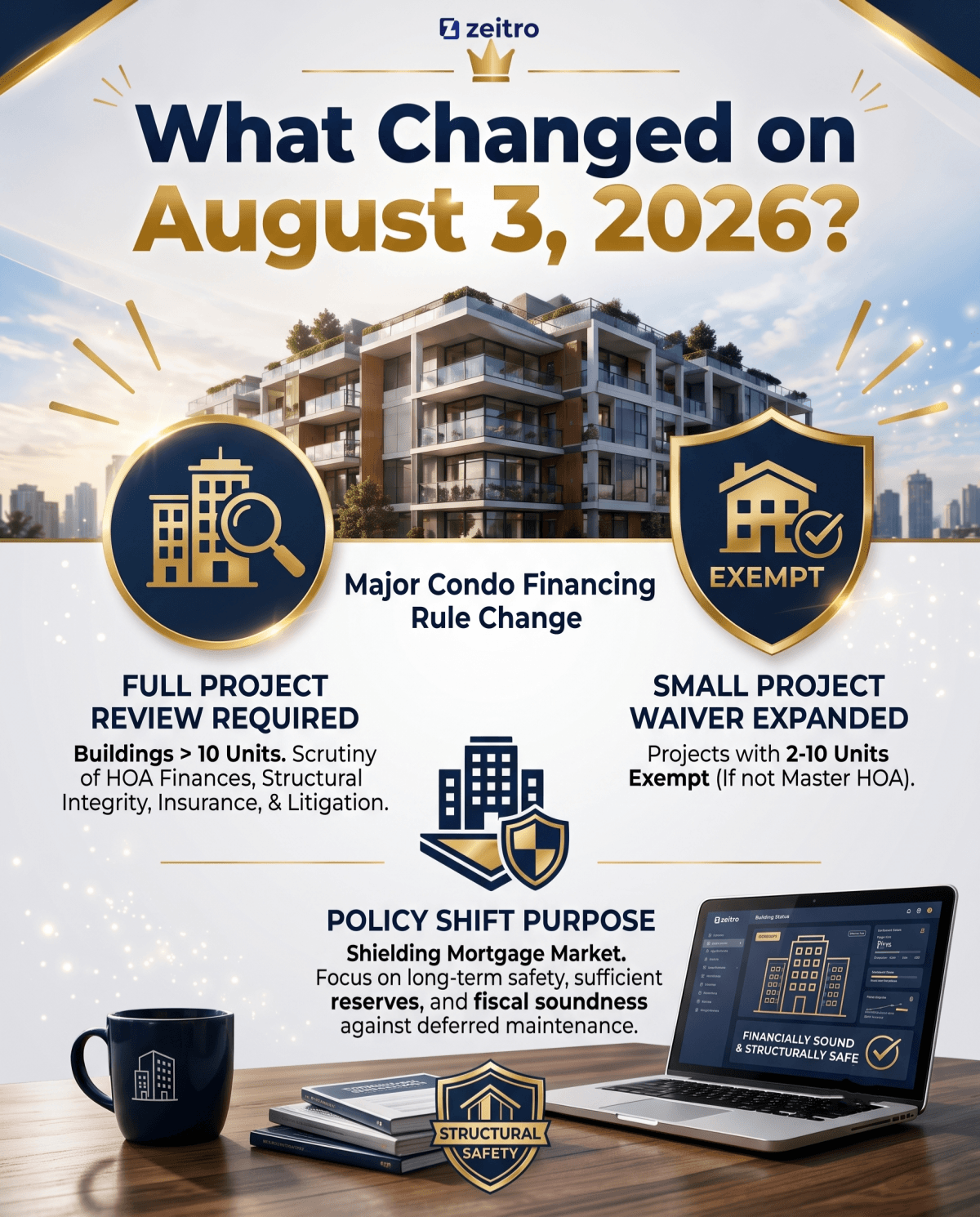
On August 3, 2026, Fannie Mae under Lender Letter LL-2026-03 and Freddie Mac under Bulletin 2026-C permanently retired the Limited Review and Streamlined Review options for conventional mortgages. In my practice, Limited Review previously accounted for nearly half of all our condo closings because buyers putting down 10% or more on a primary residence could bypass deep HOA scrutiny.
That convenient shortcut no longer exists for buildings with more than 10 units. Every conventional loan on an established condo must now undergo a Full Project Review. Underwriters must examine the association's annual budget, reserve account balances, master insurance policies, structural maintenance history, and ongoing litigation.
However, the agencies did include one positive adjustment: Projects with 2 to 10 units now qualify for an expanded ‘Exempt from Review' waiver, provided they are not part of a Master Association. Beyond that exception, the standard path for conventional condo financing is now full due diligence.
Why Are Fannie Mae and Freddie Mac Tightening Condo Reviews?
As a loan officer who watched the market react after the 2021 Surfside building collapse, I saw this policy shift coming. That tragic event exposed how many aging condominium complexes across the country were quietly suffering from decades of deferred structural repairs and severely underfunded emergency reserves.
Fannie Mae and Freddie Mac are tightening project standards to shield the secondary mortgage market from catastrophic structural and financial failures. Rising master insurance premiums and widespread special assessments have pushed many HOAs to the brink of fiscal distress. By requiring a thorough project review, the agencies are forcing lenders to verify that a building is structurally safe and financially sound before backing a thirty-year mortgage on any individual unit.
Old Condo Review Process vs New Condo Review Rules
To help my origination team visualize this shift, I put together a direct comparison between our old workflow and the current 2026 standards:
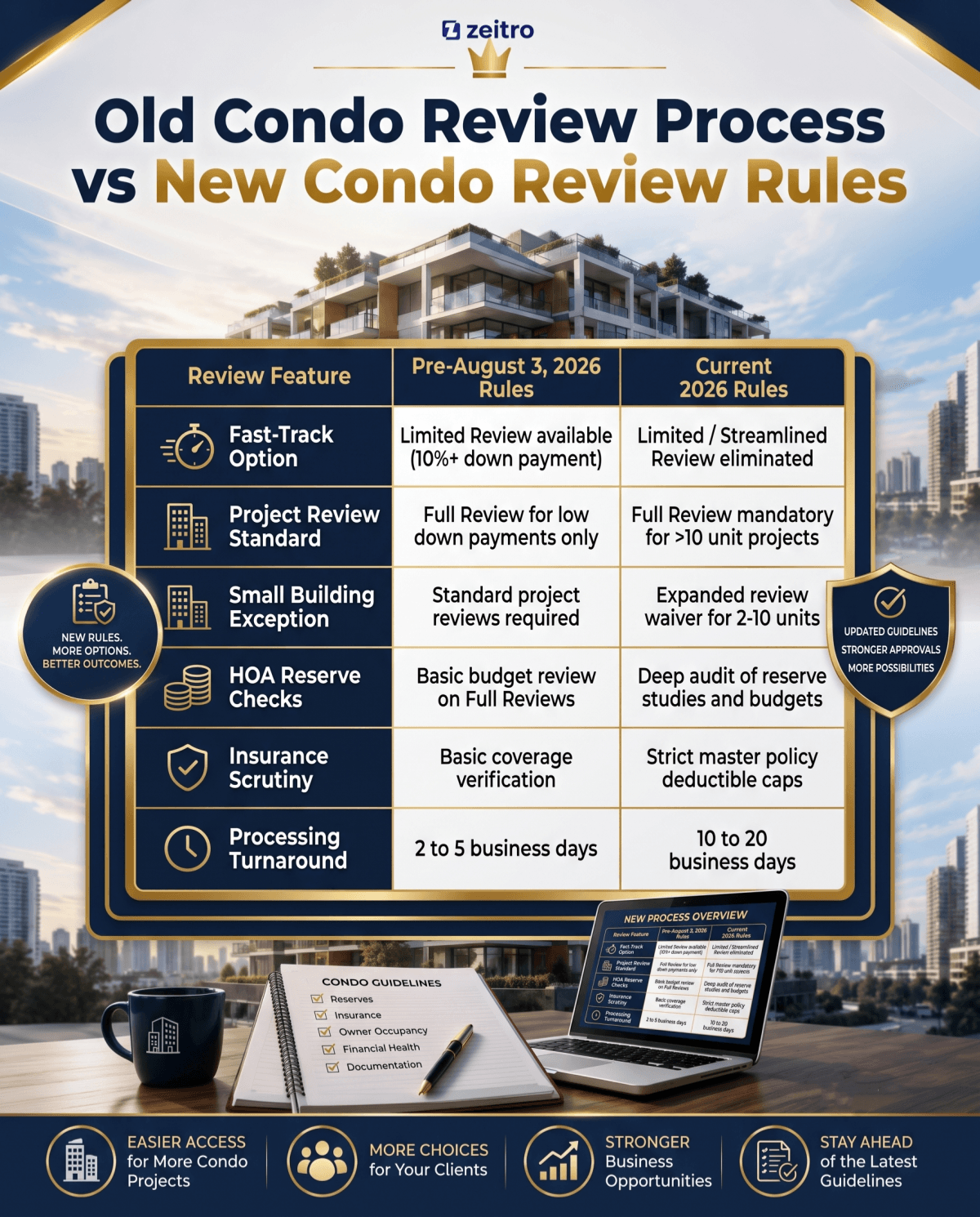
Under the old framework, my team could clear a condo file in less than a week if the buyer had strong assets. Today, the HOA's financial disclosures dictate our closing date, making early document collection non-negotiable.
The Biggest Changes Every Mortgage Professional Should Know
Limited Review Is Gone
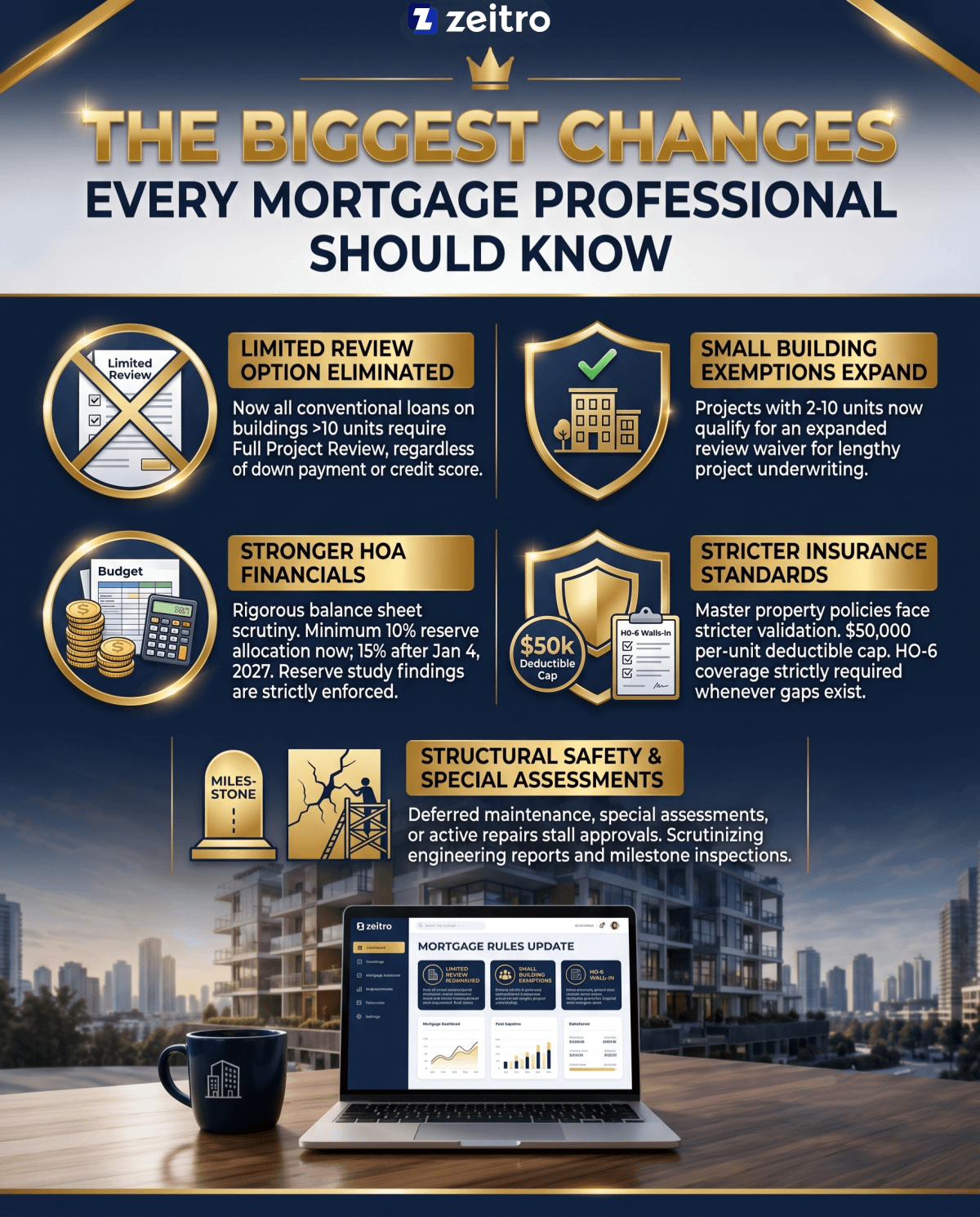
For years, a high down payment masked a weak HOA budget. That era ended on August 3. Every conventional borrower purchasing in a complex with over 10 units must now clear Full Review, regardless of down payment size or credit score.
Small Building Exemptions Expand
There is a bright spot for boutique properties. Projects containing 2 to 10 units now qualify for an expanded review waiver, allowing us to bypass lengthy project underwriting if fundamental standards are met.
Stronger HOA Financial Review and Reserve Targets
Underwriters are examining balance sheets with unprecedented rigor. While the minimum reserve allocation remains at 10% of the annual budget through 2026, it increases to 15% for loan applications dated on or after January 4, 2027. Additionally, if a reserve study is available, lenders must enforce the highest recommended funding targets from that study. Furthermore, if an HOA relies on a reserve study, lenders must enforce the highest recommended funding targets.
Insurance Requirements Take Center Stage
Master property policies face stricter validation. Master property policies are subject to a $50,000 per-unit deductible cap for per-occurrence claims, a requirement that has been in effect since March 2026. And individual walls-in (HO-6) coverage is strictly required whenever the master policy leaves interior gaps or carries per-unit deductibles.
Structural Safety and Special Assessments
If a property shows deferred maintenance, active structural repairs, or heavy special assessments, loan approvals will stall. Underwriters are now required to examine structural engineering reports and milestone inspections for aging buildings.
Who Will Be Affected Most?
This policy shift reshapes responsibilities across every node of the mortgage transaction. I created this breakdown to show how different professionals are impacted:
- Loan Officers: Must order HOA packages on Day 1; cannot promise fast 15-day closings.
- Underwriters: Face higher liability and longer review queues analyzing HOA balance sheets.
- Homebuyers: Risk deal cancellation if the building fails criteria, despite personal credit.
- Condo Associations: Burdened by detailed lender questionnaires and pressure to increase reserves.
- Real Estate Agents: Must verify building warrantability before writing purchase contracts.
In my daily calls with real estate agents this week, my message has been clear: we can no longer assume a condo is warrantable just because another lender approved a unit there last year.
Which Condo Projects Are Most Likely to Fail the New Review?
Based on recent loan files crossing my desk, certain condo developments carry a much higher risk of failing agency Full Review:
- Aging mid-rise and high-rise buildings with documented deferred maintenance or overdue milestone structural inspections.
- HOAs with cash reserve contributions below 10% of their annual operating budget (or under 15% preparing for the 2027 mandate).
- Projects with pending structural litigation between the HOA board and developers or contractors.
- Buildings carrying large special assessments to cover emergency roof, elevator, or balcony repairs.
- Properties with deficient master insurance, specifically policies featuring per-unit deductibles over $50,000.
If a client falls in love with a unit in one of these complexes, I immediately advise exploring portfolio or non-warrantable loan options upfront.
What Loan Officers Should Do Before Submitting a Condo Loan
To protect your pipeline and prevent last-minute loan denials, here is the operational checklist I implemented for my origination team this week:
- Order HOA documents immediately: Request the budget, balance sheet, master insurance policy, and completed questionnaire on Day 1.
- Audit reserve line items: Verify that at least 10% of assessment income goes directly into replacement reserves.
- Review board meeting minutes: Check if the HOA board is discussing pending special assessments or unfunded structural repairs.
- Verify master policy deductibles: Confirm the master property policy deductible does not exceed $50,000 per unit.
- Check for structural reports: Ask if the property has completed required milestone structural inspections.
- Set realistic timelines: Educate buyers and realtors that condo loan processing now requires 30 to 45 days.
Taking these proactive steps upfront saves your clients money and protects your professional reputation.
Frequently Asked Questions
Q1. Does this affect every condo?
No, it does not affect every single property type. Condominium projects consisting of 10 or fewer units may qualify for an expanded review waiver. However, for established condominium developments with more than 10 units, Full Review is now mandatory for all conventional mortgages submitted to Fannie Mae and Freddie Mac, regardless of whether the property is a primary residence, second home, or investment unit.
Q2. Can borrowers still qualify with low down payments?
Yes, qualified buyers can still purchase a condo with down payments as low as 3% or 5%. The key difference under the new rules is that placing 10%, 20%, or 30% down no longer bypasses the project review. The borrower's financial strength and the condo association's financial health are now evaluated as two entirely separate hurdles.
Q3. Does this change apply to existing loans?
No. These updated guidelines apply strictly to conventional loan applications originated on or after August 3, 2026. Existing mortgages that were already closed and purchased by Fannie Mae or Freddie Mac are unaffected. Homeowners with current conventional mortgages do not need to re-qualify or worry about their existing interest rates or terms changing.
Q4. Are Florida condos affected the most?
Florida condominiums face severe scrutiny because state-mandated milestone structural inspections and reserve requirements overlap with these agency updates. However, the August 3 rule change applies nationwide. In fact, Fannie Mae has eliminated its Florida-specific geographic restrictions, aligning the state with the national Full Review standard. However, Florida's own post-Surfside safety laws impose additional reserve and structural inspection mandates that may make compliance more stringent in practice.
Q5. How much longer will condo underwriting take?
In my experience, you should plan for condo loan processing to take an additional 10 to 20 business days. The main bottleneck is not the underwriter's review, but rather waiting for HOA management companies to complete complex questionnaires, provide updated balance sheets, and supply master insurance policy endorsements.
Q6. What documents are now required?
Lenders are now required to collect a comprehensive document package. This includes the completed HOA Questionnaire, the current annual budget, year-to-date financial statements, master property insurance declarations showing deductible details, bylaws, and any engineering structural reports or professional reserve studies completed within the last three years.
Final Thoughts
Navigating the new condo underwriting standards requires a fundamental mindset shift for loan originators. The days of relying on fast-track Limited Review shortcuts are over, but this shift ultimately creates a safer housing market for our clients. By treating project eligibility as a top priority from Day 1, collecting HOA documents early, and setting realistic closing expectations, you can keep your pipeline moving smoothly.
As mortgage professionals, our ability to guide buyers and real estate partners through these complex project requirements will be our greatest competitive advantage.


![[Solved] What Red Flags Would a Mortgage Underwriter See?](https://cdn.prod.website-files.com/6731bc6e813a541b54c30b10/6aa24ca70b95e62dd7bbeefd_red-flags-mortgage-underwriting-banner.png)