Written by

Eric
Share this article

.svg)
Subscribe to updates
Last checked and updated on Auguest, 2026.
If you're a loan officer, broker, or wholesale lender, you already know the mortgage origination process can feel like herding cats. It's complex, it's paperwork-heavy, and on a bad week it's exhausting. I've lost count of the late nights I've spent chasing down a stalled file, and every single time it came back to the same root cause: a pipeline nobody was actively managing.
Mortgage pipeline management isn't a nice-to-have. It's the difference between a lending business that scales and one that quietly bleeds revenue. In this guide, I'll walk you through what a pipeline actually is, the pieces you need to track, and the practices that keep deals moving toward the closing table instead of stalling out.
Key Takeaways
- What it is: A mortgage pipeline is every loan your team is actively working, from the first application to funded closing.
- Core elements: Strong pipeline management blends operational speed, rate-risk hedging, and airtight compliance.
- The AI edge: Tools like Zeitro cut manual guideline lookups, speed up pre-qualification, and help teams close a noticeably higher share of the loans they start.
What Is a Mortgage Pipeline?
A mortgage pipeline, in plain terms, is the full set of loan applications your team has in motion right now — from the moment a borrower applies through funding, or through withdrawal if the deal falls apart. Some people also call this a loan pipeline, and the meaning is the same whether you're a solo broker or a 200-person shop.
The mortgage industry doesn't sit still. The Mortgage Bankers Association projects roughly $2.2 trillion in single-family originations for 2026, an increase of about 8% over the prior year — which works out to something like 5.8 million individual loans moving through pipelines across the country at any given time. That's the scale problem pipeline management is actually solving.
I learned this the hard way when I started tracking my own fallout rate — the share of loans that never make it to closing. Watching that number closely was the moment I realized how much profit disappears when bottlenecks go unnoticed. Whether you're running your pipeline in a spreadsheet or dedicated mortgage pipeline software, a well-managed pipeline gives you a clear, honest view of where your business actually stands.
Here's what an organized pipeline does for you day to day:
- Forecasts revenue and cash flow: You know what's funding, and roughly when.
- Flags bottlenecks early: You can see exactly where a file is stuck — processing, underwriting, or waiting on a condition.
- Protects margin through hedging: You stay ahead of rate swings instead of getting blindsided by them.
- Balances workload: You keep processors and underwriters from burning out during volume spikes.

Key Components of Mortgage Pipeline Management
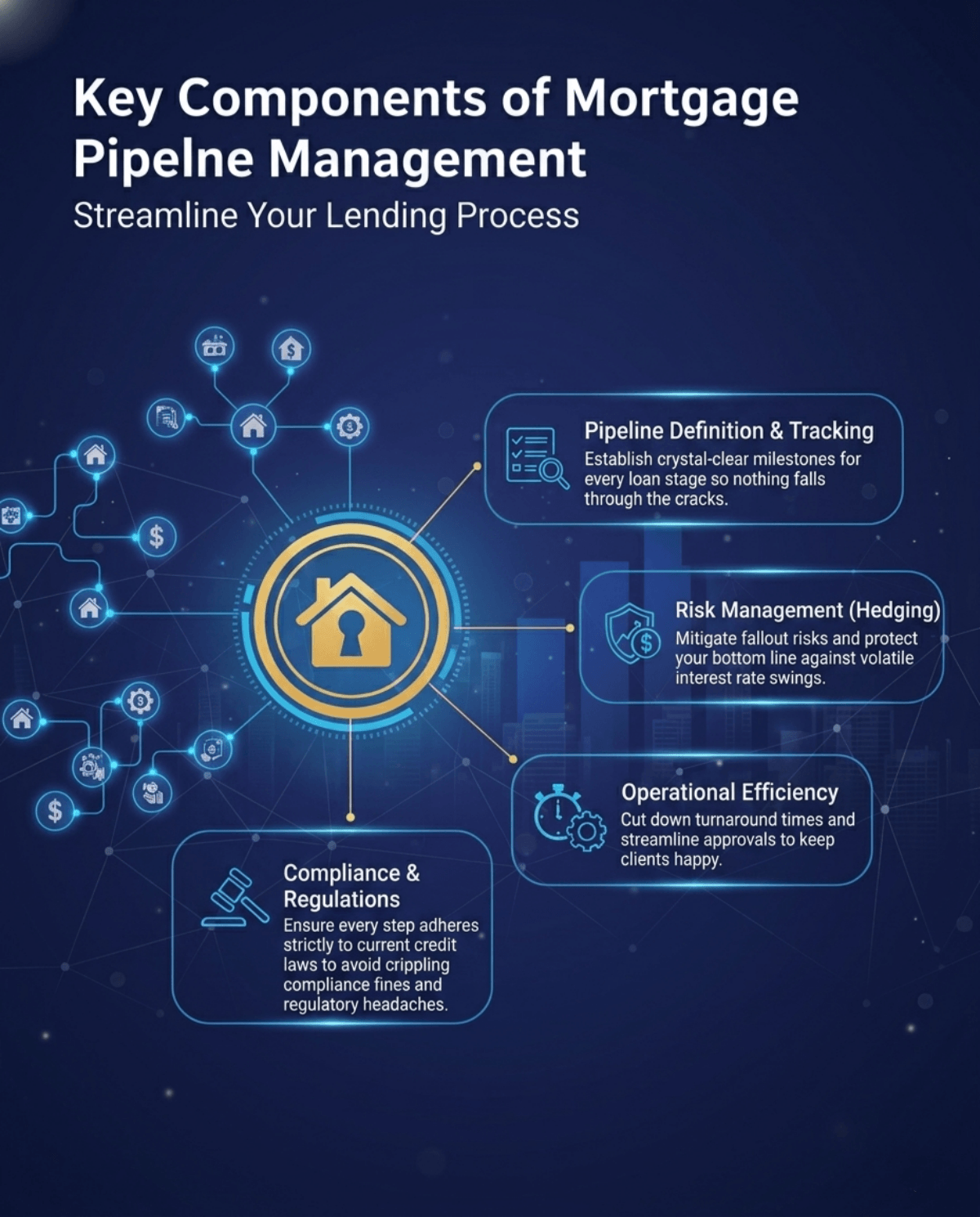
Running a pipeline well is more than shuffling files between desks — it takes a handful of habits, applied consistently. These are the same building blocks whether you're managing a mortgage pipeline, a broader bank loan pipeline, or a lending pipeline that spans multiple loan products.
- Pipeline definition and tracking: Set clear milestones for every stage so nothing quietly falls through the cracks.
- Risk management and hedging: Guard against fallout and rate-driven losses before they hit your bottom line.
- Operational efficiency: Trim turnaround times so approvals don't drag and borrowers don't get frustrated.
- Compliance and regulation: Keep every stage aligned with current lending law, since a compliance gap can undo months of good work fast.
Also Read: Best Mortgage Pipeline Management Software: Streamline Workflow
Best Practices: How to Manage Your Mortgage Pipeline Effectively?
Knowing the components is one thing, but executing them is another. Let me share the actionable best practices I rely on to turn a sluggish pipeline into a high-converting machine.
Leverage AI-Powered Pipeline Management Software
Manual data entry and spreadsheets used to be tolerable. In 2026, they're a liability — borrowers expect answers fast, and a delayed pre-qualification often means a lost lead. This is where a tool like Zeitro, an AI Agent built specifically for U.S. mortgage professionals, earns its keep. Teams using it report pre-qualifications delivered roughly 2.5 times faster, close rates up around 30%, and 18 to 20-plus hours saved per person, per month.
One question I get a lot from loan officers is whether a tool like this replaces their loan origination system. It doesn't. Platforms like Encompass and Calyx Point remain the system of record for the loan file itself, and they're genuinely good at basic status tracking. What most LOS platforms weren't built for is instantly verifying guideline eligibility or catching a missing condition across hundreds of investor programs — that's a layer that sits on top, not a replacement underneath.
Here's how Zeitro's four core tools support that layer:
- Zeitro Strata AI: This AI-powered assistant is a lifesaver. It verifies both QM and Non-QM mortgage guidelines in seconds across multiple sources, eliminating most of the manual lookup work and reducing underwriter bottlenecks.
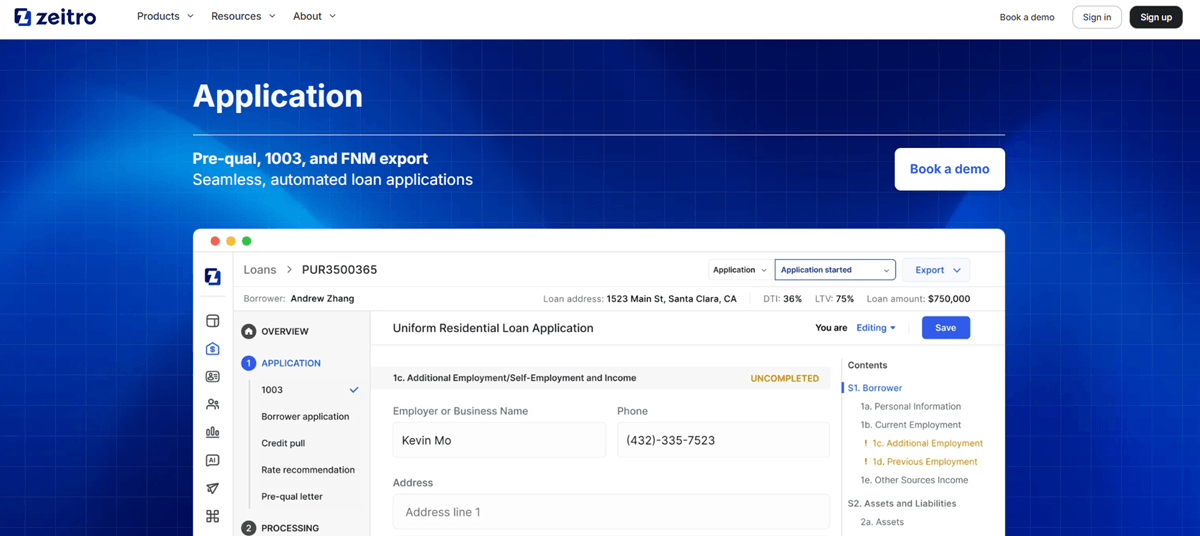
- Digital 1003 (POS): A borrower application system that automates everything from accurate AI-driven Debt-to-Income (DTI) calculations to exporting FNM 3.4 formats. It boasts a 90%+ completion rate, letting borrowers finish the 1003 form in just 5 minutes and accelerating intake.
- Pricing Engine: An intuitive rate quote tool granting instant access to up-to-the-minute conventional and Non-QM rates. You can deliver highly competitive pricing in seconds, which is crucial for early conversion.
- GrowthHub: A customizable, SEO-optimized personal microsite on Bluerate for loan officers. It features instant rate quotes and pre-qualification forms, acting as a lead-generation magnet to keep your pipeline consistently full.
Standardize Workflows Across the Pipeline
You cannot scale chaos. One of the biggest lessons I've learned is that standardizing your Standard Operating Procedures (SOPs) is vital for a smooth pipeline. Every time a file moves from a loan officer to a processor, and then to an underwriter, there's a risk of friction or miscommunication.
By establishing clear, standardized milestones, you ensure that everyone on the team knows exactly what is required at each specific stage. This means standardized document checklists, uniform communication templates, and rigid handoff protocols. When expectations are crystal clear, you dramatically reduce the back-and-forth emails and missing document requests that typically delay closings. A standardized workflow keeps the momentum going and builds trust with your borrowers.
Implement Data-Driven Reporting & Analytics
If you aren't measuring your performance, you are simply guessing. I rely heavily on data-driven reporting to make informed decisions rather than going by gut feeling. Real-time analytics are the heartbeat of effective pipeline management.
You need to constantly monitor core metrics like your pull-through rates, fallout rates, and average turnaround times. For instance, if data shows a sudden spike in loans stalling during the processing phase, I immediately know where to investigate. Utilizing advanced reporting tools allows you to proactively spot trends, identify exactly which stage is causing delays, and adjust your strategies before those bottlenecks cost you deals. Let the numbers guide your daily operations.
Optimize Loan Volume & Capacity Planning
The mortgage industry is famously cyclical. Volume fluctuates wildly. Managing capacity is all about ensuring your team doesn't buckle under pressure during a boom or sit idle during a lull. I've seen underwriters get entirely overwhelmed when a sudden surge of applications hits the pipeline, leading to costly errors and missed deadlines.
To optimize capacity, you must anticipate these waves. When the pipeline swells, leveraging AI technology, like the assistants I mentioned earlier, can absorb the excess volume without requiring you to immediately hire more full-time staff. Properly balancing the workload prevents burnout and ensures that every loan, regardless of the overall volume, receives the prompt attention required to reach the closing table on time.
Separate Workflows by Loan Types
Treating every loan exactly the same is a rookie mistake. Qualified Mortgages (QM) and Non-QM loans have vastly different documentation requirements and risk profiles. Mixing them in the same processing queue usually slows down the simpler, straightforward files.
I strongly recommend segmenting your pipeline based on loan type. By separating these workflows, you can route the complex Non-QM scenarios to your most experienced processors or let specialized AI tools quickly handle those obscure guideline queries. This prevents a complicated bank statement loan from holding up a standard W-2 conventional application. Routing files to the right expertise instantly boosts overall review efficiency and improves your team's sanity.
Manage Rate Risk With Pipeline Hedging
Here's a piece that trips up a lot of newer originators: the moment you lock a borrower's rate, you've taken on risk. If market rates climb before that loan sells on the secondary market, the value of the loan you're holding drops — and that hit comes straight out of your margin.
Pipeline hedging offsets that exposure. Say you've got $5 million in rate-locked commitments this month, and your historical pull-through rate runs around 75%. You're not actually exposed on the full $5 million — you're exposed on roughly $3.75 million, since a quarter of those locks typically fall out before closing. That pull-through assumption is what determines how much hedge coverage you actually need; overestimate it and you're overpaying to hedge loans that were never going to close, underestimate it and you're exposed when rates move against you.
Most originators execute this through TBA (to-be-announced) mortgage-backed securities trades, and larger shops often lean on specialized secondary-market hedging technology to keep those calculations current as the pipeline shifts daily. It's a deeper topic than we can fully cover here — if you want the full mechanics, our Mortgage Pipeline Hedging 101 guide walks through the entire process step by step.
FAQs About Mortgage Pipeline Management
Q1. What is a loan pipeline?
It is the total sum of all active, in-progress loan applications your business is handling before they are either fully funded or canceled.
Q2. What are the KPIs for pipeline management?
The core Key Performance Indicators (KPIs) include the pull-through rate, fallout rate, average cycle time (from origination to close), and the operational cost per loan.
Q3. What is mortgage pipeline hedging?
It is a financial risk management strategy where lenders use market instruments to protect themselves against the risk of interest rate changes after a borrower locks in their rate.
Q4. What is the difference between a mortgage pipeline and a portfolio?
A pipeline consists of active, unclosed loans still in the application process, while a portfolio refers to fully funded loans that a lender already holds as assets.
Q5. How can AI improve mortgage pipeline management?
AI transforms the process by automating mundane data entry, instantly verifying complex lending guidelines, and drastically accelerating underwriting decisions.
Q6. How do you calculate the mortgage pipeline fallout rate?
You divide the total number of loans that failed to close (before their rate lock expired) by the total number of locked applications during that same period.
Q7. Does pipeline management software replace my LOS?
No — a good pipeline management layer works alongside your existing loan origination system, not instead of it. Your LOS stays the system of record for the loan file; tools like Zeitro Strata AI add real-time guideline verification, condition tracking, and eligibility checks on top of it.
Q8. What should I look for in a mortgage pipeline tracker?
Look for real-time status visibility, automated condition and document-gap alerts, built-in reporting on pull-through and fallout rates, and the ability to segment loans by type — QM versus Non-QM in particular — so nothing gets stuck behind the wrong queue.
Final Thoughts
The mortgage market right now leaves very little room for error, and pipeline management is where that margin gets won or lost. Done right, it's not just risk avoidance — it's a genuine growth lever.
Standardize your workflows, watch your numbers closely, and bring AI into the parts of the job that don't need a human touch, and you'll free up real time for what actually grows the business: relationships and closings. If you want to see what this looks like in practice, Zeitro Strata AI gives you free guideline queries a day, so you can test it against your own toughest scenarios before deciding whether it earns a permanent spot in your workflow.
People Also Read
- Best Mortgage CRM for Brokers, Lenders, MLOs
- Top Loan Origination Systems: Close More Loans Quicker
- Best AI Mortgage Underwriting Software for Loan Professionals
- What is Mortgage Eligibility Checker? Best Tool to Verify Guidelines
- How to Determine Mortgage Eligibility? Verify Guidelines in Seconds
- Mortgage Pipeline Hedging 101: Complete Guide & Strategies

![[Tips for Loan Officers] How Can I Lower Borrower DTI?](https://cdn.prod.website-files.com/6731bc6e813a541b54c30b10/6aa3b89e281a639e7a5c6fca_lower-debt-to-income-ratio-banner.jpg)