![[Guide] Loan Origination Explained: Meaning, Process, Cost](https://cdn.prod.website-files.com/6731bc6e813a541b54c30b10/6a0ecb8eeee5ecd064027b6f_what-is-loan-origination-banner.png)
Written by

Eric
Share this article

.svg)
Subscribe to updates
Last checked and updated on Auguest, 2026.
We all love the idea of finally getting the keys to a new place, but the paperwork that stands between you and that moment can feel like a maze. As a homebuyer, mortgage loan origination is one of the earliest and most important stretches of the entire process. Understanding how it works isn't just about picking up bank jargon — it's how you avoid last-minute delays and keep more money in your pocket at the closing table. Here's exactly what happens behind the scenes, and how to come out ahead.
Key Takeaways
- The bottom line: Loan origination is the full journey your lender takes to create, verify, and fund your home loan, from your first application to the day your money is ready.
- What you'll pay: Expect an origination fee somewhere between 0.5% and 1.5% of your loan amount. Nationwide, lenders charged an average of roughly $3,822 per loan in 2024, according to federal Home Mortgage Disclosure Act (HMDA) data — though your own number depends heavily on lender, loan size, and location.
- The big difference: Origination is about building and organizing your file. Underwriting is the final yes-or-no verdict on your money.
What is Loan Origination for a Mortgage?
I've noticed a lot of first-time buyers assume getting a mortgage happens in one shot — you ask, and the bank eventually says yes. In reality, it's a much more layered administrative process, and that process has a name: loan origination.
Picture it as everything that happens between the moment you submit your first application and the day your lender has funds ready for closing. Why put you through all of it? Mostly, it comes down to risk. A bank can't hand over hundreds of thousands of dollars on a handshake. Origination is how they confirm your identity, dig into your finances, and make sure the property is actually worth what you're paying.
In my experience, buyers who treat origination as building a financial relationship with their lender — rather than just filling out forms — tend to move through it with far less frustration. It really is the foundation the rest of your purchase gets built on.
Where the Market Stands in 2026
Context helps here. The Mortgage Bankers Association projects total single-family mortgage origination volume to reach roughly $2.2 trillion in 2026, split between about $1.46 trillion in purchase loans and $737 billion in refinances. Lending volume has been climbing back after a slow stretch, but affordability pressure — especially for first-time buyers — hasn't gone away. None of that changes the mechanics of your own loan, but it explains why lenders are busier than usual and why staying organized matters even more right now.
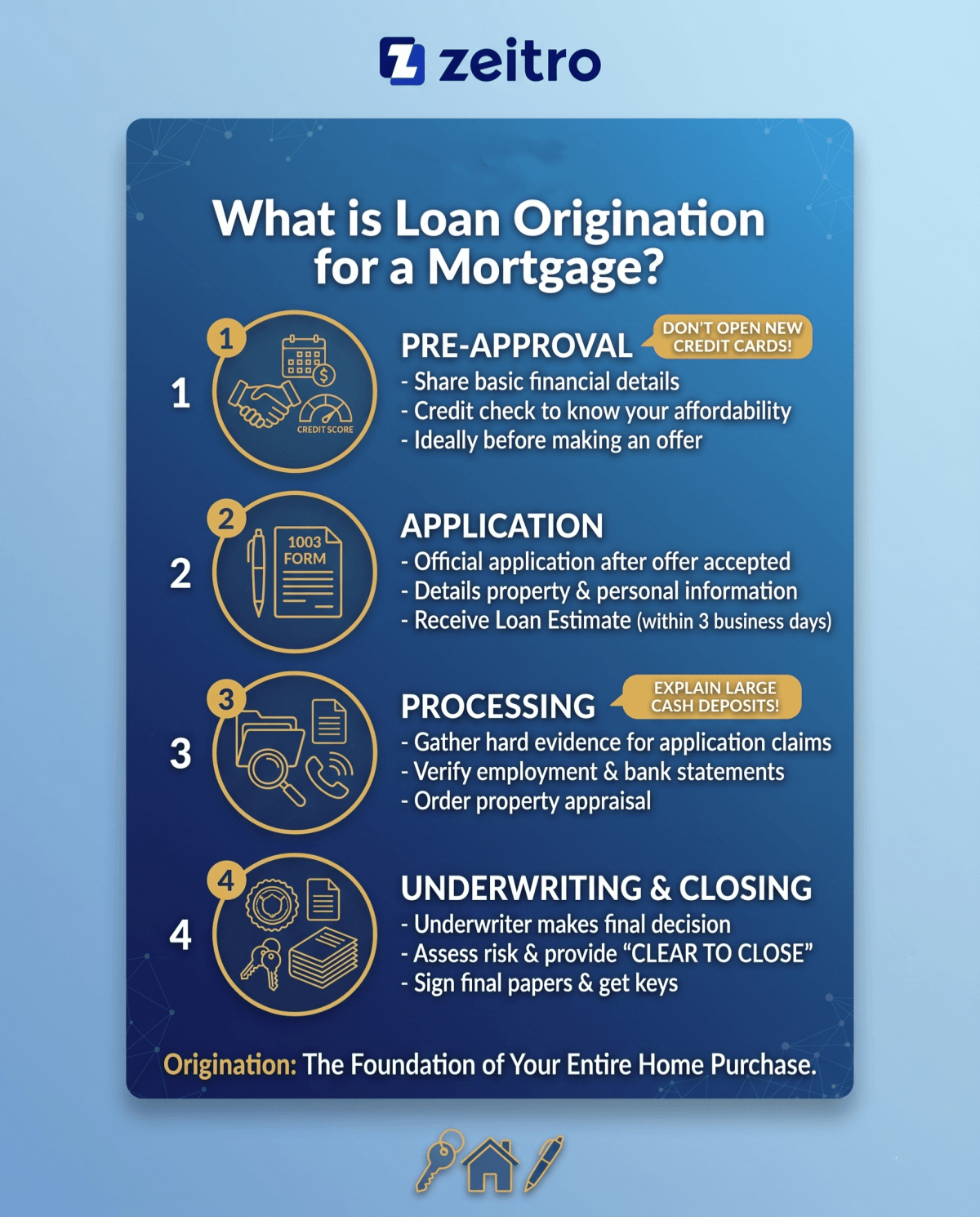
4 Stages of the Loan Origination Process
The whole timeline feels way less intimidating once you chop it into bite-sized pieces. If you know what's coming, you can actually help speed things up.
1. Pre-approval and Pre-qualification
Ideally, you should complete this step before seriously shopping for a home or making an offer. You'll share basic financial details, allowing the lender to run a credit check and tell you how much house you can afford.Please don't open new credit cards or buy a car right now. A sudden credit ding can kill your pre-approval fast.
Also Try: Zeitro Mortgage Affordability Calculator Free and Online
2. Submitting the Loan Application
Found the house and got your offer accepted? Great. Now you officially apply by filling out the Uniform Residential Loan Application (often called the 1003 form).Fill this out honestly, detailing the property and your personal info. In return, the lender is generally required to provide a Loan Estimate within three business days after receiving a complete application, breaking down your expected rate and closing costs.
3. Processing and Verification
This is the grunt-work phase. A loan processor steps in to make sure every claim on your application is backed by hard evidence. They'll order the property appraisal, call your boss to verify employment, and scrutinize your bank statements.Processors hate mystery money. If you have large, unexplained cash deposits in your checking account, prepare to write letters explaining exactly where they came from.
4. Underwriting and Closing
Finally, your thick file lands on the underwriter's desk. They are the ultimate decision-makers. They assess the risk and decide if you're good for the money. If you pass, you get a "Clear to Close," meaning you're ready to sign the final papers and get your keys.
Does the Loan Type Change the Process?
The four stages above apply no matter what kind of mortgage you're getting, but the fine print on fees can shift. VA loans, for instance, cap the lender's flat origination fee at 1% of the loan amount. FHA and USDA loans don't impose a hard percentage cap on the origination fee itself, but examiners expect the charge to stay "reasonable and customary" for the market. If you're comparing loan types, ask each lender to show you the origination charge line item specifically rather than assuming the percentage is identical across programs.
Requirements of Loan Origination
Want a secret to a stress-free mortgage? Have your documents ready before the loan officer even asks. Doing this upfront easily shaves days off your timeline. Here's the standard checklist you'll need to pull together:
- Government ID: A current driver's license or US passport.
- Proof of Income: Your two most recent W-2s and about a month's worth of recent pay stubs.
- Tax Returns: The last two years of your 1040s (super important if you're a freelancer or business owner).
- Asset Proof: The past 60 days of bank statements across checking, savings, and retirement accounts. They need to see you actually have the cash for the down payment.
- Debt Records: Statements for student loans, car payments, or credit cards to figure out your Debt-to-Income (DTI) ratio.
Keep everything updated. Lenders won't accept statements from six months ago.
Also Read:
- Max DTI for Mortgage: Requirements By Loan Types
- Max LTV: Check Maximum Loan-to-Value Ratios By Loan Types
- Guide: Loan Origination Points Explained in Mortgage
Example of Loan Origination
Let's look at how this plays out in real life. Imagine John is buying his first place in Texas for $400,000. He is putting down 20% ($80,000), meaning he needs to borrow $320,000.
John heads to a local lender to kick off the origination process. He hands over his 1003 application, his W-2s, and bank statements. The bank charges him a 1% origination fee on his $320,000 loan amount.
Over the next month, the bank's processor orders an appraisal to verify the house is truly worth that 400k price tag. Once John's financial puzzle is fully assembled, the file goes to the underwriter. They review the risk, confirm John is a solid borrower, and officially approve the $320,000.

How Much Does Loan Origination Cost?
So, what's the damage? In the U.S., a typical loan origination fee usually lands between 0.5% and 1% of your total borrowed amount. Using John's $320,000 mortgage as an example, his fee would run anywhere from $1,600 to $3,200.
You don't have to write a check for this on day one, though. It is typically included as part of your total closing costs, which you may pay upfront or, in some cases, roll into the loan depending on the structure.
These fees aren't always set in stone. I strongly recommend trying to negotiate. Ask your lender to lower the fee, or bring in a competitor's Loan Estimate and ask them to match it.
Key Differences: Loan Origination vs Underwriting
People mix these two up all the time since they happen right next to each other. To put it simply: the loan officer helps you build your case, while the underwriter is the judge who hands down the verdict.
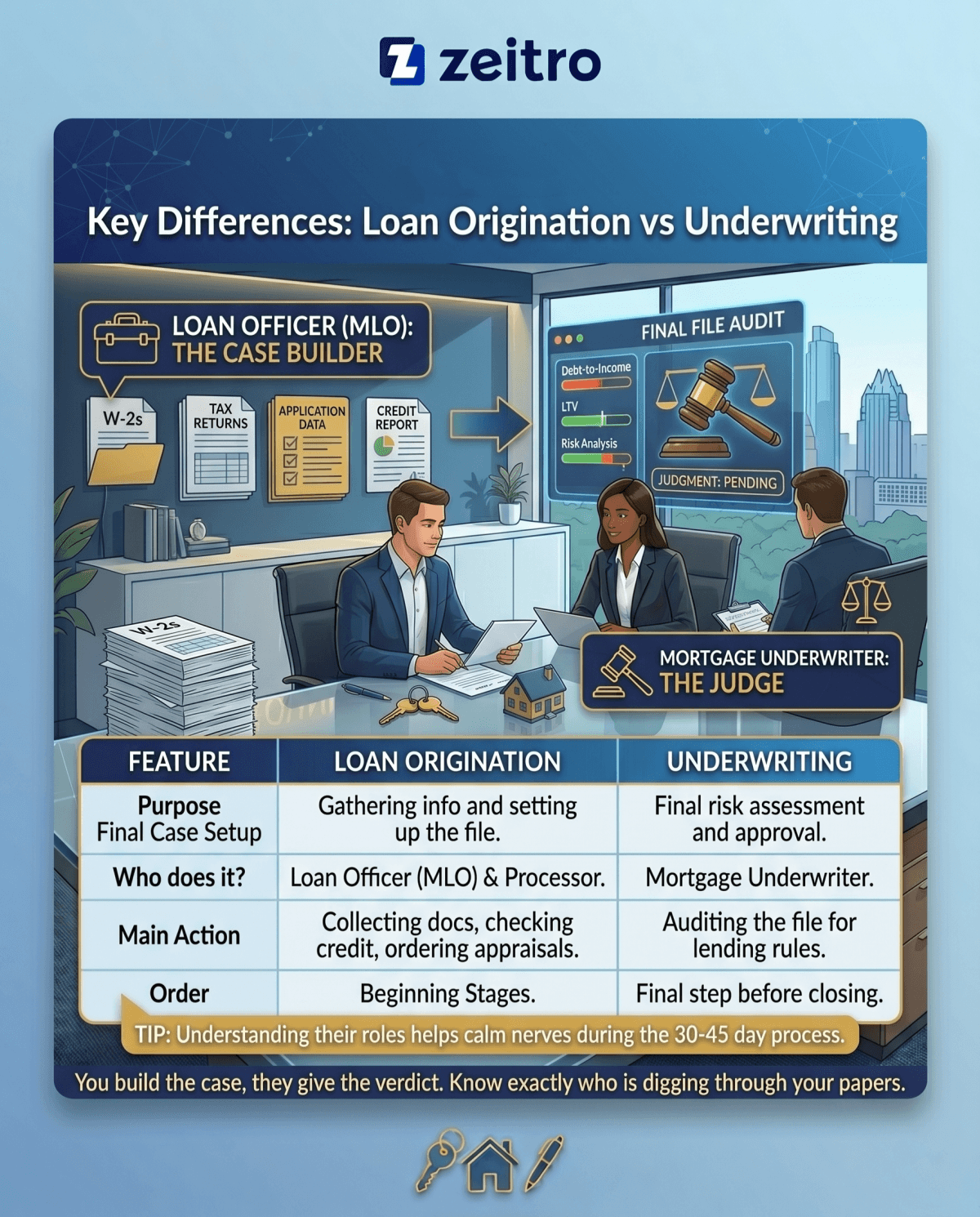
Knowing who does what really helps calm the nerves during those 30 to 45 days of waiting. You'll know exactly who is digging through your paperwork.
Also Read: Mortgage Underwriter vs Loan Officer: Which Career Is Best?
Behind the Scenes: How Lenders Manage Origination Today
Most lenders now run this entire process through a loan origination system, or LOS — software that tracks your file, triggers disclosures automatically, and flags missing documents before they slow you down. Platforms like Zeitro build this kind of technology specifically for loan officers, pairing automation with AI-assisted underwriting checks so files move faster and with fewer manual errors. If you're a loan officer rather than a borrower reading this, it's worth comparing how much of your own origination workflow could be automated.
FAQs About Loan Origination
Q1. What is a loan originator?
A mortgage loan originator (MLO) is the professional or company helping you apply for your home loan. Think of them as your main point of contact. They take your application, explain your interest rates, and guide your file through the messy early stages.
Q2. What is a loan origination system?
A loan origination system (LOS) is the backend software banks use to manage your file. This digital platform handles the heavy lifting, from spitting out initial disclosures to securely holding your tax returns and running automated compliance checks.
Q3. What is a loan's origination date?
This one trips people up because it sounds like the application date, but it isn't. Your loan's origination date is the day your mortgage was legally created and funded — usually your closing date. It's the date your amortization schedule starts counting from, and it's what shows up as your account's "open date" on your credit report. You'll find it printed on your Closing Disclosure, and later on your monthly mortgage statement or your servicer's online portal if you ever need to look it up again.
Q4. Is a loan originator the same as a broker?
No, they aren't the same. A loan originator typically works for a specific lender and offers that lender's products, though some may have access to a wider range of loan options depending on their organization. A mortgage broker, on the other hand, is a middleman who shops your application around to dozens of wholesale lenders to find the best rate.
Q5. Can you negotiate loan origination fees?
Yes, you absolutely can. When you get your Loan Estimate, look closely at the "Origination Charges." You can push back and ask the lender to lower that number, or better yet, use a competing offer from a different bank to force a price match.
Q6. How long does the loan origination process take?
From application to closing table, the whole origination process usually takes often takes around 30 to 45 days, though timelines can vary widely depending on market conditions and borrower responsiveness. Keep in mind, this timeline heavily relies on you. The faster you hand over requested documents, and the smoother the appraisal goes, the quicker you'll get to closing.
Final Word
Getting a mortgage can easily feel like drowning in paperwork, but the origination process is really just the foundational first step of buying a house. Once you understand the mechanics behind the scenes, from that first 1003 application to the underwriter's final stamp of approval, you take back control. Having your files organized early on and pushing back on fees can save you a ton of stress and cash.
Ready to finally get moving on your home hunt? Start by reaching out to a local, licensed loan officer today to check rates and get that pre-approval locked in.
People Also Read
- Warrantable vs Non-Warrantable Condo: What's the Difference?
- 10 First-Time Home Buyer Tips: What to Know in 2026
- Gross vs. Net Income for a Mortgage: What Lenders Use & Why
- Mortgage Interest Deduction: Details, Limits & FAQs
- Fixed vs Adjustable Rate Mortgage: Full Differences to Compare

![[Tips for Loan Officers] How Can I Lower Borrower DTI?](https://cdn.prod.website-files.com/6731bc6e813a541b54c30b10/6aa3b89e281a639e7a5c6fca_lower-debt-to-income-ratio-banner.jpg)