
Written by

Eric
Author from Zeitro

Share this article

Subscribe to updates

Thank you! Your submission has been received!
Oops! Something went wrong while submitting the form.

As a mortgage professional, I know the drill. A borrower wants to buy a home, but their tax returns don't tell the whole story of their actual purchasing power. Enter the WVOE. But here's the problem: figuring out exactly which lender accepts what under their specific WVOE guidelines means wasting hours reading PDF matrices. If you're tired of that manual grind, you're not alone.

Later in this guide, I'll show you how I use Zeitro Scenario AI to verify eligibility across different lenders in seconds just by chatting with it. But first, let's break down the fundamentals.

What Does WVOE Mean in a Mortgage?

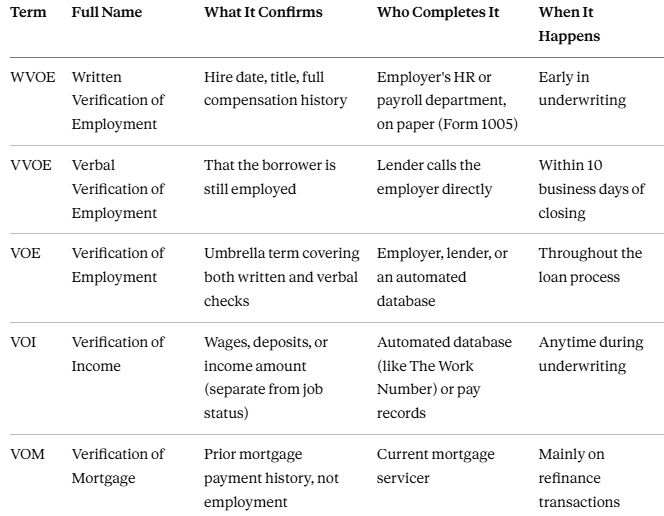
WVOE stands for Written Verification of Employment. In the industry, we usually just call it Fannie Mae Form 1005. As an underwriter or loan officer, I use this document to confirm a borrower's hire date, current title, detailed breakdown of compensation (base, bonus, overtime), and the likelihood of their continued employment.

For first mortgages, the lender must send Form 1005 directly to the employer, and the completed form must be returned directly to the lender without passing through the borrower. For second mortgages, the borrower may hand-carry the form to the employer, but the employer must mail it back directly to the lender. It's strictly designed this way to prevent fraud and give lenders a clear, verified picture of a borrower's stable income.

What is a WVOE Loan?

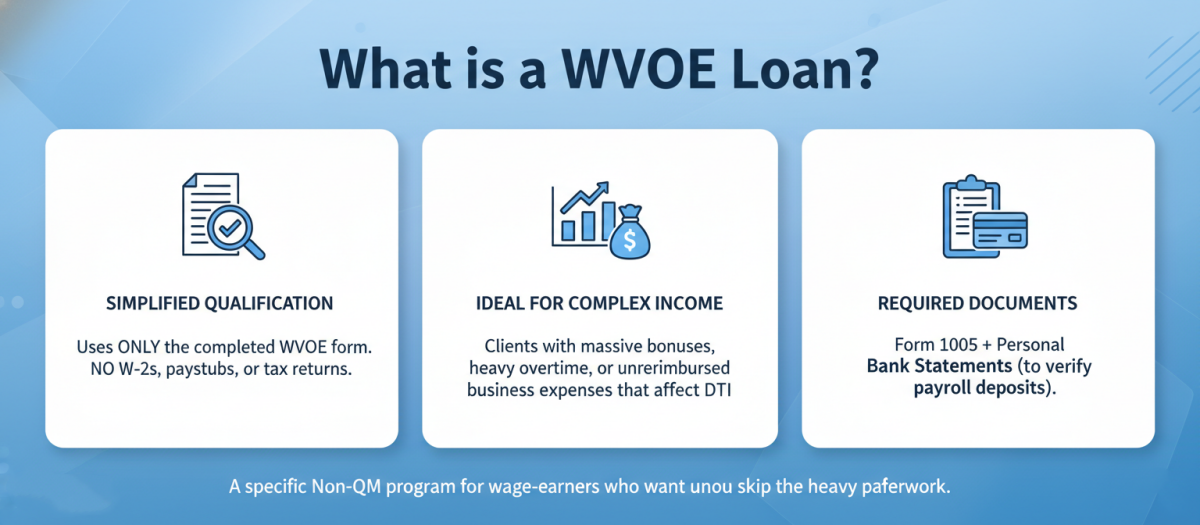
While a WVOE is just a piece of paper used in standard conventional loans, a "WVOE Loan" (or WVOE-Only Loan) is an entirely different beast. It's a specific Non-QM program tailored for traditionally employed wage-earners who want to skip the heavy paperwork.

With this product, you qualify the borrower using only the completed WVOE form. That means zero W-2s, no paystubs, and absolutely no tax returns. I find this program incredibly useful for clients who receive massive bonuses, heavy overtime, or have significant unreimbursed business expenses that ruin their debt-to-income (DTI) ratios on traditional tax filings. Lenders usually just require the Form 1005 paired with a couple of personal bank statements to prove the payroll deposits are real.

What is a WVOE Loan?

What are WVOE Mortgage Guidelines?

Guidelines exist because investors need to mitigate the risk of lending without traditional tax documents. While Fannie Mae has its standard rules, the real complexity lies in the Non-QM space. I've worked with dozens of lenders, and they all have their own unique "overlays" or extra restrictions for WVOE loans.

For instance, underwriters will rigorously vet the employer. The company must be an independently verifiable, legitimate entity. If your borrower works for a family business or holds any ownership shares in the company, they are instantly disqualified. Lenders also look at the consistency of income. If the WVOE shows a sudden, unexplained massive jump in commission right before closing, that's going to trigger conditions. Knowing these granular guidelines upfront is crucial so you don't waste time structuring a deal that will die in underwriting.

Key Requirements of a WVOE Loan

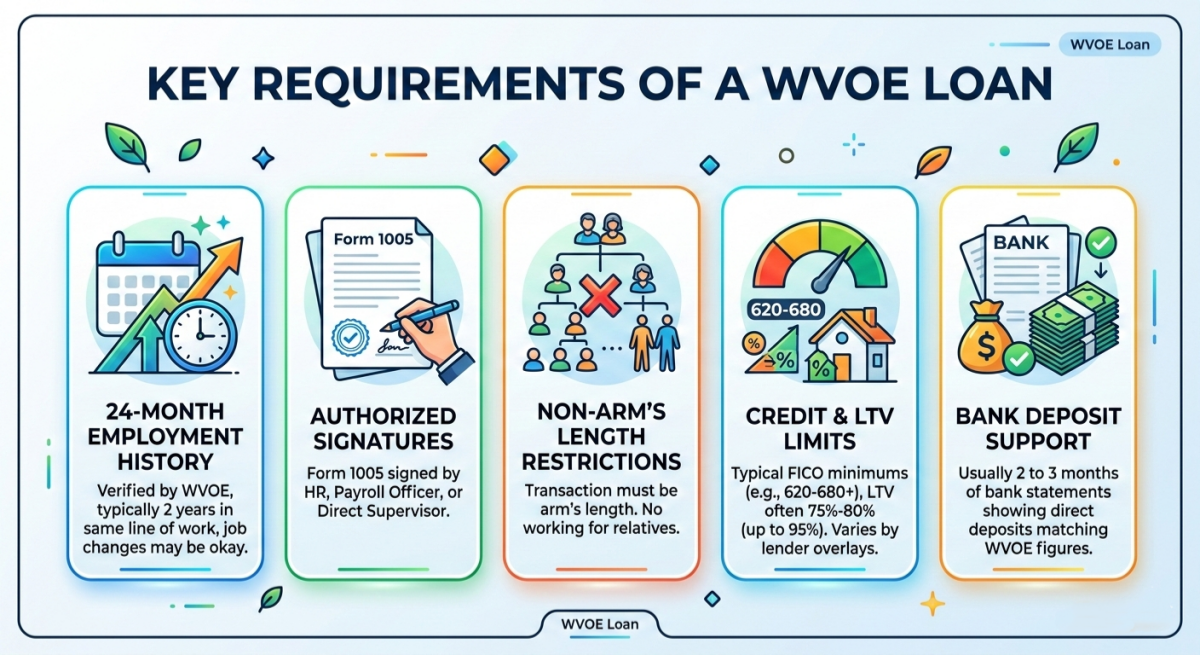
Every wholesale lender has slightly different matrices, but from my experience, the core requirements for a WVOE-only program usually follow a strict pattern to prevent fraud. Here is what you generally need to look out for:

  • Two-Year History: The borrower typically needs at least 24 months of employment history in the same line of work with the current employer, as verified by the WVOE. Changes in employer within the same field may be acceptable depending on the lender's overlays.
  • Authorized Signatures: Form 1005 must be signed by an official HR representative, a payroll officer, or a direct supervisor.
  • Non-Arm's Length Restrictions: The transaction must be arm's length. Working for a relative is a hard "no".
  • Credit & LTV Limits: FICO minimums for WVOE loans typically start at 620-680 depending on the lender and program, with LTV ratios often capped at 75%-80% for purchases (up to 95% in some cases with stronger profiles). These vary by specific Non-QM lender overlays.
  • Deposit Support: Lenders usually want to see 2 to 3 months of bank statements showing direct deposits that match the WVOE figures.
Key Requirements of a WVOE Loan

Bonus Tip: How to Efficiently Verify WVOE Guidelines?

If you're a Loan Officer or Broker, you already know the biggest pain point of Non-QM loans: comparing guidelines. Digging through a 100-page PDF from AD Mortgage or AmWest just to see if your borrower's specific scenario fits is a massive time sink.

That's why I rely on Zeitro Scenario AI. It's an AI-powered mortgage guideline assistant built specifically for our industry, and it completely changes the way I do my loan research. Instead of hitting Ctrl+F through outdated matrices, you just type your scenario into the chat, and it instantly searches the actual guidelines.

Bonus Tip: How to Efficiently Verify WVOE Guidelines?

Here's why it's a game-changer for my pipeline:

  • Massive & Updated Coverage: It pulls from nearly 300 guidelines, including 35+ specific WVOE programs, from top lenders like Freedom Mortgage, HomeXpress, MK Lending, and AAA Lending.
  • High Accuracy with Citations: It doesn't guess. It provides exact citations linking back to the source document, giving you hard proof for your underwriter.
  • Lightning-Fast Answers: Ask anything from broad eligibility questions to niche product rules, and get an answer in seconds.
  • Deep Explanation Function: If a lender's rule seems confusing, the "Explain" feature breaks it down further based on your selected documents.
  • Cost-Effective & Multi-Language: It supports both English and Chinese queries, lets you share results via link, and starts at just $8/month (plus, you get 3 free queries a day).

FAQs About WVOE Guidelines

Q1. How do you obtain a WVOE?

The borrower signs an authorization upfront. The lender then sends Fannie Mae Form 1005 directly to the employer's HR or payroll department. The employer fills out the income and history details, signs it, and sends it straight back to the lender.

Q2. Do I have to fill out the employment eligibility verification?

No. Borrowers are strictly prohibited from filling out any part of the WVOE form aside from the initial signature authorizing the release of information. If a borrower handles, types, or edits the form, the lender will reject the loan.

Q3. What is the difference between VVOE and WVOE?

A VVOE (Verbal Verification of Employment) is a phone call by the lender obtained within 10 business days prior to the note date (closing) to confirm the borrower remains employed. It supplements earlier written verifications like WVOE, which is used during underwriting. A WVOE (Written Verification) is a detailed physical form used early in underwriting to calculate your full income history.

Q4. What are acceptable alternative documents for employment verification?

If a WVOE isn't possible, lenders usually default to traditional full-doc verification using W-2s, 30 days of paystubs, and recent tax returns. Alternatively, many lenders now pull automated verification data directly from third-party databases like The Work Number.

Q5. What are common red flags on an employment background check?

Underwriters actively look for discrepancies. Red flags include white-out marks on the form, round-number income estimates, the employer's address matching a residential home or PO Box, or the HR contact number linking back to the borrower's personal cell phone.

Conclusion

WVOE loans are an incredible tool in the Non-QM space, offering a lifeline to borrowers whose tax returns don't reflect their true purchasing power. However, navigating the strict overlays and shifting requirements of dozens of different wholesale lenders can easily burn hours of your day.

As mortgage professionals, our time is better spent building relationships and closing deals, not acting as human encyclopedias for PDF matrices. If you're ready to speed up your conditions and stop second-guessing your approvals, I highly recommend ditching the manual search. Try Zeitro Scenario AI for free today. It's the fastest way to get exact, citable guideline answers in seconds and keep your pipeline moving.

People Also Read

Keep reading

1099 Form vs W2: What's the Difference? Details Here

Blog

5 min read
Arrow icon on dark background
1099 Form vs W2: What's the Difference? Details Here
W-2 vs 1099: Taxes higher on 1099 (15.3% self-employment), but deduct expenses & gain freedom. W-2 offers benefits, stability. Full guide inside.

I remember sitting across from my mortgage broker, ready to buy my first home, only to be hit with a question that stalled the whole process: "Are you a W-2 employee or a 1099 worker?" If you've ever applied for a loan, you know the panic. Your income classification dramatically impacts your financial life, especially approval odds for big purchases.

If you're navigating this maze, a quick chat with local loan officers for a free consultation can save you countless headaches. But before you make any career leaps, let's break down exactly what sets the 1099 Form vs W-2 apart and figure out which path actually benefits you most.

What is a 1099 Form?

First, what is a 1099 form? When I first started freelancing, receiving a 1099 felt like a badge of honor. As per IRS guidelines, a 1099 is the tax document given to Independent Contractors, freelancers, and gig workers. If you get this slip, you are legally running your own business. You are definitely not a traditional employee.

There are a few variations you might encounter. The most common is the 1099-NEC (Nonemployee Compensation), which tracks direct pay for your services. Interestingly, recent tax law changes updated the reporting threshold. Starting in 2026, companies only issue a 1099-NEC if they pay you $2,000 or more in a year, a huge jump from the old $600 rule. Meanwhile, the 1099-MISC handles alternate income like rent or royalty payments.

The biggest shock for newcomers? No tax withholding. Your clients write you a check for the full invoice amount, but they don't hold back a single penny for the government. It becomes entirely your responsibility to track your earnings, file a Schedule C, and pay the 15.3% self-employment tax out of your own pocket. You have complete freedom, but the IRS expects you to manage your finances like a seasoned CFO.

What is a 1099 Form?

What is a W-2 Form?

On the flip side, getting a W-2 means you belong to the club of Traditional Employees. Employers must furnish W-2 forms to employees by January 31 or next business day if weekend. I spent over a decade working under this classification, and honestly, the sheer convenience is hard to beat.

The defining feature here is automatic Tax Withholding. Every time payday rolls around, your company's HR department automatically slices off your federal and state income taxes, along with your share of FICA taxes (Social Security and Medicare). You never have to worry about accidentally spending money that belongs to Uncle Sam. Even better, your employer is legally required to cover half of those FICA taxes for you.

Receiving a W-2 signifies a direct relationship of control and protection. The company dictates when you clock in, what tools you use, and how tasks are completed. In exchange for surrendering that autonomy, you gain a massive safety net. The organization absorbs the overhead costs, deals with the messy administrative compliance, and ensures your paycheck lands in your bank account consistently, week after week, without fail.

What is a W-2 Form?

1099 vs W-2: Key Differences Explained

Choosing between these two paths isn't just about how you file taxes in April. It fundamentally changes your daily lifestyle, baseline income, and legal rights. From out-of-pocket expenses to workplace freedom, the daily realities are worlds apart. Let's dive into the core differences to see which option aligns better with your personal goals.

Taxes

As a traditional employee, your tax burden feels relatively light and hands-off. You only pay 7.65% for your half of the FICA taxes, while your employer kindly picks up the remaining 7.65% on your behalf. However, when you operate independently, you bear the full weight of the system. The IRS views you as both the worker and the business owner, meaning you must pay the entire 15.3% self-employment tax yourself. This substantial chunk comes right off the top of your net earnings, long before standard federal and state income taxes even enter the chat. It's a noticeably steep price tag for independence, requiring careful financial planning year-round.Winner for Tax Simplicity: W-2

Benefits

Corporate perks are often the golden handcuffs that keep people happily tied to a steady job. A W-2 status usually unlocks highly subsidized health insurance, employer-matched 401(k) retirement plans, paid time off (PTO), and maybe even vision or dental coverage. These “invisible” financial perks easily add tens of thousands of dollars in value to your total compensation package. Conversely, as a 1099 contractor, you are entirely on your own. If you want to take a week-long vacation, you simply don't generate income for those days. If you need comprehensive medical coverage, you must navigate the open healthcare marketplace and fund the steep monthly premiums entirely out of your own revenue stream.Winner for Comprehensive Benefits: W-2

Control

Nothing beats the feeling of setting your own alarm clock. Contractors operate with ultimate autonomy. You dictate your schedule, choose the specific projects you want to tackle, and decide whether you want to work from a local coffee shop or a beach in Bali. Clients pay for the final result, not your physical presence. Meanwhile, W-2 employees must adhere to the company rulebook. Your manager determines your working hours, your physical location, and exactly how you execute your daily tasks. If you crave creative freedom and despise micromanagement, the contractor route wins by a landslide.Winner for Flexibility and Control: 1099

Expenses

Here is where independent workers finally get to strike back against the tax code. Under current federal tax law (permanent after 2025 changes), W-2 employees cannot deduct unreimbursed business expenses such as laptops, home office, or commuting costs on their federal returns. Contractors, however, can leverage massive write-offs on their returns. You can legally deduct a percentage of your home office rent, internet bills, business mileage, marketing software subscriptions, and specialized equipment. Every legitimate business purchase directly lowers your taxable net income. If you play your cards right and track receipts diligently, these strategic deductions can dramatically offset the pain of that hefty self-employment tax.Winner for Tax Deductions: 1099

Tax Forms

Filing season as a standard employee takes about twenty minutes. You simply import your single wage document into your preferred software, opt for the standard deduction, and you're basically finished. It is remarkably stress-free and straightforward. Conversely, the self-employed face a literal mountain of tax paperwork. You must meticulously compile all your scattered income sources, complete a highly detailed Schedule C to claim those precious business expenses, and calculate your exact self-employment tax liability on Schedule SE. To avoid severe IRS underpayment penalties, you also need to accurately estimate your yearly earnings and submit quarterly tax payments four times a year. The administrative burden is heavy.Winner for Easy Filing: W-2

Legal Protections

I always advise my ambitious friends to deeply consider worst-case scenarios. If a struggling company lays off its staff, W-2 workers can immediately apply for state unemployment benefits to stay afloat. They are also federally guaranteed a minimum wage, time-and-a-half overtime pay for grueling weeks, and workers' compensation if they ever get injured on the job site. Independent contractors are completely excluded from these general labor laws. If a major client suddenly terminates your contract, you cannot collect a dime of unemployment. If a flat-fee project takes twice as long as expected, no legal authority will step in to demand overtime pay. You assume 100% of the operational risk.Winner for Legal Safety: W-2

Work Type

Your current career phase usually dictates the best choice. A W-2 role is absolutely ideal if you highly value predictability, want to steadily climb a structured corporate ladder, or urgently need reliable monthly income to support a growing family without enduring sleepless nights. It provides deeply comforting stability. On the other hand, a 1099 setup is the ultimate financial playground for aggressive side hustlers, specialized project consultants, and globe-trotting digital nomads. It uniquely allows you to scale your income infinitely because your earnings aren't arbitrarily capped by a fixed salary band. If you possess an entrepreneurial spirit and prefer betting on your own skills, independence is the way forward.Winner for Entrepreneurial Growth: 1099

W-2 vs 1099 Comparison Chart

To make things crystal clear, I've put together a quick cheat sheet. Review this table to instantly compare the everyday realities, tax obligations, and legal boundaries of both employment types.

W-2 vs 1099 Comparison Chart

FAQs About 1099 Form vs W-2

Q1. Is it better to be a W-2 employee or 1099?

There is no absolute right answer. If you strongly prioritize peace of mind, reliable corporate benefits, and legal workplace protections, choose the W-2 path. If you desire unlimited earning potential, massive tax write-offs, and the freedom of being your own boss, go 1099.

Q2. Are 1099 taxes higher than W-2?

Typically, yes. As an independent worker, you are forced to pay the full 15.3% self-employment tax burden entirely alone. Traditional employees only pay 7.65% because their company covers the remaining half. However, smart contractors use heavy business deductions to aggressively lower their taxable base.

Q3. Why do companies do 1099 instead of W-2?

Businesses often heavily prefer utilizing contractors to slash their operational overhead costs. Hiring freelancers saves them from paying expensive health insurance premiums, matching payroll taxes, and providing paid leave. It also grants them short-term flexibility to scale their workforce up or down instantly.

Q4. What are the disadvantages of a 1099 job?

The main drawbacks include unpredictable income swings and absolutely zero paid time off. You also carry the heavy administrative burden of calculating quarterly taxes, hunting for private health insurance, and facing a significantly stricter underwriting process when applying for mortgages or personal loans.

Q5. How badly does a 1099 affect my taxes?

If you don't proactively save roughly 25-30% of every single client payment, the impact can be devastating. Missing quarterly estimated deadlines or failing to track your deductible expenses correctly usually leads to massive, unexpected tax bills and harsh IRS penalties come April.

Q6. How much tax do I pay on a 1099?

Beyond your standard federal and state income tax brackets, you owe a flat 15.3% self-employment tax on your net business profit. For example, self-employment tax is 15.3% on 92.35% of net earnings, so for $100,000 net profit, it's approximately $14,130 (half deductible from income tax).

Q7. Can an employer force me to be a 1099?

Absolutely not. The IRS uses extremely strict behavioral and financial control tests to determine proper worker classification. If a company strictly dictates your daily schedule, tools, and methods, you are legally an employee. Intentional misclassification is illegal and usually a tactic to dodge taxes.

Final Word: When to Use Which?

At the end of the day, a W-2 provides genuine safety and security, while a 1099 grants you total freedom and entrepreneurial power. The right choice simply depends on what phase of life you're navigating.

However, I cannot stress this enough: your classification matters immensely when big life events happen. If you are an independent contractor trying to buy a house, lenders won't just look at a simple pay stub. They typically demand two full years of complex tax returns to verify your fluctuating income, making the underwriting process notoriously strict. Want to know exactly how your contractor revenue impacts your home-buying eligibility? I highly recommend checking out the Zeitro to verify 1099 form mortgage guidelines. Getting familiar with the latest lending policies ensures your dream home doesn't slip away over a paperwork technicality.

People Also Read

1099 Form Explained: What Is It? What Is Used for?

Blog

5 min read
Arrow icon on dark background
1099 Form Explained: What Is It? What Is Used for?
What is a 1099 form? Learn about the different types, how they impact your taxes, and how self-employed workers can use 1099 income to qualify for a mortgage today.

I still remember the sheer panic of opening my mail years ago and finding my first 1099 form. With gig work and freelancing exploding, millions of us get these tax slips every winter. But a lot of people don't really know what they are or how powerful they can be, especially when trying to buy a house. Qualifying for a mortgage without standard pay stubs feels overwhelming. Luckily, loan professionals now use tools like Zeitro Mortgage AI to verify your eligibility in seconds. Let's clear up the confusion around these forms.

What is a 1099 Form?

Think of a 1099 form as the IRS's way of keeping tabs on cash you make outside of a standard 9-to-5 job. When I used to work a corporate gig, my boss handed me a W-2, meaning taxes were already pulled from my paycheck. A 1099 does the exact opposite. It proves you got paid, but no taxes were withheld. You get the full amount upfront, and the burden of paying income and self-employment taxes falls entirely on you later.

Honestly, it isn't just one single document either. It's an entire family of forms covering everything from consulting fees to stock dividends. While primarily a tax document, it's also a massive piece of the puzzle for proving your income to lenders if you ever want a loan.

What are the Types of 1099 Forms?

Since people make money in so many different ways, the IRS created different versions of this form. I've broken down the ones you actually need to care about, whether you're freelancing, renting out a room, or trading stocks.

Form 1099-NEC

If you do any kind of freelance, contract, or gig work, the 1099-NEC (Nonemployee Compensation) is your main document. A few years back, the IRS brought this form back specifically to track freelance money. The rule is pretty straightforward: if a client pays you $600 or more during the year, they have to send you one.

I always tell my self-employed buddies to watch their mailboxes closely in late January for these. Beyond taxes, the 1099-NEC is crucial if you want to buy property. It shows underwriters exactly how much independent income you pull in. If you're trying to land a Non-QM (Non-Qualified Mortgage) loan without standard W-2s, this little piece of paper is basically your golden ticket to proving you can afford a mortgage.

Form 1099-MISC

Before the NEC form took over, freelancers used the 1099-MISC (Miscellaneous Information) for almost everything. Now, it has a more specific job. You'll usually get this if you make at least $600 from rent, prize winnings, or certain medical payments.

For example, I have a friend who rents out a condo through a property management company. Every winter, that company sends him a 1099-MISC detailing his rental revenue. If you're building a real estate portfolio or relying on rental income to qualify for a new mortgage, keeping these forms organized is non-negotiable. Lenders want to see a history of stable, reliable cash flow, and your MISC forms provide the exact paper trail they need.

Form 1099-K

Anyone selling on eBay, running an Etsy shop, or taking business payments through PayPal or Venmo will probably cross paths with the 1099-K (Payment Card and Third-Party Network Transactions).

The IRS reporting rules for this one have been a bit of a rollercoaster lately. For the 2025 tax year, the threshold is $5,000 in gross payments (no transaction minimum). It phases to $2,500 in 2026 and $600 in 2027. The prior $20,000/200 threshold was delayed according to TurboTax. One thing to watch out for: this form shows your gross volume. It includes processing fees and customer refunds. You really have to stay on top of your bookkeeping so you don't end up paying taxes on money you didn't actually keep as profit.

Form 1099-DIV & Form 1099-INT

Got a high-yield savings account or a brokerage account that pays dividends? Then expect to see these two in the mail. Form 1099-INT covers interest income of $10 or more from banks and brokerages. Form 1099-DIV handles the dividends and capital gain distributions from your investments.

I rely on these slips every year to figure out my passive income for tax season. They might seem like minor paperwork, but they matter. Some smart loan officers can actually use substantial interest and dividend earnings to help you qualify for a home loan. It shows the underwriter you have a steady, passive cash flow working in the background, making you a less risky borrower.

Form 1099-B

For the active investors and crypto traders out there, Form 1099-B (Proceeds from Broker and Barter Exchange Transactions) is the one you need to worry about. Every time you sell a stock or swap some Bitcoin, your brokerage generates this form to log your gains and losses.

What I appreciate about the 1099-B is how it separates short-term trades from long-term investments, which the IRS taxes at very different rates. It gives you the exact cost basis so filing Schedule D isn't a nightmare. Also, if you plan to use asset dissipation to qualify for a high-end mortgage, underwriters will dig deep into your 1099-B history to ensure those capital gains are consistent.

Form 1099-R

Tapping into a 401(k) or pension? You'll get Form 1099-R. This one tracks distributions from retirement plans, annuities, IRAs, and even some life insurance contracts. Fun fact: even if you just roll over an old retirement account into a new one without paying penalties, you still get a 1099-R logging the move.

I've seen plenty of retirees use the regular distributions shown on this form to qualify for a mortgage since they no longer get a paycheck. You just have to be careful with the distribution codes listed in Box 7. Those little codes tell the IRS whether your withdrawal was normal and taxable, or an early cash-out that might trigger penalties.

Other Specific 1099 Forms

Beyond the big ones, the IRS has a whole alphabet soup of niche forms. You might see a 1099-G for unemployment or state tax refunds, or a 1099-C if a lender canceled some of your debt (which, sadly, counts as taxable income). There are also forms for real estate sales (1099-S) and 529 college savings withdrawals (1099-Q). You won't see them often, but it's good to know they exist.

What is a 1099 Form Used for?

After staring at these documents year after year, I've realized they basically serve three main real-world purposes. Here's what they actually do:

  • Reporting Income to the IRS: The government wants to make sure nobody is hiding off-the-books cash. When you get a 1099, the IRS gets an exact copy at the same time.
  • Calculating Tax Liability: Since you haven't paid taxes on this money yet, you and your accountant need these numbers to figure out what you owe in federal, state, and self-employment taxes.
  • Mortgage Qualification: This is huge. If you don't have W-2s, these forms act as hard proof of your income, letting you qualify for specialized home loans designed just for self-employed buyers.

Who is a 1099 Form Required for?

The group of people receiving these forms is massive. Essentially, if you earn money outside of a traditional boss-and-employee setup, you're on the list.

  • Independent Contractors & Freelancers: Writers, designers, and consultants.
  • Gig Workers: Uber drivers and DoorDash couriers.
  • Small Business Owners: Anyone running an unincorporated business offering services to others.
  • Investors & Landlords: People earning dividends, capital gains, or rent.

The golden rule here is the $600 threshold. If a company pays you more than $600 for a service over the calendar year, the legal burden is on them (the payor) to issue this paperwork to you (the payee).

Who is a 1099 Form Required for?

How to Get a 1099 Form?

Here's the good news: you don't actually have to apply for one. The company or platform that paid you is required to send it. They usually mail a paper copy or shoot you an email with a secure download link early in the year. If something gets lost in the mail, you can pull a Wage and Income Transcript straight from the IRS website.

Once you've got your forms, what's next? If you want to use that freelance income to buy a house, things get a bit more complicated than a standard loan. I highly suggest checking out Bluerate to chat with a local, professional Loan Officer for free. They know exactly how to leverage your 1099s to find a lender that fits your situation.

When are 1099s Issued?

Timing matters a lot when you're trying to file taxes on time. Legally, payers have to send out most of these forms, like the NEC and MISC, by January 31st. If that date lands on a weekend, the deadline bumps to the next business day.

But don't stress if your mailbox is empty on February 1st. Forms related to investments, like the 1099-B from your broker, usually get an extension and might not show up until mid-February. My personal rule? I just wait until late February before I even touch my tax return to make sure nothing is missing. You'll need all of them well before the April 15th filing deadline.

Tip: How to Verify 1099 Form Eligibility?

If you're a Loan Officer, Processor, or Underwriter, you already know the pain of verifying a self-employed borrower's income. Flipping through hundreds of pages of Non-QM guidelines to figure out if a lender accepts a 1-year or 2-year 1099 history takes way too much time. This is exactly where Zeitro Mortgage AI comes in.

It's an AI-powered Mortgage Guideline Assistant built specifically for QM and Non-QM loans. It instantly searches over 300 guidelines (including 31 distinct 1099 Form Mortgage Guidelines) from top lenders like AD Mortgage, CMG Financial, and Freedom Mortgage.

Tip: How to Verify 1099 Form Eligibility?

Here's a quick look at why it's so useful:

  • Instant Citations: It gives you precise answers in seconds, backed by clickable source links so you know the info is legit.
  • All-Scenario Support: Ask broad "what is" questions or run tight prequalify scenarios in both English and Chinese.
  • DeepSearch & Explain: Filter by specific lender guidelines or ask it to break down complex underwriting blind spots.
  • Efficiency Boost: It cuts out manual reading, integrates smoothly with your LOS, and speeds up the whole loan process.
  • Great Price: It's faster than the competition and starts at just $8/month (plus you get 3 free queries a day to test it out).

FAQs About the 1099 Form

Q1. What is the difference between a 1099 and W-2?

A W-2 is for regular employees. The company takes out taxes before you even see your paycheck. A 1099 is for contractors. You get the full amount paid directly to you, which means you have to handle calculating and paying your own income and self-employment taxes later.

Q2. Does a 1099 mean I have to pay taxes?

Almost always, yes. Since the company that paid you didn't withhold anything, you have to report this income. Depending on how much profit you actually made after deducting your business expenses, you'll owe regular income tax plus the self-employment tax.

Q3. How much tax will you pay on a 1099?

It really depends on your tax bracket and your write-offs. Generally, independent contractors pay a 15.3% self-employment tax (for Medicare and Social Security) on top of their normal income tax rate. But remember, you get to deduct business expenses like internet, software, and mileage to lower that bill.

Q4. What happens if I don't file a 1099 on taxes?

I wouldn't risk it. The IRS already has a copy of the form. If your tax return doesn't match their system, it triggers an automatic CP2000 notice. That usually leads to penalties, extra interest on what you owe, or a full-blown audit.

Q5. Do I need to file a 1099 form?

If you're the one who got paid, you just use the numbers on the form to fill out your Schedule C. You don't mail the paper itself. If you're a business owner who paid a contractor over $600, then yes, you must file it with the IRS and send the contractor a copy.

Conclusion

At the end of the day, a 1099 form is more than just an annoying chore during tax season. It's actual proof of your income and financial hustle. Whether you're trying to calculate your business deductions or using that cash flow to prove you can afford a new house, keeping track of these documents is a must.

For the mortgage pros out there tired of hunting through Non-QM guidelines manually, definitely give Zeitro Mortgage AI a try to speed up your approvals. And if you're a self-employed borrower trying to figure out how to buy a home with freelance income, don't do it alone. Jump onto Bluerate AI Agent to find a local Loan Officer who can make the process smooth and painless.

People Also Read

Bank Statement Mortgage Guidelines: What Is It? How to Verify?

Blog

5 min read
Arrow icon on dark background
Bank Statement Mortgage Guidelines: What Is It? How to Verify?
What are Bank Statement Mortgage Guidelines? Discover requirements for self-employed borrowers and learn how LOs can verify rules in seconds.

As a loan officer, I know firsthand the daily headaches of navigating Non-QM lending. You get a solid self-employed borrower, and suddenly you are drowning in a sea of bank statement mortgage guidelines that change drastically from one lender to the next. Spending hours searching through hundreds of pages of PDF matrices just to find the right income calculation is exhausting.

But what if you could just ask an AI? That's where Zeitro's Scenario AI comes into play. You can now verify different lenders' complex guidelines through a simple, natural chat interface, instantly taking your workflow efficiency to the next level.

What is a Bank Statement Loan?

A bank statement loan is a highly popular Non-QM (Non-Qualified Mortgage) product designed specifically for self-employed borrowers, freelancers, gig economy workers, and business owners.

Since these clients lack traditional W-2s or regular pay stubs, standard income verification simply doesn't work for them. Instead of relying on tax returns, which usually show heavy write-offs and lower taxable income, lenders evaluate 12 to 24 months of consistent bank deposits to calculate their true earning capacity.

I've seen countless successful entrepreneurs get denied by traditional banks, only to secure their dream homes through this alternative documentation route. It's an absolute lifesaver for business owners who have strong cash flow but don't fit into the conventional lending box.

What Are Bank Statement Mortgage Guidelines?

Because these are Non-QM products, they are not backed by Fannie Mae or Freddie Mac. As a result, there is a massive lack of standardization across the industry.

Bank statement mortgage guidelines are the specific, internal underwriting rules created by individual lenders. When I review these matrices, I have to look closely at several unique dimensions. This includes maximum Loan-to-Value (LTV) limits, minimum FICO score requirements. Lenders have strict NSF/overdraft limits (e.g., no more than 2-5 per period), as they indicate unstable cash flow.

Furthermore, lenders apply an "expense factor" to business accounts to estimate operating costs. Lenders typically apply a 50% expense factor to business deposits, but may reduce it to 10-40% with a CPA letter specifying expenses (e.g., 10% for solo service businesses, 50% for larger ones). Because every lender writes their own playbook, placing a file correctly relies entirely on knowing these fractured, ever-changing guidelines.

What Are Bank Statement Mortgage Guidelines?

What Do You Need for a Bank Statement Loan?

Gathering the right documentation upfront saves everyone from a massive underwriting headache later. While traditional mortgages focus on tax transcripts, here is what you typically need to collect for a bank statement file:

  • 12 to 24 months of bank statements: This can be personal or business accounts. Make sure every single page is included, even the blank ones!
  • Proof of business existence: Lenders usually want a CPA letter, business license, or Articles of Organization proving the business has been actively operating for at least two years.
  • A larger down payment: These loans typically require a minimum of 10% to 20% down, which is higher than standard conventional options.
  • Minimum credit score: While somewhat flexible, most investors want to see a minimum 620 FICO score.

Disclaimer: Please note that exact requirements, especially expense factor calculations, vary significantly from lender to lender.

What Do You Need for a Bank Statement Loan?

Why Do You Need to Check Bank Statement Mortgage Guidelines?

Because of the disclaimer I just mentioned above, flying blind is a terrible idea. Here is why I always verify the exact guidelines before submitting my borrower's file:

  • Avoid Loan Rejections: Nothing ruins your pipeline faster than a denial that could have been avoided just by reading the fine print on overdraft limits.
  • Find the Best LTV and Rates: Matching your client with the lender that views their specific income profile most favorably means securing better terms.
  • Stay Updated: Lender matrices update constantly. The program that worked perfectly for your client last month might be suspended today.
  • Let's be real: manually flipping through dozens of 200-page PDFs is soul-crushing and prone to human error. You need a smarter approach.

Best Way to Quickly Verify Bank Statement Mortgage Guidelines

This is where my daily workflow completely transformed. I started using Zeitro's Scenario AI, an AI-Powered Mortgage Guideline Assistant that basically acts like a veteran underwriter sitting right next to you.

It covers over 300 guidelines, including more than 85 specific Bank Statement programs from top-tier lenders like AAA Lending, AD Mortgage, and CMG Financial, and it's constantly updating. Instead of downloading clunky matrices, you just type your borrower's scenario into the chat.

Best Way to Quickly Verify Bank Statement Mortgage Guidelines

Here are the standout features that make it a game-changer for Loan Officers, Brokers, and Processors:

  • High Accuracy with Citations: This is my absolute favorite part. The AI doesn't just guess. It provides specific citations and source links so you can verify the exact guideline yourself.
  • Lightning-Fast Responses: It scans vast amounts of data instantly, giving you precise answers in seconds. You no longer have to put clients on hold while you hunt for a rule.
  • Custom Data Scope (DeepSearch): You can check a single lender or cross-reference multiple lenders simultaneously to see who offers the most flexible terms.
  • Handles All Scenarios: Whether you ask a broad "What is it?" or a highly detailed eligibility question, it understands the context perfectly.
  • Explain Feature: If an answer seems confusing, the AI can further break down the details based on your selected data scope.
  • Unbeatable Value: You get 3 free queries every single day, and the paid version starts at an incredibly low $8/month. The ROI on time saved is immediate.

FAQs About Bank Statement Mortgage Guidelines

Q1. Do you need 3 or 6 months bank statements for a mortgage?

For traditional conventional or FHA loans, you usually only need 2 months to verify your assets and down payment. However, for a Non-QM Bank Statement Loan, lenders use the deposits to calculate your actual income, so you will need to provide 12 to 24 months of consecutive statements.

Q2. Does FHA require 1 or 2 months bank statements?

Standard FHA guidelines generally require two months of complete bank statements. The underwriter reviews these to ensure your down payment funds are properly seasoned and not coming from an undisclosed loan.

Q3. Can I use both personal and business bank statements?

Yes, but it depends heavily on the lender. Most prefer one or the other. If you submit business statements, the lender will apply an "expense factor" (often ranging from 10% to 50%) to deduct your estimated operating costs from the gross deposits.

Q4. Are interest rates higher on bank statement loans?

Honestly, yes. Because lenders consider these loans slightly higher risk without standard tax documentation, interest rates are typically 1% to 3% higher than conventional mortgages.

Q5. Is a bank statement loan considered a Non-QM loan?

Yes. Because it uses alternative documentation instead of standard W-2s or tax returns to verify your income, it falls outside the Consumer Financial Protection Bureau's (CFPB) standard "Qualified Mortgage" definition.

Final Word

In the mortgage industry, time is literally money. Bank statement loans are an incredible tool to help self-employed borrowers achieve homeownership, but the complex, unstructured guidelines are a massive hurdle. You simply cannot afford to lose deals or delay closings because of a misread PDF matrix or an outdated lender requirement.

That's exactly why I highly recommend adopting technology to do the heavy lifting for you. Take advantage of Zeitro's Scenario AI. With 3 free queries a day and premium plans starting at just $8/month, you can stop searching and start closing. Try typing your next tricky Non-QM scenario into the chat and experience the efficiency firsthand!

People Also Read

Try Zeitro today and transform your loan origination workflow!

Get started free