Written by

Eric
Share this article

.svg)
Subscribe to updates
When I first started out as a loan officer, getting a three-page conditional approval back from underwriting felt like a gut punch. I quickly learned that conditions are not rejections.
They are simply the underwriter's exact roadmap to get a loan across the finish line. In this guide, I will break down what these requirements really mean and how you can clear them without missing closing day.
Key Takeaways
- Underwriting conditions are compliance checkpoints that bridge the gap between initial loan files and investor agency standards.
- Conditions are divided across milestones: Prior-to-Doc (PTD) required before drawing paperwork, and Prior-to-Funding (PTF) needed before money wires.
- Sourcing large bank deposits, proving steady income, and clearing title issues represent the most common underwriting requests.
- Submitting complete, uncropped PDFs and borrower-signed explanation letters prevents endless underwriting review cycles.
- Clearing every single condition unlocks the ultimate lending milestone: Clear to Close (CTC).
What are Mortgage Underwriting Conditions?
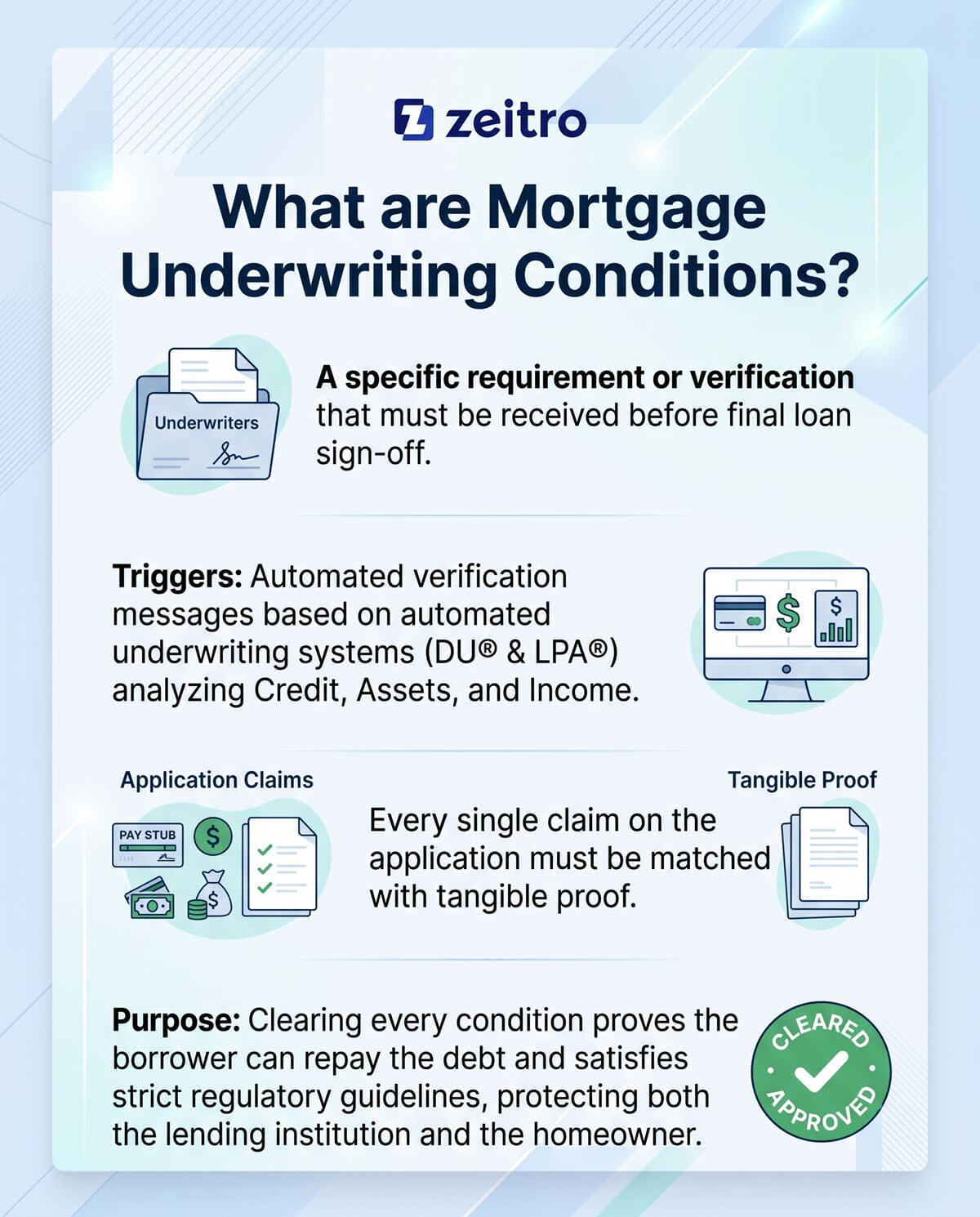
Whenever I review a new file, I see underwriting conditions as the bridge between an applicant's initial paperwork and secondary market rules. A condition is simply a specific requirement or verification that an underwriter must receive before granting final sign-off.
These items trigger because automated underwriting systems, such as Fannie Mae's Desktop Underwriter® (DU) or Freddie Mac's Loan Product Advisor® (LPA), generate automated verification messages based on credit, assets, and income. The underwriter must ensure that every single claim on the loan application matches tangible proof.
Lenders do not create these hurdles on a whim. Secondary market investors only buy mortgages that satisfy strict regulatory guidelines. Clearing every condition proves the borrower can repay the debt, protecting both the lending institution and the homeowner from severe financial surprises later.
List of Mortgage Underwriting Conditions: Common Types
In my years managing mortgage pipelines, I have seen thousands of conditions cross my desk. While they are phased by timeline milestones, they typically fall into these core categories:
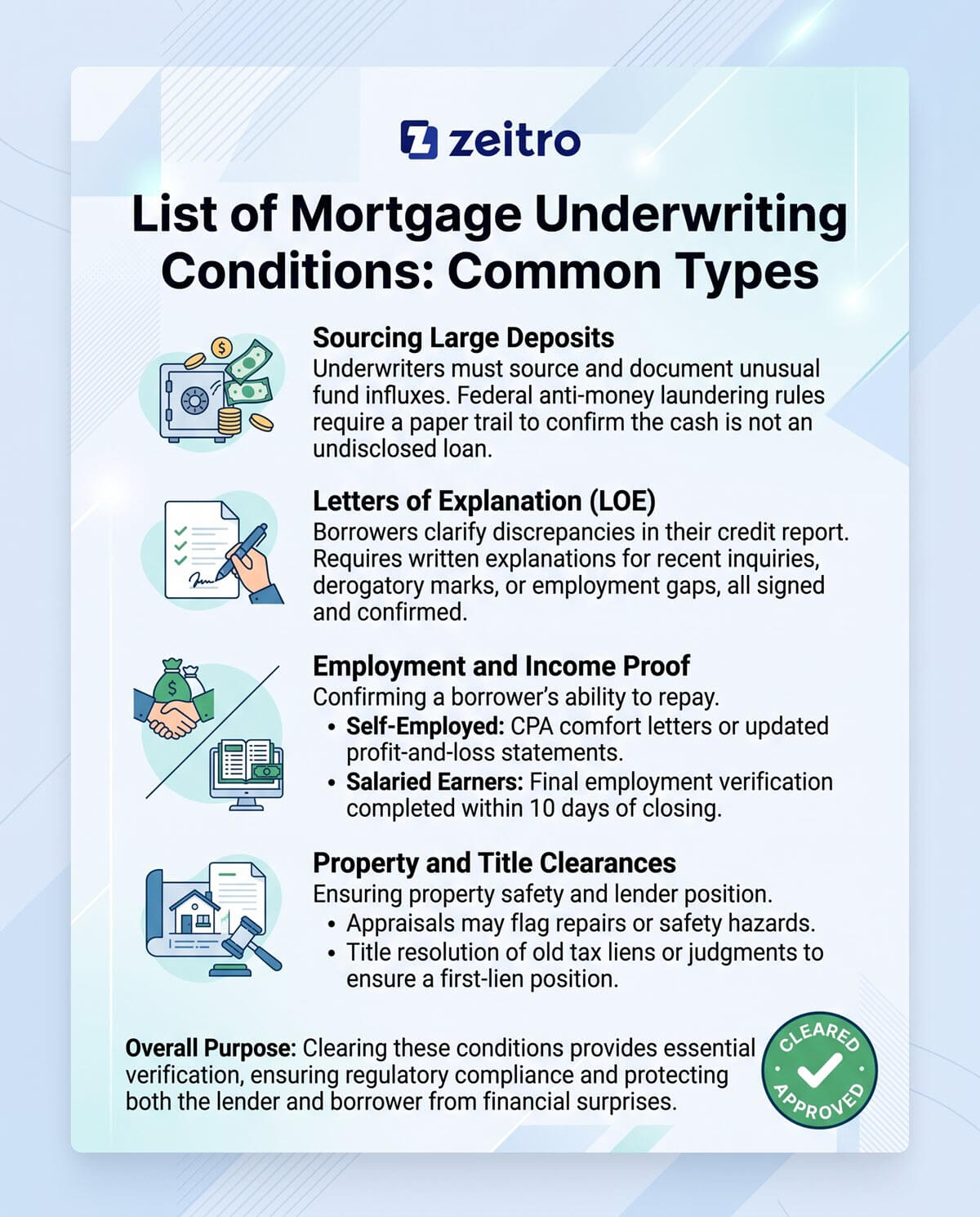
- Sourcing Large Deposits: If an asset statement reveals an unusual influx of funds that exceeds normal payroll patterns, underwriters must source it. Federal anti-money laundering regulations and agency rules require a paper trail to confirm the cash is not an undisclosed loan.
- Letters of Explanation (LOE): When a credit report displays recent inquiries, derogatory marks, or unexplained employment gaps, underwriters require clarity. The borrower must provide a signed note outlining what occurred and confirming no new debt was created.
- Employment and Income Proof: For self-employed individuals, underwriters often require a certified public accountant comfort letter or a fresh profit-and-loss sheet. For salaried earners, a final employment verification is completed within 10 days of closing to confirm the borrower remains employed and has not experienced income changes.
- Property and Title Clearances: Appraisers may flag safety hazards or repair needs on government-backed loans, requiring a completion inspection report. Meanwhile, title examiners verify that previous tax liens and judgments are fully resolved to guarantee the lender holds a first-lien position.
How to Clear an Underwriting Condition on a Mortgage?
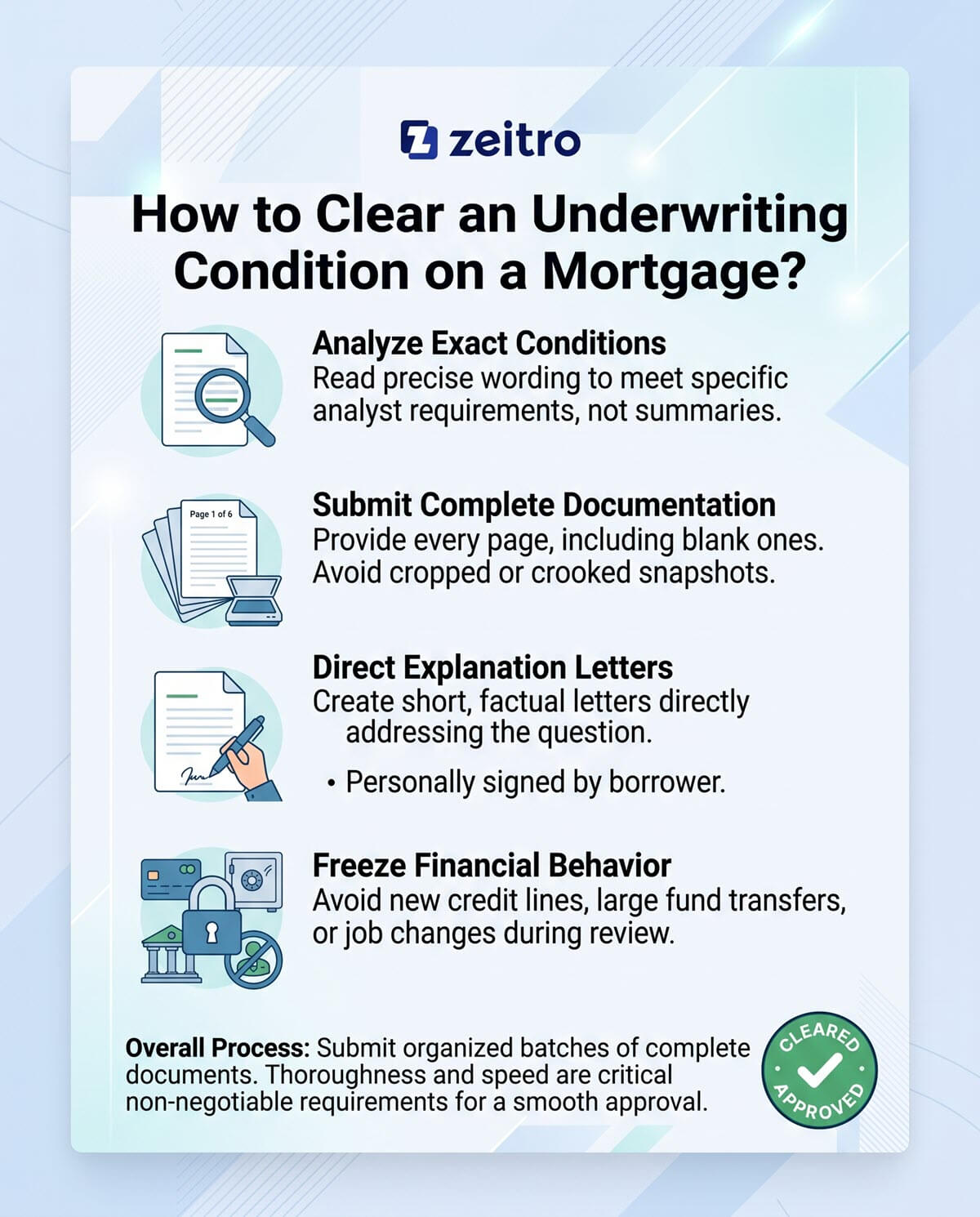
Speed and thoroughness make all the difference here. When a conditional approval arrives, treat every line item as a non-negotiable legal requirement. Here is the process I rely on to satisfy conditions smoothly:
- Read the exact condition text: Never assume what the analyst wants. If an automated finding asks for a signed tax return, sending an uncertified digital summary will fail the condition and waste review time.
- Practice strict document hygiene: Provide complete documents with every single page included, even blank ones. If an asset statement says "Page 1 of 6," underwriters will reject the file if page six is missing. Avoid crooked mobile snapshots and clipped screen captures.
- Standardize explanation letters: Have the applicant write a short, factual letter that answers the question directly. It must be signed and dated by the borrower personally, as lender-drafted letters will be rejected.
- Freeze all financial activity: Instruct borrowers to avoid opening lines of credit, shifting funds across unlinked accounts, or making job changes while conditions are under review.
- Package files in batches: Turn in clean, organized groups of documents rather than trickling single pages to the review queue.
FAQs About Underwriting Conditions for a Mortgage
Q1. Can a mortgage be denied after conditional approval?
Yes, it can. A conditional approval is an agreement to lend only if all requirements are satisfied. The file can still be denied if a borrower loses their job, runs up balances on credit cards, cannot properly source down payment funds, or if property inspections reveal major defects the seller refuses to fix.
Q2. What happens after underwriting approval
Once an underwriter signs off on every condition, your loan achieves Clear to Close (CTC) status. The lender issues the final Closing Disclosure, which the borrower must receive at least three business days before closing. This review period allows the borrower to examine the final loan terms before signing settlement documents.
Q3. What is the difference between Prior-to-Doc (PTD) and Prior-to-Funding (PTF) conditions?
Prior-to-Doc (PTD) conditions must be satisfied before the lender issues final closing paperwork and disclosures to the settlement agent. Prior-to-Funding (PTF) conditions are final verifications completed after closing documents are signed but before the lender releases funds, such as a final employment check within 10 days of closing, confirmation of no new debt, and verification that the property condition has not changed.
Q4. How long does it take an underwriter to clear conditions?
Underwriting teams typically take between 24 and 72 hours, though turn times can extend to 3–5 business days during peak seasons or if documentation requires additional review. Turn times can stretch longer during heavy purchase seasons or if documentation is submitted piecemeal, forcing the underwriter to re-queue the file multiple times.
Q5. Why do underwriters reject condition documents or ask for them again?
Submissions are usually rejected due to basic technical issues: bank statements missing final blank pages, online account printouts missing the account holder's name or web URL, documents exceeding their validity periods, such as pay stubs older than 30 days, bank statements beyond 60 days, or credit reports and employment verifications past 120 days, or explanation letters missing a handwritten signature.
Final Word
Underwriting conditions can feel intimidating, but they are just standard operating procedure in modern home financing. Once you learn to view conditions not as roadblocks, but as a straightforward compliance checklist, the mystery vanishes.
By collecting spotless, full documents right from the start and communicating promptly, you can glide past conditional approval and reach the closing table smoothly, on schedule, and stress-free.
People Also Read
- What Conditions Will Underwriting Ask for? Get to Know
- What Income Documents are Needed for Underwriting? Learn Here
- AI Mortgage Underwriting Explained: Will You Be Replaced?
- What is Mortgage Underwriting? A Complete Guide & FAQs
- [Solved] How Long Does Mortgage Underwriting Take?


![[Tips for Loan Officers] How Can I Lower Borrower DTI?](https://cdn.prod.website-files.com/6731bc6e813a541b54c30b10/6aa3b89e281a639e7a5c6fca_lower-debt-to-income-ratio-banner.jpg)