Written by

Eric
Share this article

.svg)
Subscribe to updates
Last week, a borrower came across my desk with a 760 credit score and solid assets, but panicking because they started a new position just 90 days ago. The short answer? Yes, you can qualify. Underwriters do not automatically disqualify you for switching employers recently. What truly matters is your overall two-year earning continuity, reliable pay structure, and proper file documentation.
Key Takeaways
- A 90-day tenure easily satisfies the standard 30-day consecutive paystub requirement.
- Agency guidelines (Fannie Mae, Freddie Mac, FHA) emphasize a two-year employment and income history rather than tenure at a single employer, and none impose a blanket "multi‑year at current job" rule. However, FHA treats employment gaps longer than six months differently: if you had an extended absence, you generally must be back at your new job for at least six months before that income can be used for qualifying.
- Staying in the same industry with consistent W-2 base earnings speeds up underwriting.
- Watch out for investor overlays that require direct-deposit verification or electronic VOE reports for new hires.
Can You Get a Mortgage If You Recently Changed Jobs?
In my experience underwriting loan files, moving to a new employer is treated as a documentation and stability check rather than an automatic denial. The major agencies focus on whether your total income flow remains predictable over a 24-month span:
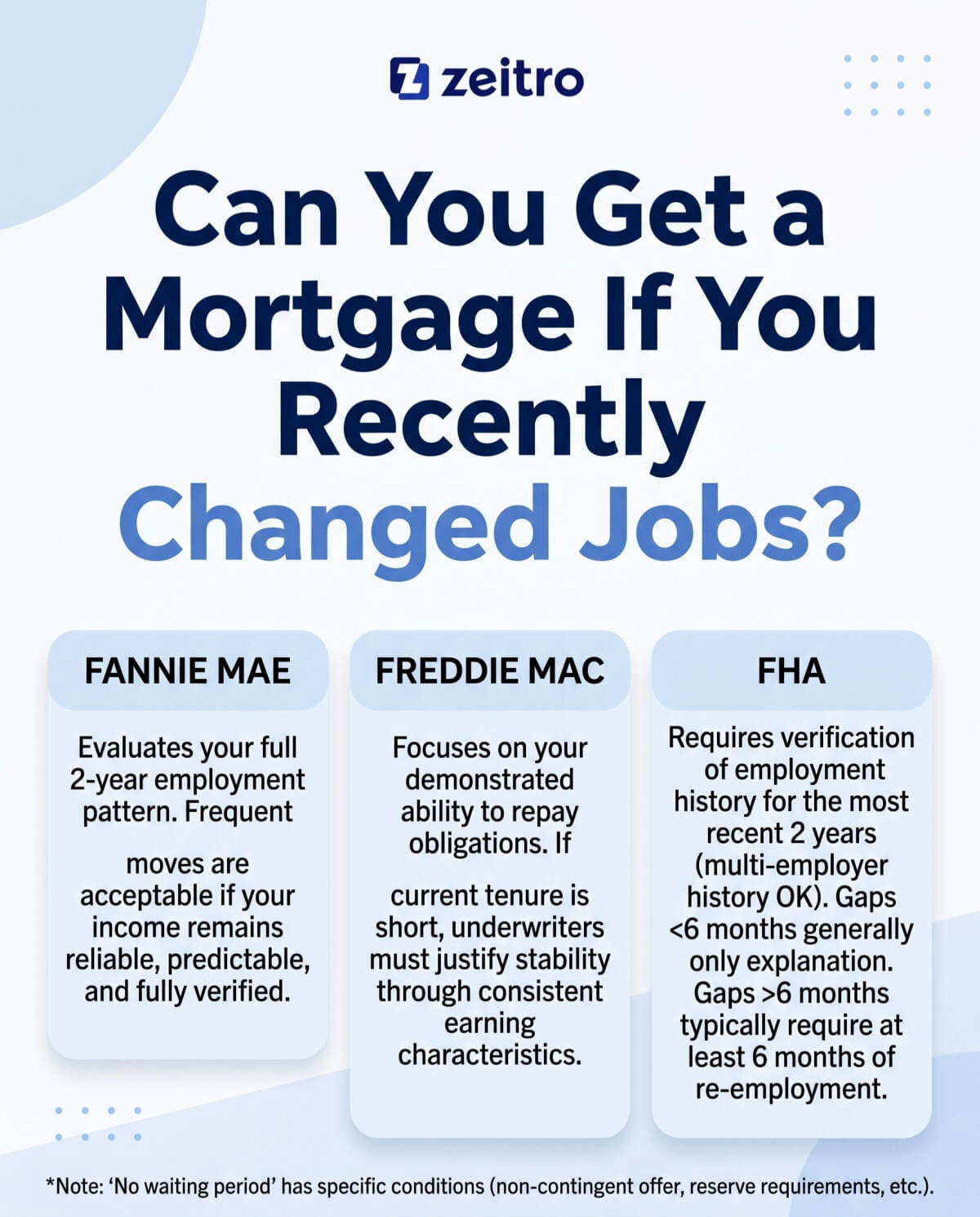
- Fannie Mae: Evaluates your full two-year employment pattern. Frequent moves are acceptable if your income remains reliable, predictable, and fully verified.
- Freddie Mac: Focuses on your demonstrated ability to repay obligations. If current tenure is short, underwriters must justify stability through consistent earning characteristics.
- FHA: Requires verification of the borrower's employment for the most recent two years, but the history does not have to be with a single employer. Gaps of six months or less generally need only an explanation. Gaps longer than six months typically require at least six months of re‑employment before the new income can be used for qualifying.
For new or future income, Fannie Mae and Freddie Mac have specific conditions (e.g., non‑contingent offer, income starting within 60–90 days of closing for many scenarios, and sufficient reserves), so "no waiting period" is not universally true in every situation.
Lender Overlays to Keep on Your Radar
While agency rules provide baseline flexibility, specific lenders often enforce stricter internal overlays for hires with less than six months on the clock.
- Enhanced VOE Paths: Lenders like Cardinal Financial often require automated third-party verification (such as The Work Number) or documented proof of direct-deposit enrollment if you lack six months of paystubs.
- Job-Switch Frequency: Investors such as Nations Direct may flag files with more than three job changes within 12 months, asking for training transcripts or proof of rising compensation.
- Career Advancement: Programs like Mega Capital Silver Jumbo look favorably on lateral moves or promotions that increase your base earnings.
Pro Tip: Because overlays vary widely across wholesale lenders, I always run scenarios through Zeitro Strata to verify guidelines and compare investor matrices instantly before submitting a file.
Key Underwriting Approval Factors to Consider
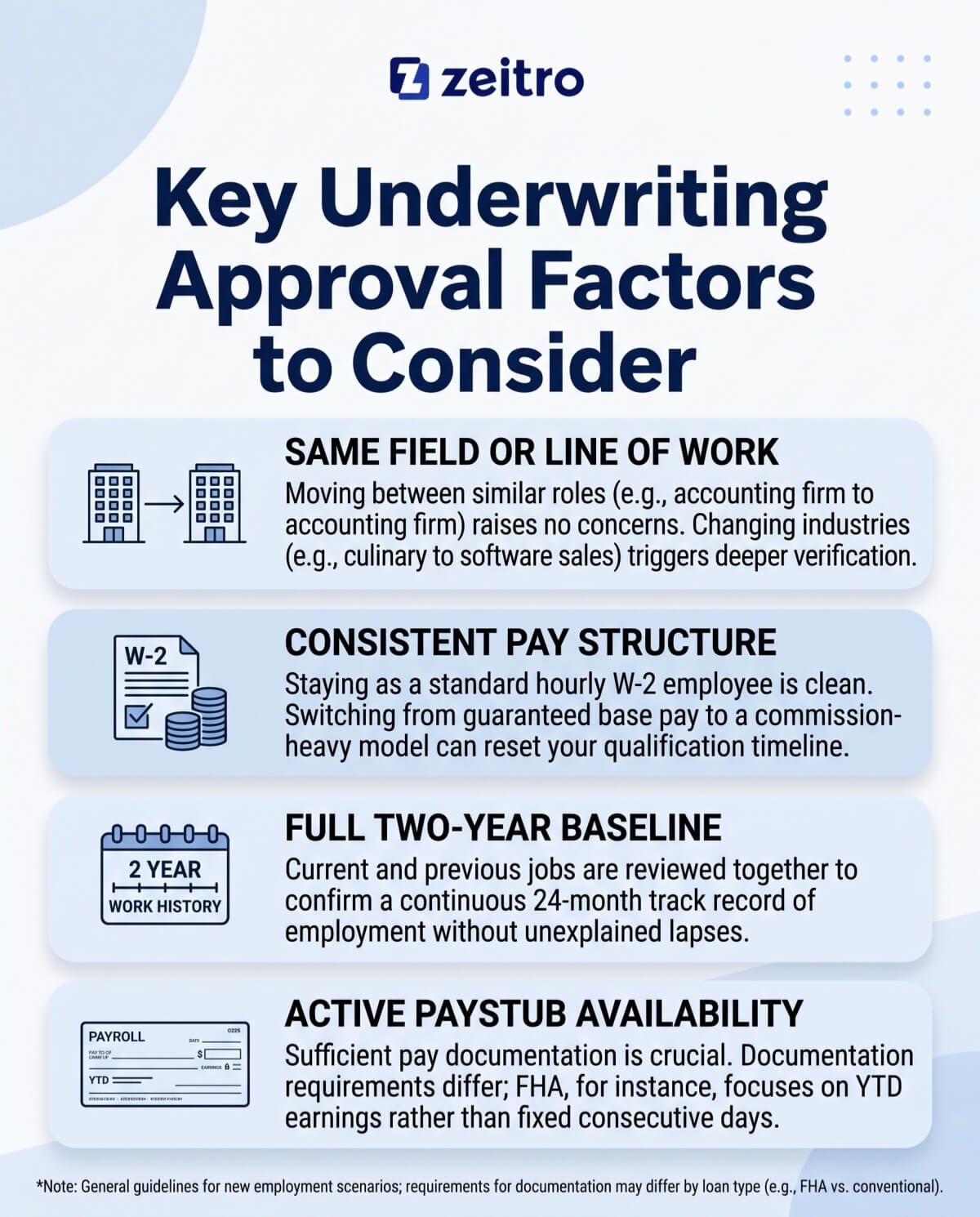
When I review a file where someone recently switched roles, I look past the calendar date and focus on four critical risk indicators:
- Same Field or Line of Work: Moving from one accounting firm to another raises zero red flags. Shifting from culinary work to software sales triggers deeper scrutiny.
- Consistent Pay Structure: Staying a salaried or standard hourly W-2 employee is clean. Switching from guaranteed base pay to 100% commission resets your qualification clock.
- Full Two-Year Baseline: We combine your previous and current jobs to confirm a 24-month track record of active employment without unexplained lapses.
- Active Paystub Availability: With three months on the job, most lenders will have sufficient recent pay documentation, but the exact requirement varies. FHA, for instance, requires the most recent pay stub showing at least one month of year‑to‑date earnings plus additional employment verification, rather than a fixed "30 consecutive days" rule.
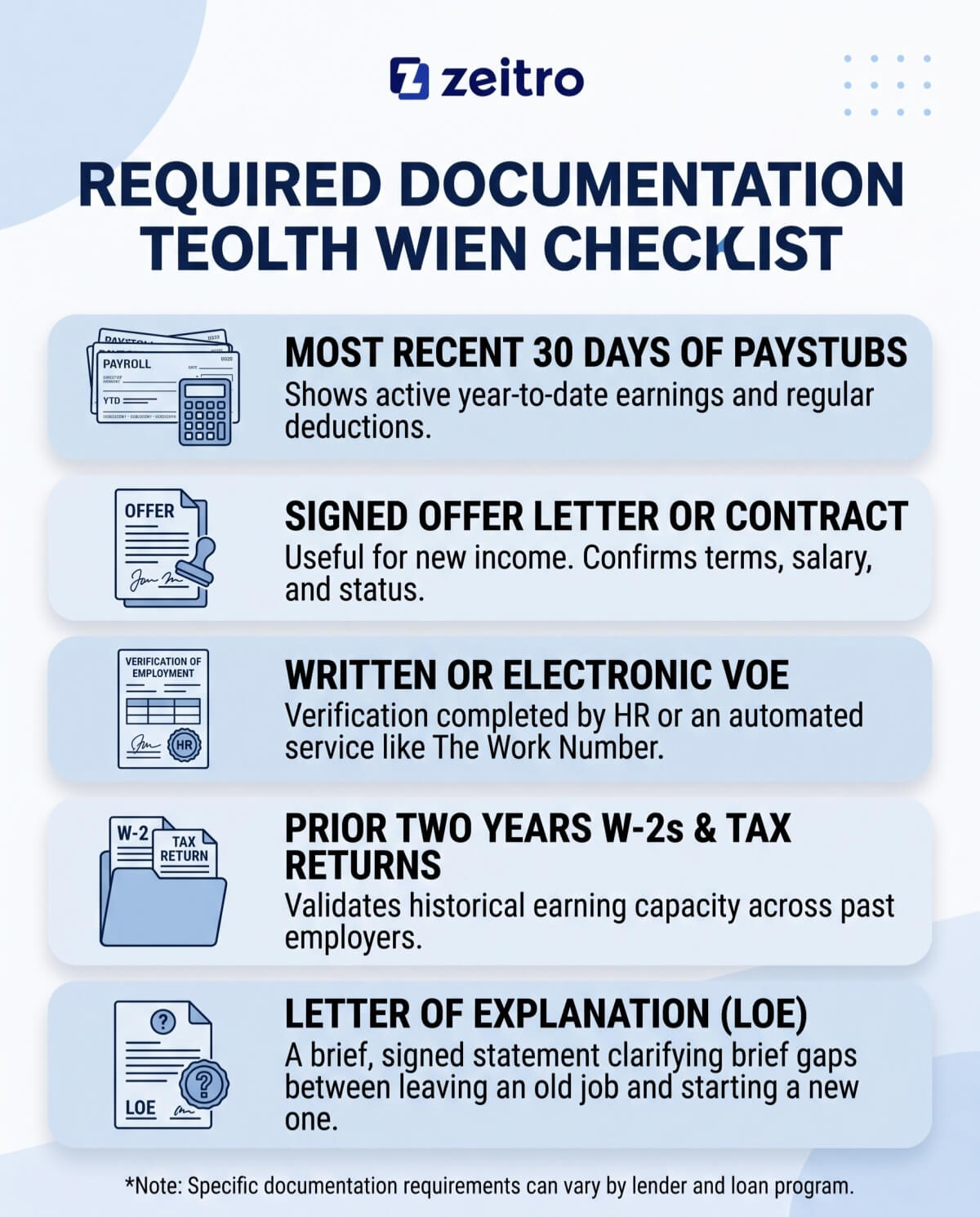
Required Documentation Checklist
To get your loan approved without underwriting delays, you must hand your loan officer a clean paper trail upfront. Here is the exact checklist I collect from my clients:
- Most Recent 30 Days of Paystubs: Shows active year-to-date earnings and regular deductions from your new payroll.
- Signed Offer Letter or Employment Contract (if applicable): Particularly useful when income is new or will commence shortly after closing. It confirms start date, guaranteed base salary, and full‑time status.
- Written or Electronic VOE: Completed by your HR department or pulled through an automated service like The Work Number.
- Prior Two Years of W-2s and Tax Returns: Validates historical earning capacity across past employers.
- Letter of Explanation (LOE): A brief, signed statement clarifying any brief gap between leaving your old job and starting the new one.
FAQs About Mortgage Qualification After a Job Change
Q1. Can I change jobs before buying a house?
Yes, provided the new role is in the same field and maintains a similar or higher guaranteed W‑2 base salary. Moving to variable commission, 1099 contract work, or self‑employment can complicate qualification because lenders typically require a 12–24 month history of that income type, but it does not automatically reset to a “fresh two years” in every scenario. The exact requirement depends on the income type, prior history, and lender guidelines.
Q2. How soon can I change jobs after closing on a house?
Once your loan is fully funded, recorded, and closed, you are free to accept a new position. However, never make career moves during the active loan process. However, never make career moves during the active loan process. Lenders typically perform a final verification of employment shortly before closing (often within 10 days of the note date for FHA), and an unannounced job change can derail your approval.
Q3. Do I have to tell my mortgage lender if I lose my job after closing?
No. After closing, your relationship transfers to mortgage servicing. As long as you make your monthly payments on time, loan servicers do not track your employment status. If you lose your job before loan documents are signed and funded, you are legally required to disclose it.
Q4. What happens if my new job pays commission or bonus instead of a base salary?
Lenders generally cannot count new commission, bonus, or overtime income toward your debt-to-income ratio without a verifiable two-year history of receiving that income and a reasonable expectation that it will continue. Some lenders may consider shorter histories (e.g., 12+ months) under certain conditions, but the baseline agency expectation is a 24-month track record.
Q5. Will an employment gap between my old and new job hurt my approval?
Gaps under six months rarely cause issues under FHA guidelines as long as you provide a brief explanation and have returned to the same line of work with stable W‑2 income. If you were out of the workforce for six months or longer, lenders typically require at least six continuous months at your new job before that income can be used for qualifying, though individual overlays may be stricter.
Conclusion
Starting a new job three months ago will not stop you from buying a home. As long as your two-year employment history is solid, your pay structure remains stable, and your documentation is organized, underwriters can clear your loan quickly. Reach out to a knowledgeable loan officer early to review lender overlays, gather your paperwork, and move forward with total confidence.

![[Tips for Loan Officers] How Can I Lower Borrower DTI?](https://cdn.prod.website-files.com/6731bc6e813a541b54c30b10/6aa3b89e281a639e7a5c6fca_lower-debt-to-income-ratio-banner.jpg)