Written by

Eric
Share this article

.svg)
Subscribe to updates
In my experience advising tech professionals and executives, the short answer is yes. You can use restricted stock income to qualify for a home loan. However, lenders follow strict Fannie Mae and Freddie Mac rules. To count toward your mortgage, your equity must be fully vested, backed by a one to two-year receipt history, and expected to continue for at least three more years.
Key Takeaways
- Yes, RSUs count: Vested restricted stock income is eligible for conventional mortgages.
- Strict requirements: Shares must be vested, distributed, and issued by a publicly traded company.
- Track record matters: Lenders require a 12 to 24-month history of receipt.
- Future continuity: Your vesting schedule generally requires you to show income continuing for at least 36 months.
What is Restricted Stock Income?
Restricted stock income, commonly granted as Restricted Stock Units (RSUs) or restricted stock awards, is equity-based compensation provided by employers as an incentive. Unlike base salary, lenders view equity compensation as variable income, similar to performance bonuses or commission earnings.
When I review loan applications, I always emphasize one critical distinction: unvested stock holds no value for mortgage qualification. Because unvested shares are contingent on future employment or performance milestones, mortgage underwriters completely exclude them.
Only RSU awards that have fully vested and been recognized as taxable compensation (e.g., reported on your W‑2) can be counted toward your qualifying gross monthly income. Whether the shares are delivered as stock to your brokerage account or settled in cash depends on your employer's plan, but the key underwriting requirement is that the income is vested, documented, and verifiable.
Can You Use Restricted Stock Income for a Mortgage?
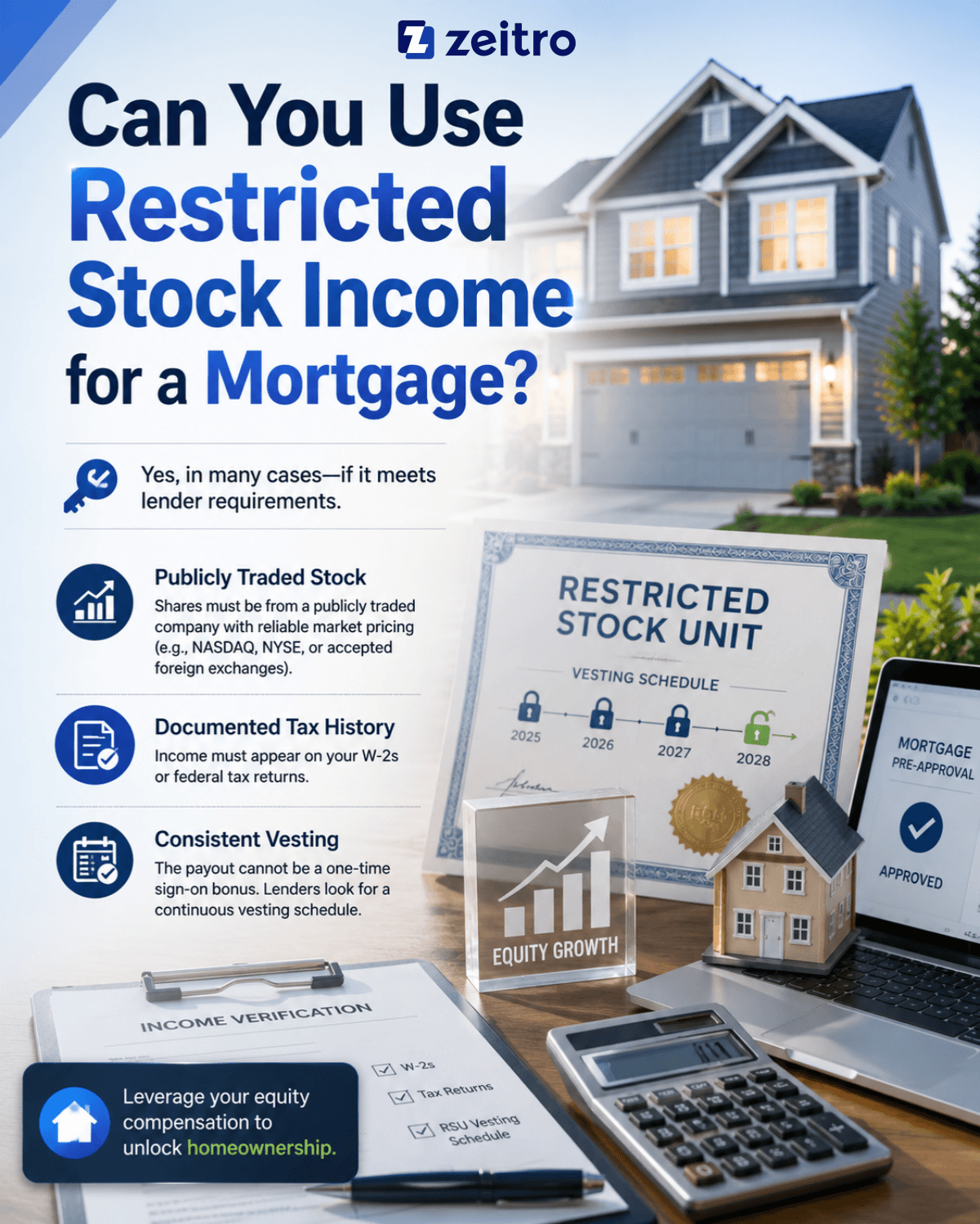
Yes, you can leverage restricted stock income to boost your borrowing power, but it depends heavily on your employer's structure and your payout history. Over the years, I have helped many clients buy homes using equity compensation under specific conditions:
- Publicly traded stock: The shares must be from a publicly traded company with reliable, objective market pricing (e.g., listed on major U.S. exchanges such as NASDAQ or NYSE, or certain recognized foreign exchanges acceptable to the lender/investor). Private company RSUs generally do not qualify due to liquidity and valuation concerns.
- Documented tax history: Income must appear on your W-2s or federal tax returns.
- Consistent vesting: The payout cannot be a one-time sign-on bonus without a continuous vesting schedule.
Mortgage Qualification Requirements for Restricted Stock Income
To ensure your loan gets approved, underwriters follow standard conventional guidelines set by Fannie Mae (B3-3.3-07) and Freddie Mac. When I prepare files for underwriting, I make sure the client meets four core requirements:
- Fully Vested & Distributed: Unvested promises or future grants cannot count toward your qualifying income today.
- Receipt History: Lenders typically require a 12‑month history for time‑based RSU income and a 24‑month history for performance‑based RSU income. Under Freddie Mac's Bulletin 2024‑16 (effective April 1, 2025), performance‑based RSU income may be calculated using less than 24 months (but not less than 12 months) when the borrower has 12–24 months of receipt with the current employer, provided the lender documents a written analysis and compensating factors. Fannie Mae similarly allows some flexibility with strong compensating factors, but if the minimum history is not met, the RSU income generally cannot be used.
- Public Trading: The issuing company must be publicly traded with reliable, objective market pricing.
- Continuance: For recurring RSU awards, Freddie Mac requires that the income be likely to continue for at least three years. For nonrecurring awards, at least three years of vesting and distribution must remain on the vesting schedule. Fannie Mae similarly expects documentation that future RSU income is likely to continue (e.g., via a vesting schedule showing future distributions or employer verification of ongoing grants), but the precise evidentiary standard can vary by lender and scenario.
Note: Many lenders or investors impose internal limits on how much of your total qualifying income can come from RSUs (for example, capping RSU income at 35% of total income). This is not a universal Fannie Mae/Freddie Mac rule but a common underwriting practice, so confirm with your loan officer.

Required Documentation for Restricted Stock Income
Gathering complete documentation upfront prevents underwriting delays. When clients bring me RSU income, I ask for a comprehensive paper trail showing both historical earnings and future grants. Here is the checklist you will need to provide:
- Tax Records: Your W‑2 forms for the last two years and, if requested, federal tax returns (Form 1040). Note that RSU vesting is typically reported as wages on your W‑2. Schedule D is used for capital gains/losses when shares are sold and is not the primary document for verifying RSU income.
- Proof of Distribution: Recent pay stubs showing RSU income alongside year-end statements or brokerage account statements (e.g., Schwab or Fidelity) confirming share transfers.
- Award Agreements: Official employer RSU award agreements detailing original grant amounts and vesting terms.
- Vesting Schedule: An active schedule proving ongoing share vestings for the next three years.
How to Calculate Restricted Stock Income for a Mortgage?
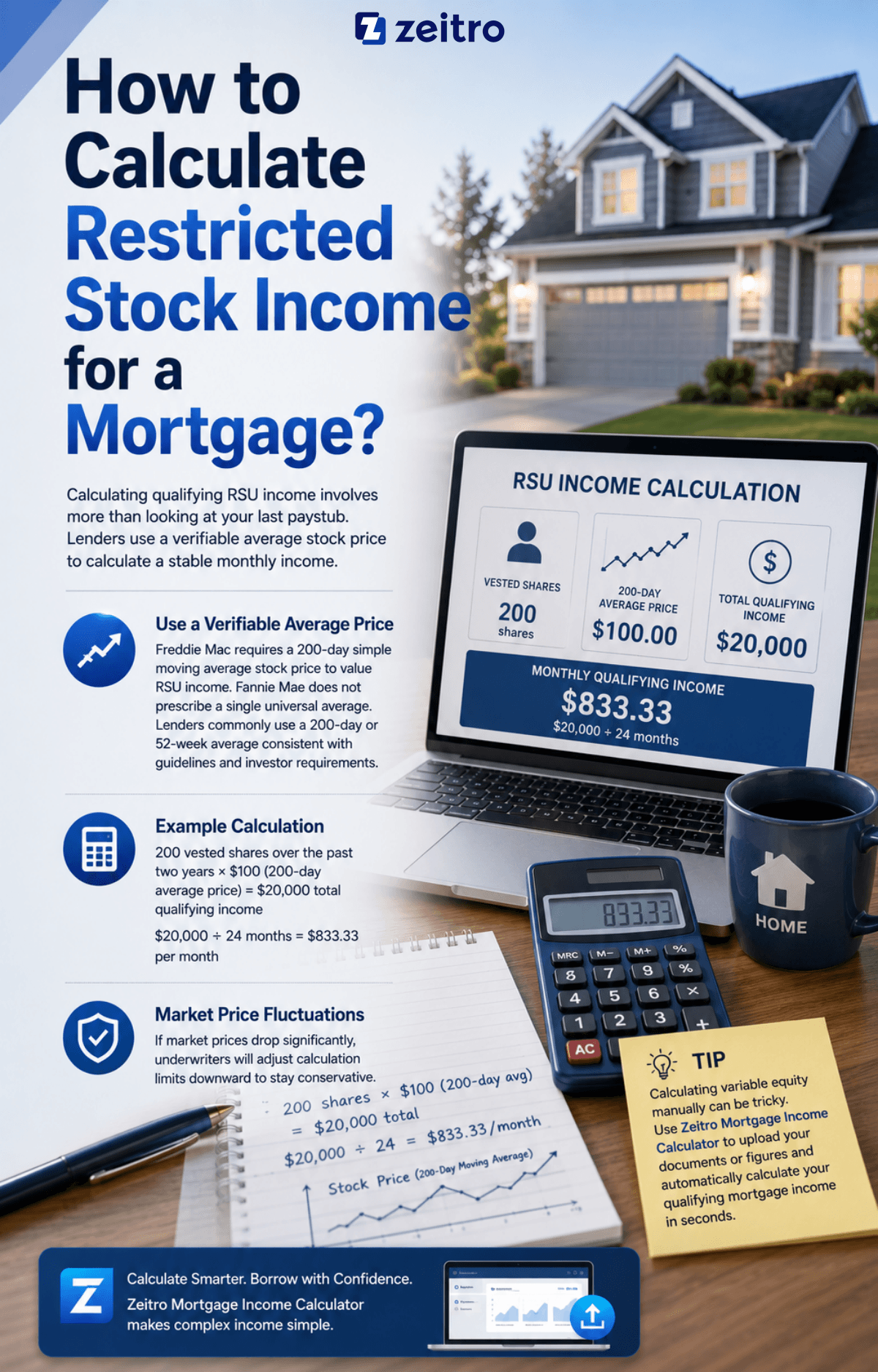
Calculating qualifying RSU income involves more than looking at your last paystub. Freddie Mac now requires using a 200‑day simple moving average stock price to value RSU income. Fannie Mae does not prescribe a single universal average in the same way. Lenders typically use a verifiable average price (commonly a 200‑day or 52‑week average) consistent with Fannie Mae's guidelines and investor requirements.
For example, if you received 200 vested shares over the past two years, and the 200-day moving average price is $100, your qualifying total is $20,000, which equals $833.33 per month ($20,000/24). If market prices drop significantly, underwriters will adjust calculation limits downward to stay conservative.
Tip: Calculating variable equity manually can be tricky. You can use Zeitro Mortgage Income Calculator to easily upload your documents or figures and automatically calculate your qualifying mortgage income in seconds.
FAQs About RSI on a Mortgage
Q1. Do RSUs count as total income?
Yes, RSUs count toward your total gross annual income if they meet underwriting criteria. However, mortgage underwriters classify RSUs as variable income rather than fixed base salary. They will average your historical RSU payouts over a 12 to 24-month period rather than taking your current single-day stock value at face value.
Q2. What is Freddie Mac RSU income policy?
Freddie Mac requires a minimum receipt history of 12 to 24 months, proof that stock is publicly traded, and evidence of a 3-year continuance. For stock-distributed RSUs, Freddie Mac typically calculates qualifying RSU income using the 200‑day moving average stock price multiplied by the vested shares distributed over the prior 12 to 24 months, divided by the number of months in that period. For performance‑based RSUs with 12–24 months of history, Freddie Mac allows using less than 24 months (but not less than 12) when supported by a written lender analysis and compensating factors.
Q3. What happens to my mortgage qualification if the stock price drops?
If your company's stock price declines sharply, underwriters prioritize capital preservation. They will apply the lower current market price or a revised moving average instead of past peak values. This conservative adjustment reduces your calculated monthly income, which in turn lowers your maximum debt-to-income (DTI) limit and overall home purchase budget.
Q4. Can I use unvested RSUs to qualify for a mortgage?
No, you cannot use unvested RSUs as direct monthly income to qualify for a mortgage loan. Because unvested shares remain conditional on continued employment, underwriters treat them as unearned equity. However, unvested shares can serve as excellent evidence to satisfy the mandatory three-year income continuance requirement for currently vesting shares.
Q5. Can I use RSU income if I have been with my tech company for less than 2 years?
If you have been with your current employer for less than two years, you may still qualify for time‑based RSU income if you have at least 12 months of vested and reported RSU income with that employer and can document likely continuance. Prior work history in the same industry does not substitute for the required receipt history with the current employer, and any history prior to the stock being publicly traded generally does not count.
Conclusion
Restricted stock income can significantly increase your mortgage purchasing power when documented correctly. By satisfying history, public trading, and three-year continuance guidelines, you can comfortably include equity compensation in your application. To simplify your preparation, try the Zeitro Mortgage Income Calculator to calculate your eligible income instantly.
Disclaimer: Mortgage guidelines vary by lender and investor. Always consult a licensed loan officer for official loan qualification analysis.
People Also Read
- How to Calculate Employment Income for a Mortgage?
- How Do I Calculate Tip Income for a Mortgage?
- How Do I Calculate Bonus Income for a Mortgage?
- Can I Use Fluctuating Income for Mortgage Qualification?
![[Solved] Why is Loan Product Advisor (LPA) Rejecting Income?](https://cdn.prod.website-files.com/6731bc6e813a541b54c30b10/6aa11d2cb785a137b728997d_loan-product-advisor-reject-income-banner.jpg)

![[Solved] Why is Desktop Underwriter (DU) Rejecting Files?](https://cdn.prod.website-files.com/6731bc6e813a541b54c30b10/6aa11212d02666b337b8d2f4_desktop-underwriter-reject-file-banner.jpg)