Written by

Eric
Share this article

.svg)
Subscribe to updates
Over my decade as a loan officer, I've worked with dozens of servers, bartenders, and rideshare drivers who feared their tips couldn't buy them a home. Good news: they absolutely can.
As long as your gratuities are legally reported to the IRS, underwriters can count them if they are properly documented and shown to be stable. To quickly see where you stand before diving into guidelines, test your numbers in this Mortgage Income Calculator.
Key Takeaways
Here is what underwriters look for when approving your tip income:
- Two-Year History: Most conventional programs expect a two-year history of tip income. A 12-month history may be acceptable in limited cases (e.g., prior experience in the same occupation or strong compensating factors), but this is not guaranteed and depends on the investor and lender overlays.
- Tax Paperwork: Tip income must be documented on your federal tax returns (typically via Form 1040 with Schedule 1/SE as applicable) and, when reported to your employer, reflected on your W‑2 (usually in Box 1 wages/tips. Box 7 is for allocated tips only). If you did not report tips to your employer, lenders generally require Form 4137 with your tax returns to verify unreported tip income.
- Averaging Method: Lenders typically average the last two full years of reported tip income (24 months) and then review YTD to confirm stability or growth. If income is declining, underwriters generally use the lower, stabilized amount rather than a higher historical average.
- Unreported Cash Warning: Cash kept off tax returns cannot be used to qualify.
Do Tips Count as Income for a Mortgage?
Yes, tip income counts for conventional, FHA, USDA, and VA loans. However, mortgage underwriters treat tips as "variable income," meaning we must verify that the earnings are stable and likely to continue. The most important rule I tell my clients is that unreported cash tips generally cannot be used to qualify for a mortgage. If gratuities appear on your W-2 or federal tax returns, we can use them to boost your purchasing power.
How to Calculate Tip Income for a Mortgage?
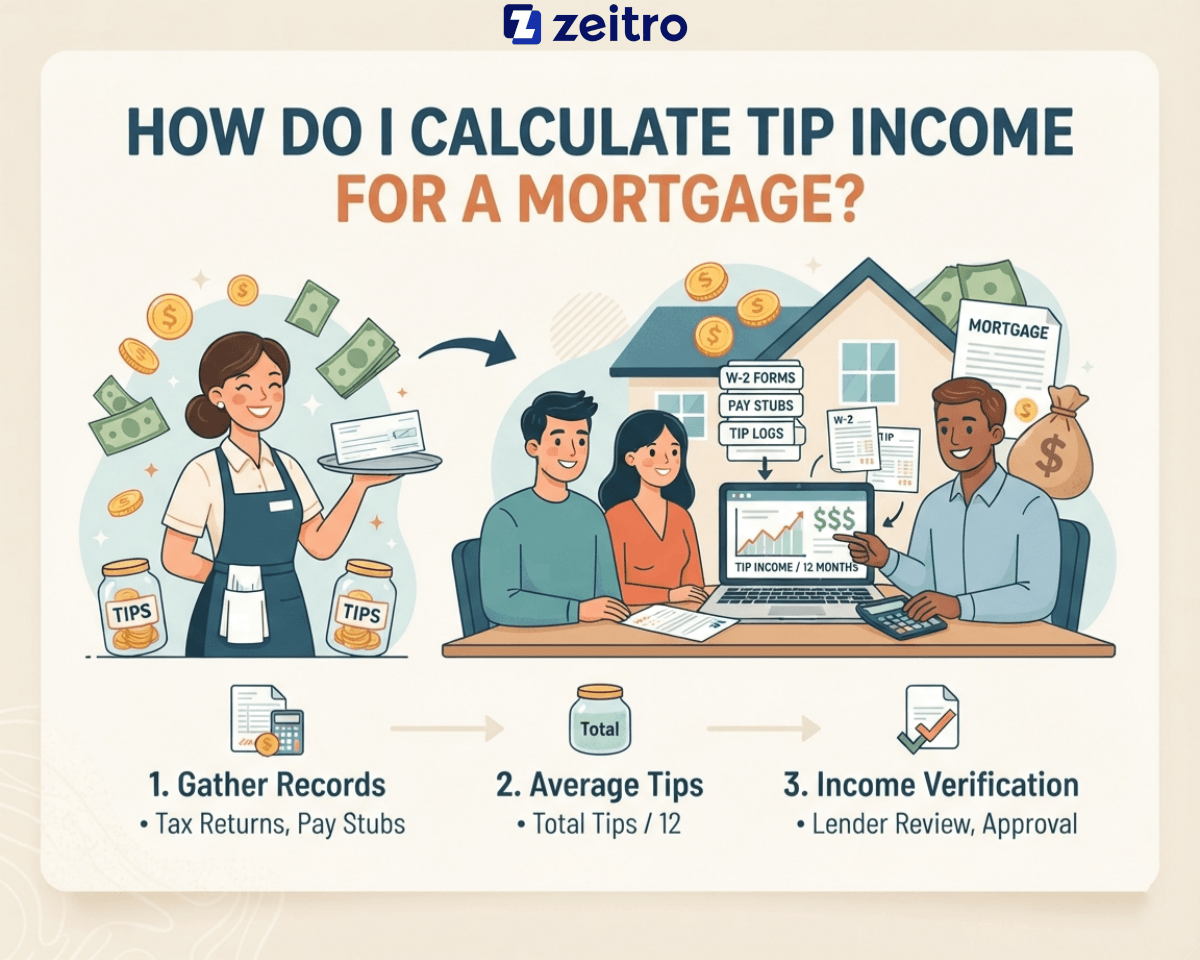
Calculating tip income comes down to finding your monthly average over a 12- to 24-month window. If your earnings are stable or growing, we add your Year-to-Date (YTD) tips to your prior years' reported tips, then divide by the total months worked.
For example, if you earned $14,000 in tips last year and have $10,000 YTD over 10 months, your 22-month average is $1,090 per month. If your tip income dropped recently, underwriters won't average the higher months—underwriters typically use the lower, stabilized amount.
Rather than doing manual math across multiple pay stubs, you can run your numbers through the Zeitro Mortgage Income Calculator to get an instant breakdown.
Guideline Requirements for Tip Income Calculation
Each agency handles variable tip income with slightly different rules:
- Fannie Mae: Generally expects a two-year history of variable income (including tips) and evidence that it is likely to continue. Lenders may accept Form 4137 with tax returns to verify tip income that was not reported to the employer, but documentation requirements are driven by the need to show stable, reportable income rather than a specific form mandate.
- Freddie Mac: Typically requires a two-year history of tip income and evidence that it is stable and likely to continue. Temporary interruptions (e.g., documented closures or renovations) may be excused with proper explanation
- FHA: For fluctuating or declining tip income, underwriters generally use the lower, more conservative figure (often the recent year or stabilized level) rather than a higher historical average.
- USDA: Generally prefers a two-year history of stable income. A one-year history may be considered with strong compensating factors or prior experience in the same field. Significant year-over-year changes may prompt additional underwriting scrutiny, but there is no fixed 20% rule in USDA guidelines.
- Lender Overlays: Some lenders may perform a VVOE shortly before closing to confirm ongoing employment. Whether tips are specifically addressed varies by lender. There is no universal 10-day rule requiring confirmation that tips will continue.

Required Documentation
To verify your gratuities, I always ask my borrowers to gather two distinct documentation packages based on how their tips are reported:
- Employer-Reported Tips: Your W-2 forms from the last two years (tips are typically included in Box 1 wages/tips. Box 7 is only for allocated tips) along with recent YTD pay stubs (usually 30–60 days).
- Self-Reported Cash Tips: Signed federal tax returns for the last two years. If you did not report tips to your employer, lenders often require IRS Form 4137 to show those tips were reported and taxed. If tips were reported to your employer, Form 4137 may not be necessary.
- Verification of Employment (VOE): Lenders may use Form 1005 or other methods to verify employment and income history. While some lenders ask employers to comment on the typicality and continuity of tip income, this is not universally required.
Risk Considerations
When reviewing tip income, underwriters watch closely for red flags that could stall your loan:
- Declining Income Trend: If your most recent year's tip income is lower, underwriters generally use the lower, stabilized amount rather than averaging with the higher prior year. The variable portion may be excluded only if income continues to decline and cannot be shown as stable.
- Unreported Cash Deposits: Large cash deposits in your bank account that do not match your tax returns cannot be counted as income and may require written explanation letters.
- Recent Job Swaps: Moving between service industry jobs within two years is acceptable only if you can prove continuous tip-earning history in the same field.
FAQs About Tip Income Calculation
Q1. Can I use tip income for a mortgage with only 1 year of work history?
Possibly. While two years is the norm, some lenders may consider 12 months if you have prior experience in the same occupation and strong compensating factors. Approval depends on the investor guidelines and lender overlays.
Q2. What is IRS Form 4137, and why do mortgage lenders ask for it?
Form 4137 is used to report tips you did not report to your employer and to calculate the associated Social Security and Medicare tax. Lenders often require it with your tax returns when tips were not reported to your employer. If tips were reported to your employer, Form 4137 may not be needed.
Q3. How do lenders calculate tip income if my earnings went down this year?
If your tip income decreased, lenders will not average your higher past earnings. Instead, we must verify the income has leveled off and calculate your qualifying income using only the lower, stabilized current amount.
Q4. What happens if my employer doesn't report my tips on my W-2?
If your W-2 does not show tips, you'll need to show they were reported on your federal tax returns. Many lenders will ask for IRS Form 4137 when tips were not reported to your employer, but documentation requirements can vary. Completely unreported (off-the-books) tips cannot be used to qualify.
Q5. Do cash tips and credit card tips get calculated differently for a mortgage?
No. Underwriters calculate both cash and credit card tips the same way, provided both are officially documented on your pay stubs, W-2s, or tax returns. Unverified cash, however, is completely excluded.
Conclusion
Qualifying for a mortgage with tip income comes down to three things: reporting your cash, showing a stable two-year track record, and organizing your tax paperwork. You don't need to let fluctuating paychecks stand between you and homeownership.
Before gathering your tax returns, check your monthly qualifying figures using our free Mortgage Income Calculator to see what price range fits your budget today.
People Also Read
- How Do I Calculate Bonus Income for a Mortgage?
- Can A Raise Be Used for a Mortgage? Check Requirements Here
- How Do I Calculate Seasonal Income for a Mortgage?
- How to Calculate Employment Income for a Mortgage?
![[Solved] Why is Loan Product Advisor (LPA) Rejecting Income?](https://cdn.prod.website-files.com/6731bc6e813a541b54c30b10/6aa11d2cb785a137b728997d_loan-product-advisor-reject-income-banner.jpg)

![[Solved] Why is Desktop Underwriter (DU) Rejecting Files?](https://cdn.prod.website-files.com/6731bc6e813a541b54c30b10/6aa11212d02666b337b8d2f4_desktop-underwriter-reject-file-banner.jpg)