Written by

Eric
Share this article

.svg)
Subscribe to updates
As a loan officer, I often meet clients who are incredibly close to qualifying for their dream home, only to be held back by a high debt-to-income (DTI) ratio. In these situations, using boarder income can be a complete lifesaver. But calculating it under strict agency guidelines can feel like a minefield. Here is how I navigate these calculations to get files approved.
Key Takeaways
- Verification History: You generally need documentation showing a stable, verifiable history of boarder income, with program-specific requirements varying by loan type.
- Program Limitations: Countable boarder income is subject to the specific rules of the loan program and should not be assumed to follow a universal 30% cap.
- Documentation Matters: Only clean bank statement trails are accepted—no unverified cash payments.
- Automation Helps: Tech tools can speed up calculations and verify program compliance easily.
What is Boarder Income?
When we talk about boarder income, we are referring to the rent paid by an individual who lives with the borrower in their primary home. Over the years, I have seen many colleagues mistake this for traditional rental income. Traditional rental income involves leasing an independent unit, like an investment property or a duplex, and is tracked on tax returns under Schedule E. In contrast, a boarder lives under the same roof, sharing common spaces with the homeowner.
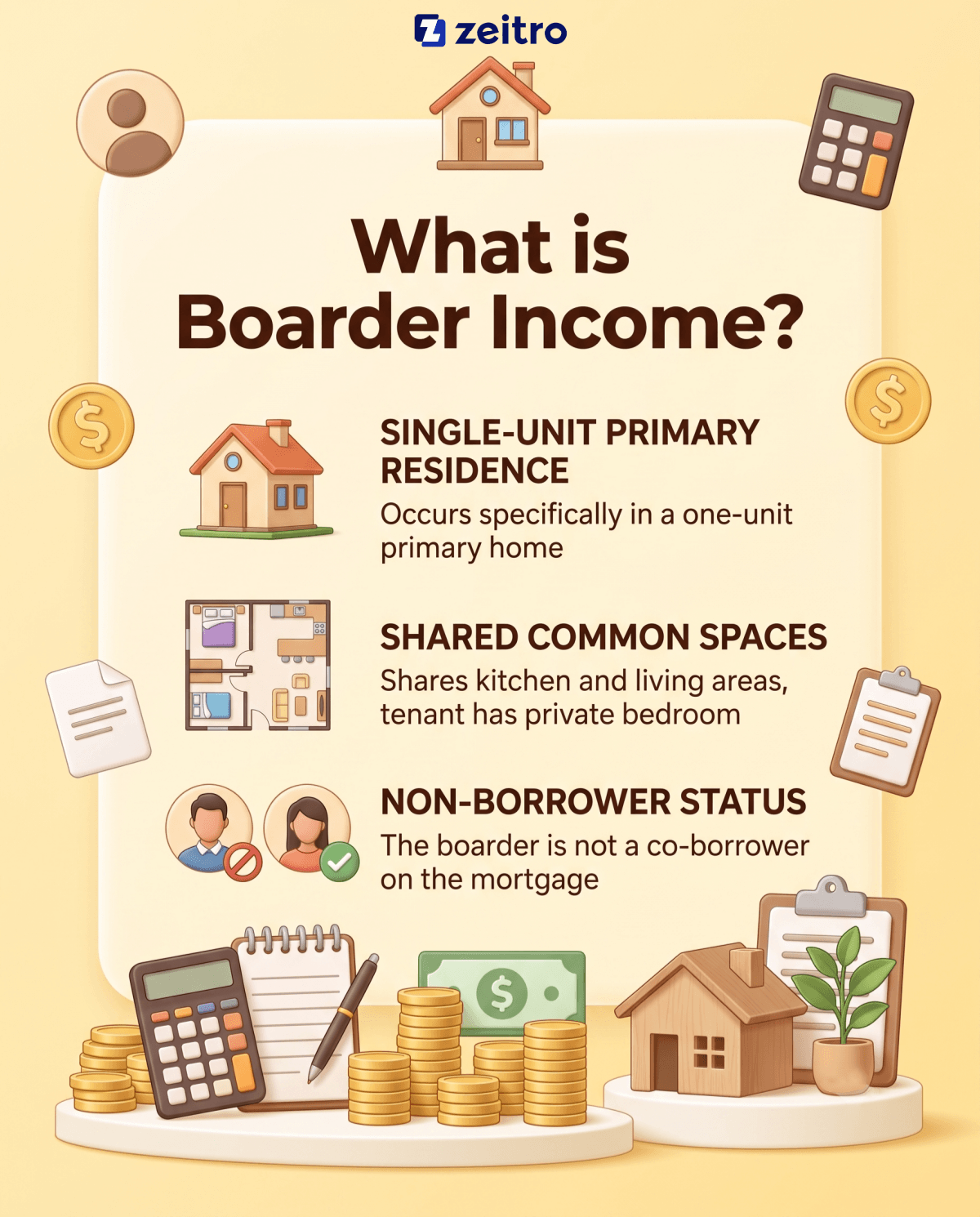
Here are the primary features that define boarder income in our underwriting world:
- Single-Unit Living: It occurs specifically within a one-unit primary residence.
- Shared Space: The tenant has a private bedroom but shares the kitchen and living areas.
- Non-Borrower Status: The boarder must not be a co-borrower or obligated on the mortgage loan.
Can I Use Boarder Income to Qualify for a Mortgage?
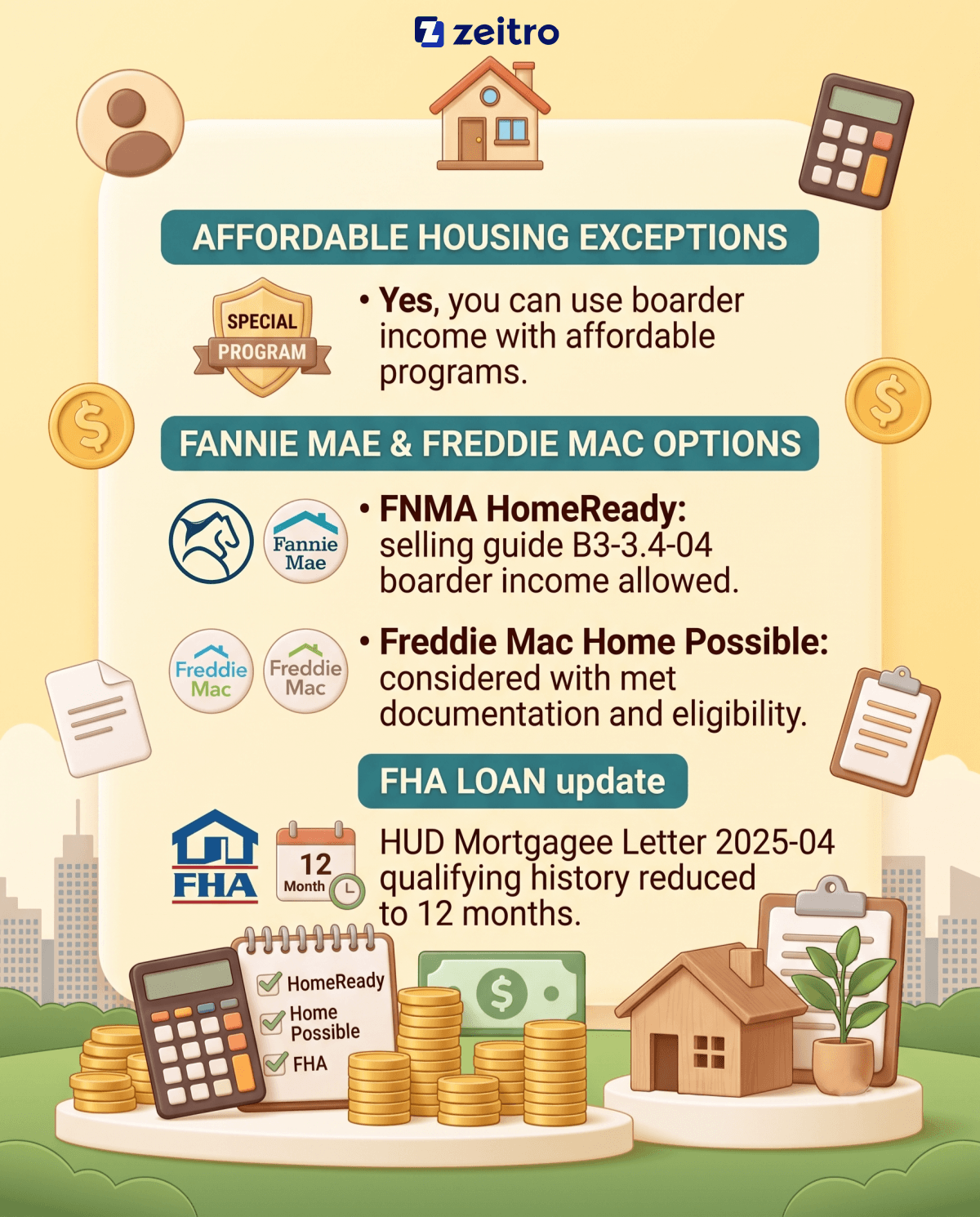
Yes, you can use boarder income, but standard conforming conventional loans usually reject it. To make it work, I guide my borrowers toward specific affordable housing programs that allow this exception.
Here are the main paths you can take:
- Fannie Mae HomeReady: Under Section B3-3.4-04 of the Selling Guide, boarder income is allowed for qualifying.
- Freddie Mac Home Possible: Boarder income may be considered when the loan program's documentation and eligibility requirements are met.
- FHA Loans: Thanks to HUD's Mortgagee Letter 2025-04, FHA slashed the qualifying history to 12 months, making this option much more accessible for low-to-moderate-income buyers.
How to Calculate Boarder Income for Mortgage Qualification?
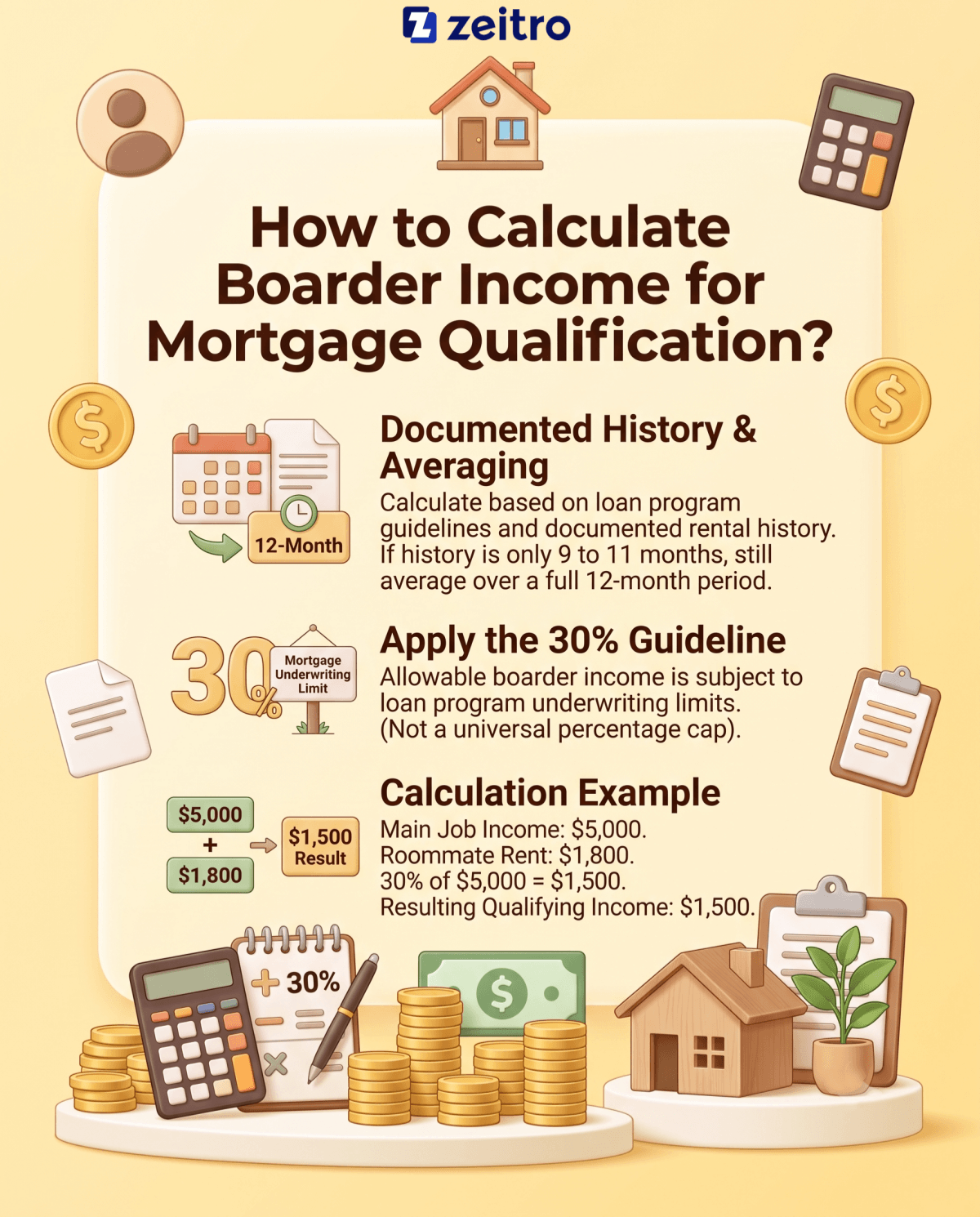
Boarder income should be calculated according to the applicable loan program, using the borrower's documented rental history and the lender's underwriting rules. If your client has documented payments for only 9 to 11 months, we must still average that total over a full 12-month period.
Next, we must apply the 30% rule. Any allowable boarder income is subject to the loan program's underwriting limits and may not be treated as a universal percentage cap.
For example, if your borrower earns $5,000 monthly from their main job, and a roommate pays them $1,800 in rent, 30% of $5,000 is $1,500. This means we can only use $1,500 of that boarder income to qualify, not the full $1,800.
💡 Pro-Tip for LOs: Manual calculations leave room for compliance errors during underwriting reviews. To ensure speed and accuracy, upload your borrower's bank statements directly into the Zeitro Rental Income Calculator. It safely organizes the paperwork and does the math for you automatically.
Tips for Using Boarder Income for Mortgage Qualification
Based on my experience in the field, underwriters will thoroughly scrutinize these files. To prevent delays, always secure a clear paper trail. Hand-written rent receipts or cash payment claims are instant deal-killers. Lenders may require bank statements, canceled checks, or electronic transfer records, along with documentation that helps verify shared residency and payment history.
FAQs About Boarder Income Calculation
Q1. Can the boarder be a family member?
Yes. As long as they are not on the mortgage and you can verify a 12-month history of shared residency and rent payments, relatives are acceptable boarders.
Q2. Is boarder income allowed on standard conventional 30-year loans?
No. It is restricted to affordable housing programs like HomeReady, Home Possible, or FHA loans. Most standard conventional loans do not count boarder income, but eligibility depends on the specific loan program and underwriting guide.
Q3. Are cash rent receipts accepted?
No. Underwriters require an audited paper trail, such as canceled checks, direct deposits, or bank statement transactions. Cash payments cannot be verified.
Q4. What is the new FHA requirement for boarder income?
FHA boarder income requirements should be verified against the latest HUD/FHA guidance, as history and calculation rules may differ from conventional loan programs.
Q5. Can I use boarder income on a multi-unit property?
No. Boarder income applies to renting out a room in a one-unit primary residence. Multi-unit properties fall under standard rental income guidelines.
Final Word
Boarder income is an incredibly valuable underwriting tool, especially in tight housing markets. However, the guidelines are strict, and even a minor error can cause your loan file to be rejected. Keeping up with the latest rules is key to keeping your deals on track.
To protect your pipeline, using a reliable tool like the Zeitro Rental Income Calculator can make a big difference. It helps you verify the numbers safely and keeps your calculations accurate every single time.
People Also Read
- How to Calculate Rental Income? Loan Officer's Guide
- How Do I Calculate Subject Property Rental Income?
- Income Verification Documents: A Complete Guide for Employees and Self-Employed
- How to Verify Income for Mortgage: Detailed Guide for Loan Pros

![[Tips for Loan Officers] How Can I Lower Borrower DTI?](https://cdn.prod.website-files.com/6731bc6e813a541b54c30b10/6aa3b89e281a639e7a5c6fca_lower-debt-to-income-ratio-banner.jpg)