Written by

Eric
Share this article

.svg)
Subscribe to updates
Last Checked and Updated on August, 2026
When I first considered switching into the mortgage business, my biggest question wasn't about licensing exams or paperwork — it was money. How do loan officers actually get paid, and is the income as good as everyone claims? If you're weighing a career change or you've already started working toward becoming a licensed loan officer, understanding commission is the first thing you need to get right. Here's how the paychecks actually work, with real numbers.
Key Takeaways
- Commission Structure: Most loan officers earn between 0.5% and 2.5% of each closed loan, often quoted in basis points rather than a flat percentage.
- Pay Varies by Channel: Mortgage brokers typically earn a higher commission per loan than retail bank loan officers, who usually get a base salary plus a smaller bonus.
- Regulatory Limits: Federal rules still block pay that varies by interest rate or loan terms — though that rule is under review as of 2026.
- Realistic Income: Depending on volume, annual pay for loan officers ranges anywhere from the mid-$70,000s to well over $180,000.
Do Loan Officers Get Commission?
Yes — the overwhelming majority of mortgage loan officers are paid primarily through commission. It's part of what draws people into the field in the first place: your paycheck is tied directly to your effort, not to a fixed schedule. Depending on where you work, you'll usually land in one of three setups:
- Commission-Only: Standard at independent brokerages. There's no base salary, but the percentage you keep per loan is the highest available in the industry.
- Salary Plus Commission: Common at banks and credit unions. You might see a flat salary, a salary with bonus, a fixed per-loan fee, or a hybrid of all three.
- Flat Fee: Some employers, especially for junior originators, pay a set dollar amount per closed loan regardless of size.

How Much Commission Does a Loan Officer Make?
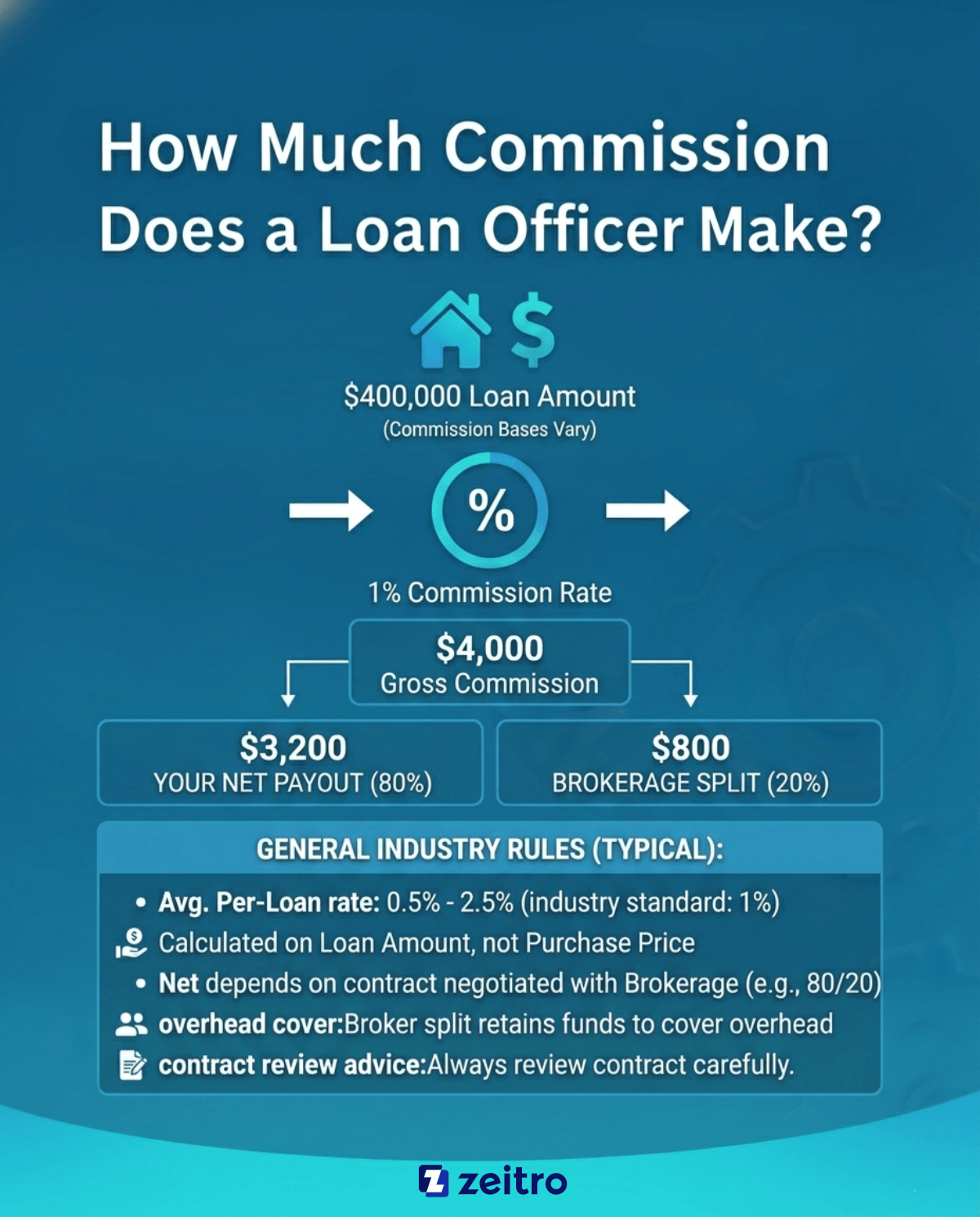
On average, loan officers earn between 0.5% and 2.5% per closed loan, with 1% acting as the unofficial industry norm. In practice, though, most compensation plans aren't written as a clean percentage — they're quoted in basis points, or bps. One basis point equals 0.01%, so 100 bps is the same as 1%. If your plan pays 75 bps on a $300,000 loan, that's $2,250 before any split. Once you start reading offer letters, you'll see bps everywhere, so it's worth getting comfortable with the math early.
Here's a simple example. Say you close a $400,000 mortgage at a 1% (100 bps) commission rate. That generates $4,000 in gross commission for your brokerage. You don't keep all of it — your take-home depends on your negotiated split. At an 80/20 split, you'd walk away with $3,200, and the brokerage keeps $800 to cover overhead, compliance, and support staff. Negotiating that split mattered just as much to my early paychecks as generating the leads themselves, so read your compensation agreement line by line before you sign anything.
Average Salary of Loan Officers
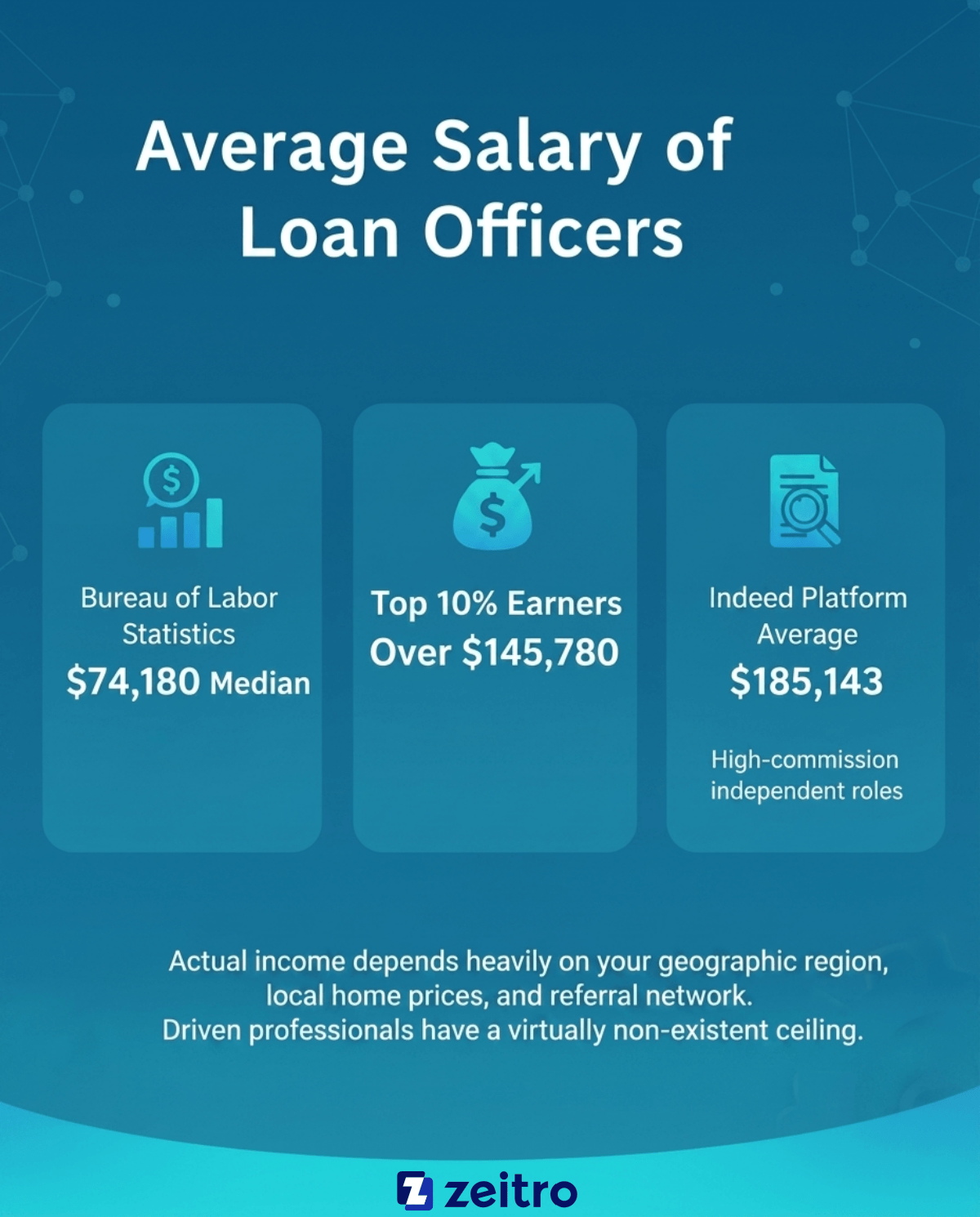
Because commissions fluctuate with the housing market, annual earnings vary widely. According to the U.S. Bureau of Labor Statistics, the median annual wage for loan officers is $74,180, with the top 10% of earners clearing more than $145,780. Meanwhile, job platforms like Indeed report average annual salaries exceeding $185,000, heavily driven by high-volume, commission-only originators.
From what I've seen in the field, your actual income depends heavily on your geographic region, local home prices, and your referral network.
- Bureau of Labor Statistics Median: $74,180
- Top 10% Earners: Over $145,780
- Indeed Platform Average: $185,143 (reflecting high-commission independent roles)
This wide spectrum proves that while the floor is low for those who struggle to find clients, the ceiling is virtually non-existent for driven professionals.
If you're trying to ballpark your own numbers, here's how a few common loan sizes shake out at a standard 1% (100 bps) commission rate, before any brokerage split:
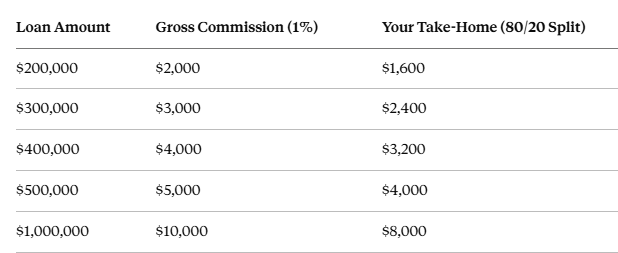
Adjust the rate up or down based on your own comp plan — broker channels often run 150 to 275 bps instead of 100, which changes these numbers significantly.
Also Read:
- Mortgage Loan Officer Salary: How Much Do Loan Officers Make?
- Loan Officer Requirements: Education, Licensing & Qualifications
- Is There a Loan Officer University for Newcomers?
How Does a Loan Officer Get Paid?
In most commission-based setups, you get paid once the loan actually closes and funds — not when you take the application, and not when it goes to underwriting. Once funding happens, the closing agent releases the gross commission to your brokerage, which then processes your split and issues your paycheck.
Because closings can take weeks, many brokerages offer a "draw against commission" — a regular advance to cover living expenses that gets deducted from earnings once loans fund. It's worth asking about this upfront if you're new to the industry, since a slow first quarter without a draw can be rough. You should also ask about clawbacks: if a borrower refinances or pays off the loan within a lender's clawback window (often six to twelve months), part or all of your commission on that loan can be pulled back. It's an unpleasant surprise if nobody warns you about it in advance, so get it in writing before you start.
On the regulatory side, federal rules still prohibit tying loan originator compensation to a loan's interest rate, fees, or other terms — a protection that dates back to reforms after the 2008 housing crisis. As of 2026, the CFPB has flagged this rule for long-term review as part of a broader push to ease mortgage compliance costs, and industry groups have lobbied for changes to how employee loan officers are paid. Nothing has changed yet, though, so the current restrictions remain fully in effect.
Broker vs. Bank: Where the Bigger Checks Come From
One thing that surprised me early on is just how differently a broker and a retail bank loan officer get paid for the exact same loan. Mortgage brokerages typically pay somewhere between 150 and 275 bps per loan, since the originator is closer to the wholesale pricing and there's no large retail overhead to fund. Retail banks and larger direct lenders, on the other hand, usually pay closer to 50 to 120 bps, but they make up for it with a base salary, benefits, marketing support, and company-provided leads.
Run the math on a $500,000 loan and the gap is obvious: at 75 bps, a retail loan officer earns roughly $3,750. At 250 bps, a broker on the same loan could clear $12,500. That doesn't make the broker path automatically better — a steady base salary and built-in leads have real value, especially in your first year or two — but it explains why so many experienced originators eventually move from a bank to a brokerage once they've built a referral base that doesn't depend on company leads anymore.
FAQs About Loan Officer Commission
Q1. How much commission do loan officers make on a $500,000 loan?
At a standard 1% commission, a $500,000 loan generates $5,000 gross. With an 80/20 split, you'd personally earn $4,000. Under a bank's salary-plus-commission model, that same loan might only pay a flat bonus of $500 to $1,000 — but with a guaranteed paycheck behind it.
Q2. Will MLO be replaced by AI?
No, AI will not replace mortgage loan officers. While automated systems are excellent for processing paperwork, uploading documents, and verifying credit scores, borrowers still demand human guidance. Navigating a mortgage is highly emotional and legally complex. Real estate agents and buyers want a trusted human professional to solve sudden underwriting issues, offer empathy, and negotiate complex financial scenarios.
Also Read: AI Mortgage Underwriting Explained: Will You Be Replaced?
Q3. Do loan officers get commission in California?
Yes, but California enforces strict labor laws. All California loan officers must receive at least the state's minimum wage of $16.90 per hour for all hours worked, regardless of closed deals. If an MLO is classified as non-exempt, employers must also pay overtime. Thus, pure commission plans in California are highly regulated to protect employee wages.
Q4. How much does a loan officer make per loan?
Typically, a loan officer nets between $2,000 and $5,000 per closed loan. This estimate assumes a standard loan size of $300,000 to $500,000 and a typical commission split, though high-end luxury loans can yield significantly higher single-payday results.
Q5. Do loan officers pay for their own marketing and leads?
It depends on your business model. In my experience, commission-only independent brokers must fund their own marketing, CRMs, and lead generation, which eats into their profits but offers higher commission splits. Conversely, retail bank loan officers receive company-provided leads and marketing support, but accept a much lower commission percentage in return.
Q6. Do loan processors get commission?
Usually not. Loan processors are almost always paid a flat salary rather than commission, since their job is administrative — collecting documents, coordinating with underwriting, and moving the file forward. Some employers add a small per-file bonus, but processors don't carry the same commission risk (or upside) that loan officers do. That's one of the clearest differences between the two roles, even though borrowers often confuse them.
Conclusion
Loan officer commission looks complicated from the outside, but once you understand the split, the basis points, and the difference between broker and retail pay, it's actually one of the more transparent compensation structures in finance. Whether you choose the stability of a bank or the higher ceiling of an independent brokerage, your income will come down to your work ethic and the strength of your referral network more than anything else.
If you're ready to take the next step, start by researching your state's licensing requirements and preparing for the SAFE MLO exam through the NMLS. And once you're licensed and originating, the tools you use matter more than people expect — loan officers running on modern, AI-assisted platforms like Zeitro tend to close more loans per month simply because less time gets lost to manual data entry and back-and-forth paperwork. More closed loans, at the end of the day, is what actually moves your commission number.
People Also Read
- Best AI Mortgage Underwriting Software for Loan Professionals
- Mortgage Underwriter vs Loan Officer: Which Career Is Best?
- 11 Best Loan Officer Schools for Newbies: Online & Local
- [Guide] What is a Loan Officer License? How to Get It?
- Best Mortgage Loan Officer Training: Which to Pick?
- Loan Officer vs Real Estate Agent: Key Differences to Learn

![[Tips for Loan Officers] How Can I Lower Borrower DTI?](https://cdn.prod.website-files.com/6731bc6e813a541b54c30b10/6aa3b89e281a639e7a5c6fca_lower-debt-to-income-ratio-banner.jpg)