Written by

Eric
Share this article

.svg)
Subscribe to updates
Almost every week, a panicked borrower asks me if their new business venture just ruined their chances of buying a home. The standard industry myth says you must wait a full two years before applying. Fortunately, that rule is not absolute. If your situation checks specific boxes, official mortgage guidelines allow qualified borrowers to get approved with just twelve to twenty-four months of history.
Key Takeaways
- Program-specific minimums: FHA generally does not treat self-employment income earned for less than one year as effective qualifying income. USDA generally requires two consecutive years of documented self-employment income for repayment qualification.
- Conventional flexibility: Fannie Mae may consider income from a borrower with less than two years of self-employment when the latest signed tax returns document a full 12 months of current-business income and the file documents prior income from a similar business or occupation.
- Income analysis: Qualifying income is calculated under the applicable agency's cash-flow and stability rules. Some Freddie Mac scenarios may use the lesser of current-business income or prior-occupation income, but this is not a universal rule.
- Documentation matters: Tax returns, IRS transcripts, business records, year-to-date financial statements, and evidence that the business is active may be required, depending on the program and automated underwriting findings.
- Non-QM alternatives: Bank-statement and other alternative-documentation programs may be available, but they are lender-specific and may involve different pricing, reserves, down-payment, and documentation requirements.
Can a Borrower with Less than Two Years Self-Employment be Qualified?
Yes, you can qualify with under two years of self-employment, but approval hinges on meeting strict compensating factors and agency rules. In my underwriting desk reviews, here is how each major program treats this exception:
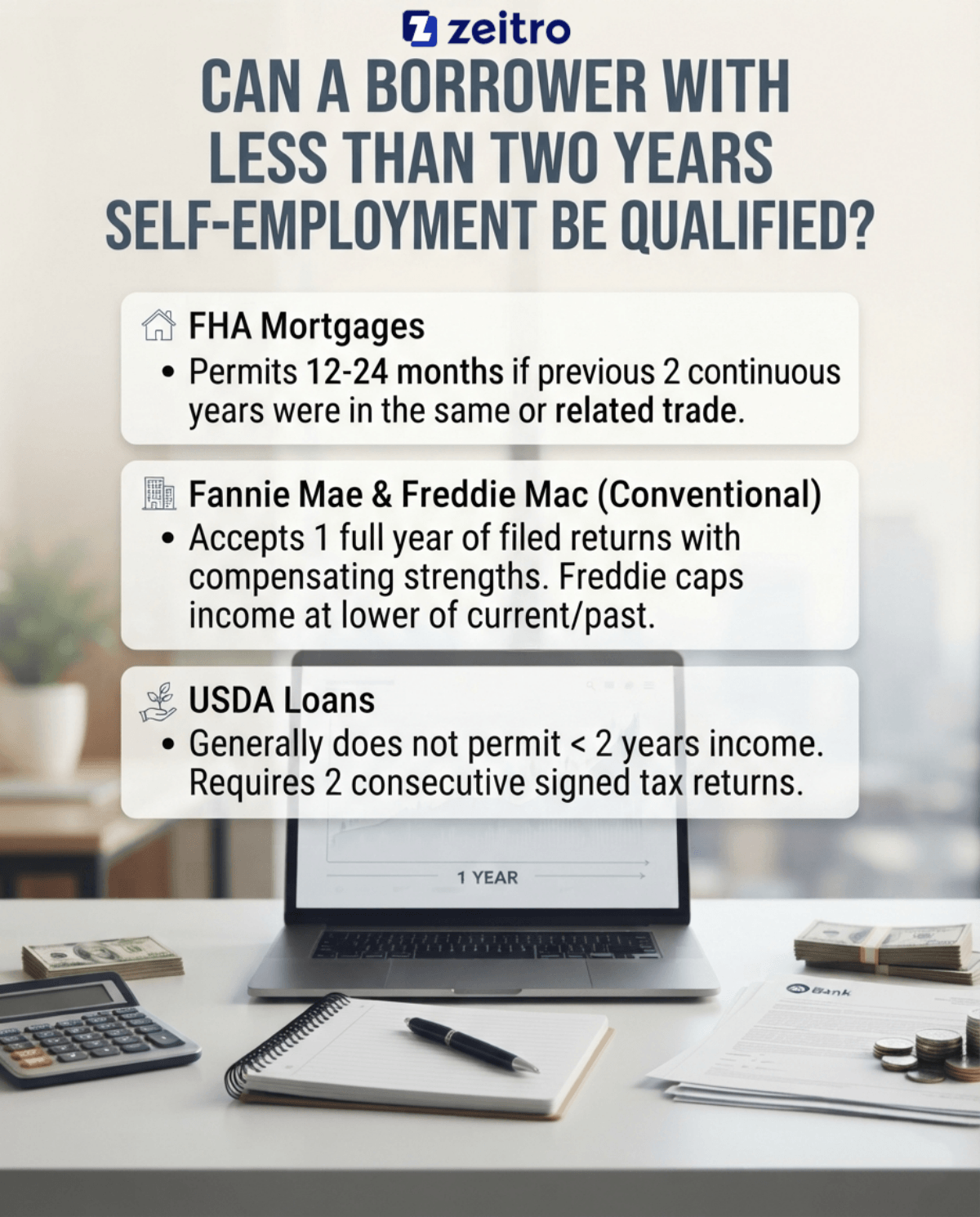
- FHA Mortgages: FHA permits twelve to twenty-four months of self-employment only if you spent the previous two continuous years working in the same line of work or a related trade.
- Fannie Mae & Freddie Mac: Conventional guidelines accept one full year of filed tax returns if your file demonstrates compensating strengths. Freddie Mac specifically caps qualifying income at the lower figure between your current earnings and past job.
- USDA Loans: USDA's current guidance generally does not permit self-employment income received for less than two years to be used in repayment-income calculations. USDA guidance indicates that two consecutive years of signed tax returns are required for self-employment income. This should not be confused with FHA's separate allowance for combining prior work experience with formal education or training.
To quickly verify guidelines, try Zeitro Strata AI.
Common Exceptions and Rules to Learn
When I structure these files, underwriters lean on specific exception criteria rather than raw tenure alone. Here are the core qualifying shortcuts to know:
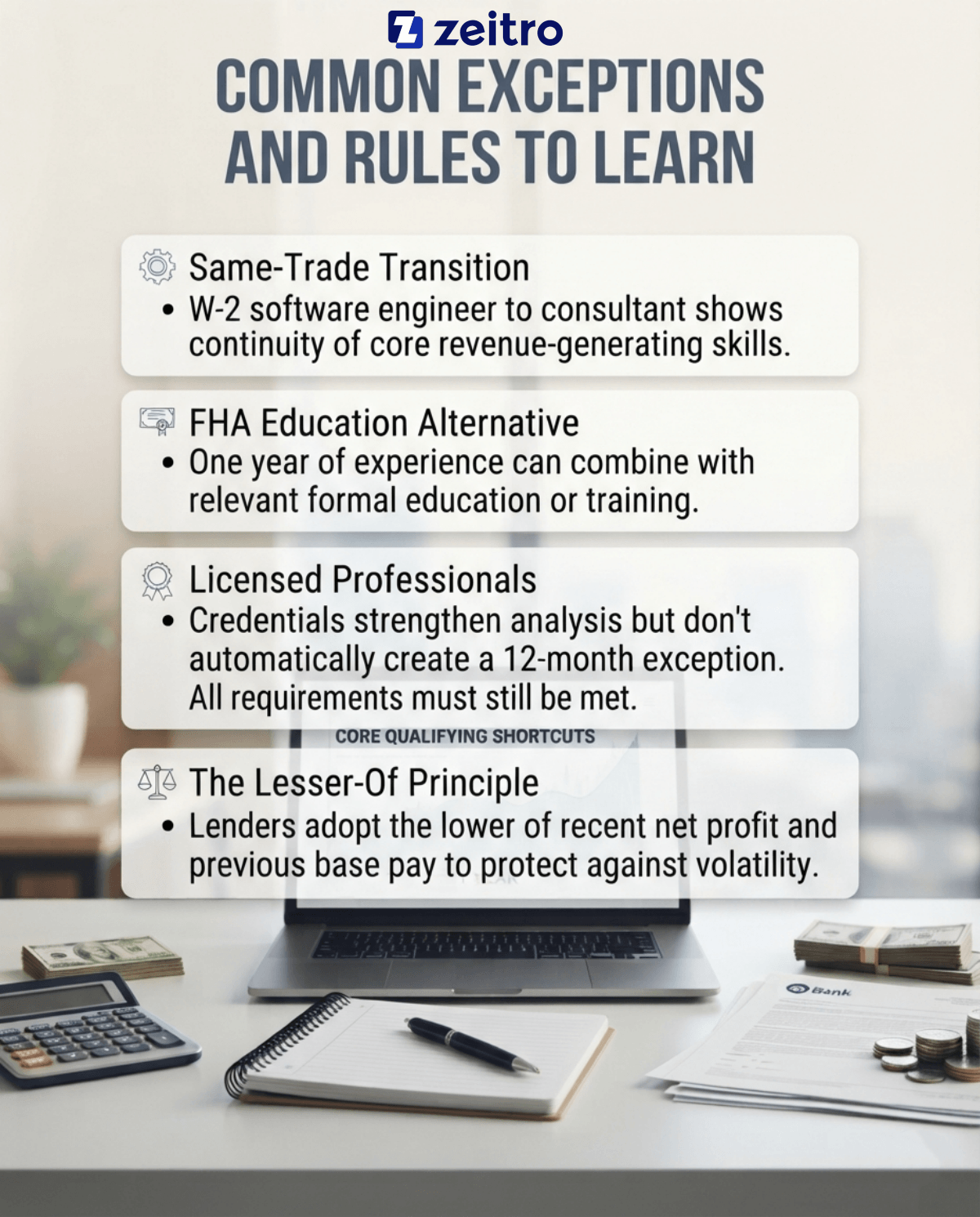
- Same-Trade Transition: Moving from a W-2 software engineer to an independent consultant gives underwriters confidence because your core revenue-generating skill set remains identical.
- FHA Education Alternative: Under FHA guidance, one year of documented employment experience may be combined with relevant formal education or training in the same or a related occupation. This alternative should not be presented as a universal rule for all conventional or USDA loans.
- Licensed Professionals: Professional credentials may strengthen the overall underwriting analysis, but they do not automatically create a 12-month self-employment exception. Doctors, CPAs, attorneys, and other licensed professionals must still satisfy the applicable program's income-history, tax-return, business-stability, and documentation requirements.
- The Lesser-Of Principle: When calculating income, lenders often adopt the lower number between your recent net profit and previous base pay to protect against early-stage volatility.
Alternative Options to Consider
If traditional guidelines turn down your file because tax write-offs wiped out your bottom line, several non-conforming loan products offer practical solutions:
- Bank Statement Loans: Lenders examine twelve to twenty-four months of business or personal deposits to evaluate real cash flow rather than taxable adjusted gross income.
- 1099 and P&L Programs: Some non-QM lenders offer programs that use 1099 income, a CPA-prepared profit-and-loss statement, or other alternative documentation instead of standard tax-return analysis. These programs are lender-specific, may carry higher pricing or fees, and still require verification of the business, income history, credit, assets, and ability to repay.
- Asset Depletion: Some loan programs and lenders may allow eligible liquid or investment assets to be converted into qualifying monthly income using a prescribed calculation. Eligibility depends on the asset type, ownership, documentation, program rules, and whether the assets are also needed for the down payment, closing costs, or reserves.
- Non-Occupant Co-Borrowers: Some loan programs permit a non-occupant co-borrower, but eligibility, income treatment, debt inclusion, loan-to-value limits, and other restrictions vary by program. Adding a co-borrower does not automatically make otherwise ineligible self-employment income acceptable.
Risk Factors and Conditions Attached to the Shorter-History Exception
Taking advantage of a shorter self-employment history triggers heightened underwriter scrutiny and specific defensive conditions:
- Program-Specific Minimums: FHA generally will not treat self-employment income earned for less than one year as effective qualifying income. USDA generally requires two years of documented self-employment income for repayment qualification. Conventional programs must be evaluated under the applicable Fannie Mae or Freddie Mac requirements, including the documented tax-return period and prior related experience.
- Reserves: Additional reserves may be required by a specific loan program, automated underwriting recommendation, property type, risk profile, or lender overlay. There is no universal agency rule requiring every borrower with a short self-employment history to maintain an additional three to six months of mortgage payments.
- Declining Income: A declining income trend requires careful analysis and may reduce or eliminate the income that can be used for qualification. It does not automatically result in denial in every case. The lender must evaluate the cause, the most recent documented income, business viability, and the likelihood that the income will continue.
- Individual Lender Overlays: Even if agency rulebooks permit one-year approvals, individual mortgage companies frequently enforce stricter internal standards demanding twenty-four months without exception.
More Frequently Asked Questions
Q1. What are Fannie Mae's guidelines for self-employed borrowers?
Fannie Mae generally looks for a two-year operational history. However, they allow underwriting approval with twelve to twenty-four months if your most recent tax return covers a full twelve-month period and your overall profile demonstrates compensating strengths like identical prior experience and stable earnings.
Q2. At what point are you considered self-employed?
A borrower who owns 25% or more of a business is generally treated as self-employed for agency underwriting. A borrower receiving 1099 income may also be evaluated under self-employment or independent-contractor rules, but the treatment depends on the nature of the income, the borrower's business structure, tax reporting, and the applicable loan program.
Q3. What is the documentation required for self-employed borrowers?
Typical documentation may include signed federal tax returns, applicable schedules, IRS transcripts, a year-to-date profit-and-loss statement, a balance sheet, business-existence documentation, and other records requested by the lender. The exact requirements vary by loan program, business structure, time in business, automated underwriting findings, and whether business income or business assets are being used.
Q4. What are the new rules for self-employed people?
The lender must verify that the business is active and that the qualifying income is reasonably expected to continue. The timing and method vary by agency and loan program. For example, Fannie Mae's verbal verification requirements generally use a 120-calendar-day period before the note date for self-employment income, while other programs or lender overlays may require more recent evidence.
Q5. What is the minimum income required for self-employed?
There is no universal minimum income or universal debt-to-income cap for self-employed borrowers. Qualification depends on the loan program, credit profile, loan-to-value ratio, assets and reserves, property type, automated-underwriting findings, and the lender's analysis of stable and continuable income. Tax-return income may be adjusted for allowable non-cash items such as depreciation, but the lender must perform the applicable cash-flow analysis rather than simply add back every deduction.
Final Word
Being self-employed for under two years does not lock you out of homeownership. As long as you have cleared the twelve-month operational milestone and hold solid experience in your craft, multiple financing paths remain open. Gather your previous W-2s, complete tax documents, and business records early, then connect with an experienced loan originator who understands how to package agency exceptions and non-traditional loan programs.
People Also Read
- Borrower Changed Jobs Three Months Ago: Can They Qualify?
- [Answered] Can I Use Asset Depletion Income for a Mortgage?
- How to Average Self-Employed Income Over Two Years?
- [Ultimate Guide] How Do I Analyze Self-Employed Tax Returns?
- How to Calculate Self-Employed Income for a Mortgage?

![[Tips for Loan Officers] How Can I Lower Borrower DTI?](https://cdn.prod.website-files.com/6731bc6e813a541b54c30b10/6aa3b89e281a639e7a5c6fca_lower-debt-to-income-ratio-banner.jpg)