Written by

Eric
Share this article

.svg)
Subscribe to updates
When borrowers come to me with multiple businesses—say, a consulting S-Corp and an e-commerce LLC—they often assume we simply total their gross revenue. In reality, mortgage underwriting requires a strict entity-by-entity audit.
We must assess individual cash flows, offset paper losses, and verify balance sheet liquidity before combining qualifying figures. Here is exactly how I calculate multi-business mortgage income under Agency and Non-QM guidelines.
Key Takeaways
- Separate Entity Analysis: Each business is evaluated independently on dedicated cash flow worksheets before combining qualifying earnings.
- Ownership Threshold (25%): Borrowers with 25% or greater ownership are classified as self-employed and must provide full business tax returns and cash flow analysis. Borrowers with less than 25% ownership may still qualify using Schedule K-1 income if a two-year history and verifiable distributions are documented, not solely W-2 wages.
- Mandatory Loss Offsetting: Losses from entities where the borrower has 25% or greater ownership are generally offset against other self-employment income. Losses from less-than-25% K-1 holdings are not automatically deducted unless they impact the borrower's cash flow.
- Documentation Consistency: Agency loans generally prohibit mixing alternative documentation (e.g., bank statements) with full tax returns for the same borrower. However, many Non-QM programs allow multiple documentation types across different income streams as long as income is not double-counted.
How to Calculate Mortgage Income If Borrower Has Businesses?
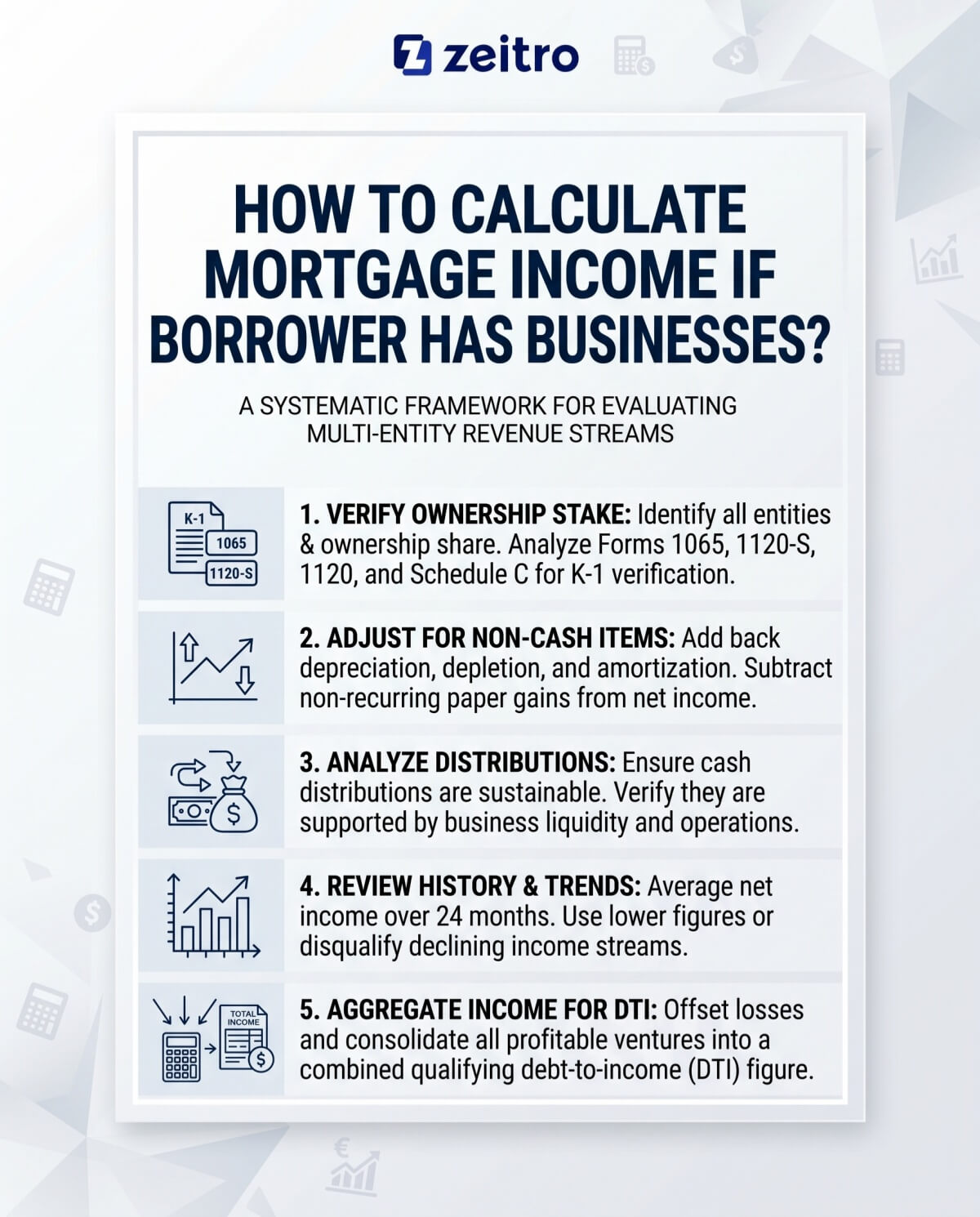
When I evaluate a borrower with multiple companies, I follow a systematic framework to ensure every revenue stream is stable, recurring, and compliant with lending standards.
- Classify Entity Type and Ownership Share: I pull personal returns and business schedules (Form 1065, 1120-S, 1120, or Schedule C) to verify your exact ownership stake via Schedule K-1.
- Adjust for Non-Cash Deductions: Starting with ordinary net income, I add back non-cash paper write-offs like depreciation, depletion, and amortization while subtracting non-recurring gains.
- Liquidity and Distribution Analysis: For pass-through entities, lenders verify that cash distributions are supported by business liquidity and do not jeopardize operations, but formal quick or current ratio tests are not universally required by Agency guidelines.
- Apply Operating History and Trending: I average net income over 24 months. If earnings drop in the most recent year, I use the lower figures or disqualify declining streams.
- Offset Losses and Aggregate: I deduct negative cash flows from profitable ventures to arrive at a combined monthly qualifying figure for your debt-to-income (DTI) ratio.
💡 Pro Tip: Manually calculating multiple K-1s and 1120-S schedules gets messy fast. I recommend uploading your full tax packages into Zeitro Strata to automate entity-level cash flow worksheets, verify solvency ratios, and run side-by-side scenario comparisons across different loan programs in minutes.
Mortgage Guideline Requirements
Agency investors and Non-QM lenders evaluate multi-entity portfolios through slightly different rulebooks:
- Agency Guidelines (Fannie Mae & Freddie Mac): Require standard cash flow forms (Fannie Mae Form 1084 or Freddie Mac Form 91) along with a two-year income trend analysis using the borrower's tax returns.
- Operating Longevity Rules: Most lenders require a two-year operating history for each business or 1099 income stream, though exceptions exist (e.g., Fannie Mae allows one year of returns if the business has operated for five years with 25%+ ownership).
- Entity Limits and Non-QM Calculations (e.g., Mega Capital & Windsor): Many portfolio lenders place no cap on the total number of companies you can own, but they may cap qualifying earnings to the lower of actual tax averages or recent P&L trends.

Documents Needed to Calculate Mortgage Income
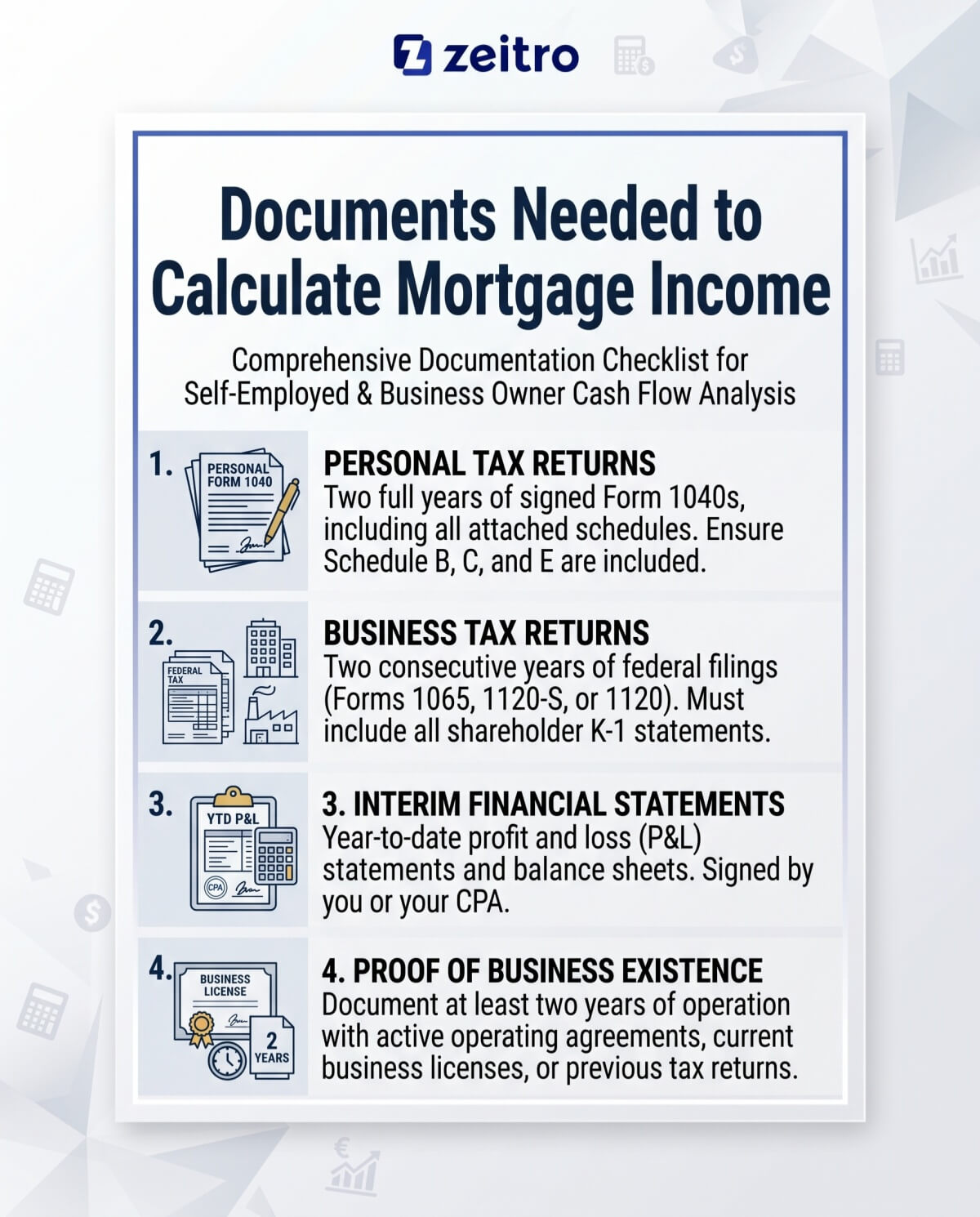
To run an accurate multi-business cash flow assessment, I always collect a complete documentation package upfront:
- Personal Tax Returns: Two full years of signed Form 1040s, including all attached schedules (especially Schedule B, C, and E).
- Business Tax Returns: Two consecutive years of federal filings (Forms 1065, 1120-S, or 1120) with all shareholder K-1 statements.
- Interim Financial Statements: Year-to-date profit and loss (P&L) statements and balance sheets signed by you or your CPA.
- Proof of Business Existence: Active operating agreements, business licenses, or tax returns showing at least two years of operation. CPA verification letters may be used in some Non-QM programs but are not universally required.
Risk Factors and Rule Interactions
When handling complex multi-entity files, several technical underwriting traps can derail an approval:
- Mixing Documentation Types: Major Non-QM matrices prohibit combining alternative documentation (like 12-month bank statements for one business) with full tax returns for another on the same borrower.
- Inter-Company Fund Transfers: Moving cash between sibling entities to artificially inflate revenue will be caught during bank audits and stripped out to prevent double-counting.
- Illiquid Paper Profits: Showing substantial K-1 income means nothing if the company has depleted reserves and cannot safely distribute funds to you.
- Undisclosed Loss Drag: Failing to disclose a struggling secondary business will backfire once Schedule E reveals losses that directly inflate your DTI.
More FAQs
Q1. What happens if one of my businesses is operating at a net loss?
When a secondary business shows negative earnings, I must subtract that monthly loss directly from the qualifying income of your profitable businesses. The only rare exception is if we can document that the loss-making company is fully self-sustaining and will not draw on your personal liquidity.
Q2. Can I qualify with Bank Statements for one business and Tax Returns for another?
It depends on the program. Agency loans generally prohibit mixing documentation methods for the same borrower. However, many Non-QM programs allow different documentation types across separate income streams (e.g., bank statements for one business and tax returns for another) as long as income is not double-counted.
Q3. How is income calculated if my ownership in a business is less than 25%?
If you own under 25% of an enterprise, you are not considered self-employed for mortgage purposes. In this scenario, I cannot count pass-through company profits. I can only use your actual W-2 wages or a documented two-year history of regular cash distributions.
Q4. Does every single business need a minimum two-year operating history?
Not always. While many lenders prefer a two-year history for each business or 1099 stream, exceptions exist (e.g., Fannie Mae may accept one year if the business has operated for five years with 25%+ ownership), and some Non-QM programs consider 12 months of consistent revenue.
Q5. How do underwriters prevent double-counting income across multiple entities?
I scrutinize general ledgers and corporate bank statements for inter-company transfers, management fees, or owner loans. Any internal payments shuffled between your affiliated companies are eliminated from our calculation to ensure every dollar of qualifying income is genuinely earned once from external clients.
Conclusion
Qualifying for a mortgage with multiple businesses is not a guessing game—it is an exacting process of separate cash flow analysis, liquidity verification, and loss netting. To avoid underwriting delays, gather complete tax packages for every entity early. Understanding these rules upfront ensures your true earning power is presented clearly, giving your loan file the best possible path to a smooth approval.
People Also Read
-
Declining Income? Can the Borrower Qualify for a Mortgage?
How Should I Calculate Income If the Borrower Owns an LLC?
[Ultimate Guide] How Do I Analyze Self-Employed Tax Returns?
How Do I Calculate Income from an S Corp?

![[Tips for Loan Officers] How Can I Lower Borrower DTI?](https://cdn.prod.website-files.com/6731bc6e813a541b54c30b10/6aa3b89e281a639e7a5c6fca_lower-debt-to-income-ratio-banner.jpg)