Written by

Eric
Share this article

.svg)
Subscribe to updates
As a loan officer, I am often asked by clients if their part-time jobs can help them qualify for a mortgage. The short answer is yes, you absolutely can use part-time earnings. However, the catch lies in how reliably we can document your work history and prove its stability. Let us look at what it takes to make this extra income count toward your home purchase.
Key Takeaways
- Two-Year Standard: Lenders usually require a two-year history of uninterrupted part-time work.
- Income Averaging: Your qualifying income is based on a 12 to 24-month average, not just your current hourly rate.
- Dual Employment: Holding a full-time and part-time job simultaneously requires proving you have successfully managed both for two years.
- Primary Source: Part-time earnings may serve as your primary qualifying income if the hours are stable, the two-year history is uninterrupted, and the employer confirms in writing that the employment and income level are likely to continue.
Can You Buy a House on Part-Time Income?
Yes, you can buy a home using only part-time income. While it is entirely possible, the real hurdle is proving stability. If your hours are steady and your employment history is strong, underwriters will treat this just like a standard full-time application.
Agency Baselines for Part-Time Income on a Mortgage
When I submit your file, we must align with government and agency standards first.
- FHA Rules: To count part-time pay as effective income, FHA requires a solid two-year uninterrupted work history. We must average this income over 24 months. If you received a documented pay raise, we can average your hours over the past 12 months at the new rate. Gaps under two years might only count as compensating factors, not qualifying income.
- Fannie Mae Rules: While Fannie Mae does not specify a rigid minimum duration for part-time income used as primary income, its Selling Guide (B3-3.2-02) requires lenders to verify that the income is stable, predictable, and likely to continue. In practice, most lenders require at least a two-year history unless strong compensating factors exist (e.g., same-field employment post-graduation, written employer confirmation of long-term status).

Lender Overlays for Part-Time Income on a Mortgage
Agencies set the baseline, but individual lenders often add stricter rules, known as overlays. In my experience, navigating these overlays is where deals succeed or fail.
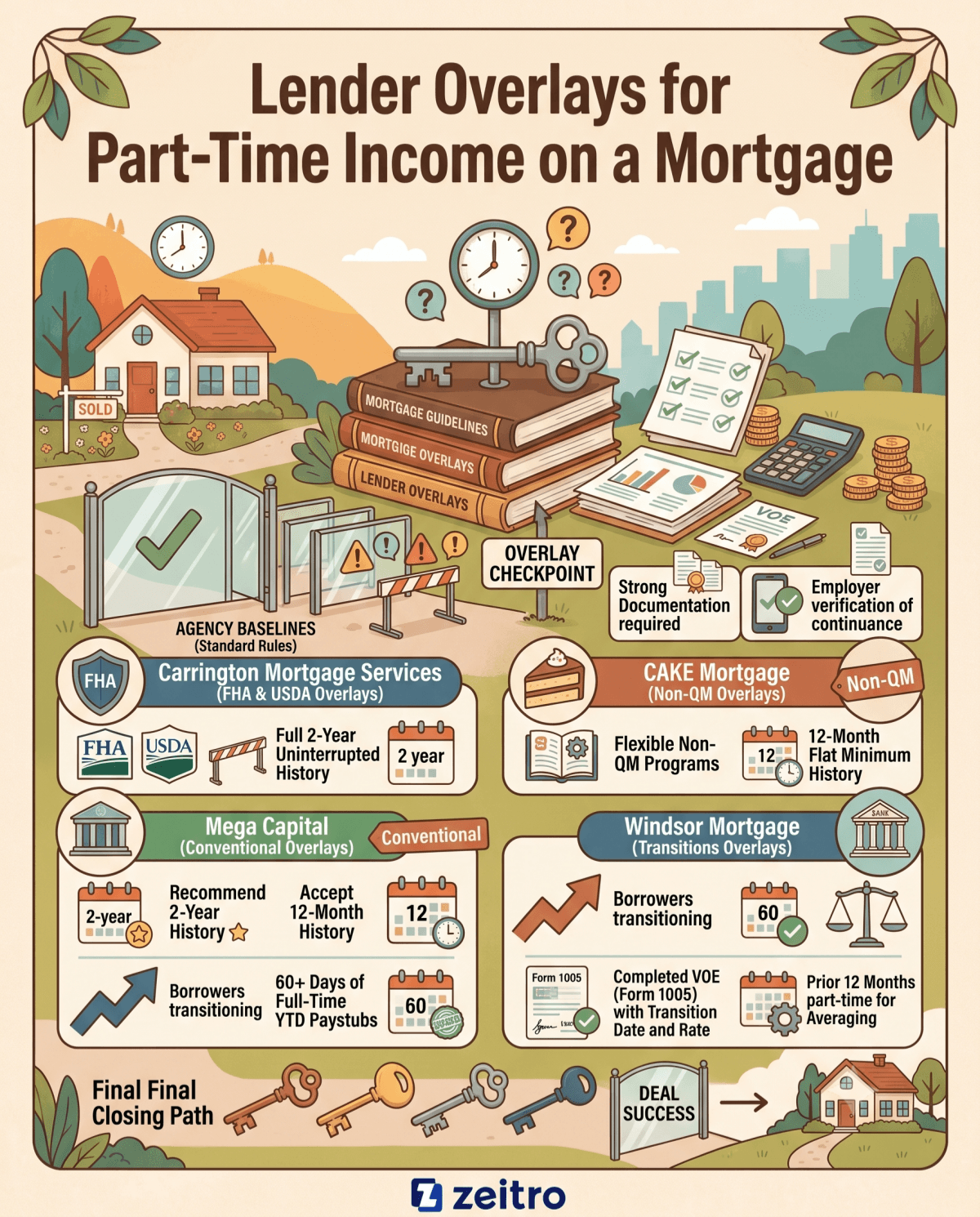
- Carrington Mortgage Services: For FHA and USDA loans, Carrington typically requires a full two-year uninterrupted history for part-time or secondary income. However, they may consider exceptions aligned with FHA baseline rules (e.g., recent graduates in related fields, military transitions) when supported by strong documentation and employer verification of continuance.
- CAKE Mortgage: A bit more flexible for Non-QM programs, requiring a flat 12-month minimum history for part-time work.
- Mega Capital: For conventional programs, they recommend a two-year history for secondary jobs but will accept 12 months if you have strong compensating factors.
- Windsor Mortgage: For borrowers transitioning from part-time to full-time with the same employer, Windsor generally requires at least 60 days of full-time year-to-date paystubs, a completed VOE (Form 1005) specifying the official transition date and new compensation rate, and often the prior 12 months of part-time earnings history to support income averaging.
Mortgage Program Comparison for Part-Time Income
To make sense of these varying rules, I have broken down how different mortgage programs and specific lenders handle part-time qualification.

This comparative breakdown of lender guidelines was researched, compiled, and verified by Zeitro Strata AI.
Documentation Requirements: Cross-Program Standards
To verify your income, underwriters will require a specific paper trail. Regardless of the program, you should expect to gather these standard items:
- Year-to-Date Paystubs: Your most recent paystub showing at least 30 days of year-to-date earnings.
- W-2 Forms: Your W-2s from the last one to two years, depending on the loan program.
- Verbal Verification of Employment (VVOE): Most lenders require a verbal confirmation from your employer no later than 10 business days prior to closing. Some programs (e.g., FHA) permit a written VOE dated within 120 days of closing as an alternative, provided no material changes in employment status have occurred.
- Written VOE (Form 1005): A completed form from your employer detailing your average weekly hours and pay structure.
- Tax Transcripts: Form 4506-C to verify your earnings directly with the IRS.
Gathering these early prevents last-minute processing delays.
Underwriting Risks and Red Flags to Keep in Mind
Over my years of reviewing files, I have seen several recurring issues that can pause an approval.
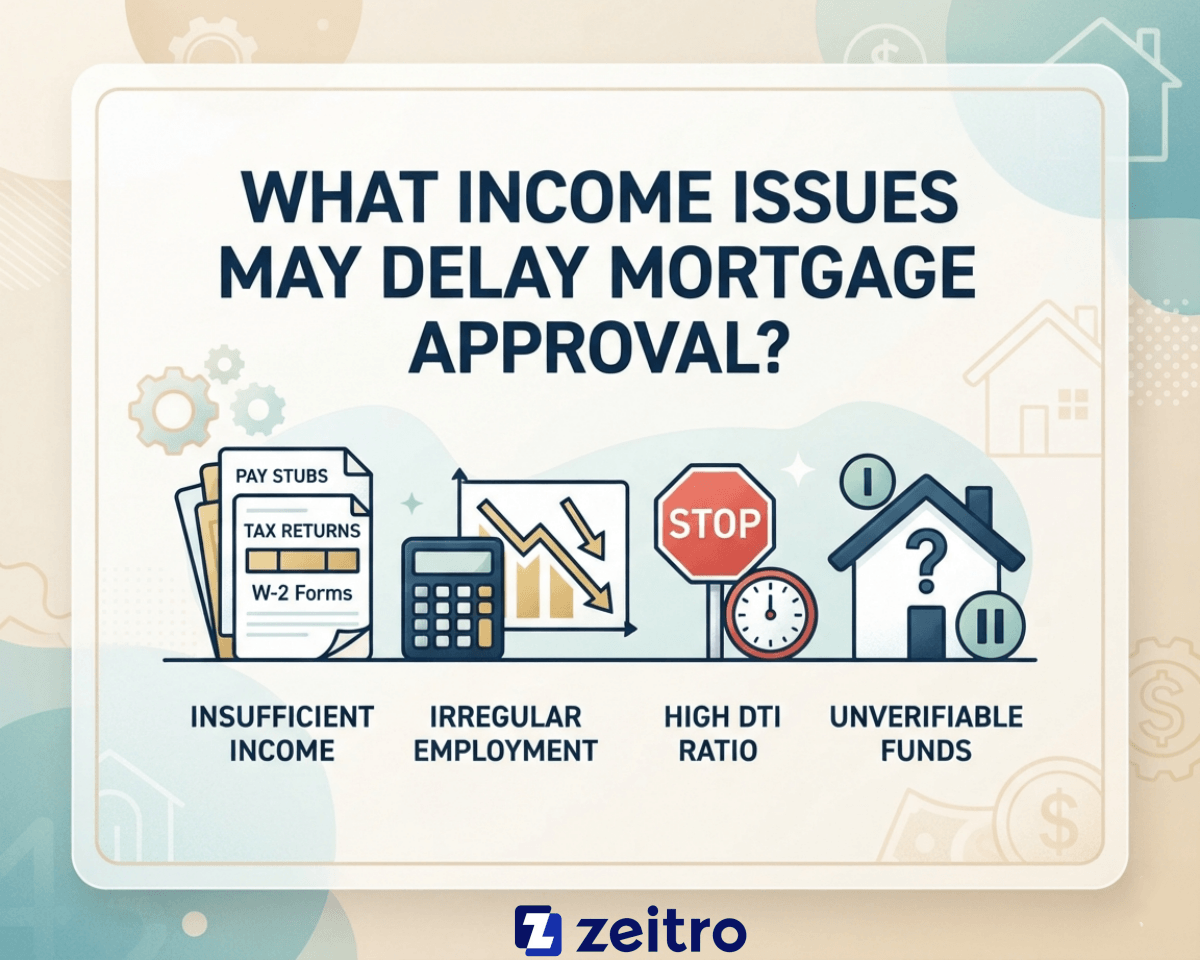
- Short Work History: If you have less than two years on the job, you will need documented compensating factors, such as high cash reserves or an excellent credit score, to satisfy the underwriter.
- Declining Hours: If your year-to-date paystub shows fewer hours than your previous year's W-2, underwriters see this as declining income. They will likely use the lower current average or reject the income entirely.
- Job Gaps: Gaps in your part-time history, especially under FHA, can restart your two-year clock.
- Part-time to Full-time Shifts: If you recently switched to full-time, we cannot easily use your new higher salary without a solid 30-day history of those new earnings.
FAQs About Using Part-Time Income for a Mortgage
Q1. Do I need to disclose my part-time income to a mortgage lender?
You only need to disclose your part-time income if you plan to use it to help you qualify for the loan. If your primary income is enough, you can leave it off. However, if your part-time work is self-employed (1099) and shows a net loss on your Schedule C tax return, you must disclose it. Lenders will pull your tax transcripts and deduct those losses from your qualifying income.
Q2. Can I combine multiple part-time jobs to qualify for a loan?
Yes, you can combine multiple part-time jobs to meet income requirements, but it is highly scrutinized. The key hurdle is proving you can sustain the workload. Underwriters typically require you to show a continuous two-year history of working both jobs at the same time. If you just recently took on a second job, we generally cannot count those new earnings.
Q3. How do lenders calculate part-time income if my hours fluctuate?
When your hours vary, underwriters will not simply use your highest paystub. They will look at the big picture by averaging your earnings over the past 12 to 24 months. If your hours are steadily increasing, we can usually make a strong case for using a 12-month average. However, if your hours are decreasing, they will base your qualification on the lowest, most recent earnings.
Q4. What if I recently transitioned from part-time to full-time work?
This transition is generally viewed as a positive move, but timing matters. Most lenders will not let you use your new, higher full-time salary immediately without proof. You will typically need to show at least 30 days of consistent year-to-date earnings at your full-time rate. We will also need a written verification of employment from your boss to confirm the official transition date.
Final Word
Qualifying with part-time income is highly achievable if you have the right history. Since lender overlays vary so wildly from agency baselines, I always recommend doing your homework early. To save yourself time and avoid unexpected declines, you can use Zeitro Strata to quickly verify specific lender guidelines and find the right loan programs for your unique financial situation.
Lender overlays vary and change frequently. Always consult your loan officer or verify current guidelines via authoritative sources (e.g., Fannie Mae Selling Guide, HUD Handbook 4000.1, or lender-specific underwriting manuals).

![[Tips for Loan Officers] How Can I Lower Borrower DTI?](https://cdn.prod.website-files.com/6731bc6e813a541b54c30b10/6aa3b89e281a639e7a5c6fca_lower-debt-to-income-ratio-banner.jpg)