

The top USDA lenders in 2026, by USDA's own count, are Guild Mortgage, DHI Mortgage, Neighbors Bank, Flat Branch Mortgage and CrossCountry Mortgage, the five leaders in USDA's 2026 Top Originating Lender awards. Any USDA-approved lender can make the same guaranteed loan: 0% down, a 1.00% upfront fee and a 0.35% annual fee, for households earning no more than 115% of the area median income and buying in an eligible area. Where lenders differ is their own credit score minimums (from 540 at Guild to a preferred 640 at Flat Branch), fees and speed.
If you're dreaming of a zero-down-payment home in a rural or suburban area, finding the right lender matters just as much as finding the right house. I remember comparing rates, hidden fees, and strict government guidelines when I first started digging into USDA financing, and it can feel overwhelming fast. To save you that headache, I pulled USDA's 2026 National Lender of the Year rankings, announced in June, and matched them against current market data to build this list of the best USDA loan lenders for the year.
Picking a knowledgeable partner affects your approval odds and how fast you close. But if you'd rather skip the research entirely, Bluerate's AI Chat can match you with a vetted local loan officer in minutes based on your specific financial picture.
USDA Loans: Key Numbers and Sources
These are USDA's own program rules from Rural Development and its HB-1-3555 handbook; each lender can add stricter rules (overlays) on top.
| Item | Number | Detail | Source |
|---|---|---|---|
| Down payment | 0% | 100% financing; USDA guarantees 90% of the loan for the lender | USDA Single Family Housing Guaranteed Loan Program |
| Income limit | 115% of median household income | Applies to adjusted household income; the dollar limit depends on county and household size | USDA program page; 7 CFR 3555.10 |
| Guarantee fees | 1.00% upfront, 0.35% a year | Fiscal year 2027 rates (October 1, 2026 to September 30, 2027), purchase and refinance | USDA Rural Development FY 2027 notice |
| Debt-to-income | 29% housing, 41% total | GUS Accept files need no waiver; manual waivers go up to 32/44 with a 680+ credit score | USDA HB-1-3555, Chapter 11 |
| Credit score | No USDA minimum | GUS sets the acceptable score on automated files; manual files need one applicant with a validated score | USDA program page; HB-1-3555, Chapter 10 |
| Loan term | 30-year fixed only | Rates are set by each lender | USDA program page |
| Seller concessions | Up to 6% of the sales price | Must go toward eligible loan purposes such as closing costs | USDA HB-1-3555, Chapter 6 |
| Streamlined-assist refinance | $50+ monthly savings | No new appraisal or debt ratios; current loan closed at least 180 days earlier | USDA HB-1-3555, Chapter 6 |
| Top originating lenders, 2026 | 1. Guild, 2. DHI, 3. Neighbors Bank, 4. Flat Branch, 5. CrossCountry | USDA's 2026 National Lender of the Year awards, June 17, 2026 | USDA news release |
10 Top USDA Home Loan Lenders to Pick
How did I narrow down hundreds of mortgage companies to just 10 top-tier picks? By evaluating their processing speed, dedicated rural housing expertise, minimum credit requirements, and customer satisfaction. Here is my carefully curated list of the best USDA lenders you should seriously consider this year.
Also Read: How to Check Mortgage Eligibility? Quick and Accurate with Sources
#1. Guild Mortgage
NMLS: 3274
Best for: First-time homebuyers with lower credit scores seeking flexible underwriting.
Min. Credit Score: As low as 540, per Guild's USDA loan page.
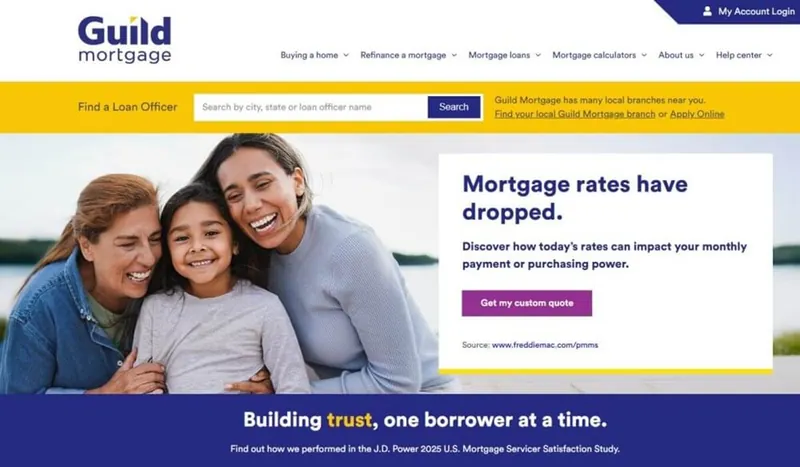
Guild Mortgage topped USDA's own 2026 Top Originating Lender rankings, and once you dig into their loan products, it's easy to see why. Their rural housing expertise runs deep, and they're genuinely willing to work with borrowers whose financial history isn't spotless. USDA also named Guild its 2026 Manufactured Housing Champion, which tells you something about how far their government-loan expertise stretches beyond the standard single-family purchase.
I'd point clients here because their loan officers treat USDA guidelines as their specialty, not an afterthought squeezed between conventional files.
Pros:
- Advertises USDA credit scores as low as 540
- Considers alternative credit data like rent or utility payment history
- Nationwide branch network for face-to-face support
- In-house processing tends to mean faster, more predictable closings
Cons:
- Rates aren't published on their site
- Origination fees can run a bit above the national average
- The online application eventually requires a phone call to move forward
#2. DHI Mortgage
NMLS: 14622
Best for: Buyers purchasing a brand-new construction home through D.R. Horton.
Min. Credit Score: Not published on DHI Mortgage's site.
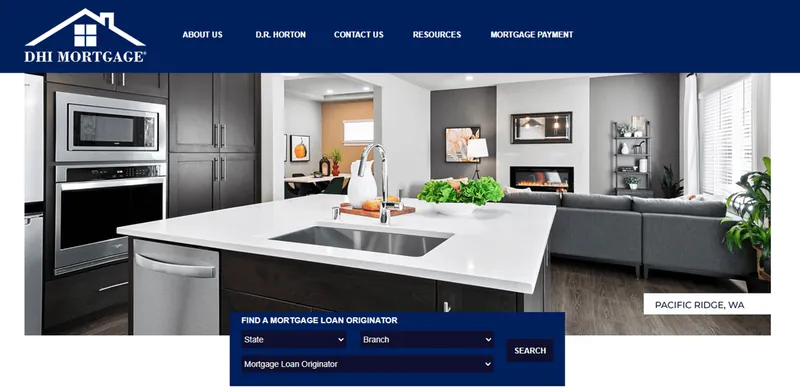
As the in-house lender for D.R. Horton, one of the country's largest homebuilders, DHI Mortgage ranked second nationally in USDA's 2026 originating lender awards. If you're buying a newly built home in an eligible suburban or rural subdivision, having your builder and lender under one roof removes a lot of the back-and-forth that slows other files down while third-party lenders wait on builder paperwork.
Pros:
- Streamlined process if you're buying a D.R. Horton home
- Frequently offers seller incentives like rate buydowns or closing cost credits
- Online portal lets you track your build and loan status together
- Strong grasp of USDA new-construction eligibility rules
Cons:
- Only practical for D.R. Horton properties
- Not a fit if you're eyeing an existing, older rural home
- Customer service experience varies by local branch
#3. Neighbors Bank
NMLS: 491986
Best for: Borrowers needing educational resources and dedicated USDA loan specialists.
Min. Credit Score: 620+, though compensating factors may be allowed.
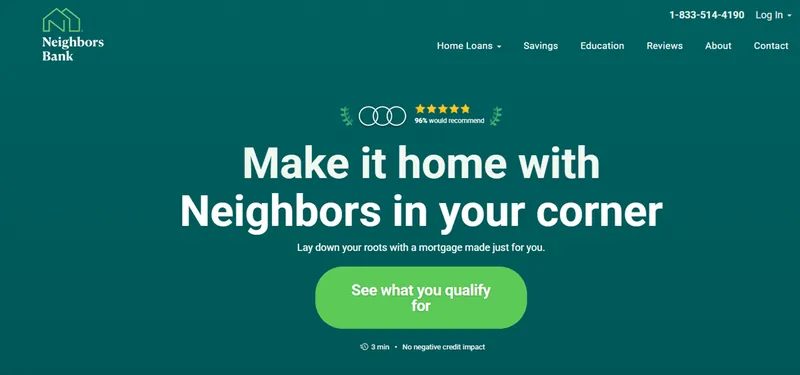
Neighbors Bank is an absolute powerhouse when it comes to government-backed mortgages, specifically catering to rural and suburban markets. USDA ranked it third nationally in its 2026 Top Originating Lender awards. When I researched their platform, I was thoroughly impressed by their comprehensive educational guides that walk you through complex property eligibility maps and income limits.
They made my list because they do not just process applications. They provide free credit consulting to help you actually qualify. This makes them a fantastic partner for anyone feeling intimidated by the process.
Pros:
- Deep USDA specialization means fewer processing surprises
- Free credit coaching for borrowers under their minimum score
- Strong reputation for walking borrowers through paperwork
- Online and mobile-app preapproval
Cons:
- Limited physical branch presence; mostly online and phone-based
- 620 minimum is stricter than a few competitors
- Fees can vary noticeably depending on your state
#4. Flat Branch Mortgage
NMLS: 224149
Best for: Midwest homebuyers looking for hyper-local market expertise.
Min. Credit Score: 640+ preferred, with flexibility below that.
Established in Missouri and dominating the Midwest, Flat Branch Mortgage is an employee-owned company that truly understands rural communities. Flat Branch says it was the No. 1 USDA lender in Missouri, Kansas, Illinois and Oklahoma for 2025, based on home loan (HMDA) data, and USDA ranked it fourth nationally in its 2026 Top Originating Lender awards.
I love their community-focused approach. Their loan officers live in the areas they serve, which is crucial when verifying rural property boundaries. I recommend them if you want a regional expert who treats you like a neighbor rather than just another application number.

Pros:
- Strong local knowledge of Midwest rural markets
- Flexible on credit scores below its preferred 640
- Community-focused and active in affordable housing initiatives
- Localized underwriting tends to speed up closings
Cons:
- Not available in every state
- Website lacks upfront rate-comparison tools
- Smaller footprint than national banks
#5. Fairway Independent Mortgage
NMLS: 2289
Best for: Buyers wanting a smooth, hybrid closing process with cutting-edge tech.
Min. Credit Score: Not published on Fairway's USDA loan page.
Fairway Independent Mortgage Corporation is a giant in the mortgage industry, and USDA loans are a core part of its lineup. From my perspective, their biggest advantage is how they blend modern technology with local branch support.
Their highly-rated mobile app allows you to track your zero-down loan progress in real-time. I added them to this list because they have the vast resources and hybrid closing options to push complex rural housing files across the finish line quickly.
Pros:
- Mobile app makes document upload and status tracking simple
- Offers digital closing options
- Large national footprint makes finding a local loan officer easy
- Known for hitting closing dates without last-minute surprises
Cons:
- Rates aren't posted online; you'll need to talk to a rep
- Automated underwriting overlays can be stricter than smaller lenders
- Company size can make the process feel less personal
#6. Movement Mortgage
NMLS: 39179
Best for: Buyers who need lightning-fast underwriting and quick closing times.
Min. Credit Score: Not published on Movement's USDA loan page.
Movement Mortgage revolutionized the lending industry with their goal to underwrite in hours, process in days, and close rapidly. When you are competing for a home, this speed is an incredible advantage. They do a phenomenal job with USDA loans, bypassing the sluggish timelines typically associated with government mortgages. I recommend them if you are in a competitive real estate market where sellers might otherwise be hesitant to accept a zero-down-payment offer due to perceived delays.
Pros:
- Among the fastest processing times in the industry
- Upfront underwriting means fuller approval before you even find a home
- Reinvests a meaningful share of profits into community programs
Cons:
- Rates and fee structures aren't published online
- Origination fees can run slightly above average
- The fast pace may feel rushed for borrowers who prefer a slower process
#7. Flagstar Bank
NMLS: 417490
Best for: Buyers who want their mortgage from a full-service bank.
Min. Credit Score: Not confirmed for this update; ask a Flagstar loan officer.
Flagstar Bank is a full-service traditional bank that also offers government-backed home loans. Because they're a full bank, not just a mortgage shop, you can apply with a lender you may already bank with. One thing to know: Flagstar sold its mortgage servicing business to Mr. Cooper in November 2024, so after closing your loan may be serviced by another company. Confirm that Flagstar still offers USDA loans in your state before you apply.
Pros:
- Online application plus branch support where Flagstar has branches
- Convenient if you already bank with Flagstar
- Competitive rates for well-qualified borrowers
Cons:
- Your loan may be serviced by another company after closing
- Fees can run higher than independent mortgage brokers
- Larger institution size can mean a more bureaucratic feel
#8. PrimeLending
NMLS: 13649
Best for: Buyers looking to finance home renovations into their USDA purchase.
Min. Credit Score: Not published; PrimeLending's USDA page cites flexible credit requirements.
PrimeLending is an established national lender that brings exceptional versatility to the table. In my analysis, their standout feature is their deep expertise in renovation loans, which is perfect if you find an affordable rural property that needs a little TLC.
Their loan officers are highly trained in structuring complex government files. I highly recommend them because they give you the flexibility to transform a fixer-upper into your dream home using a single, manageable mortgage.

Pros:
- Incredible variety of loan options, including specialized renovation combinations.
- Branch offices across the country for personalized, face-to-face guidance.
- Features a transparent, educational website that helps demystify the mortgage process.
Cons:
- Does not openly publish minimum credit scores or interest rates online.
- Origination fees may be slightly more expensive than strictly online discount lenders.
- Their digital portal is functional but feels slightly less modern than some tech-first competitors.
#9. New American Funding
NMLS: 6606
Best for: Self-employed individuals and borrowers with non-traditional income streams.
Min. Credit Score: Typically 580, per New American Funding's USDA loan page.
New American Funding is a family-owned company known for its incredibly inclusive lending practices. I have always appreciated their manual underwriting capabilities, which specifically benefit gig workers, freelancers, and minority homebuyers who might not fit the traditional W-2 mold.
When it comes to USDA loans, their team takes the time to manually verify complex income situations rather than instantly rejecting them via an automated system. I selected them because they genuinely advocate for underrepresented rural homebuyers.
Pros:
- Exceptional manual underwriting team that understands complicated self-employed tax returns.
- Strong focus on diversity, bilingual support, and minority homeownership initiatives.
- Services the majority of their own loans, meaning your account will not be sold constantly.
- Offers a highly rated mobile app for seamless document and account management.
Cons:
- Can have slightly longer processing times due to detailed manual financial reviews.
- Their customized approach sometimes results in higher upfront lending fees.
- Current interest rates are not explicitly advertised without submitting personal contact information.
#10. CMG Financial
NMLS: 1820
Best for: Homebuyers wanting to crowdsource their closing costs safely.
Min. Credit Score: 580, per CMG's USDA loan page.
CMG Financial is an innovative lender that constantly pushes the boundaries of traditional mortgages. While USDA loans require zero down payment, closing costs can still be a massive hurdle. CMG solves this with their proprietary "HomeFundIt" platform, a compliant crowdfunding tool that lets friends and family contribute to your home purchase without triggering underwriting red flags.
I added them to this top 10 list because this unique feature, combined with their strong USDA knowledge, provides a brilliant solution for cash-strapped buyers.

Pros:
- Exclusive HomeFundIt platform makes raising closing cost funds easy and completely legal.
- Excellent customer satisfaction ratings and transparent communication throughout the process.
- Highly competitive interest rates across their government-backed loan portfolio.
- Knowledgeable staff who are well-versed in complex rural property boundaries.
Cons:
- Its published 580 credit minimum is higher than the 540 Guild advertises.
- They operate primarily as a retail lender, so physical branches are limited in some states.
- Their myriad of proprietary programs can feel slightly confusing for a novice buyer.
Quick Comparison: Best USDA Lenders at a Glance
| Lender | Best for | Min. credit score (lender's site, October 2026) |
|---|---|---|
| Guild Mortgage | Lower credit, flexible underwriting | As low as 540 |
| DHI Mortgage | New D.R. Horton construction | Not published |
| Neighbors Bank | First-time buyers who want guidance | 620+ (compensating factors may be allowed) |
| Flat Branch Mortgage | Midwest local expertise | 640+ preferred |
| Fairway Independent Mortgage | Hybrid, tech-forward closing | Not published |
| Movement Mortgage | Fast underwriting | Not published |
| Flagstar Bank | A full-service bank | Not confirmed; ask a loan officer |
| PrimeLending | Renovation financing | Not published |
| New American Funding | Self-employed borrowers | Typically 580 |
| CMG Financial | Crowdfunded closing costs | 580 |
How to Choose the Best USDA Mortgage Lender?
Selecting the perfect lender is just as crucial as finding the right house. Based on my experience, you should not just look at a familiar brand name. You need to evaluate specific, tangible metrics.
- USDA Expertise: Government loans are notoriously quirky. Ensure the loan officer specifically specializes in USDA property eligibility and local income limits to prevent a heartbreaking last-minute denial.
- Rates & Fees: Always compare origination fees. While USDA base interest rates are generally low across the board, individual lender fees can vary by thousands of dollars.
- Processing Time: USDA files require dual approval from both the lender and the regional government office. Always ask the lender for their average closing timeline.
If you do not want to spend hours manually comparing these tedious factors, Bluerate AI Chat can do the heavy lifting. In just minutes, it analyzes your profile and connects you with a vetted, top-performing USDA expert.
If you're a loan officer comparing these lenders for a client, Zeitro's pricing engine prices government loans alongside conventional and non-QM in one search, and Zeitro Strata answers USDA guideline questions with the guideline passage cited.
Not on This List? How to Find the Full USDA-Approved Lender Directory
USDA doesn't restrict borrowers to just ten companies. Hundreds of lenders across the country are approved to originate USDA Guaranteed Loans, and the ten above are simply the ones I'd point most borrowers toward first based on volume, specialization, and borrower feedback. If you want to browse the complete, official roster or confirm that a lender you're already talking to is actually USDA-approved, USDA Rural Development maintains that list directly as its Active Lenders list, searchable by state, and you can also verify any lender's NMLS license through NMLS Consumer Access before signing anything.
How to Check the USDA Property Eligibility Map
A lot of buyers assume USDA loans only apply to farmland, but eligible areas also include many small towns and suburbs just outside major metro areas. Before you fall for a house, it's worth confirming the address actually sits in an eligible zone. USDA's interactive eligibility map lets you type in any address and get an instant yes-or-no answer, and it's the same tool lenders use internally, so there's no guesswork involved. I'd bookmark it early in your search rather than waiting until you've already made an offer.
USDA Loan Income Limits: What You Actually Need to Know
USDA caps adjusted household income at 115% of the area median income (AMI) for the county where you're buying, but that dollar figure moves a lot depending on where you live and how many people are in your household. A family in a high-cost county might qualify with an income well above six figures, while the same household would be over the limit in a lower-cost area. Rather than quote a single national number that won't apply to your situation, I'd recommend running your address and household size through USDA's official income eligibility tool, since it pulls the current figure for your exact county.
One detail worth knowing: USDA counts income from every adult in the household, not just the people on the loan application, though qualified childcare and dependent care costs can be deducted before the limit is applied.
Looking to Build? USDA Construction Loan Lenders
If you'd rather build than buy existing, USDA's Single-Close Construction-to-Permanent Loan lets you finance the lot, construction costs, and permanent mortgage in one closing, so you're not stuck qualifying twice or paying two sets of closing costs. USDA actually recognized 1st Signature Lending as its 2026 Single-Close Construction Champion, which makes them worth a call if new construction is your plan. DHI Mortgage, covered above, is your go-to if you're specifically building with D.R. Horton, since the builder and lender relationship is already built in.
FAQs About USDA Loan Lenders
Q1. Are there any downsides to a USDA loan?
Yes. You have to buy in a designated rural or suburban area, and your household income can't exceed 115% of the area's median income. You'll also pay an upfront guarantee fee of 1% of your loan amount and an annual fee of 0.35% of the remaining balance (the rates for USDA's 2027 fiscal year, which began October 1, 2026). The upfront fee is usually rolled into the loan amount, and the annual fee is paid monthly as part of your mortgage payment rather than as separate mortgage insurance.
Q2. What is the 20% rule for USDA?
This is a common misconception about down payments. Conventional loans often require 20% down to avoid private mortgage insurance, but USDA loans require 0% down regardless. You'll still pay the government guarantee fee no matter how much equity you have.
Q3. Is USDA or FHA better?
It depends on your location and cash reserves. USDA works better if you're buying in an eligible rural or suburban area, since it skips the down payment entirely. FHA fits city properties or borrowers with lower credit scores, but it comes with a 3.5% minimum down payment.
Q4. Do all mortgage lenders offer USDA loans?
No. Only lenders specifically approved by the U.S. Department of Agriculture can originate and underwrite USDA Guaranteed Loans. That's exactly why checking a curated list of specialized USDA lenders, or the full official directory, matters before you start applying.
Q5. Can I get a USDA loan with a 580 credit score?
It's possible, though it's not easy. USDA itself sets no minimum credit score: its automated system (GUS) decides which scores it accepts, and manually underwritten files need a validated score. Most lenders add their own minimum, and several on this list publish one at or below 580 (Guild advertises 540; New American Funding and CMG list 580), so strong compensating factors like a low debt-to-income ratio or solid cash reserves still help.
Q6. Can I refinance an existing USDA loan?
Yes. The USDA Streamlined-Assist Refinance is the most common route, and it skips the new appraisal, debt-to-income test and most of the credit review that a typical refinance requires, though the lender still has to confirm your household income is under the limit. Your current USDA loan must have closed at least 180 days before the request with no payment more than 30 days late in the last 180 days, and your principal, interest and annual fee payment has to drop by at least $50 a month to qualify.
Q7. Can a government shutdown delay my USDA loan closing?
It can. USDA Rural Development offices close during a federal shutdown and stop issuing new loan guarantees, which can stall closings that haven't been finalized yet. If your file already has a Conditional Commitment before a shutdown starts, some lenders will still close at their own risk, but new approvals typically pause until funding resumes. USDA is currently funded by a stopgap spending law through December 11, 2026, so it's worth keeping an eye on federal budget news if your closing is scheduled near that date.
Conclusion
Securing a zero-down mortgage does not have to be a stressful, confusing ordeal. Finding the best lender for USDA home loans ultimately depends on your specific credit score, location, and financial goals.
- If you need maximum flexibility, Guild Mortgage is my top overall pick.
- For those building a new suburban home, DHI Mortgage offers unbeatable convenience.
- Meanwhile, Neighbors Bank is excellent for first-timers needing patient guidance.