


A borrower may arrive with pay stubs from a foreign tech company, asking if those earnings could back a U.S. home purchase. It is a common question, yet verifying overseas pay can quickly turn complex. To navigate these intricate guidelines without digging through endless lender manuals, loan officers can use Zeitro Strata to verify specific rules and find clear answers instantly.
Key Takeaways
- You can qualify using foreign income under FHA and Fannie Mae guidelines if you have a documented two-year history.
- Some lenders may apply their own conservative adjustments for exchange-rate risk, but there is no universal industry-wide foreign-income haircut of 5% to 25%.
- Foreign-language documents generally must be translated into English and foreign currency converted to U.S. dollars.
- Many Non-QM programs bypass foreign employment entirely, qualifying borrowers through DSCR or asset depletion instead.
Can I Use Foreign Income for a Mortgage?
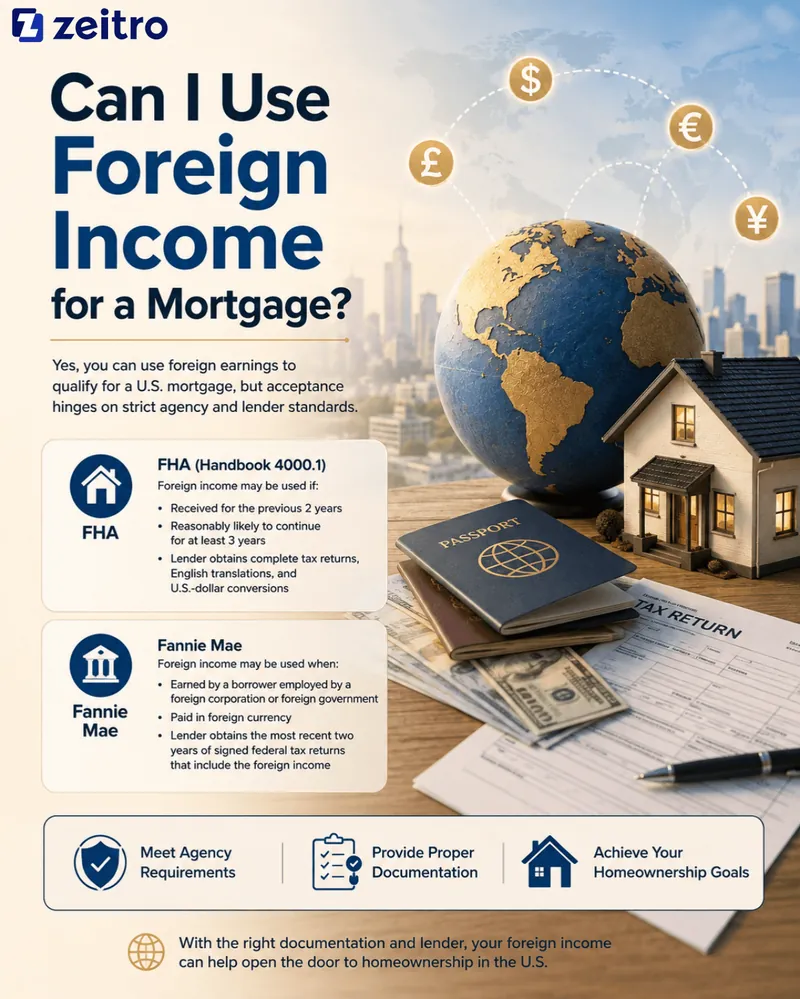
Yes, you can use foreign earnings to qualify for a U.S. mortgage, but acceptance hinges on strict agency and lender standards. Agency programs handle this through very specific frameworks:
- FHA (Handbook 4000.1): Foreign income may be used if the borrower has received it for the previous two years, it is reasonably likely to continue for at least three years, and the lender obtains complete tax returns, complete and accurate English translations where needed, and U.S.-dollar conversions.
- Fannie Mae: Foreign income may be used when it is earned by a borrower employed by a foreign corporation or foreign government and paid in foreign currency, provided the lender obtains the most recent two years of signed federal tax returns that include the foreign income.
Types of Acceptable Foreign Income
Underwriters can accept several distinct forms of overseas revenue, provided the paper trail is solid:
- Salaried Employment: Earnings paid by a recognized international firm or foreign employer are the easiest to approve when supported by pay stubs and tax records.
- Foreign Self-Employment: Foreign self-employment income may be acceptable, but it is usually subject to additional documentation and underwriting review, such as tax returns, financial statements, and other evidence the lender requires based on the income type.
- Rental and Investment Dividends: Cash flow from foreign real estate or global portfolios can count toward qualifying income, evaluated strictly on a case-by-case basis.
Requirements and Rules to Learn
When preparing a file with foreign income, meeting standard documentation rules is non-negotiable. Key requirements include:
- Two-Year History: FHA requires a two-year history of foreign income and evidence that it is reasonably likely to continue for at least three years. Fannie Mae generally requires the most recent two years of signed federal tax returns that include the foreign income.
- Tax Returns & Verification: Full U.S. or foreign tax filings, recent bank statements, and an employer verification letter are required.
- Translations and USD Conversion: All non-English paperwork requires a complete and accurate English translation, and earnings must be converted to U.S. dollars.
- Currency Haircuts: Some lenders reduce foreign earnings to buffer against exchange rate volatility, but FHA and Fannie Mae set no standard haircut.
- Higher Down Payments: Some lenders may require larger down payments, but FHA and Fannie Mae do not set a higher minimum for foreign income.
What Lenders Accept Foreign Income?
In underwriting practice, lender appetites for foreign income vary dramatically depending on the loan product:
- Agency Lenders: Standard FHA and Fannie Mae lenders accept foreign wages if full two-year tax and translation guidelines are satisfied.
- Specialized Non-QM Lenders: Programs like AD Mortgage or Luxury Mortgage often sidestep foreign wage audits altogether, qualifying buyers through property DSCR or asset qualifier models.
- Strict Exclusion Lenders: Lenders such as Carrington Mortgage Services explicitly prohibit foreign national programs or foreign income sources in specific guidelines.
Risk and Underwriting Implications
Assessing foreign income involves unique underwriting risks to account for before submitting a file:
- Currency Volatility: Fluctuating exchange rates can alter debt-to-income ratios overnight, which is why some lenders apply conservative currency discounts.
- Geopolitical Restrictions: Some lenders exclude income or assets tied to OFAC-sanctioned countries, entities, or persons, and they may require enhanced review for higher-risk jurisdictions.
- Documentation Friction: Translating foreign tax forms and verifying overseas employers creates delays.
- Shift to Alternative Qualification: To avoid complex income audits, underwriters often pivot borrowers toward DSCR or asset-based loans that focus on property cash flow instead.
FAQs About Foreign Income on a Mortgage
Q1. Does Fannie Mae allow foreign income for mortgage qualification?
Yes, Fannie Mae explicitly permits foreign-earned income. The borrower should provide two years of signed federal tax returns reflecting those earnings, along with complete and accurate English translations and converted U.S. dollar calculations.
Q2. How do lenders calculate currency haircuts on foreign earnings?
Some lenders apply their own haircut to protect against currency fluctuations; FHA and Fannie Mae set no standard percentage. It's worth factoring in this discount early to make sure you still meet the required debt-to-income limits.
Q3. Do overseas tax returns need to be translated into English?
Absolutely. Every foreign-language document, including tax returns and bank statements, must include a complete and accurate translation, along with clear conversion into U.S. dollars.
Q4. Can self-employed foreign income be used to secure a U.S. mortgage?
Yes, but it requires thorough verification. Borrowers must show a two-year history of business earnings using tax filings, audited financial statements, or a formal CPA letter. Alternatively, some Non-QM loans offer streamlined asset-based pathways.
Q5. What if a lender excludes foreign income entirely?
If a lender rejects foreign wages, a common alternative is Non-QM solutions like DSCR loans, which qualify the mortgage based on subject-property rental income rather than personal earnings.
Final Word
Qualifying for a mortgage with foreign income is entirely doable, but success depends on matching your profile with the right lender guidelines. Because programs range from strict agency tax rules to asset-based Non-QM options, keeping up with changing matrices is tough. Zeitro Strata can quickly verify complex lender guidelines so you can lock in the right loan scenario without the guesswork.