
Written by

Eric
Author from Zeitro

Share this article

Subscribe to updates

Thank you! Your submission has been received!
Oops! Something went wrong while submitting the form.

If there is one company that divides opinion more than any other, it's Better Mortgage. One user claimed they saved $4,000 in fees effortlessly, while another posted a horror story about being "ghosted" three days before closing.

In 2026, with interest rates still being the biggest hurdle for homebuyers, the promise of a "no-commission, digital-first" lender is incredibly tempting. But is the lower price tag worth the potential lack of human support? I've analyzed their latest terms, tested their famous "One Day Mortgage" claim, and dug into thousands of borrower reviews to give you the unvarnished truth. Here is my deep dive into whether Better Mortgage is a brilliant hack for saving money or a headache waiting to happen.

What Is Better Mortgage?

Better Mortgage (NMLS ID #330511) isn't your grandfather's bank. Better Mortgage launched its mortgage services in 2016, but the parent company Better.com was founded by Vishal Garg in 2014. It launched with a specific mission: to digitize the mortgage process and eliminate the "middleman."

Most traditional lenders employ Loan Officers who earn a commission, which is usually 1% to 2% of the loan amount on every deal they close. Better.com removed this layer entirely. Instead, they use non-commissioned support staff and a proprietary algorithm (affectionately dubbed "Tinman") to underwrite loans.

By 2026, they have solidified their position as a Direct Lender. This means they lend their own money rather than just brokering the deal to someone else. For you, this business model supposedly translates to lower rates and zero lender fees but as we'll see, a purely digital approach isn't for everyone.

What Is Better Mortgage?

Better Mortgage Pros and Cons: A Quick Snapshot

No lender is perfect. In my analysis, Better Mortgage is a tool, exceptional for some jobs, but terrible for others. Here is the high-level breakdown:

Pros

  • Zero Lender Fees: They genuinely do not charge origination, application, or underwriting fees. This alone can save you $1,000-$2,000 compared to big banks, as traditional origination fees often range from 1% of the loan or $995–$1,500 flat.
  • One Day Mortgage™: They can issue a Commitment Letter which carries more weight than a pre-approval, in 24 hours if you link your bank accounts digitally.
  • Better Price Guarantee: If you find a competitor with a better price, they promise to match it (and historically have offered $100 credits if they match).
  • Speed: Their automated system runs 24/7. You can get pre-approved at 2 AM on a Sunday.

Cons

  • Inconsistent Human Support: You don't get a dedicated Loan Officer. You get a "team," meaning you might talk to a different person every time you call.
  • Strict on "Weird" Income: If you are self-employed with complex tax write-offs, their algorithm often struggles to approve you.
  • No USDA Loans: As of early 2026, they still do not offer USDA loans for rural properties.
  • Rate Volatility: While often lower, their rates can change rapidly based on market algorithm shifts.

Loan Options & Services: What Does Better Offer?

Better isn't a niche lender anymore. They offer a full suite of products. However, their menu is tailored toward the "standard" borrower.

Loan Options & Services: What Does Better Offer?

Purchase Loans (FHA, VA, Conventional)

I checked their current roster, and they cover the "Big Three":

  • Conventional Loans: Standard fixed-rate (15 or 30 years) and adjustable-rate mortgages (ARMs).
  • FHA Loans: Great for first-time buyers with lower credit scores (minimum 580 usually required).
  • VA Loans: For veterans and active military. Better is known for offering competitive rates here, though they don't always have the specialized military expertise of a lender like Veterans United.

They generally do not support USDA loans or construction loans.

Refinance Options (Cash-Out & Rate-and-Term)

This is Better's bread and butter. Because refinancing is usually less time-sensitive than buying a home, their digital model shines here.

  • Rate-and-Term: Purely to lower your interest rate or change the loan length.
  • Cash-Out: If you have built up equity, you can refinance for a larger amount and take the difference in cash.

One Day Mortgage™: How It Works

This is their flagship feature for 2026. Most lenders take days to underwrite a file. Better claims to do it in 24 hours.

It's legit, but there is a catch. You must link your bank accounts (via Plaid) and upload your paystubs within 4 hours of locking your rate. If you do this, they provide a "Commitment Letter."

In a bidding war, a Commitment Letter beats a Pre-approval letter every time because it means an underwriter has already vetted your finances.

HELOC & Home Equity Lines

If you don't want to lose your low interest rate on your main mortgage, Better offers a HELOC (Home Equity Line of Credit).

They advertise funding in as fast as 7 days. I noticed they often waive appraisal fees for HELOCs by using automated valuation models (AVMs), which keeps closing costs very low.

Better Cover (Insurance) & Better Real Estate Services

They want to be your "One-Stop Shop."

  • Better Cover: This is an insurance aggregator that lets you shop for homeowners insurance during the loan process.
  • Better Real Estate: If you use one of their partner real estate agents, they often offer a discount on closing costs, which is historically around $2,000, but check current terms.

Better Mortgage Rates, Fees, and Closing Costs

This is the main reason you are reading this review. Are they actually cheaper?

The "Zero Lender Fee" Promise

Yes, it is real. Most banks charge a 1% "Origination Fee" or a flat "Admin Fee" of $995 to $1,500. Better charges 0 for this. On a $400,000 loan, that is an instant saving.

The "Hidden" Costs

However, "No Lender Fees" does not mean "No Closing Costs." You will still pay:

  • Third-Party Fees: Appraisal, Credit Report, Title Insurance, and Government Recording Fees.
  • Escrows: Property taxes and insurance pre-payments.
  • Points: Watch out for this. Sometimes Better shows a very low interest rate, but if you look closely at the Loan Estimate, it might require you to pay "Discount Points" upfront to get that rate. Always check Section A of your Loan Estimate.

Special Features & Incentives

Beyond the standard loans, Better uses aggressive incentives to win business.

The Better Price Guarantee

I love this feature for negotiation. If you get a Loan Estimate from a competitor like Rocket or a local broker, that has a lower APR for the same loan terms, Better will match it. In the past, they have even credited customers $100 if they honor the match.

Even if you don't plan to use Better, get a quote from them to force your local lender to drop their price.

Better Real Estate Agent Match

They have a network of partner agents. If you buy a home with one of them, Better typically applies a discount to your closing costs. While the discount is nice, ensure the agent knows your local market. Don't hire a bad agent just to save $2,000 on a $500,000 purchase.

Better Mortgage Customer Reviews & Reputation

Marketing is one thing. User experience is another. I analyzed sentiment across major platforms for 2025-2026.

Positive Feedback (Trustpilot, Zillow, Credit Karma)

Ratings vary by platform: Trustpilot shows around 3.9/5 ("great"), but some recent aggregates dip to 2.3/5 ("poor"). BBB holds an A- rating.

Tech-savvy users love them. Reviews frequently mention "fastest process ever," "loved not talking on the phone," and "saved huge money on fees." The One Day Mortgage feature is heavily praised by people who needed to close quickly.

Common Complaints & Issues

The negative reviews are specific and concerning. The most common complaint is "Ghosting." Because there is no single commission-based loan officer, files sometimes get stuck in limbo if an issue arises.

Borrowers with slightly complicated income (freelancers, recent job changes) report that Better's underwriters ask for the same documents repeatedly or deny the loan at the last minute.

Better Mortgage BBB Rating & History

Better.com generally maintains a B to A- rating with the Better Business Bureau (BBB). They are accredited, which means they pay to be there, but they also respond to complaints.

You will see a spike in complaints from 2022-2023 regarding layoffs, but recent 2025-2026 feedback shows operations have stabilized.

Comparison: Better Mortgage vs. Rocket Mortgage

These are the two giants of online lending. How do they compare?
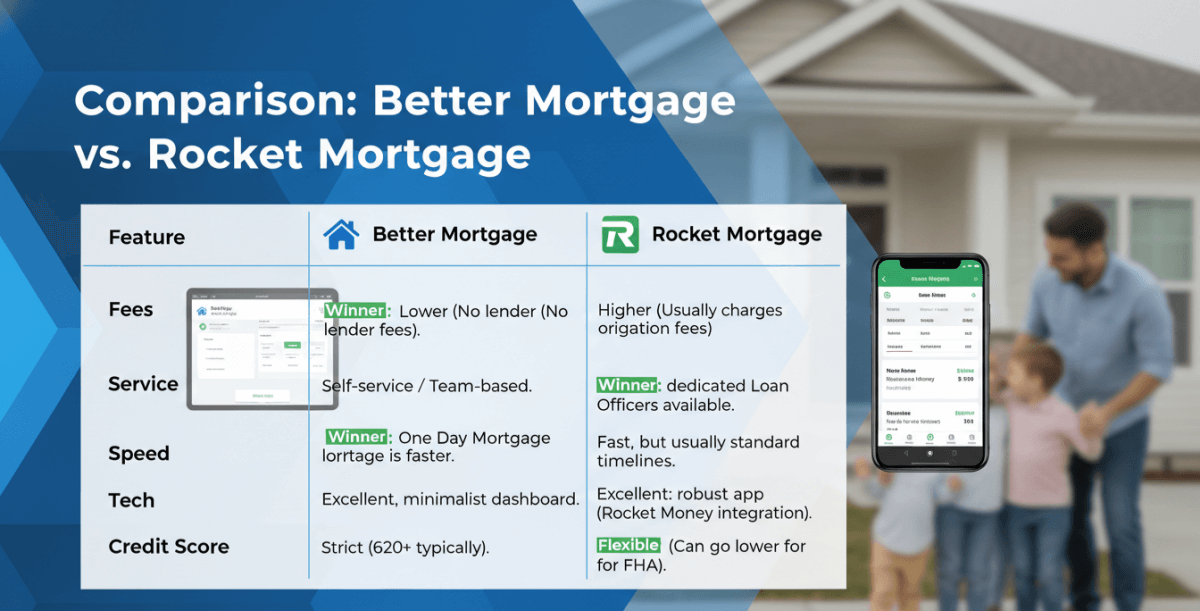
Comparison: Better Mortgage vs. Rocket Mortgage
  • Choose Better if you are price-sensitive and have a simple financial profile.
  • Choose Rocket if you are a first-time buyer who needs someone to answer the phone and walk you through every step.

Frequently Asked Questions (FAQs)

Is Better Mortgage legitimate and safe?

Yes. They are a fully licensed lender (NMLS #330511) regulated by federal and state laws. They have funded billions in loans and are a public company (Better Home & Finance).

Why are Better Mortgage rates lower than others?

It comes down to overhead. They don't have physical branches, and they don't pay loan officers commissions. They pass those operational savings on to you in the form of lower rates.

What credit score is required for Better Mortgage?

Minimum credit scores are 620 for conventional loans, 580 for FHA loans, and 620 for VA loans (higher than some competitors for VA).

Does Better Mortgage charge origination fees?

No. They famously charge $0 in origination fees, underwriting fees, or application fees.

Who owns Better.com?

Better is a publicly traded company. It was founded by Vishal Garg, who remains the CEO. SoftBank was famously a major early investor.

The Verdict: Should You Use Better Mortgage?

After reviewing the data for 2026, my verdict is that Better Mortgage is an excellent financial tool, but a mediocre service provider.

You should use Better Mortgage if:

  • You are a W-2 employee with a steady paycheck and good credit (700+).
  • You are comfortable uploading documents and managing tasks online without help.
  • You want the absolutely lowest closing costs possible.
  • You are doing a simple refinance.

You should avoid Better Mortgage if:

  • You are self-employed with complex tax returns.
  • You are buying a unique property (fixer-upper, rural land).
  • You get stressed easily and need a human to reassure you throughout the process.

Even if you don't use them, apply with them. Get their official Loan Estimate. It costs you nothing, and you can show that paper to any other lender and say, "Can you beat this?" That piece of paper is your most powerful weapon in buying a home this year.

People Also Read

Keep reading

DSCR Loan Requirements (2026): Ratio, Credit Score, and More

Blog

5 min read
Arrow icon on dark background
DSCR Loan Requirements (2026): Ratio, Credit Score, and More
Learn 2026 DSCR loan requirements. No tax returns needed. Discover minimum credit scores, cash flow ratios, and down payment rules to qualify for your investment property.

I've been there. You find the perfect investment property, the numbers look incredible, but then your CPA reminds you that you wrote off so much income last year that you look “broke” on paper. It's the classic real estate investor's dilemma: smart tax planning often destroys your ability to qualify for a conventional mortgage.

That is exactly where a DSCR (Debt Service Coverage Ratio) loan saves the day. Unlike traditional financing, a DSCR loan doesn't care about your W-2s or tax returns. It cares about one thing: Does the property generate enough rent to pay for itself?

In 2026, lenders have tightened some guidelines while loosening others, particularly for short-term rentals. In this guide, I'm going to walk you through the exact requirements you need to hit this year to get approved, so you can stop worrying about DTI (Debt-to-Income) ratios and start scaling your portfolio.

Quick Summary: DSCR Loan Requirements at a Glance

If you are in a rush and just need the raw numbers to see if you qualify, here is the snapshot of the current lending landscape.

To qualify for a DSCR loan in 2026, lenders typically look for the following criteria:

  • DSCR Ratio: Lenders typically require a minimum DSCR of 1.00 or higher, with 1.25+ unlocking the lowest rates and maximum leverage.
  • Credit Score: Expect a minimum FICO of 640–660, with scores above 700 needed for optimal terms and higher LTV.
  • Down Payment: Expect to put down 20% to 25%. Unlike FHA loans, there is no 3.5% down option here.
  • Cash Reserves: Lenders typically require 6 months of PITIA payments in liquid reserves post-closing, though some accept 3 months or waive for cash-out refinances.
  • Loan Amount: Typically start at $100,000–$150,000 and reach up to $3–5 million for qualifying properties.
  • Experience: While "first-time investors" can qualify, having a track record of owning at least one other property often unlocks better rates.
Quick Summary: DSCR Loan Requirements at a Glance

Minimum DSCR Ratio Lenders Look For

The "Ratio" is the heart of this loan. If you understand this math, you understand how to get approved.

The formula lenders use is simple: DSCR = Gross Rental Income ÷ Total Monthly Debt (PITIA)

PITIA includes Principal, Interest, Taxes, Insurance, and HOA fees.

DSCR lenders price your loan based on risk tiers. Here is what I am seeing in the market right now:

  • The Safe Zone (> 1.25): If your rent is $2,500 and your mortgage is $2,000, your ratio is 1.25. This gets you the lowest interest rates and easiest underwriting.
  • The Break-Even Zone (1.00 – 1.24): The property pays for itself, but barely. You can still get funded, but the rate will be slightly higher.
  • The No-Ratio Zone (< 1.00): Yes, you can get a loan even if the property loses money monthly (often used for properties in high-appreciation areas like Austin or Miami). However, expect to put 30-35% down and pay a significantly higher rate.

If your ratio is tight (e.g., 0.95), consider buying down the interest rate with "points." Lowering the rate lowers the monthly payment, which mathematically raises your DSCR ratio back into the passing zone.

Credit Score & Borrower Qualifications for DSCR Loans

A common misconception I hear is, "Since they don't look at my income, my credit score doesn't matter." False. In fact, because they aren't looking at your income, your credit history is the primary way lenders judge your reliability.

While the technical minimum score is often 620, I wouldn't recommend applying with that score unless you have no other choice. Lenders use a tiered pricing matrix:

  • 740+ FICO: Unlocks the maximum LTV (up to 80%) and the lowest rates.
  • 700–739 FICO: Standard rates, usually 75% LTV max.
  • 620–679 FICO: You will likely be capped at 65% or 70% LTV, meaning you need a larger down payment, and your rate could be 1–2% higher than a top-tier borrower.

If you have had a bankruptcy or foreclosure, you typically need to wait 3 to 4 years before applying. This is much shorter than the 7-year wait for conventional loans, which is a huge advantage for investors recovering from a rough patch.

Also, I highly recommend closing these loans in an LLC (Limited Liability Company). Closing in an LLC is common and preferred by many lenders for asset protection, though personal guarantees may still apply.

Down Payment, LTV, and Reserve Requirements

Let's talk cash to close. DSCR loans are commercial-grade products, so they require "skin in the game."

In 2026, the standard down payment is 20% for a purchase. If you want a slightly better rate, 25% is the sweet spot.

  • Purchase: Max 80% LTV (Loan-to-Value).
  • Cash-Out Refinance: Max 70% – 75% LTV. Lenders are more conservative when you are pulling cash out.

This is where many beginners get denied. You cannot drain your bank account to zero at the closing table. Lenders require Reserves, liquid cash left over after the down payment.

  • Requirement: Usually 6 months of PITIA payments.
  • Example: If your mortgage is $2,000/month, you need $12,000 sitting in the bank after you pay the down payment.
  • Acceptable Sources: Business bank accounts, personal savings, and sometimes stocks/401k (though they may only count 70% of the vested value).
  • If you are short on cash, some lenders allow Gift Funds from a family member, but verify this early, not all DSCR lenders allow gifts.

Eligible Property Types & Loan Product Variations

One of the biggest shifts in 2026 is how lenders view Short-Term Rentals (STRs). A few years ago, financing an Airbnb with a DSCR loan was tough. Now, it's a standard product.

Eligible property types include the following.

  • Standard: Single-Family Homes (SFR), Condos, Townhomes.
  • Small Multi-Family: 2–4 Unit properties (Duplex, Triplex, Fourplex).
  • Large Multi-Family: 5+ units usually fall under commercial multifamily loans, not residential DSCR.

If you are buying a vacation rental, you don't have a long-term lease to show the lender. Lenders now accept data from AirDNA or a 1007 Rent Schedule marked for short-term usage. Lenders will often cut the projected AirDNA income by 10-20% to be safe. Ensure your numbers still work with that "haircut."

To maximize cash flow, many investors look for Interest-Only DSCR loans. You only pay interest for the first 10 years. This lowers your monthly obligation significantly, which boosts your DSCR ratio and puts more cash in your pocket today, though you aren't paying down principal.

Documentation Lenders Require: What to Prepare?

The beauty of this loan is the lack of paperwork. You can skip the call to your accountant. However, "Low-Doc" doesn't mean "No-Doc."

Here is the checklist you need to have ready:

  • Application: Standard 1003 loan application.
  • Credit Report: The lender will pull this (Tri-merge).
  • Bank Statements: Usually the most recent 2 months to prove you have the down payment and reserves.
  • Property Insurance: You need a policy ready before closing.
  • LLC Documents: Articles of Organization and Operating Agreement.
  • The Appraisal (The Big One): The appraiser fills out a Form 1007 (Rent Schedule). This document tells the lender what the "Market Rent" is. If the appraiser says the rent is $2,000, but you think it's $2,500, the lender uses the appraiser's number. This can kill your ratio. Meet the appraiser at the property with comps in hand to justify your rental numbers!
Documentation Lenders Require: What to Prepare?

How to Qualify: 6 Practical Steps to Improve Approval Odds

Navigating the Non-QM (Non-Qualified Mortgage) world can be tricky because every lender has different rules. Here is my proven workflow to get from application to funding.

  1. Check Your Credit: Ensure you are above 700 if possible. If you are at 660, pay down some credit card balances to boost your score before applying.
  2. Calculate Your Own DSCR: Don't guess. Take the expected rent and divide it by the new mortgage payment (including taxes/insurance). If you are under 1.15, you might need to put more money down.
  3. Organize Your Entity: Have your LLC registered and your EIN ready. Lenders hate waiting on state paperwork.
  4. Shop and Compare Rates (Critical Step): Here is the secret: DSCR rates are not standardized like conventional mortgages. Lender A might quote you 7.5% while Lender B quotes 8.5% for the exact same deal. That 1% difference kills your cash flow. I strongly recommend comparing quotes from multiple specialized loan officers. You can do this easily at Bluerate.
  5. Order the Appraisal: Once you pick a lender, they order the appraisal. Pray for a good rental valuation.
  6. Close: Sign the docs, wire the funds, and pick up the keys.
How to Qualify: 6 Practical Steps to Improve Approval Odds

Common DSCR Loan Requirements FAQs

Q1. Do DSCR loans typically require 20% down?

Yes. 20% is the industry standard minimum. While you might find a rare lender offering 15% down in a booming market, it usually requires an 800+ credit score and comes with a punishingly high interest rate.

Q2. Can equity be used for a DSCR down payment?

Yes. If you own another property with high equity, you can do a "Cash-Out Refinance" on that property first to generate the cash for the DSCR down payment. Some lenders also allow "Cross-Collateralization" loans, where you pledge two properties to secure one loan.

Q3. Is it difficult to qualify for a DSCR loan?

No, generally it is easier. Because there is no income verification or DTI calculation, the process is faster and less invasive than a conventional loan. If you have the cash for the down payment and a decent credit score, you will likely qualify.

Q4. What are the downsides of DSCR loans?

The main downsides are Rates and Prepayment Penalties. Expect an interest rate 1%–2% higher than a standard conventional loan. Also, most DSCR loans have a "Prepayment Penalty" (e.g., a 5-year step-down), meaning if you sell or refinance quickly, you pay a hefty fee.

Q5. How long are DSCR loan terms available for?

30 Years is standard. Most are 30-year fixed loans. However, 5/1 ARMs (Adjustable Rate Mortgages) and 40-year Interest-Only terms are also available if you need lower monthly payments to make the cash flow work.

Conclusion: Is a DSCR Loan Right for Your Investment?

In the 2026 real estate market, agility is everything. If you are a self-employed investor, or if you simply want to keep your personal debt-to-income ratio clean for a future primary home purchase, the DSCR loan is arguably the best tool in your arsenal.

Yes, the rate is slightly higher, and you need a solid down payment. But the ability to scale your portfolio without handing over your tax returns is a superpower.

If you are ready to see what numbers you can qualify for, don't just take the first offer you get. Compare live quotes. It's the smartest way to ensure your new investment starts profitable from day one.

People Also Read

Blog

5 min read
Arrow icon on dark background
CrossCountry Mortgage Review 2026: Rates, Services, Insights
Read our 2026 CrossCountry Mortgage review covering rates, loan types, and fees. Plus, see real borrower feedback and employee insights for loan officers.

If you have driven through a suburban neighborhood recently, you have likely seen a "Sold" sign financed by CrossCountry Mortgage (CCM). As one of the largest retail lenders in the United States, they are everywhere. But does popularity equal quality?

I have analyzed the mortgage landscape for years, and the 2026 market presents unique challenges for both borrowers looking for the best deal and loan officers seeking a stable career. This review isn't just a regurgitation of their website. It is a deep dive into what actually happens when you apply, or work, there. From their "black box" rate policy to their niche loan products, I will break down the good, the bad, and the essential facts you need before signing on the dotted line.

Who is CrossCountry Mortgage?

To understand if this lender is safe for your finances, we first need to look at their track record. Founded in 2003 by CEO Ronald Leonhardt Jr. in Cleveland, Ohio, CrossCountry Mortgage has grown from a small brokerage into a massive direct lender.

Unlike a broker who shops your loan around to others, CCM is a Direct Lender (NMLS #3029). This means they lend their own money and handle the underwriting in-house. Over the last two decades, they have aggressively expanded, landing on the Inc. 5000 list of fastest-growing private companies multiple times.

In 2026, their footprint is undeniable. They operate over 700 branches across all 50 states, plus Washington D.C. and Puerto Rico. Their reputation in the industry is built on speed and a "get it done" attitude. They are widely known for taking on complex loan scenarios that big banks often reject. However, because they operate on a branch-model system, your experience can depend heavily on which specific office you walk into. They are a legitimate, heavy-hitting player in the U.S. housing market, but they are certainly not a small, boutique operation.

Who is CrossCountry Mortgage?

Pros and Cons: Is CCM Right for You?

No lender is perfect. In my experience analyzing loan estimates, the "right" lender depends entirely on your specific financial profile. After reviewing data from 2024 through 2026, here is an honest assessment of where CCM shines and where they fall short.

The Benefits:

  • Broad Product Menu: They offer significantly more options than a standard bank, including Non-QM loans for self-employed borrowers.
  • Fast Closing Times: They utilize a "FastTrack" credit approval program that can clear a loan to close in as little as 10 to 21 days, a massive advantage in a competitive seller's market.
  • Physical Presence: If you prefer shaking hands and sitting across a desk from your loan officer rather than chatting with a call center bot, their branch network is a major plus.

The Drawbacks:

  • Lack of Rate Transparency: This is my biggest gripe. You cannot simply go to their website and see today's rates. You must speak to a loan officer to get a mortgage quote.
  • Fees Can Vary: Because branches operate somewhat independently, origination fees can vary. You have to watch your Loan Estimate document closely.
  • Servicing Complaints: While the loan process is often praised, some borrowers report frustration after the loan closes, specifically regarding payment processing or when the loan is sold to another servicer.
Pros and Cons: Is CCM Right for You?

What Types of Mortgages Does CCM Offer?

One area where I give CrossCountry Mortgage high marks is their catalog. They are not just looking for the perfect borrower with a 780 credit score. They have programs for almost everyone. Here is the breakdown:

  • Conventional Loans: These are your standard Fannie Mae/Freddie Mac loans. If you have a credit score above 620 and a steady W-2 job, this is likely your route.
  • Government Loans (FHA, VA, USDA):
    • FHA: Great for lower credit scores (down to 580 with 3.5% down).
    • VA: The gold standard for veterans, offering 0% down payment options.
    • USDA: Zero-down financing for homes in eligible rural areas.
  • Jumbo Loans: Essential for buyers in high-cost areas like California or New York, where home prices exceed federal lending limits.
  • Refinance Options: They offer both Rate-and-Term to lower your monthly payment, and Cash-Out refinances to tap into your home equity.
  • Home Equity: They provide HELOCs (Home Equity Lines of Credit) and closed-end Home Equity Loans, allowing homeowners to borrow against their property without refinancing their primary low-rate loan.

The "Secret Weapon": Special Loan ProgramsThis is where CCM stands out from big banks. They offer Non-QM (Non-Qualified Mortgage) products:

  • Bank Statement Loans: Perfect for self-employed gig workers or business owners who have cash flow but lack traditional tax returns.
  • ITIN Loans: For borrowers who live and work in the U.S. but do not have a Social Security Number.
  • Doctor Loans: High-balance loans with lower down payments designed specifically for medical professionals carrying student debt.
What Types of Mortgages Does CCM Offer?

What Can CrossCountry Mortgage Do for You?

The CCM platform is designed to guide you through the lifecycle of homeownership. Here is what the user journey looks like:

  • Buy a Home & Refinance: CCM has modernized its application process. You can apply via their digital portal, upload documents securely from your phone, and track progress. It is a hybrid model: tech-forward execution backed by a human loan officer.
  • Find a Loan Officer: On their website, you can search for officers by zip code. This is useful if you want someone local. However, here is a pro tip: Searching on a single lender's site limits you to their rates only. In my opinion, you should always compare the market. I often recommend tools like Bluerate for this. Bluerate allows you to find loan officers and creates a competitive environment where you can compare real-time rate quotes from multiple lenders simultaneously, completely for free. It's the smartest way to ensure the quote you get from CCM is actually competitive.
  • Mortgage Calculators: Before you apply, I suggest running the numbers. CCM offers a suite of about eight calculators. The most useful ones include:
    • Affordability Calculator: Tells you "how much house" you can buy based on income.
    • Rent vs. Buy: Helps you decide if 2026 is the year to stop renting.
    • Refinance Calculator: Shows your break-even point.
    • Early Payoff Calculator: Demonstrates how much interest you save by paying an extra $100/month.

Market Sentiment: Real Reviews from Borrowers and Staff

To get the real story, I looked beyond the marketing brochures and analyzed thousands of reviews across major platforms. Here are the recurring themes.

Borrower Experience: Zillow & Bankrate Ratings

On Zillow, CrossCountry Mortgage maintains very high ratings, such as 4.97/5 stars based on over 20,000 reviews. The most common praise refers to speed. Borrowers frequently mention, "We closed on time when another lender said we couldn't." If you are in a bidding war, this reputation matters.

Customer Service Reputation: Trustpilot & Yelp Feedback

Trustpilot shows a low average rating around 1.8-2 stars from limited reviews, while Yelp has mixed feedback with more negative comments on service. The positive reviews still focus on individual loan officers being "rockstars." However, negative feedback often revolves to servicing transfers. It is common for mortgage lenders to sell your loan after closing. Some users found the communication during this handoff to be confusing or frustrating.

Loan Officer Perspective: Glassdoor & Indeed Reviews

If you are looking for a job, this section is for you. Employee reviews on Glassdoor highlight that CCM is a sales-driven culture.

  • The Good: High earning potential. The commission structure is competitive, and the marketing support is top-tier.
  • The Reality Check: It is often described as "fast-paced" and "sink or swim." As a Loan Officer, you are largely expected to generate your own leads. It is not a 9-to-5 corporate gig. It is an entrepreneurial role.

Expert Verdict: Nerdwallet's Analysis

NerdWallet rates CrossCountry Mortgage at 4.0 stars overall for home loans, praising loan variety but noting lower customer satisfaction scores during origination. They praise the variety of loan types (FHA, VA, Non-QM) but consistently dock points for the lack of online rate transparency. They agree that CCM is a strong contender for borrowers with unique financial situations.

FAQs About CrossCountry Mortgage

Here are the answers to the most common questions I hear about CCM.

Q1. Credit Score Requirements: What is the Minimum?

For a standard Conventional loan, you generally need a 620 credit score. However, for FHA loans, CCM can often work with scores as low as 580 (and sometimes lower with a larger down payment). VA loans technically have no minimum, but 580-620 is the practical floor.

Q2. Down Payment: How Much Cash Do You Need?

You don't always need 20%.

  • Conventional: As low as 3% for first-time buyers.
  • FHA: 3.5% minimum.
  • VA & USDA: 0% down payment required if you qualify.

Q3. Legitimacy: Is CrossCountry Mortgage a Scam?

Absolutely not. They are a fully licensed, legitimate lender (NMLS #3029) accredited by the Better Business Bureau (BBB) with an A+ rating. They have been operating legally for over 20 years.

Q4. For First-Time Buyers: Is CCM a Good Choice?

Yes. Aside from low-down-payment options, they participate in various state and local Down Payment Assistance (DPA) programs. If you are cash-strapped, ask your loan officer specifically about DPA grants available in your county.

Q5. Career FAQ: Is CCM a Good Company to Work For?

If you are a "hunter" who thrives on commission and building relationships with realtors, yes. They provide excellent technology and processing support. If you prefer a salaried role with little pressure, this might not be the right environment for you.

Conclusion: Final Verdict for Buyers and Job Seekers

After reviewing the data, here is my final take.

  • For Borrowers: CrossCountry Mortgage is an excellent choice if you need speed or have a "tricky" financial situation (like being self-employed). Their product range is their superpower. However, because they don't publish rates online, you are flying blind until you talk to someone. Do not settle for the first number you hear. I strongly recommend using a comparison tool like Bluerate to verify that the quote CCM gives you is truly the best market rate available.
  • For Loan Officers: CCM offers a high-performance vehicle for your career. If you can drive sales, they provide the fuel (marketing and tech). Just be prepared for a competitive, high-energy culture where your income is directly tied to your hustle.

People Also Read

AmeriSave Mortgage Review 2026: An Honest Look for Borrowers & LOs

Blog

5 min read
Arrow icon on dark background
AmeriSave Mortgage Review 2026: An Honest Look for Borrowers & LOs
Is AmeriSave right for you? We analyze 2026 loan options, real customer complaints, and career insights for Loan Officers in this deep-dive review.

If you have ever Googled "low mortgage rates" in the last few years, you have almost certainly seen an ad for AmeriSave Mortgage. They are everywhere. But whether you are a borrower looking to save money on a refinance, or a Loan Officer (LO) looking for your next career move, the flashy ads don't tell the whole story.

I know the feeling—you see a rate that looks too good to be true, and you wonder, "What's the catch?" Or, if you are in the industry, you see their job postings promising endless leads and wonder, "Is this a churn-and-burn shop?"

I decided to dig deep into the data, the fine print, and real user feedback to separate the marketing fluff from reality. In this 2026 review, I'm pulling back the curtain on AmeriSave to help you decide if you should sign your loan papers or your employment contract with them.

What is AmeriSave Mortgage?

To understand if AmeriSave is right for you, you first need to understand how they operate. Founded in 2002 and headquartered in Sandy Springs, Georgia (a suburb of Atlanta). The corporate office is at 1200 Altmore Avenue, Building 2, Suite 300, Sandy Springs, GA 30342. AmeriSave Mortgage Corporation (NMLS ID #1168) is a Direct Lender, not a broker. This is a crucial distinction. It means they lend their own money and handle the underwriting in-house, which usually speeds up the process compared to a middleman.

In 2026, AmeriSave continues to operate with a "digital-first" business model. They are licensed in 49 states excluding New York, plus the District of Columbia, but you won't find a brick-and-mortar branch on your local street corner. They are strictly a consumer-direct shop.

By cutting out physical branches, they aim to lower overhead costs and pass those savings on to borrowers in the form of lower rates. For Loan Officers, this means you are likely working out of a centralized call center or remotely, processing high volumes of internet leads rather than shaking hands at open houses.

What is AmeriSave Mortgage?

The Good and The Bad: AmeriSave Highlights

Every lender has its strengths and weaknesses. Based on my analysis of current market data and customer feedback, here is the brutally honest breakdown of what you are getting into.

Pros:

  • Transparency: Unlike many competitors who hide their rates behind a "Call Us" button, AmeriSave allows you to see live rates and payments on its website instantly.
  • Speed: Their proprietary technology, often touted in their "click to close" marketing, really does streamline the document upload process.
  • No Origination Fee Options: They frequently offer loan structures where lender fees are waived though you might take a slightly higher rate in exchange.

Cons:

  • Aggressive Marketing: This is the big one. Once you enter your phone number, expect a lot of calls. I mean, immediately.
  • Discount Points: Those rock-bottom rates you see in the ads? They almost always require paying "discount points" upfront (prepaid interest). Make sure you do the math to see if the break-even point makes sense.
  • Lock Fees: If you want to lock in your rate for an extended period while shopping, it might cost you an upfront fee, which isn't industry standard everywhere.
The Good and The Bad: AmeriSave Highlights

What Loan Options Are Available?

AmeriSave is primarily known as a refinancing giant, but over the last few years, it has expanded its menu significantly to survive the shifting market. Here is a look at what you can actually apply for in 2026.

  • Refinance Loans: This is their "bread and butter." Whether it is a Rate-and-Term Refinance to lower your monthly payment or a Cash-Out Refinance to pull equity for renovations or debt consolidation, their system is optimized for this.
  • Home Equity Options: With home values still high in 2026, their HELOC (Home Equity Line of Credit) and fixed-rate Home Equity Loans are popular for homeowners who want cash without touching their low primary mortgage rate.
  • Purchase Loans: Yes, they do loans for buying homes, though their model is often less personalized than a local broker who attends closing with you.
  • FHA Loans: Government-backed loans ideal for those with credit scores as low as 600 or 620, depending on current overlays.
  • VA Loans: excellent options for veterans with $0 down payment requirements. AmeriSave is generally very competitive on VA interest rates.
  • USDA Loans: Zero-down financing for eligible rural and suburban homes.
  • DSCR Loans: A massive plus for real estate investors. These loans qualify you based on the property's rental income (Cash Flow) rather than your personal tax returns.
  • Jumbo Loans: For high-value properties that exceed conforming loan limits.
What Loan Options Are Available?

What Real Customers Are Saying?

Data is useful, but user experience is king. I've analyzed sentiment across multiple platforms to see how actual humans feel about their transactions. The results are a mixed bag, largely depending on which Loan Officer you get.

Trustpilot & Yelp: The Consensus on Rates

There is a fascinating divide here. Trustpilot rating is around 4.6/5 from over 17,000 reviews as of late 2025. Yelp shows low average ratings around 1-2 stars from hundreds of reviews, with complaints about service and rates.

Yelp tells a grittier story. The score here is often lower, with the primary complaint being "Bait and Switch" tactics regarding interest rates. Users report being quoted one rate, only to find out later that locking it required thousands of dollars in points. The takeaway? The happy customers are those who read the fine print. The unhappy ones felt misled by the initial ad.

Credit Karma Reviews: User Experience Feedback

On Credit Karma, the feedback loops back to the "Soft Pull" vs. "Hard Pull" experience. Many users appreciate that AmeriSave allows them to check rates with a soft credit inquiry, which doesn't hurt your score.

However, a recurring theme in the negative reviews is the post-inquiry barrage. Users report that moments after checking their rate, their phone began ringing off the hook. It seems their dialer system is extremely aggressive, which can be overwhelming if you are just in the early "browsing" phase.

NerdWallet

Industry experts like NerdWallet typically rate AmeriSave solidly, often in the 4 to 4.5-star range. They praise the lender for its technological integration. The expert consensus is that AmeriSave is an excellent choice for the "Self-Service Borrower", someone who is comfortable scanning documents, e-signing, and managing a dashboard without needing a human to hold their hand through every step.

For Loan Officers: Is AmeriSave a Good Career Move?

Now, let's flip the script. If you are an LO holding an NMLS license, should you work here?

Employee Satisfaction: Inside the Glassdoor Reviews

Looking at Glassdoor in 2026, the sentiment is distinct. The company generally scores well on "Training" and "Technology." New LOs appreciate the structured environment.

However, "Work-Life Balance" is a common pain point. Reviews frequently mention the "grind" culture. The positive reviews often come from high-performers who thrive in high-pressure environments, while negative reviews cite burnout from the demanding metrics and call volume requirements.

The Reality of Being an LO at AmeriSave

Here is the inside scoop: AmeriSave operates on a Consumer Direct (CD) model.

  • The Good: You don't have to hunt for business. You aren't driving to realtor offices begging for referrals. The company feeds you leads (warm transfers and internet leads) all day long.
  • The Bad: Because they provide the leads, the Commission Split (BPS) is significantly lower than what you would get in a self-gen retail retail role.

If you are a closer who hates prospecting, this is heaven. If you want autonomy and maximum commission per deal, this might feel like a factory.

AmeriSave FAQs: Your Questions Answered

Is AmeriSave Mortgage legit and safe?

Yes, absolutely. They are a legitimate, BBB Accredited business (often holding an A+ rating) and have been operating for over two decades. They are a regulated Direct Lender, not a scam.

How competitive are AmeriSave's rates?

Their rates are often among the lowest in the industry if you are willing to pay discount points. Their base par rates are competitive, but their advertised "teaser" rates almost always assume you are buying the rate down.

How fast is the closing process?

AmeriSave is generally faster than big banks. Because they use automated underwriting and digital portals, they can often close refinances in 25 to 30 days, provided the borrower uploads documents immediately.

Conclusion: Who Should Choose AmeriSave?

After analyzing the data from both sides of the desk, here is my final verdict for 2026.

  • For Borrowers: AmeriSave is a fantastic option if you are tech-savvy, credit-worthy (680+ score), and speed-focused. If you are comfortable uploading your own W2s and don't need a loan officer to explain every single acronym to you, you can save a lot of money here. However, if you have a very complex financial situation or thin skin for sales calls, you might prefer a local broker.
  • For Loan Officers: If you are new to the industry or tired of the inconsistency of realtor referrals, AmeriSave offers stability and volume. It is a great place to sharpen your sales skills and close a high number of units. But be prepared to work hard. This is a high-volume game, not a high-margin one.

Disclaimer: Mortgage rates and employment conditions change daily. Always verify the latest terms directly with the company.

People Also Read

Try Zeitro today and transform your loan origination workflow!

Get started free