I've sat on both sides of the closing table, as a buyer sweating over my budget, and as a loan officer watching deals fall apart over unexpected fees. Figuring out your exact housing cost isn't just a good idea. It's survival.
Whether you're a borrower trying not to go broke or a loan pro managing client expectations, you need to nail these numbers early. Below, I'll walk you through the manual math and a tool that does the heavy lifting for you.
(Disclaimer: This guide is for educational purposes. Always chat with a licensed pro for actual rates.)
Key Takeaways
Your actual housing bill goes way beyond principal and interest—taxes and insurance matter just as much.
Crunching numbers by hand teaches you the basics, but it's incredibly easy to mess up the math.
Using a solid online calculator instantly gives you a realistic budget, baking in sneaky costs like HOA dues and mortgage insurance.
Why Do You Need to Calculate Mortgage Payments?
Jumping into the 2026 housing market without knowing your monthly limit is a recipe for disaster. Here's why you need to pin down these numbers before touring houses:
Avoiding the "House-Poor" Trap: You want a home, but you also want to eat. Budgeting ahead ensures your mortgage doesn't eat your entire paycheck.
Protecting Your DTI Ratio: Lenders obsess over your Debt-to-Income (DTI) ratio. If you run your own math early, you'll know if you actually qualify before applying.
Shopping for the Best Deal: A tiny drop in interest rates or a switch from a 15-year to a 30-year term changes everything. Running different scenarios helps you spot the best financial move.
Ways to Calculate Mortgage Payments
You generally have two options here. You can grab a calculator and a scratchpad to figure out the underlying math yourself, or you can use smart software to get an instant, error-free answer.
Use a Formula to Manually Estimate Mortgage Payments
If you really want to see how the math works, you can use the standard amortization formula:
M = P[ i(1 + i)^n ] /[ (1 + i)^n - 1 ]
Don't let the algebra scare you. Here is what those letters actually stand for:
M (Monthly Payment): The baseline amount you'll owe.
P (Principal): The actual loan size (your purchase price minus whatever cash you put down).
i (Monthly Interest Rate): Take your annual interest rate and divide it by 12.
n (Number of Months): Your loan term multiplied by 12 (a standard 30-year mortgage means 360 months).
I need to warn you, though. This formula only spits out your Principal and Interest (P&I). It completely ignores property taxes and home insurance, meaning your actual out-of-pocket cost will definitely be higher.
Use the Zeitro Mortgage Calculator to Do the Math
I still remember the headache of guessing my real budget on my first house. The fear of missing some hidden fee is exactly why tools like the Zeitro Mortgage Calculator exist. Built for both nervous first-time buyers and busy loan officers, it strips away the guesswork.
Why use it instead of a spreadsheet?
Free Instant Calculation: Get your numbers in under five seconds.
Comprehensive Cost Breakdown: It catches all those annoying extra fees.
Dynamic Amortization Tracking: Watch exactly how much interest you'll pay over the years.
You literally just type in your Home Price, Down Payment, Loan Term, and Interest Rate. To make it hyper-accurate, add your Monthly HOA Fees, local State Tax Rate, and PMI (that extra insurance fee if you put down less than 20%). No math degree needed—just plug it in and let Zeitro do the work.
Mortgage Payment Calculation Examples
Let's put this into perspective using a $400,000 home, pretty close to the typical U.S. home price level in 2026. We'll assume a 6.3% interest rate for both scenarios so you can see how much your down payment changes things.
Scenario A: The 20% Down Payment
Let's say you've managed to save up 20% ($80,000). That leaves you borrowing $320,000 on a 30-year fixed loan. Because you put down a solid chunk of cash, you don't have to pay PMI. Your base principal and interest (P&I) comes out to about $1,981. Throw in an estimated $300 a month for property taxes and $100 for insurance, and your actual monthly payment sits right around $2,381.
Scenario B: The 5% Down Payment
Now, let's say you only put down 5% ($20,000). Your loan jumps to $380,000. Right away, your base P&I increases to $2,352. But here's the kicker: because your down payment is small, the lender will force you to pay PMI. That's an extra $300 or so every month. If this house also happens to have a $150 HOA fee, plus those same taxes and insurance costs, your new monthly bill balloons to around $3,202.
That's the exact same house, but it costs you over $800 more a month simply because of how the loan is structured and the local fees involved.
Factors that Influence Your Mortgage Payment
Your monthly bill isn't just one single charge. Mortgage pros use the acronym PITI, Principal, Interest, Taxes, and Insurance, to describe the four main puzzle pieces. Here is what moves the needle on those costs:
Down Payment: More cash upfront means a smaller loan. Hit 20%, and you instantly drop that pesky PMI.
Loan Term: A 15-year mortgage comes with a massive monthly payment compared to a 30-year term, but it saves you an absolute fortune in long-term interest.
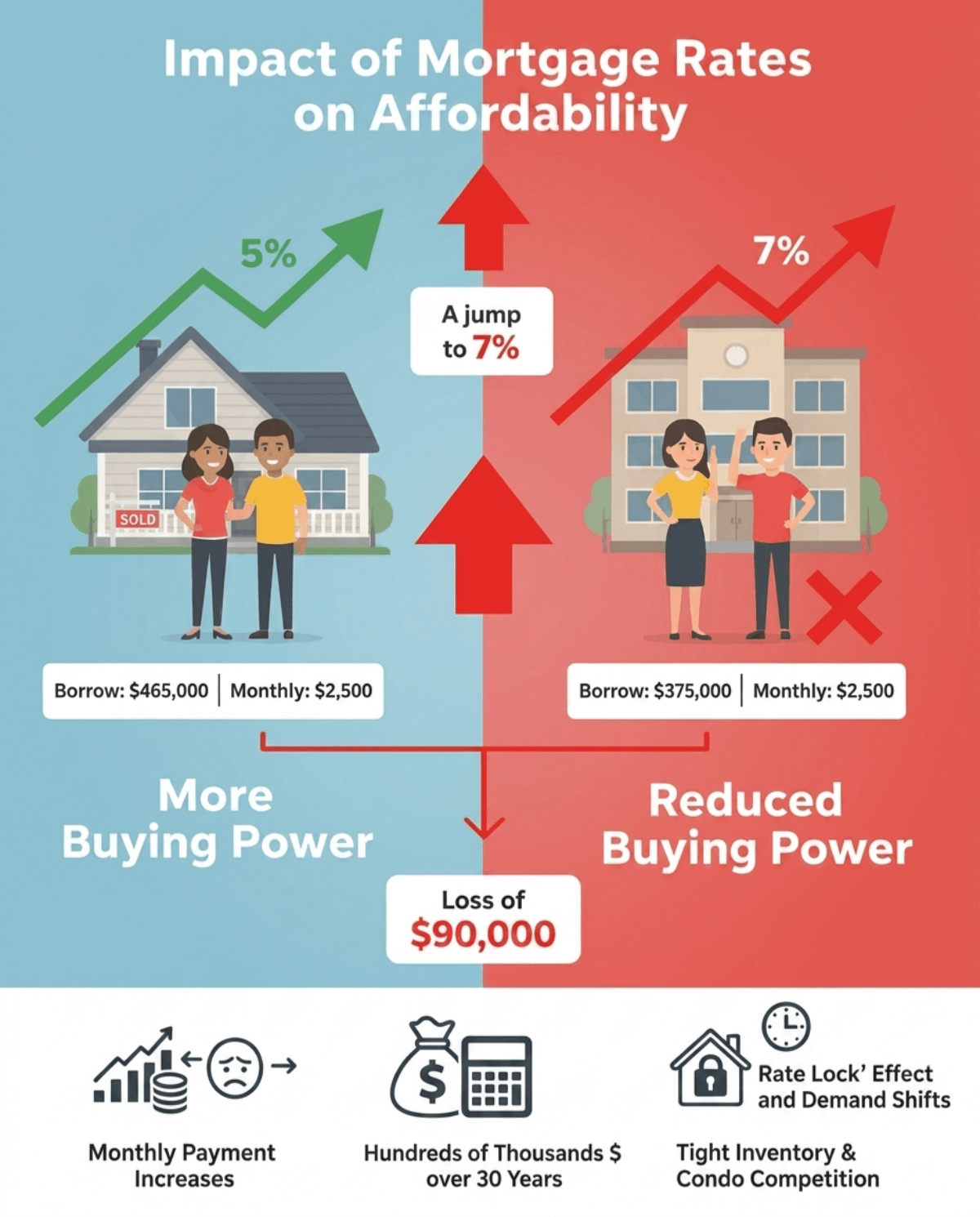
Interest Rate: Even a tiny half-percent bump in today's rates can add hundreds of dollars to your monthly bill.
Property Taxes & Insurance: Your loan's principal and interest might be fixed, but your local property taxes and home insurance premiums are likely to fluctuate over the years.
FAQs About Calculating Monthly Mortgage Payments
Q1. What is the formula to calculate monthly mortgage payment?
The standard formula is M = P [ i(1 + i)^n ] / [ (1 + i)^n - 1 ]. It's great for finding your base cost, but remember this only calculates principal and interest. It leaves out taxes and insurance completely.
Q2. How much is a $60,000 mortgage per month?
Assuming a 6.3% interest rate on a standard 30-year fixed loan, your base principal and interest would run roughly $371 a month. However, you still need to factor in local property taxes and insurance, which will push that total higher.
Q3. How much is a $200,000 mortgage payment for 30 years?
At a 6.3% rate, the principal and interest for a $200,000 loan over 30 years sits around $1,238. Add in average property taxes and homeowners' insurance, and your true monthly out-of-pocket cost will likely land closer to $1,500.
Q4. Does my mortgage payment include property taxes and insurance?
Almost always, yes. Most lenders set up an "escrow account." They collect a portion of your annual property taxes and home insurance premiums every single month, hold the money safely, and pay those bills for you when they're due.
Q5. How can I lower my monthly mortgage payment?
The fastest way is to put more money down, which shrinks your loan and kills PMI. You could also buy down your interest rate by paying discount points upfront, or simply stretch out the repayment term to 30 years.
Final Word
Nailing down your exact monthly payment is honestly the most important step in the homebuying process. You never want to sign the final paperwork on your dream home only to realize the monthly hit is going to keep you up at night.
Stop guessing and let the software do the heavy lifting. I highly recommend running your specific numbers through the Zeitro Mortgage Calculator to see where you actually stand today. It's completely free and provides the crystal-clear breakdown you need. Once you find a comfortable estimate, take those numbers straight to a licensed loan officer to secure your pre-approval.
Looking for the best mortgage eligibility checker? Discover how AI tools help loan officers verify guidelines in seconds and save 7+ hours per loan.
As a mortgage professional, I know firsthand how exhausting the loan origination process can be. The constant battle of matching borrower profiles against hundreds of pages of complex investor rules is not just labor-intensive—it's a massive bottleneck. If you are searching for a way to quickly and accurately verify mortgage guidelines, you aren't alone.
We all need a reliable tool to stop wasting hours on manual underwriting. In this guide, I'll explain what a mortgage eligibility checker does and show you why leveraging an AI-powered assistant is the absolute best way to cut your research time down to literal seconds.
What is a Mortgage Eligibility Checker?
A mortgage eligibility checker is a specialized system that cross-references borrower data against vast investor guidelines to determine loan qualification. Historically, this meant flipping through massive PDFs or relying on clunky spreadsheets. Today, the most effective solution is a dedicated AI Agent.
After testing several platforms, my top recommendation for the US market is Zeitro. Founded in 2018 by engineering leaders from Google and Apple, it's an AI-native, completely neutral tech company with no lender affiliations. What gives me real peace of mind is their SOC 2 Type II certification, meaning your borrowers' sensitive data is protected by enterprise-grade security.
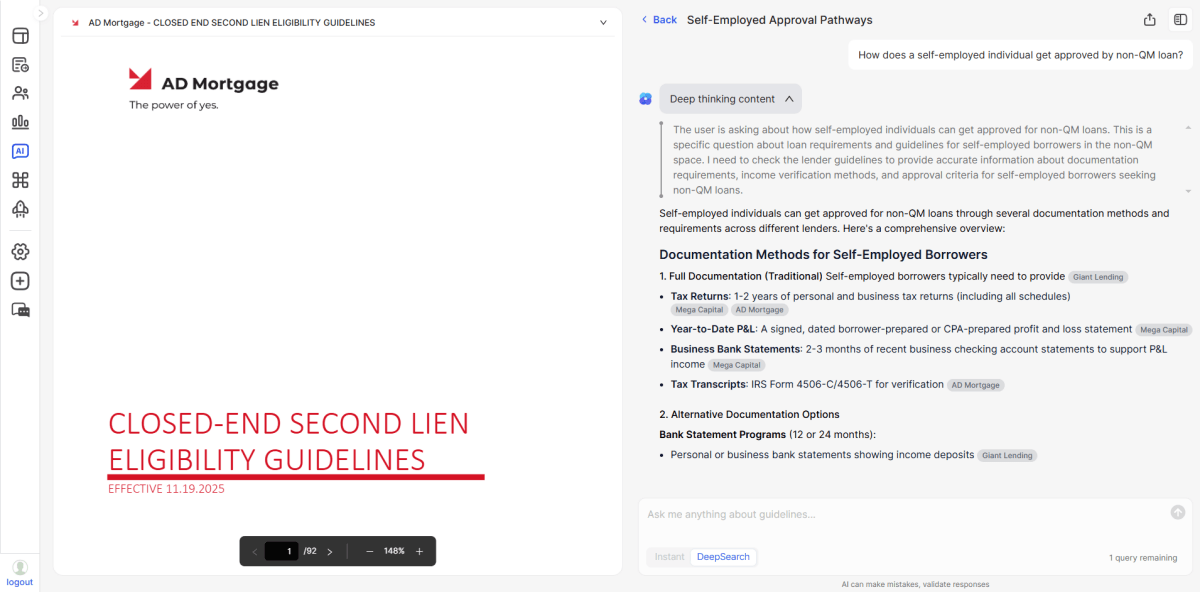
Their standout feature is Zeitro Strata AI, a wildly powerful guideline assistant. It uses a "DeepSearch" function to cross-check over 100 investors and 300+ guidelines simultaneously. Whether you are dealing with standard conventional loans or tricky Non-QM scenarios, like DSCR, ITIN, or Bank Statement loans, it delivers pinpoint accurate answers in seconds. Best of all, it provides exact source citations so you can confidently verify the information yourself. If a rule seems confusing, the "Explain" feature breaks it down further. You can even type your queries in multiple languages, including Chinese.
Beyond just guideline verification, Zeitro offers a complete ecosystem to streamline your entire workflow:
GrowthHub: Lets you launch a personalized microsite to boost your SEO, display live rates, and capture organic leads.
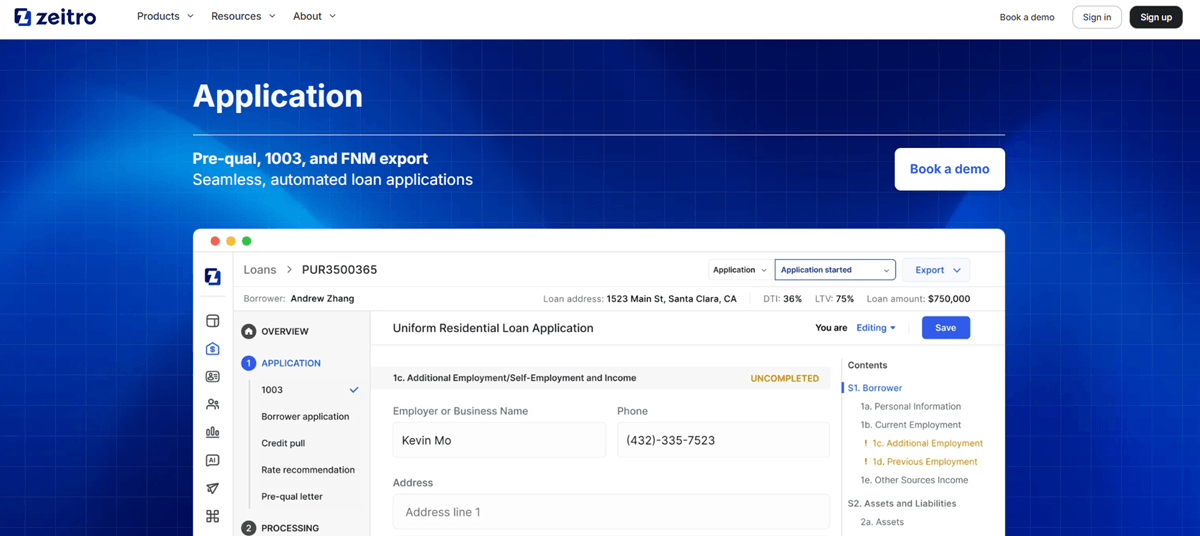
Digital 1003 (POS): Automates the borrower application, calculates DTI instantly with AI, and exports seamlessly in FNM 3.4 format.
Pricing Engine: A real-time rate quote tool for both conventional and Non-QM products to help you offer competitive pricing on the spot.
Who is a Mortgage Eligibility Checker for?
In today's highly competitive housing market, the professional who delivers accurate pre-qualifications the fastest usually wins the deal. A robust eligibility checker is practically mandatory for anyone involved in loan origination.
Loan Officers & Brokers: If you interact directly with borrowers, this tool is a total game-changer. By automating the heavy lifting, you can deliver pre-qualifications 2.5 times faster and save over 7 hours per loan file. This frees you up to focus on relationship-building and bringing in new business.
Wholesalers & Lenders: For teams managing high volumes or complex lending criteria, eliminating 100% of manual guideline research is crucial. Using an AI system ensures an 85%+ income calculation accuracy, allowing your team to close loans up to 20% faster and ultimately increase your total closed loans by 30%.
Ditching the old method of manually hitting "CTRL+F" through endless PDFs is incredibly liberating. To show you how simple it is, here is how I use Zeitro Strata AI to check mortgage eligibility in my own daily workflow:
STEP 1. Input Your Scenario: Simply type your question into the chat interface. You can ask broad "what is" questions or highly specific eligibility queries. It even natively supports both English and Chinese inputs.
STEP 2. Customize Your Scope: Apply custom tags like DSCR, ITIN, loan-type, or specific investor names. This instantly narrows the DeepSearch to the exact programs you actually care about.
STEP 3. Get Instant, Sourced Answers: Within seconds, the AI provides a precise answer. I always click the provided citation link to double-check the source for 100% accuracy. If a specific caveat is unclear, I just use the "Explain" function for a deeper breakdown.
STEP 4. Share & Proceed: Once verified, you can easily share the results via a link or email to keep your clients and real estate partners perfectly in the loop.
FAQs About a Mortgage Eligibility Checker
Can an AI eligibility checker handle Non-QM loans?
Absolutely. In my experience, this is where a tool like Zeitro Strata AI truly shines. It continuously updates over 300 guidelines from major US lenders like AAA Lending, AD Mortgage, and AmWest, with deep support for complex Non-QM products like Profit and Loss, Foreign National, and DSCR loans.
How accurate are the AI-generated guideline answers?
They are highly accurate because the AI doesn't just guess or hallucinate. It actively cross-checks the most up-to-date guidelines and provides exact citations. You can always trace the answer back to the original source document, which virtually eliminates human error.
How much does a mortgage eligibility checker cost?
Pricing is surprisingly accessible. Zeitro offers a Freemium model. Their popular Explorer plan is completely free, giving you 3 queries per day, a personal website, and 10 lifetime FNM 1003 exports. For power users, it's just $8/month per user or $35/month per company.
Is my borrowers' data secure?
Yes. Security is a non-negotiable top priority in our industry. Zeitro is SOC 2 Type II certified. This means they maintain strict, enterprise-grade operational controls, ensuring all your sensitive customer data is fully protected from start to finish.
Final Word
Navigating the complexities of the US mortgage market shouldn't mean drowning in endless paperwork. A reliable mortgage eligibility checker is no longer just a luxury. It's an absolute necessity for modern loan professionals who want to scale their business. By adopting an AI Agent like Zeitro Strata AI, you can drastically improve your client satisfaction, speed up the lending process, and see a real boost in your overall ROI.
If you are tired of wasting hours on manual guideline research and want to close loans faster, it is time to make a change. I highly recommend taking advantage of Zeitro's Free Explorer Plan. You get three free queries every single day. So go ahead, test a complex scenario, and experience the magic of instant, accurate guideline verification for yourself.
Find out how to check mortgage eligibility quickly in 2026. Explore DTI, loan types, and how professionals verify complex guidelines accurately.
Whenever I talk to homebuyers or fellow loan professionals, one common frustration always comes up: mortgage guidelines are painfully complex and constantly changing. If you're wondering how to check mortgage eligibility in 2026, you're definitely not alone. Figuring out whether a borrower qualifies traditionally takes hours of digging through massive PDF manuals.
But the process is evolving. While everyday buyers still need to understand the basic requirements to do a quick self-check, mortgage professionals can now instantly verify mortgage eligibility with accurate sources using AI-native tools like Zeitro, which even offers free daily queries to get started.
What is Mortgage Eligibility?
Mortgage eligibility is simply the set of financial criteria lenders use to decide if you can afford to repay a home loan. When I evaluate a file, I look at factors like income history, debts, credit, and down payment. Since limits update annually, here are the baseline minimum requirements for 2026:
Conventional Loans: You'll need a minimum credit score of 620 and at least 3% down. The 2026 baseline conforming loan limit for most U.S. counties is $832,750 for a single-family home, with high-cost areas up to $1,249,125.
VA & USDA Loans: Both offer 0% down options for eligible veterans or rural buyers, though most lenders prefer a 620-640 credit score.
Non-QM Loans: These skip traditional W2 requirements. If you're self-employed, you can qualify using alternative methods like bank statements or DSCR (Debt Service Coverage Ratio) for investment properties.
You might think these rules only apply to the person buying the house, but compliance is actually a two-way street. Both sides of the transaction must strictly follow the guidelines to ensure a successful closing.
Borrowers: Whether you are a standard W-2 employee seeking a conventional mortgage or a real estate investor applying for a Non-QM loan, you must prove you meet the lender's financial thresholds to get approved.
Lenders and Loan Professionals: Brokers, loan officers, and wholesalers must meticulously verify every applicant against massive rulebooks. If we approve a loan that doesn't actually comply with the stated mortgage eligibility guidelines, the lender risks massive financial penalties or holding unsalable loans.
Why Do You Need to Check Mortgage Eligibility?
I always advise my clients and colleagues to run the numbers before even opening Zillow. Why? Because checking your status upfront saves a lot of heartbreak and wasted time.
Understand Purchasing Power: You immediately know your realistic price range, preventing you from falling in love with a home you simply can't finance.
Identify Red Flags Early: A quick check reveals credit reporting errors or high debts, giving you time to fix them before officially applying.
Find the Right Loan Program: It helps match you to the perfect product. If your tax returns don't show enough income, checking early reveals that you should pivot to a Non-QM bank statement loan instead.
How to Check for Home Loan Eligibility?
If you want to know where you stand, doing a basic self-assessment is easier than you think. Here are the steps I recommend to check for home loan eligibility before contacting a bank.
STEP 1. Check Your Credit Score
Your credit dictates almost everything. Pull your score from a free app or your credit card dashboard. Keep in mind that a 620 is the floor for conventional options, but pushing that score above 740 will unlock significantly better interest rates and cheaper mortgage insurance.
STEP 2. Calculate DTI
Lenders care deeply about your Debt-to-Income (DTI) ratio. Take your total monthly debt payments (car loans, minimum credit card payments, student loans) plus your estimated new mortgage payment, and divide that by your gross monthly income. Most QM (Qualified Mortgage) lenders cap this at 43% to 45%.
STEP 3. Assess Funds
Look at your liquid cash. You need enough to cover the down payment (anywhere from 3% to 20%), plus closing costs (usually 2% to 5% of the loan amount). Lenders also like to see "reserves," which is a few months of mortgage payments sitting safely in your bank account.
STEP 4. Get Pre-qualified
Once you've run your own numbers, take them to a professional. A loan officer can run a soft credit pull and give you a formal pre-qualification letter, which proves to sellers that you are a serious and capable buyer.
How to Verify Mortgage Eligibility? (For Professionals)
While borrowers can do a rough self-check, loan officers and brokers face a much harder task. We have to cross-reference borrower data against 300+ constantly shifting guidelines to verify eligibility. It used to be a nightmare of manual reading, but now, I rely on Zeitro Strata AI.
Zeitro is an AI-native SaaS platform built exclusively for the U.S. mortgage industry. This mortgage AI is an incredibly powerful mortgage guideline assistant that completely transforms how we work. Here is what it brings to the table:
Instant DeepSearch with Citations: Instead of spending 30 minutes reading PDFs, you can type a scenario and get an accurate answer in seconds. It cross-checks over 100 investors and provides exact citations, so you always have a verifiable source.
Comprehensive Non-QM & QM Coverage: It doesn't just know Fannie Mae and FHA. Zeitro Strata AI covers complex Non-QM scenarios, like Asset Utilization, DSCR, ITIN, and Foreign National loans, from mainstream lenders like AD Mortgage and Luxury.
Customizable Scenario Analysis: You can narrow searches using custom tags for specific loan types or lenders. If an answer seems complicated, the "Explain" feature acts as a secondary AI review to break down the logic further.
Boost Efficiency & Close Rates: Using Zeitro saves professionals over 7 hours per loan file and delivers 2.5x faster pre-qualifications. Plus, it currently offers 3 free queries a day, making it easy to test out.
FAQs About Checking Mortgage Eligibility
Does checking my mortgage eligibility hurt my credit score?
Usually, no. An initial pre-qualification check by a lender only requires a "soft pull," which has zero impact on your credit score. It's only when you move forward with a formal, full application that a "hard pull" occurs.
Can I get a mortgage with a high DTI ratio?
Yes, it's definitely possible. If your DTI exceeds the traditional 45% limit, you might need to make a larger down payment, pay off smaller debts, or explore Non-QM loans that offer much more flexible debt-to-income underwriting standards.
What is the difference between Pre-qualification and Pre-approval?
Pre-qualification is a quick estimate of how much you can borrow based on unverified information you provide. Pre-approval carries much more weight because the lender has thoroughly verified your tax returns, bank statements, and actual credit report.
How do Non-QM loans affect eligibility?
Non-QM (Non-Qualified Mortgage) loans drastically expand eligibility for people who don't fit the standard mold. Instead of requiring traditional W-2s, they allow self-employed buyers or investors to qualify using alternative documents like bank statements or property rental income.
For a buyer doing a basic self-assessment, it takes just a few minutes. For mortgage professionals using modern AI tools like Zeitro, verifying complex, multi-layered investor guidelines now literally takes seconds instead of hours.
Conclusion
Understanding your borrowing power is the crucial first step in any real estate journey. Whether you're aiming for a standard conventional loan or a complex DSCR setup, knowing your 2026 limits and requirements saves everyone involved massive amounts of time.
If you are a mortgage professional tired of manually digging through guidelines, you need to modernize your workflow. I highly recommend trying Zeitro Strata AI. It gives you fast, fully-cited answers and you can start with 3 free queries every day to instantly boost your productivity.
On the other hand, if you are a homebuyer ready to find out exactly what you qualify for, head over to Bluerate. There, you can connect directly with top-tier loan officers equipped with the best technology to get a free consultation and personalized rate quotes today.
Confused by reverse mortgage rules? Check the latest reverse mortgage eligibility requirements here. Discover age limits, property rules.
Let's talk about tapping into your home's value during retirement. A reverse mortgage sounds like an easy fix for cash flow, but the eligibility rules trip up a lot of people. You can't just sign a paper and get a check. Lenders have strict criteria you have to meet first, and the paperwork gets complicated fast.
Instead of getting lost in confusing guidelines, both homeowners and loan officers can actually check reverse mortgage eligibility requirements for free using smart platforms like Zeitro. Let's walk through exactly what it takes to qualify, what might get you rejected, and how to verify everything without the usual stress.
What is a Reverse Mortgage?
Generally speaking, a reverse mortgage is a loan specifically designed for older homeowners. Rather than you paying the bank every month, the lender pays you by converting a chunk of your home equity into cash. The loan balance doesn't come due until you sell the property, move out permanently, or pass away.
There isn't just one standard product out there. You generally have three types to look at:
Home Equity Conversion Mortgages (HECMs): These are federally insured by the FHA. They are the most common and have the strictest guidelines.
Proprietary reverse mortgages: Think of these as private loans. They are usually meant for high-value properties that exceed normal FHA limits.
Single-purpose reverse mortgages: Offered by some state or local agencies. They cost less but restrict exactly how you use the money, like strictly for property taxes.
What are Reverse Mortgage Eligibility Requirements?
Assuming you qualify just because your mortgage is paid off is a huge mistake. The Federal Housing Administration sets a rigid baseline for HECMs, mostly to ensure borrowers don't end up in a worse financial spot down the road. I've seen applications stall out simply because people missed one minor detail.
Here is what you actually need to check off the list:
Age limit: The youngest person on the title must be at least 62. No workarounds here.
Property type restrictions: This loan only works for your primary residence. Forget about using a vacation home or an investment property you rent out.
Sufficient equity: You either need to own the house free and clear or have paid down a massive chunk of your current mortgage, usually hitting around 50% equity.
Passing the financial assessment: Underwriters will dig into your credit history and cash flow. You have to prove you can handle ongoing costs like property taxes, HOA fees, and homeowner's insurance.
Mandatory counseling session: Before anything gets approved, the government requires you to meet with a HUD-approved counselor. They make sure you truly understand how this loan affects your future and your heirs. Taking this step seriously protects you from predatory lending practices.
What Disqualifies You from Getting a Reverse Mortgage?
Finding out you don't qualify after weeks of paperwork is frustrating. I always tell clients to look at the dealbreakers first. Lenders will hand out a quick rejection if you hit any of these roadblocks.
You'll likely get denied if:
Age: You or a co-borrower hasn't hit that 62nd birthday yet.
Equity shortage: Your existing mortgage balance is simply too high.
Residency issues: You spend more than half the year living somewhere else.
Financial red flags: The lender decides your income won't cover basic property taxes and insurance premiums.
Federal debt: You have unresolved delinquent federal debt, like unpaid income taxes or defaulted student loans.
Tip: How to Accurately and Quickly Verify Reverse Mortgage Eligibility?
If you work in the mortgage industry, you already know that manually checking FHA handbooks and investor overlays is a massive time sink. Guidelines change, and trying to memorize credit and property restrictions is virtually impossible. That's why relying on old PDFs is risky.
I started pointing professionals toward Zeitro Strata AI. It's an AI-native SaaS tool built purely for the mortgage space, and it essentially kills the need for manual guideline research.
Here is what makes it stand out:
Instant answers across the board: The DeepSearch feature cross-checks over 100 investors and 300+ guidelines (covering conventional, non-QM, DSCR, and more). It turns a 30-minute manual lookup into a two-second query.
Real source citations: It doesn't just guess. Every single answer includes a direct citation back to the original guideline, giving you the confidence that the data is 100% accurate.
Handles messy questions: Borrowers rarely fit a perfect mold. You can type in vague scenarios or highly specific requirements in English or Chinese, and it still pulls the right rules.
Built-in 'Explain' tool: If a specific underwriting rule still looks like gibberish, you can hit the explain function to get a plain-English breakdown of that specific text.
Free daily access: You can actually test it out without committing. The platform gives you 3 free queries every day to run your own scenarios.
FAQs About Reverse Mortgage Eligibility
Q1. Is there a credit score or income requirement for a reverse mortgage?
There isn't a hard credit score cutoff. However, lenders run a financial assessment. They just want to ensure your cash flow can handle the ongoing property taxes and home insurance. If your credit is rough, they might require a set-aside account to cover those bills.
Q2. What is the 95% rule on a reverse mortgage?
It's a safety net. Since these are non-recourse loans, you or your heirs will never owe more than the loan balance or 95% of the home's appraised value when it's time to sell and settle the debt, whichever is lower.
Q3. What is the biggest problem with a reverse mortgage?
The upfront costs are painfully high. Between closing costs, origination fees, and compounding interest that grows because you aren't making monthly payments, your home equity gets eaten up much faster than most people expect.
Q4. What is a better alternative to a reverse mortgage?
If you have decent credit and income, a Home Equity Line of Credit (HELOC) or a standard Home Equity Loan usually costs less. Selling the house and downsizing to a cheaper place is often the smartest financial move.
Q5. What is the best age to get a reverse mortgage?
Waiting is usually better. The maximum amount you can borrow is tied directly to your life expectancy. A 75-year-old will qualify to pull out significantly more cash than a 62-year-old.
Q6. Can I lose my home with a reverse mortgage?
Absolutely. You don't have a monthly mortgage bill, but you are still strictly responsible for property taxes, insurance, and basic maintenance. Ignore those, and the lender can foreclose on the house.
Q7. Who owns your house if you have a reverse mortgage?
You do. A lot of people think the bank takes the deed, but that's a myth. You stay on the title. The lender just puts a lien on the property, exactly like they do with a regular mortgage.
Conclusion
Tapping into home equity can save a retirement plan, but the eligibility hurdles are steep. Understanding these rules upfront saves everyone a lot of wasted time.
If you're a broker or loan officer tired of fighting through PDF guidelines, check out Zeitro. Their AI tools help pros deliver pre-qualifications 2.5 times faster and bump up loan closes by 30%. It's a massive efficiency boost.
On the other hand, if you are a homeowner trying to figure out if you qualify, don't guess. Head to Bluerate. You can find and connect with top loan officers who use these advanced AI tools to give you accurate, free consultations and rate quotes tailored to your exact situation.
No W-2? No problem. I reviewed the 6 best no income verification mortgage lenders of 2026 for self-employed buyers. Take a look here!
Being a freelancer, business owner, or real estate investor often means traditional W-2s aren't available. I've been there, watching banks turn you down despite having perfectly healthy cash flow.
Fortunately, no income verification loans (now widely known as Non-QM loans) offer a realistic way out. In this 2026 guide, I am breaking down the top mortgage institutions that look at your bigger financial picture instead of just tax returns. If you're unsure which lender fits your unique financial profile, use Bluerate free AI Chat to instantly match with the best loan officer for your exact needs.
What No Income Mortgage Loan is Good for You?
Let's clear up a major misconception right away: the pure "NINJA" (No Income, No Job, No Assets) loans from 2008 no longer exist. Today, a "no income verification" mortgage actually means using alternative documentation to prove your ability to repay.
Depending on your situation, here are the main paths you can take:
Bank Statement Loans: Best for the self-employed or gig-workers. Lenders review 12 to 24 months of your personal or business bank deposits to calculate an average qualifying cash flow.
DSCR Loans (Debt Service Coverage Ratio): Best for real estate investors. The property's projected rental income must cover the monthly mortgage debt. Your personal income isn't even part of the equation.
Asset Depletion Loans: Best for retirees or high-net-worth individuals. Banks divide your total liquid assets by the loan term to create a monthly "income" figure.
6 Best No Income Mortgage Lenders to Choose from
Over the past few weeks, I analyzed dozens of mortgage companies. I selected these six based on their maximum loan-to-value (LTV) limits, alternative documentation flexibility, processing speed, and solid reputation in the 2026 Non-QM market.
1. Quontic Bank
NMLS: 403503
Suitable for: Best for non-traditional earners seeking an established, flexible community bank.
Pros: Highly regulated bank offering safety; excellent products for self-employed home buyers.
Cons: Rates can be slightly higher than conventional products; requires a solid down payment (often 20% or more).
Quontic is a rare breed in today's market. As a certified Community Development Financial Institution (CDFI), they actually have a mission to serve underbanked communities. I really appreciate their Non-Traditional Loan program, which bypasses standard tax verification and focuses on your broader financial health. While you do need a decent credit history, they are incredibly open-minded regarding how you make your living.
Features:
Certified CDFI offering dedicated Non-QM and bank statement mortgage options .
No-doc streamline refinance options available for up to $3 million .
Minimum FICO score requirement is typically 660 or higher for Non-QM loans.
No W2s or standard tax returns are required to get approved .
Crypto-friendly, allowing Bitcoin to be used for down payments.
2. Stratton Equities
NMLS: 1795154
Suitable for: Best for real estate investors needing fast approvals and hard money options.
Pros: Incredibly fast funding times; massive variety of nationwide loan programs under one roof.
Cons: Primarily geared toward investment properties, including NON-QM for one-to-four family properties; interest rates reflect the speed and higher risk.
If you are flipping houses or building a rental portfolio, speed is everything. Stratton Equities operates as a direct private money and Non-QM lender, meaning they don't get bogged down in institutional red tape. I've noticed they can often close a deal in just a few weeks. They focus heavily on the asset itself rather than your personal W-2, making them a powerhouse for landlords.
Features:
Massive library of direct DSCR loans, Fix and Flip, and private money products.
Loan amounts range from $100,000 up to a massive $5 million.
No upfront junk fees and absolutely no tax returns needed for their investor programs.
Blazing fast closing timelines, often within 10 to 14 days.
LTV ratios up to 80% on certain investment property purchases.
3. Griffin Funding
NMLS: 1120111
Suitable for: Best for self-employed business owners and veterans looking for alternative financing.
Pros: Very forgiving credit score minimums; highly transparent alternative income processes.
Cons: Does not offer loans for vacant land or ground-up construction; geographically limited in a few states.
Griffin Funding is a standout direct lender that aggressively promotes its bank statement mortgage and asset-based loan programs. What caught my eye is their willingness to work with slightly lower credit profiles as long as you have strong compensating factors. They operate in a large footprint across the US, making them a very accessible choice for entrepreneurs trying to buy a primary residence.
Features:
Accepts 12 to 24 months of bank statements to qualify your cash flow.
Down payments as low as 10% with credit score of 660+.
Provides Non-QM cash-out refinance options.
4. Gelt Financial
NMLS: Not applicable (direct private commercial lender, non-bank portfolio lender).
Suitable for: Best for commercial real estate investors facing bank rejections or severe credit hurdles.
Pros: Supreme flexibility with damaged credit; extremely fast "common sense" underwriting.
Cons: Short-term focus (bridge loans usually 1-5 years); strictly for investment and commercial properties, not primary homes.
Sometimes a real estate deal is too messy for a standard mortgage broker. Gelt Financial is a direct balance sheet lender that has been operating since 1989. They proudly advertise the motto, "When your bank says NO, we say YES". Because they look purely at the collateral and the deal's intrinsic viability, they act as a fantastic safety net for tricky commercial or investment properties.
Features:
No minimum credit score requirements on many of their commercial programs.
No personal income qualification, strictly collateral-based lending.
Offers blanket loans to pull equity from multiple properties for a down payment.
Appraisals and environmental checks are sometimes waived to speed up funding.
Loan amounts generally start at $100,000 with highly customized terms.
5. Block Financial Resources (BFR)
NMLS: 132830
Suitable for: Best for East Coast borrowers with complex financial histories requiring manual underwriting.
Pros: The broker model means they shop multiple banks for you; excellent at handling complex, manual underwriting files.
Cons: Geographically limited to a handful of states; you are subject to the final wholesale lender's timeline.
Based out of New York, Block Financial Resources is a mortgage broker rather than a direct bank. I included them because they have incredible access to niche Non-QM loans via wholesale channels. If you've experienced a major credit event recently, BFR knows exactly which banks will manually underwrite your file and accept alternative income proofs.
Features:
Access to loans up to $3 million using 12 to 24 months of bank statements.
Forgiving on past credit events (accepts 1 major event in the past 3 years).
Offers interest-only payment structures to help buyers free up monthly cash flow.
Expert local knowledge in the NY, NJ, and FL real estate markets.
6. MortgageDepot
NMLS: 1133788
Suitable for: Best for self-employed buyers in diverse markets looking for high-value Non-QM and Co-op financing.
Pros: Phenomenal niche products (like Co-op financing); very accommodating to foreign buyers and diverse communities.
Cons: High down payment requirements (often 30% down payment) for their top-tier no-doc loans; broker origination fees may apply.
MortgageDepot is another powerhouse broker that really understands out-of-the-box financing. I'm particularly impressed by their ability to arrange "no income verification" loans for Co-ops, which is notoriously difficult in places like New York. They cater heavily to a culturally diverse crowd, offering streamlined digital processes for both local and foreign buyers.
Features:
No tax return required programs with high limits up to $5 million.
Unique no-income verification options designed specifically for Co-op properties.
Reduced seasoning requirements on major credit events (eligible just 12 months after a short sale or foreclosure).
Accepts foreign nationals and ITIN borrowers.
Offers interest-only options to increase initial purchasing power.
Which to Pick? Considerations Here
Choosing the right partner from this list ultimately boils down to your specific financial reality. Self-employed home loan products carry unique risks for lenders, so I always advise readers to carefully evaluate these key factors before signing anything:
Interest Rates & Fees: Alternative documentation means higher risk for the bank, which translates to higher rates for you. Always compare the APR, not just the base interest rate.
Down Payment Requirements: Expect to put more skin in the game. You'll generally need a 20% down payment (or even 30%) to offset the lack of W-2 forms.
Credit Score Minimums: Just because they skip income verification doesn't mean they ignore credit history. A FICO score of 680+ unlocks the best terms, though some institutions will go down to 600.
Prepayment Penalties: These are especially common with real estate investor financing. Check if you'll be penalized for refinancing or paying off the property early.
FAQs About Top No Income Mortgage Lenders
Q1. Can I get a mortgage loan with strictly no income?
No. The days of getting a mortgage with absolutely zero proof of cash flow are gone due to "Ability to Repay" regulations. Today's Non-QM loans require you to prove your repayment capacity through bank deposits, liquid assets, or property rental income (DSCR).
Q2. What not to say to a mortgage lender?
Never lie or exaggerate your assets. Additionally, avoid telling them you plan to quit your business soon, take on massive new auto debt, or open several credit cards before closing. Total transparency and financial stability are your best friends during underwriting.
Q3. What is the minimum down payment for a no-income verification loan?
You should prepare for a minimum of 10% to 20% down. However, for true alternative documentation or investment DSCR loans, many wholesale lenders will ask for 25% or even 30% to secure the best possible interest rate.
Q4. Do I need a high credit score for a non-QM loan?
Not necessarily, but it helps immensely. Some lenders accept scores as low as 600 or 620. However, having a higher score (like 680+) proves your financial responsibility, compensating for the lack of traditional tax returns and significantly lowering your rate.
Final Word
Securing a property as a freelancer, business owner, or investor in 2026 doesn't have to be an uphill battle. No-income verification mortgages have evolved beautifully, offering realistic, flexible pathways to homeownership and portfolio expansion. Just keep in mind that these Non-QM products come with stricter down payment rules and higher rates, making comparison shopping absolutely critical.
Don't navigate the complex Non-QM market alone. Head over to Bluerate and use the free AI Chat to seamlessly connect with a top-rated loan officer tailored to your exact scenario today. Let the technology do the heavy lifting so you can focus on finding your dream property.
Protect your retirement with our 2026 guide to the 8 best reverse mortgage companies. Compare fees, pros, and cons to find the right lender for you.
When my parents first considered tapping into their home equity to fund their retirement, the sheer number of reverse mortgage lenders left us completely overwhelmed. If you're a homeowner over 62, you probably feel the same way—anxious about hidden fees, aggressive sales tactics, and making an irreversible mistake with your biggest asset. You want a trustworthy partner, not just a sales pitch. That's why I've done the heavy lifting to evaluate the top lenders for 2026.
However, if navigating through endless reviews feels like too much work, you can skip the guesswork. I highly recommend using Bluerate's free AI Chat. It instantly matches you with top-rated, local loan officers tailored to your specific financial situation, saving you time and stress.
How We Selected the Best Reverse Mortgage Companies
To give you the most accurate recommendations, I didn't just look at glossy marketing brochures. I dug into the hard data. My selection criteria focused heavily on trust and transparency. I cross-referenced Better Business Bureau (BBB) ratings, verified Trustpilot customer reviews, and checked the NMLS registry for compliance histories.
I also prioritized companies offering a wide variety of products, both government-backed HECMs and proprietary jumbo loans, so you have actual choices. Finally, I evaluated their fee transparency and whether they prioritize mandatory HUD counseling, ensuring these lenders meet strict E-E-A-T standards for your financial safety.
8 Best Reverse Mortgage Companies to Consider
Below is my curated list of the top eight reverse mortgage companies for 2026. Keep in mind that these aren't ranked from best to worst. Rather, each has its own unique strengths. Whether you need the lowest fees, face-to-face service, or a massive jumbo loan, you'll find a match here.
1. Finance of America
NMLS Number: 2285 States: Available in most states (Not all 50) Verdict: Best overall for a wide variety of proprietary and HECM reverse mortgage options.
Finance of America Reverse (FAR) acquired American Advisors Group (AAG) in 2023, solidifying its position as a powerhouse in the reverse mortgage space. What I really like about FAR is its product flexibility. If your home is worth over the 2026 FHA limit of $1,249,125, their HomeSafe jumbo reverse mortgage allows you to access up to $4 million. They even have options that act as a second mortgage, letting you keep your current low-interest first mortgage intact.
Looking at online feedback, borrowers frequently praise their loan officers for being patient educators rather than pushy salespeople. On the BBB and Trustpilot, they maintain high marks for walking seniors through the complex math of reverse mortgages. While their interest rates might not always be the absolute rock-bottom lowest, their deep industry expertise makes them an incredibly safe bet for most families.
Pros:
Massive variety of proprietary products (like the HomeSafe loan).
Minimum age of 55 for certain non-FHA loans.
Cons:
Not licensed in every single U.S. state.
Interest rates are middle-of-the-road compared to discount brokers.
2. Longbridge Financial
NMLS Number: 957935 States: All 50 states plus Washington, D.C. Verdict: Best for low upfront costs and innovative proprietary products.
Founded in 2012, Longbridge Financial has built a reputation around borrower education and low costs. They are one of the few lenders actively trying to modernize the industry. For example, their newly launched "Platinum Preserve" product is fantastic. It allows you to tap into your home equity now while keeping 10% to 40% of it safely tucked away for your kids or future medical emergencies.
From my research, Longbridge really shines in customer service. They boast a stellar rating on Trustpilot (around 4.8/5), with thousands of seniors highlighting how transparent their fee structure is from day one. They even have a solid mobile presence, which is surprisingly uncommon in this sector. If you want a lender that operates nationwide, keeps origination fees competitive, and actively encourages you to explore alternatives before signing, Longbridge is a top-tier choice.
Pros:
Licensed in all 50 states for maximum accessibility.
Unique "Platinum Preserve" product lets you intentionally save equity for heirs.
Cons:
Some proprietary products require higher minimum property values.
The third-party appraisal process can occasionally be slow.
3. Fairway Independent Mortgage Corporation
NMLS Number: 2289 States: All 50 states plus Washington, D.C. Verdict: Best for in-person customer service and speedy closings. Sometimes, you just want to sit across a desk from a real human being and shake their hand. If that sounds like you, Fairway Independent Mortgage is exactly what you need. With over 30 years in the business and physical branches scattered across the entire country, they bring a local, personalized touch to a very intimidating financial decision. Fairway is famous in the real estate world for its speed.
While a typical reverse mortgage can take 30 to 45 days to close due to counseling and appraisals, Fairway's dedicated reverse underwriting team often cuts that time down significantly. Customer reviews across the web consistently highlight the warmth and responsiveness of their local agents. They might not have the flashiest digital tools, but their hands-on, face-to-face guidance provides incredible peace of mind for older homeowners.
Pros:
Exceptional A+ BBB rating and huge local branch network.
Known for closing loans significantly faster than the industry average.
Cons:
Lacks a dedicated mobile app for reverse mortgage management.
Rates can be slightly higher than online-only brokers.
4. Mutual of Omaha Mortgage
NMLS Number: 1025894 States: 49 states (Excludes New York) Verdict: Best for brand trust and comprehensive retirement planning integration.
When it comes to financial products for seniors, name recognition matters. Mutual of Omaha has been a household name since 1909, and its mortgage division carries that same commitment to stability and trust. In recent years, they have been among the top HECM lenders in the United States by dollar volume, often ranking #1. What makes them stand out is how they view the reverse mortgage.
Their loan officers don't just sell you a loan. They look at how a HECM fits into your broader retirement portfolio, ensuring it won't negatively impact your Medicare or Social Security benefits. Online reviews frequently mention the relief of working with a legacy brand rather than a fly-by-night operation. They hold an A+ rating with the BBB. The only downside is that their conservative, careful approach means their underwriting process is rigorous.
Pros:
Backed by a highly trusted, 100-year-old insurance and financial legacy.
Excellent at treating home equity as part of a holistic retirement plan.
Cons:
Underwriting guidelines can be quite strict.
Not licensed to operate in New York.
5. Liberty Reverse Mortgage
NMLS Number: 2726 States: 50 states, Washington, D.C., and Puerto Rico Verdict: Best for deep educational resources and long-standing industry experience.
Liberty Reverse Mortgage has been a cornerstone of the industry for over 20 years, funding billions of dollars in loans for more than 60,000 older Americans. They are one of the most experienced lenders you can find, and it shows in their approach. Liberty is famous for its zero-pressure educational resources, breaking down complex FHA rules into plain English so you actually understand what you are signing.
Operating in all 50 states, they offer everything from standard HECMs to HECM for Purchase loans (which lets you buy a new home using reverse mortgage proceeds). While their parent company, PHH, is currently shifting its business model, which may impact long-term servicing, Liberty's historical track record remains solid. Customers on third-party sites frequently commend their agents for explaining the nitty-gritty details without rushing the sale.
Pros:
Over two decades of specialized reverse mortgage experience.
Excellent "Equity 101" educational materials for seniors.
Cons:
Parent company is currently transitioning its servicing portfolio.
No dedicated mobile application available.
6. CrossCountry Mortgage
NMLS Number: 3029 States: All 50 states Verdict: Best for borrowers looking for a massive, full-service retail lender. CrossCountry Mortgage is a giant in the traditional retail mortgage world, originating 1 in every 35 homes in the U.S. Recently, they have made a massive push into the reverse mortgage space, bringing over top-tier industry executives to build out a dedicated, highly trained reverse division. The main advantage of using CrossCountry is their sheer scale and resources.
They have access to over 170 investor outlets, meaning they can usually find a creative solution for unique property types or financial situations. Because they are so large, you can easily find a local branch in your town. The caveat, based on customer reviews, is that your personal experience will depend heavily on the specific loan officer you get. However, when you connect with one of their certified reverse specialists, the service is prompt and highly professional.
\ Pros:
Licensed nationwide with a huge network of over 3,500 loan officers.
Offers a true one-stop shop for both forward and reverse mortgages.
Cons:
Reverse mortgages are a newer core focus compared to their traditional loans.
Customer experience can vary widely depending on your specific local branch.
7. Northwest Reverse Mortgage
NMLS Number: 347051 States: 28 states Verdict: Best boutique broker for comparison shopping and localized expertise.
Unlike the direct lenders on this list, Northwest Reverse Mortgage operates primarily as a specialized niche broker. I absolutely love this model for borrowers who want to comparison shop without making a dozen phone calls. Because they aren't tied to a single bank's products, Northwest can pull quotes from places like Finance of America, Longbridge, and others to find you the absolute best deal. They are particularly strong in the Pacific Northwest but are licensed in 28 states.
They offer everything from standard FHA HECMs to highly specific products like second-lien reverse mortgages. Reviews for Northwest are overwhelmingly positive, with clients praising their transparent, consultative approach. They act more like financial advisors than mortgage brokers. If you live in their service area, they are a phenomenal choice.
Pros:
As a broker, they shop multiple lenders to find you the best rate.
Access to unique products like the HomeSafe Second loan.
Cons:
Limited geographic footprint (only available in 28 states).
They originate the loan but don't service it long-term.
8. South River Mortgage
NMLS Number: 1854524 States: 28 states Verdict: Best for HECM refinances and incredibly fast processing times. If you already have a reverse mortgage and are looking to refinance it to get a better rate or pull out more cash, South River Mortgage should be at the top of your list. They have carved out a very specific niche in HECM-to-HECM refinancing and have grown rapidly into the fourth-largest reverse lender in the country by volume.
South River is heavily technology-driven, which is how they manage to close loans in an average of just 26 days—lightning fast for this industry. While they only operate in about 28 states, their rates consistently rank among the lowest available. Looking at their Trustpilot feedback, homeowners are thrilled with the speed and the low fees. Once you start working with their team, the process is smooth, efficient, and highly professional.
Pros:
Highly competitive interest rates, especially for refinancing.
Extremely fast closing process (averaging around 26 days).
Cons:
Limited state availability.
Initial marketing outreach can feel a bit aggressive to some.
Considerations to Know in Advance
Before you sign any paperwork, I want to be completely honest with you: a reverse mortgage isn't free money. It's a loan against your home, and it comes with strict industry rules. Here is what you must consider before moving forward:
Mandatory Counseling: You cannot legally get a HECM without completing a session with an independent, HUD-approved counselor. This protects you from predatory lending.
Ongoing Responsibilities: You still own the house. This means you must continue paying your property taxes, homeowners insurance, and any HOA fees. If you default on these, the lender can foreclose on your home.
Upfront Costs: Closing costs can be high. Expect to pay origination fees, appraisal costs, and an initial FHA mortgage insurance premium. These are usually rolled into the loan, eating into your available cash.
Impact on Heirs: When you pass away or move out permanently, the loan becomes due. Your heirs will need to decide whether to sell the property to pay off the balance or refinance it to keep the family home.
FAQs About Top Reverse Mortgage Companies
Q1. What is the dark side of reverse mortgage?
The main downside is the high upfront costs and compounding interest. Because you aren't making monthly payments, the interest rolls into the loan balance, which grows larger every month. Additionally, if you fail to pay your property taxes or home insurance, you face the very real risk of losing your home to foreclosure.
Q2. How much can a 70-year-old borrow on a reverse mortgage?
There isn't a single flat number. It entirely depends on your home's appraised value, current interest rates, and the exact age of the youngest borrower. Generally speaking, the older you are, the more equity you can access. A 70-year-old might qualify for roughly 45% to 55% of their home's value in today's market.
Q3. What is better than a reverse mortgage?
It depends on your goals. If you have the income to make monthly payments, a Home Equity Loan or a Home Equity Line of Credit (HELOC) usually has much lower closing costs. Alternatively, simply downsizing, selling your large house and buying a smaller, cheaper one with cash, is often the cleanest financial move.
Q4. Is a reverse mortgage a good idea for seniors?
Yes, but only in the right circumstances. It's an excellent tool if you plan to "age in place" and stay in your current home for the rest of your life. However, if you plan to move into an assisted living facility or relocate closer to your grandkids in the next few years, the high upfront fees make it a poor short-term choice.
Q5. Can a 90-year-old get a reverse mortgage?
Absolutely, yes. In fact, because the loan amounts are calculated based on life expectancy, a 90-year-old will be able to access a significantly higher percentage of their home's equity compared to a 62-year-old. There is no maximum age limit for these FHA loans.
Q6. What disqualifies you from a reverse mortgage?
You will be disqualified if the youngest homeowner is under 62 (for FHA loans) or 55 (for some jumbo loans). You also won't qualify if you lack sufficient equity (usually you need at least 50%), fail the financial assessment proving you can pay ongoing property taxes, or have delinquent federal debt.
Q7. Why do banks not recommend reverse mortgages?
Traditional big banks like Chase or Wells Fargo largely exited the reverse mortgage market years ago. These loans are highly regulated, complex, and carry reputational risks if a senior faces foreclosure due to unpaid taxes. Traditional banks prefer to sell you a standard HELOC because the profit model is simpler and less risky for them.
Q8. What is the 95% rule on a reverse mortgage?
The 95% rule allows heirs to repay a reverse mortgage by paying the lesser of the full loan balance or 95% of the home's current appraised value if they want to keep the house. They simply have to pay 95% of the home's current appraised value, and the FHA insurance covers the remaining deficit.
Conclusion: What Company is Best for a Reverse Mortgage?
Deciding to take out a reverse mortgage is one of the most significant financial choices you will make in retirement. It's not just about getting cash. It's about securing your long-term comfort while fully understanding the costs involved.
If you want a quick recap, here is my Best For list of reverse mortgage companies:
Finance of America: Best overall options and jumbo loans.
Longbridge Financial: Best for keeping upfront costs low.
Fairway: Best if you want in-person, local customer service.
Mutual of Omaha: Best for brand trust and retirement planning.
Northwest: Best for having a broker compare rates for you.
Every homeowner's situation is entirely unique, and I always suggest talking to an independent financial advisor before signing anything. If you are ready to explore your exact numbers but don't want to deal with endless sales calls, try Bluerate AI Agent. It's the smartest way to safely connect with a vetted, local professional who actually understands your specific needs today.
Discover what a reverse mortgage is, how it works, and 2026 requirements. Explore real examples, pros, and cons to decide if tapping your home equity is right for you.
What is a reverse home mortgage, exactly? Basically, it lets homeowners 62 and older turn their house's equity into usable cash, without selling the place or taking on new monthly mortgage bills. After years in the lending industry, I constantly see seniors struggling with fixed incomes while sitting on a goldmine: their home. While the concept sounds simple, the actual 2026 rules can get pretty tangled.
For borrowers, knowing the basics is everything. For my fellow loan officers, leveraging AI tools like Zeitro helps us instantly verify reverse mortgage eligibility, so we can give clients the accurate, fast answers they desperately need.
What is a Reverse Mortgage?
Think of a traditional mortgage as you slowly buying your house from the bank. A reverse mortgage flips that script, the lender actually pays you based on the equity you've already built up. You skip the monthly principal and interest payments entirely.
This setup is exclusively for older homeowners. Whenever I sit down with clients, their first question is almost always, "Will the bank own my house?" Let me be crystal clear: you keep your title and ownership. You just live there like normal. The loan balance is only repaid when you permanently move out, sell the property, or pass away. It's simply a practical way to pad your retirement fund, cover unexpected medical bills, or afford basic home renovations without the heavy burden of a monthly payment hanging over your head.
Reverse Mortgage Example
Let's look at a realistic scenario. Take John, a 65-year-old retiree whose house is worth $500,000. He finally paid off his original mortgage years ago, but his current pension barely covers groceries and utilities.
By taking out a reverse mortgage, John taps into that $500,000 value. Since he has full equity, he qualifies for a tax-free line of credit. Instead of taking a massive lump sum, he sets up a $1,000 monthly payout to make life easier. Every month, his loan balance slowly grows because interest is added to what he borrows. But John still owns his home, lives comfortably, and never has to write a check to a lender.
Pros and Cons of a Reverse Mortgage
No financial product is perfect. I always insist my clients look closely at both sides of the coin before signing anything. Here is the honest breakdown:
Pros:
Zero monthly mortgage bills: You stop paying monthly principal and interest.
Tax-free money: The IRS treats the cash as loan proceeds, not taxable income.
You stay put: You remain the legal owner and can live there forever.
Payout choices: Pick a lump sum, monthly checks, or a standby line of credit.
Cons:
Your debt grows: Interest piles up, increasing your total loan balance over time.
Smaller inheritance: Your kids will inherit less equity.
Ongoing property costs: You absolutely must keep paying property taxes and home insurance. Miss these, and you could face foreclosure.
What are the 3 Types of Reverse Mortgages?
If you decide this path makes sense, you'll need to pick the right program. Generally, the market offers three main types, depending on your home's worth and why you need the cash.
Home Equity Conversion Mortgages (HECMs)
HECMs are the industry standard. Because they are insured by the Federal Housing Administration (FHA), they offer great safety nets, like the guarantee that you'll never owe more than the home's market value.
However, the government sets strict boundaries. For 2026, the FHA capped the maximum claim amount at $1,249,125. So, if your house is worth $2 million, the lender still calculates your loan based on that $1.24 million ceiling. Also, to make sure older folks aren't being taken advantage of, the FHA forces every single applicant to complete a financial counseling session with an independent, HUD-approved advisor before the loan can move forward.
Proprietary Reverse Mortgages
Sometimes called jumbo reverse mortgages, these are private loans created by individual lending companies instead of the government. They are built specifically for borrowers sitting on multi-million dollar properties who want to borrow far past the FHA's limits.
Note for Mortgage Professionals: Handling proprietary products means dealing with messy, investor-specific Non-QM overlays. It used to take me hours to hunt down specific criteria. Now, top loan officers use Zeitro Strata AI to deep-search through 100+ investor guidelines. You can literally ask a vague scenario question and get a precise, fully-cited answer in seconds. It completely removes the guesswork when you are trying to structure a complex jumbo loan for a high-net-worth senior.
Single-Purpose Reverse Mortgages
These are the cheapest option out there, but they come with a major catch. Usually offered by local state agencies or non-profits, single-purpose loans restrict exactly how you spend the cash.
Just like the name says, the lender dictates the purpose. Typically, you can only use the funds for urgent home repairs, like fixing a collapsed roof, or catching up on past-due property taxes to avoid losing the house. While the fees and interest rates are rock-bottom compared to standard HECMs, you can't just use the money to pay for a vacation or daily groceries. Plus, these programs aren't available in every state, so you have to check with your local housing authority first.
How Does a Reverse Mortgage Work?
The mechanics of these loans often confuse people. Let me break down exactly what happens to the money once you are approved:
You Pick Your Cash Flow: Do you want a lump sum right at closing? Regular monthly checks? Or a line of credit you can tap into whenever you want? You get to choose the structure.
Interest Gets Capitalized: Since you aren't sending the bank a check every month, the lender just adds that month's interest directly to your loan balance. Slowly but surely, your debt grows while your remaining home equity shrinks.
The "Non-Recourse" Protection: This is huge. These are strictly non-recourse loans. If the housing market crashes and your loan balance eventually grows larger than what your house is worth, the lender eats the loss. Neither you nor your kids will ever have to pay the difference out of your own pockets.
Reverse Mortgage Requirements in 2026
You can't just walk into a bank and demand a reverse mortgage. The 2026 rulebook has some pretty firm hurdles you have to clear first. Let's check the reverse mortgage eligibility below:
Age Limit: The youngest borrower on the property title must be at least 62 for a standard HECM. Some proprietary jumbo loans may allow 55, but confirm with the specific lender
Primary Residence: You actually have to live there for the majority of the year. Forget about using this on a beach house or a rental property.
Plenty of Equity: A good rule of thumb is having at least 50% equity. The new reverse loan must be big enough to completely wipe out any old mortgage you still have.
No Federal Debt: If you owe the IRS back taxes or defaulted on federal student loans, you're usually disqualified.
Upkeep: An FHA appraiser will check to ensure the house is structurally safe and sound.
How Do You Qualify for a Reverse Mortgage?
Beyond the basic age and equity rules, lenders need to know you won't default on your basic homeowner duties. The approval process starts with that mandatory HUD counseling I mentioned earlier, just to prove you understand what you're signing up for.
Then comes the Financial Assessment. There is no minimum credit score requirement. Lenders assess your overall financial patterns to confirm ability to pay property taxes, insurance, and HOA fees. We have to verify you bring in enough cash every month to easily cover your property taxes, homeowners insurance, and HOA fees.
Chasing down borrower documents for this assessment is notoriously slow. Smart brokerages are moving to POS systems like Zeitro's Digital 1003. It lets borrowers self-pre-qualify online in minutes while AI instantly crunches the Debt-to-Income (DTI) ratios. It delivers pre-qualifications 2.5x faster and literally saves loan officers over 7 hours of manual data entry per file.
HELOC vs. Reverse Mortgage
"Should I just get a HELOC instead?" I hear this question constantly. While both let you turn your home's value into cash, they are entirely different animals. A Home Equity Line of Credit (HELOC) works like a massive credit card secured by your house, and it expects you to pay the money back right away. A reverse mortgage is built for long-term retirement survival.
Here is how they stack up against each other:
Basically, if you can afford another monthly bill, a HELOC is cheaper. If you need cash but cannot handle another payment, go with the reverse option.
FAQs About Reverse Home Mortgage
Q1. How to get out of a reverse mortgage?
By law, you get a three-day "Right of Rescission" to cancel the deal right after closing without any penalties. After that window closes, your only way out is to pay off the balance by selling the house or refinancing it into a traditional loan.
Q2. How do you pay back a reverse mortgage?
The debt typically comes due when the last borrower dies or permanently moves into a care facility. Heirs usually handle this by selling the house, paying off the lender, and keeping whatever profit is left over. Alternatively, they can use their own money to pay off the loan and keep the family home.
Q3. Is reverse mortgage interest deductible?
Not immediately. Because you aren't actually making monthly payments, you can't deduct the interest on your taxes every year. You only get to claim that mortgage interest deduction in the specific year the loan is entirely paid off.
Q4. How long does it take to get a reverse mortgage?
Expect the process to take roughly 30 to 45 days. It drags on a bit longer than a standard mortgage because you have to schedule the mandatory HUD counseling session and wait for a specialized FHA appraisal.
Q5. How much can I get from a reverse mortgage?
Your final number depends on your exact age, current interest rates, and the appraised value of your home. Generally, the older you are and the more your house is worth, the bigger your payout will be. You can pull personalized, instant rate quotes for clients using the Zeitro Pricing Engine, which grabs live pricing for both conventional and Non-QM products, so you can show borrowers real numbers in seconds.
Q6. How much equity do you need for a reverse mortgage?
Most lenders want to see that you own the home outright or have at least 50% equity. Since the new reverse loan has to pay off your old traditional mortgage first, you need a large cushion of equity to ensure you actually get cash in your pocket.
Conclusion: Is a Reverse Mortgage a Good Idea?
After guiding hundreds of families through this process, I firmly believe a reverse mortgage is a fantastic tool if used correctly. It's a lifesaver if you want to age in your own home, need to kill off your current mortgage bill, and want extra breathing room in your budget. But if you plan on moving soon, or if leaving a massive paid-off house to your kids is your top priority, skip it. Always sit down with a financial advisor first.
Handling these loans requires patience. By bringing AI solutions like Zeitro into your workflow, using DeepSearch for guidelines or setting up personal landing pages via GrowthHub, you can answer clients' questions instantly. It builds incredible trust and helps you close loans up to 20% faster when folks need your help the most.
Learn what WVOE guidelines are, the requirements for WVOE-only loans, and how mortgage professionals can use AI to verify eligibility in seconds.
As a mortgage professional, I know the drill. A borrower wants to buy a home, but their tax returns don't tell the whole story of their actual purchasing power. Enter the WVOE. But here's the problem: figuring out exactly which lender accepts what under their specific WVOE guidelines means wasting hours reading PDF matrices. If you're tired of that manual grind, you're not alone.
Later in this guide, I'll show you how I use Zeitro Scenario AI to verify eligibility across different lenders in seconds just by chatting with it. But first, let's break down the fundamentals.
What Does WVOE Mean in a Mortgage?
WVOE stands for Written Verification of Employment. In the industry, we usually just call it Fannie Mae Form 1005. As an underwriter or loan officer, I use this document to confirm a borrower's hire date, current title, detailed breakdown of compensation (base, bonus, overtime), and the likelihood of their continued employment.
For first mortgages, the lender must send Form 1005 directly to the employer, and the completed form must be returned directly to the lender without passing through the borrower. For second mortgages, the borrower may hand-carry the form to the employer, but the employer must mail it back directly to the lender. It's strictly designed this way to prevent fraud and give lenders a clear, verified picture of a borrower's stable income.
What is a WVOE Loan?
While a WVOE is just a piece of paper used in standard conventional loans, a "WVOE Loan" (or WVOE-Only Loan) is an entirely different beast. It's a specific Non-QM program tailored for traditionally employed wage-earners who want to skip the heavy paperwork.
With this product, you qualify the borrower using only the completed WVOE form. That means zero W-2s, no paystubs, and absolutely no tax returns. I find this program incredibly useful for clients who receive massive bonuses, heavy overtime, or have significant unreimbursed business expenses that ruin their debt-to-income (DTI) ratios on traditional tax filings. Lenders usually just require the Form 1005 paired with a couple of personal bank statements to prove the payroll deposits are real.
What are WVOE Mortgage Guidelines?
Guidelines exist because investors need to mitigate the risk of lending without traditional tax documents. While Fannie Mae has its standard rules, the real complexity lies in the Non-QM space. I've worked with dozens of lenders, and they all have their own unique "overlays" or extra restrictions for WVOE loans.
For instance, underwriters will rigorously vet the employer. The company must be an independently verifiable, legitimate entity. If your borrower works for a family business or holds any ownership shares in the company, they are instantly disqualified. Lenders also look at the consistency of income. If the WVOE shows a sudden, unexplained massive jump in commission right before closing, that's going to trigger conditions. Knowing these granular guidelines upfront is crucial so you don't waste time structuring a deal that will die in underwriting.
Key Requirements of a WVOE Loan
Every wholesale lender has slightly different matrices, but from my experience, the core requirements for a WVOE-only program usually follow a strict pattern to prevent fraud. Here is what you generally need to look out for:
Two-Year History: The borrower typically needs at least 24 months of employment history in the same line of work with the current employer, as verified by the WVOE. Changes in employer within the same field may be acceptable depending on the lender's overlays.
Authorized Signatures: Form 1005 must be signed by an official HR representative, a payroll officer, or a direct supervisor.
Non-Arm's Length Restrictions: The transaction must be arm's length. Working for a relative is a hard "no".
Credit & LTV Limits: FICO minimums for WVOE loans typically start at 620-680 depending on the lender and program, with LTV ratios often capped at 75%-80% for purchases (up to 95% in some cases with stronger profiles). These vary by specific Non-QM lender overlays.
Deposit Support: Lenders usually want to see 2 to 3 months of bank statements showing direct deposits that match the WVOE figures.
Bonus Tip: How to Efficiently Verify WVOE Guidelines?
If you're a Loan Officer or Broker, you already know the biggest pain point of Non-QM loans: comparing guidelines. Digging through a 100-page PDF from AD Mortgage or AmWest just to see if your borrower's specific scenario fits is a massive time sink.
That's why I rely on Zeitro Scenario AI. It's an AI-powered mortgage guideline assistant built specifically for our industry, and it completely changes the way I do my loan research. Instead of hitting Ctrl+F through outdated matrices, you just type your scenario into the chat, and it instantly searches the actual guidelines.
Here's why it's a game-changer for my pipeline:
Massive & Updated Coverage: It pulls from nearly 300 guidelines, including 35+ specific WVOE programs, from top lenders like Freedom Mortgage, HomeXpress, MK Lending, and AAA Lending.
High Accuracy with Citations: It doesn't guess. It provides exact citations linking back to the source document, giving you hard proof for your underwriter.
Lightning-Fast Answers: Ask anything from broad eligibility questions to niche product rules, and get an answer in seconds.
Deep Explanation Function: If a lender's rule seems confusing, the "Explain" feature breaks it down further based on your selected documents.
Cost-Effective & Multi-Language: It supports both English and Chinese queries, lets you share results via link, and starts at just $8/month (plus, you get 3 free queries a day).
FAQs About WVOE Guidelines
Q1. How do you obtain a WVOE?
The borrower signs an authorization upfront. The lender then sends Fannie Mae Form 1005 directly to the employer's HR or payroll department. The employer fills out the income and history details, signs it, and sends it straight back to the lender.
Q2. Do I have to fill out the employment eligibility verification?
No. Borrowers are strictly prohibited from filling out any part of the WVOE form aside from the initial signature authorizing the release of information. If a borrower handles, types, or edits the form, the lender will reject the loan.
Q3. What is the difference between VVOE and WVOE?
A VVOE (Verbal Verification of Employment) is a phone call by the lender obtained within 10 business days prior to the note date (closing) to confirm the borrower remains employed. It supplements earlier written verifications like WVOE, which is used during underwriting. A WVOE (Written Verification) is a detailed physical form used early in underwriting to calculate your full income history.
Q4. What are acceptable alternative documents for employment verification?
If a WVOE isn't possible, lenders usually default to traditional full-doc verification using W-2s, 30 days of paystubs, and recent tax returns. Alternatively, many lenders now pull automated verification data directly from third-party databases like The Work Number.
Q5. What are common red flags on an employment background check?

Underwriters actively look for discrepancies. Red flags include white-out marks on the form, round-number income estimates, the employer's address matching a residential home or PO Box, or the HR contact number linking back to the borrower's personal cell phone.
Conclusion
WVOE loans are an incredible tool in the Non-QM space, offering a lifeline to borrowers whose tax returns don't reflect their true purchasing power. However, navigating the strict overlays and shifting requirements of dozens of different wholesale lenders can easily burn hours of your day.
As mortgage professionals, our time is better spent building relationships and closing deals, not acting as human encyclopedias for PDF matrices. If you're ready to speed up your conditions and stop second-guessing your approvals, I highly recommend ditching the manual search. Try Zeitro Scenario AI for free today. It's the fastest way to get exact, citable guideline answers in seconds and keep your pipeline moving.
W-2 vs 1099: Taxes higher on 1099 (15.3% self-employment), but deduct expenses & gain freedom. W-2 offers benefits, stability. Full guide inside.
I remember sitting across from my mortgage broker, ready to buy my first home, only to be hit with a question that stalled the whole process: "Are you a W-2 employee or a 1099 worker?" If you've ever applied for a loan, you know the panic. Your income classification dramatically impacts your financial life, especially approval odds for big purchases.
If you're navigating this maze, a quick chat with local loan officers for a free consultation can save you countless headaches. But before you make any career leaps, let's break down exactly what sets the 1099 Form vs W-2 apart and figure out which path actually benefits you most.
What is a 1099 Form?
First, what is a 1099 form? When I first started freelancing, receiving a 1099 felt like a badge of honor. As per IRS guidelines, a 1099 is the tax document given to Independent Contractors, freelancers, and gig workers. If you get this slip, you are legally running your own business. You are definitely not a traditional employee.
There are a few variations you might encounter. The most common is the 1099-NEC (Nonemployee Compensation), which tracks direct pay for your services. Interestingly, recent tax law changes updated the reporting threshold. Starting in 2026, companies only issue a 1099-NEC if they pay you $2,000 or more in a year, a huge jump from the old $600 rule. Meanwhile, the 1099-MISC handles alternate income like rent or royalty payments.
The biggest shock for newcomers? No tax withholding. Your clients write you a check for the full invoice amount, but they don't hold back a single penny for the government. It becomes entirely your responsibility to track your earnings, file a Schedule C, and pay the 15.3% self-employment tax out of your own pocket. You have complete freedom, but the IRS expects you to manage your finances like a seasoned CFO.
What is a W-2 Form?
On the flip side, getting a W-2 means you belong to the club of Traditional Employees. Employers must furnish W-2 forms to employees by January 31 or next business day if weekend. I spent over a decade working under this classification, and honestly, the sheer convenience is hard to beat.
The defining feature here is automatic Tax Withholding. Every time payday rolls around, your company's HR department automatically slices off your federal and state income taxes, along with your share of FICA taxes (Social Security and Medicare). You never have to worry about accidentally spending money that belongs to Uncle Sam. Even better, your employer is legally required to cover half of those FICA taxes for you.
Receiving a W-2 signifies a direct relationship of control and protection. The company dictates when you clock in, what tools you use, and how tasks are completed. In exchange for surrendering that autonomy, you gain a massive safety net. The organization absorbs the overhead costs, deals with the messy administrative compliance, and ensures your paycheck lands in your bank account consistently, week after week, without fail.
1099 vs W-2: Key Differences Explained
Choosing between these two paths isn't just about how you file taxes in April. It fundamentally changes your daily lifestyle, baseline income, and legal rights. From out-of-pocket expenses to workplace freedom, the daily realities are worlds apart. Let's dive into the core differences to see which option aligns better with your personal goals.
Taxes
As a traditional employee, your tax burden feels relatively light and hands-off. You only pay 7.65% for your half of the FICA taxes, while your employer kindly picks up the remaining 7.65% on your behalf. However, when you operate independently, you bear the full weight of the system. The IRS views you as both the worker and the business owner, meaning you must pay the entire 15.3% self-employment tax yourself. This substantial chunk comes right off the top of your net earnings, long before standard federal and state income taxes even enter the chat. It's a noticeably steep price tag for independence, requiring careful financial planning year-round.Winner for Tax Simplicity: W-2
Benefits
Corporate perks are often the golden handcuffs that keep people happily tied to a steady job. A W-2 status usually unlocks highly subsidized health insurance, employer-matched 401(k) retirement plans, paid time off (PTO), and maybe even vision or dental coverage. These “invisible” financial perks easily add tens of thousands of dollars in value to your total compensation package. Conversely, as a 1099 contractor, you are entirely on your own. If you want to take a week-long vacation, you simply don't generate income for those days. If you need comprehensive medical coverage, you must navigate the open healthcare marketplace and fund the steep monthly premiums entirely out of your own revenue stream.Winner for Comprehensive Benefits: W-2
Control
Nothing beats the feeling of setting your own alarm clock. Contractors operate with ultimate autonomy. You dictate your schedule, choose the specific projects you want to tackle, and decide whether you want to work from a local coffee shop or a beach in Bali. Clients pay for the final result, not your physical presence. Meanwhile, W-2 employees must adhere to the company rulebook. Your manager determines your working hours, your physical location, and exactly how you execute your daily tasks. If you crave creative freedom and despise micromanagement, the contractor route wins by a landslide.Winner for Flexibility and Control: 1099
Expenses
Here is where independent workers finally get to strike back against the tax code. Under current federal tax law (permanent after 2025 changes), W-2 employees cannot deduct unreimbursed business expenses such as laptops, home office, or commuting costs on their federal returns. Contractors, however, can leverage massive write-offs on their returns. You can legally deduct a percentage of your home office rent, internet bills, business mileage, marketing software subscriptions, and specialized equipment. Every legitimate business purchase directly lowers your taxable net income. If you play your cards right and track receipts diligently, these strategic deductions can dramatically offset the pain of that hefty self-employment tax.Winner for Tax Deductions: 1099
Tax Forms
Filing season as a standard employee takes about twenty minutes. You simply import your single wage document into your preferred software, opt for the standard deduction, and you're basically finished. It is remarkably stress-free and straightforward. Conversely, the self-employed face a literal mountain of tax paperwork. You must meticulously compile all your scattered income sources, complete a highly detailed Schedule C to claim those precious business expenses, and calculate your exact self-employment tax liability on Schedule SE. To avoid severe IRS underpayment penalties, you also need to accurately estimate your yearly earnings and submit quarterly tax payments four times a year. The administrative burden is heavy.Winner for Easy Filing: W-2
Legal Protections
I always advise my ambitious friends to deeply consider worst-case scenarios. If a struggling company lays off its staff, W-2 workers can immediately apply for state unemployment benefits to stay afloat. They are also federally guaranteed a minimum wage, time-and-a-half overtime pay for grueling weeks, and workers' compensation if they ever get injured on the job site. Independent contractors are completely excluded from these general labor laws. If a major client suddenly terminates your contract, you cannot collect a dime of unemployment. If a flat-fee project takes twice as long as expected, no legal authority will step in to demand overtime pay. You assume 100% of the operational risk.Winner for Legal Safety: W-2
Work Type
Your current career phase usually dictates the best choice. A W-2 role is absolutely ideal if you highly value predictability, want to steadily climb a structured corporate ladder, or urgently need reliable monthly income to support a growing family without enduring sleepless nights. It provides deeply comforting stability. On the other hand, a 1099 setup is the ultimate financial playground for aggressive side hustlers, specialized project consultants, and globe-trotting digital nomads. It uniquely allows you to scale your income infinitely because your earnings aren't arbitrarily capped by a fixed salary band. If you possess an entrepreneurial spirit and prefer betting on your own skills, independence is the way forward.Winner for Entrepreneurial Growth: 1099
W-2 vs 1099 Comparison Chart
To make things crystal clear, I've put together a quick cheat sheet. Review this table to instantly compare the everyday realities, tax obligations, and legal boundaries of both employment types.
FAQs About 1099 Form vs W-2
Q1. Is it better to be a W-2 employee or 1099?
There is no absolute right answer. If you strongly prioritize peace of mind, reliable corporate benefits, and legal workplace protections, choose the W-2 path. If you desire unlimited earning potential, massive tax write-offs, and the freedom of being your own boss, go 1099.
Q2. Are 1099 taxes higher than W-2?
Typically, yes. As an independent worker, you are forced to pay the full 15.3% self-employment tax burden entirely alone. Traditional employees only pay 7.65% because their company covers the remaining half. However, smart contractors use heavy business deductions to aggressively lower their taxable base.
Q3. Why do companies do 1099 instead of W-2?
Businesses often heavily prefer utilizing contractors to slash their operational overhead costs. Hiring freelancers saves them from paying expensive health insurance premiums, matching payroll taxes, and providing paid leave. It also grants them short-term flexibility to scale their workforce up or down instantly.
Q4. What are the disadvantages of a 1099 job?
The main drawbacks include unpredictable income swings and absolutely zero paid time off. You also carry the heavy administrative burden of calculating quarterly taxes, hunting for private health insurance, and facing a significantly stricter underwriting process when applying for mortgages or personal loans.
Q5. How badly does a 1099 affect my taxes?
If you don't proactively save roughly 25-30% of every single client payment, the impact can be devastating. Missing quarterly estimated deadlines or failing to track your deductible expenses correctly usually leads to massive, unexpected tax bills and harsh IRS penalties come April.
Q6. How much tax do I pay on a 1099?
Beyond your standard federal and state income tax brackets, you owe a flat 15.3% self-employment tax on your net business profit. For example, self-employment tax is 15.3% on 92.35% of net earnings, so for $100,000 net profit, it's approximately $14,130 (half deductible from income tax).
Q7. Can an employer force me to be a 1099?
Absolutely not. The IRS uses extremely strict behavioral and financial control tests to determine proper worker classification. If a company strictly dictates your daily schedule, tools, and methods, you are legally an employee. Intentional misclassification is illegal and usually a tactic to dodge taxes.
Final Word: When to Use Which?
At the end of the day, a W-2 provides genuine safety and security, while a 1099 grants you total freedom and entrepreneurial power. The right choice simply depends on what phase of life you're navigating.
However, I cannot stress this enough: your classification matters immensely when big life events happen. If you are an independent contractor trying to buy a house, lenders won't just look at a simple pay stub. They typically demand two full years of complex tax returns to verify your fluctuating income, making the underwriting process notoriously strict. Want to know exactly how your contractor revenue impacts your home-buying eligibility? I highly recommend checking out the Zeitro to verify 1099 form mortgage guidelines. Getting familiar with the latest lending policies ensures your dream home doesn't slip away over a paperwork technicality.
What is a 1099 form? Learn about the different types, how they impact your taxes, and how self-employed workers can use 1099 income to qualify for a mortgage today.
I still remember the sheer panic of opening my mail years ago and finding my first 1099 form. With gig work and freelancing exploding, millions of us get these tax slips every winter. But a lot of people don't really know what they are or how powerful they can be, especially when trying to buy a house. Qualifying for a mortgage without standard pay stubs feels overwhelming. Luckily, loan professionals now use tools like Zeitro Mortgage AI to verify your eligibility in seconds. Let's clear up the confusion around these forms.
What is a 1099 Form?
Think of a 1099 form as the IRS's way of keeping tabs on cash you make outside of a standard 9-to-5 job. When I used to work a corporate gig, my boss handed me a W-2, meaning taxes were already pulled from my paycheck. A 1099 does the exact opposite. It proves you got paid, but no taxes were withheld. You get the full amount upfront, and the burden of paying income and self-employment taxes falls entirely on you later.
Honestly, it isn't just one single document either. It's an entire family of forms covering everything from consulting fees to stock dividends. While primarily a tax document, it's also a massive piece of the puzzle for proving your income to lenders if you ever want a loan.
What are the Types of 1099 Forms?
Since people make money in so many different ways, the IRS created different versions of this form. I've broken down the ones you actually need to care about, whether you're freelancing, renting out a room, or trading stocks.
Form 1099-NEC
If you do any kind of freelance, contract, or gig work, the 1099-NEC (Nonemployee Compensation) is your main document. A few years back, the IRS brought this form back specifically to track freelance money. The rule is pretty straightforward: if a client pays you $600 or more during the year, they have to send you one.
I always tell my self-employed buddies to watch their mailboxes closely in late January for these. Beyond taxes, the 1099-NEC is crucial if you want to buy property. It shows underwriters exactly how much independent income you pull in. If you're trying to land a Non-QM (Non-Qualified Mortgage) loan without standard W-2s, this little piece of paper is basically your golden ticket to proving you can afford a mortgage.
Form 1099-MISC
Before the NEC form took over, freelancers used the 1099-MISC (Miscellaneous Information) for almost everything. Now, it has a more specific job. You'll usually get this if you make at least $600 from rent, prize winnings, or certain medical payments.
For example, I have a friend who rents out a condo through a property management company. Every winter, that company sends him a 1099-MISC detailing his rental revenue. If you're building a real estate portfolio or relying on rental income to qualify for a new mortgage, keeping these forms organized is non-negotiable. Lenders want to see a history of stable, reliable cash flow, and your MISC forms provide the exact paper trail they need.
Form 1099-K
Anyone selling on eBay, running an Etsy shop, or taking business payments through PayPal or Venmo will probably cross paths with the 1099-K (Payment Card and Third-Party Network Transactions).
The IRS reporting rules for this one have been a bit of a rollercoaster lately. For the 2025 tax year, the threshold is $5,000 in gross payments (no transaction minimum). It phases to $2,500 in 2026 and $600 in 2027. The prior $20,000/200 threshold was delayed according to TurboTax. One thing to watch out for: this form shows your gross volume. It includes processing fees and customer refunds. You really have to stay on top of your bookkeeping so you don't end up paying taxes on money you didn't actually keep as profit.
Form 1099-DIV & Form 1099-INT
Got a high-yield savings account or a brokerage account that pays dividends? Then expect to see these two in the mail. Form 1099-INT covers interest income of $10 or more from banks and brokerages. Form 1099-DIV handles the dividends and capital gain distributions from your investments.
I rely on these slips every year to figure out my passive income for tax season. They might seem like minor paperwork, but they matter. Some smart loan officers can actually use substantial interest and dividend earnings to help you qualify for a home loan. It shows the underwriter you have a steady, passive cash flow working in the background, making you a less risky borrower.
Form 1099-B
For the active investors and crypto traders out there, Form 1099-B (Proceeds from Broker and Barter Exchange Transactions) is the one you need to worry about. Every time you sell a stock or swap some Bitcoin, your brokerage generates this form to log your gains and losses.
What I appreciate about the 1099-B is how it separates short-term trades from long-term investments, which the IRS taxes at very different rates. It gives you the exact cost basis so filing Schedule D isn't a nightmare. Also, if you plan to use asset dissipation to qualify for a high-end mortgage, underwriters will dig deep into your 1099-B history to ensure those capital gains are consistent.
Form 1099-R
Tapping into a 401(k) or pension? You'll get Form 1099-R. This one tracks distributions from retirement plans, annuities, IRAs, and even some life insurance contracts. Fun fact: even if you just roll over an old retirement account into a new one without paying penalties, you still get a 1099-R logging the move.
I've seen plenty of retirees use the regular distributions shown on this form to qualify for a mortgage since they no longer get a paycheck. You just have to be careful with the distribution codes listed in Box 7. Those little codes tell the IRS whether your withdrawal was normal and taxable, or an early cash-out that might trigger penalties.
Other Specific 1099 Forms
Beyond the big ones, the IRS has a whole alphabet soup of niche forms. You might see a 1099-G for unemployment or state tax refunds, or a 1099-C if a lender canceled some of your debt (which, sadly, counts as taxable income). There are also forms for real estate sales (1099-S) and 529 college savings withdrawals (1099-Q). You won't see them often, but it's good to know they exist.
What is a 1099 Form Used for?
After staring at these documents year after year, I've realized they basically serve three main real-world purposes. Here's what they actually do:
Reporting Income to the IRS: The government wants to make sure nobody is hiding off-the-books cash. When you get a 1099, the IRS gets an exact copy at the same time.
Calculating Tax Liability: Since you haven't paid taxes on this money yet, you and your accountant need these numbers to figure out what you owe in federal, state, and self-employment taxes.
Mortgage Qualification: This is huge. If you don't have W-2s, these forms act as hard proof of your income, letting you qualify for specialized home loans designed just for self-employed buyers.
Who is a 1099 Form Required for?
The group of people receiving these forms is massive. Essentially, if you earn money outside of a traditional boss-and-employee setup, you're on the list.
Independent Contractors & Freelancers: Writers, designers, and consultants.
Gig Workers: Uber drivers and DoorDash couriers.
Small Business Owners: Anyone running an unincorporated business offering services to others.
Investors & Landlords: People earning dividends, capital gains, or rent.
The golden rule here is the $600 threshold. If a company pays you more than $600 for a service over the calendar year, the legal burden is on them (the payor) to issue this paperwork to you (the payee).
How to Get a 1099 Form?
Here's the good news: you don't actually have to apply for one. The company or platform that paid you is required to send it. They usually mail a paper copy or shoot you an email with a secure download link early in the year. If something gets lost in the mail, you can pull a Wage and Income Transcript straight from the IRS website.
Once you've got your forms, what's next? If you want to use that freelance income to buy a house, things get a bit more complicated than a standard loan. I highly suggest checking out Bluerate to chat with a local, professional Loan Officer for free. They know exactly how to leverage your 1099s to find a lender that fits your situation.
When are 1099s Issued?
Timing matters a lot when you're trying to file taxes on time. Legally, payers have to send out most of these forms, like the NEC and MISC, by January 31st. If that date lands on a weekend, the deadline bumps to the next business day.
But don't stress if your mailbox is empty on February 1st. Forms related to investments, like the 1099-B from your broker, usually get an extension and might not show up until mid-February. My personal rule? I just wait until late February before I even touch my tax return to make sure nothing is missing. You'll need all of them well before the April 15th filing deadline.
Tip: How to Verify 1099 Form Eligibility?
If you're a Loan Officer, Processor, or Underwriter, you already know the pain of verifying a self-employed borrower's income. Flipping through hundreds of pages of Non-QM guidelines to figure out if a lender accepts a 1-year or 2-year 1099 history takes way too much time. This is exactly where Zeitro Mortgage AI comes in.
It's an AI-powered Mortgage Guideline Assistant built specifically for QM and Non-QM loans. It instantly searches over 300 guidelines (including 31 distinct 1099 Form Mortgage Guidelines) from top lenders like AD Mortgage, CMG Financial, and Freedom Mortgage.
Here's a quick look at why it's so useful:
Instant Citations: It gives you precise answers in seconds, backed by clickable source links so you know the info is legit.
All-Scenario Support: Ask broad "what is" questions or run tight prequalify scenarios in both English and Chinese.
DeepSearch & Explain: Filter by specific lender guidelines or ask it to break down complex underwriting blind spots.
Efficiency Boost: It cuts out manual reading, integrates smoothly with your LOS, and speeds up the whole loan process.
Great Price: It's faster than the competition and starts at just $8/month (plus you get 3 free queries a day to test it out).
FAQs About the 1099 Form
Q1. What is the difference between a 1099 and W-2?
A W-2 is for regular employees. The company takes out taxes before you even see your paycheck. A 1099 is for contractors. You get the full amount paid directly to you, which means you have to handle calculating and paying your own income and self-employment taxes later.
Q2. Does a 1099 mean I have to pay taxes?
Almost always, yes. Since the company that paid you didn't withhold anything, you have to report this income. Depending on how much profit you actually made after deducting your business expenses, you'll owe regular income tax plus the self-employment tax.
Q3. How much tax will you pay on a 1099?
It really depends on your tax bracket and your write-offs. Generally, independent contractors pay a 15.3% self-employment tax (for Medicare and Social Security) on top of their normal income tax rate. But remember, you get to deduct business expenses like internet, software, and mileage to lower that bill.
Q4. What happens if I don't file a 1099 on taxes?
I wouldn't risk it. The IRS already has a copy of the form. If your tax return doesn't match their system, it triggers an automatic CP2000 notice. That usually leads to penalties, extra interest on what you owe, or a full-blown audit.
Q5. Do I need to file a 1099 form?
If you're the one who got paid, you just use the numbers on the form to fill out your Schedule C. You don't mail the paper itself. If you're a business owner who paid a contractor over $600, then yes, you must file it with the IRS and send the contractor a copy.
Conclusion
At the end of the day, a 1099 form is more than just an annoying chore during tax season. It's actual proof of your income and financial hustle. Whether you're trying to calculate your business deductions or using that cash flow to prove you can afford a new house, keeping track of these documents is a must.
For the mortgage pros out there tired of hunting through Non-QM guidelines manually, definitely give Zeitro Mortgage AI a try to speed up your approvals. And if you're a self-employed borrower trying to figure out how to buy a home with freelance income, don't do it alone. Jump onto Bluerate AI Agent to find a local Loan Officer who can make the process smooth and painless.
What are Bank Statement Mortgage Guidelines? Discover requirements for self-employed borrowers and learn how LOs can verify rules in seconds.
As a loan officer, I know firsthand the daily headaches of navigating Non-QM lending. You get a solid self-employed borrower, and suddenly you are drowning in a sea of bank statement mortgage guidelines that change drastically from one lender to the next. Spending hours searching through hundreds of pages of PDF matrices just to find the right income calculation is exhausting.
But what if you could just ask an AI? That's where Zeitro's Scenario AI comes into play. You can now verify different lenders' complex guidelines through a simple, natural chat interface, instantly taking your workflow efficiency to the next level.
What is a Bank Statement Loan?
A bank statement loan is a highly popular Non-QM (Non-Qualified Mortgage) product designed specifically for self-employed borrowers, freelancers, gig economy workers, and business owners.
Since these clients lack traditional W-2s or regular pay stubs, standard income verification simply doesn't work for them. Instead of relying on tax returns, which usually show heavy write-offs and lower taxable income, lenders evaluate 12 to 24 months of consistent bank deposits to calculate their true earning capacity.
I've seen countless successful entrepreneurs get denied by traditional banks, only to secure their dream homes through this alternative documentation route. It's an absolute lifesaver for business owners who have strong cash flow but don't fit into the conventional lending box.
What Are Bank Statement Mortgage Guidelines?
Because these are Non-QM products, they are not backed by Fannie Mae or Freddie Mac. As a result, there is a massive lack of standardization across the industry.
Bank statement mortgage guidelines are the specific, internal underwriting rules created by individual lenders. When I review these matrices, I have to look closely at several unique dimensions. This includes maximum Loan-to-Value (LTV) limits, minimum FICO score requirements. Lenders have strict NSF/overdraft limits (e.g., no more than 2-5 per period), as they indicate unstable cash flow.
Furthermore, lenders apply an "expense factor" to business accounts to estimate operating costs. Lenders typically apply a 50% expense factor to business deposits, but may reduce it to 10-40% with a CPA letter specifying expenses (e.g., 10% for solo service businesses, 50% for larger ones). Because every lender writes their own playbook, placing a file correctly relies entirely on knowing these fractured, ever-changing guidelines.
What Do You Need for a Bank Statement Loan?
Gathering the right documentation upfront saves everyone from a massive underwriting headache later. While traditional mortgages focus on tax transcripts, here is what you typically need to collect for a bank statement file:
12 to 24 months of bank statements: This can be personal or business accounts. Make sure every single page is included, even the blank ones!
Proof of business existence: Lenders usually want a CPA letter, business license, or Articles of Organization proving the business has been actively operating for at least two years.
A larger down payment: These loans typically require a minimum of 10% to 20% down, which is higher than standard conventional options.
Minimum credit score: While somewhat flexible, most investors want to see a minimum 620 FICO score.
Disclaimer: Please note that exact requirements, especially expense factor calculations, vary significantly from lender to lender.
Why Do You Need to Check Bank Statement Mortgage Guidelines?
Because of the disclaimer I just mentioned above, flying blind is a terrible idea. Here is why I always verify the exact guidelines before submitting my borrower's file:
Avoid Loan Rejections: Nothing ruins your pipeline faster than a denial that could have been avoided just by reading the fine print on overdraft limits.
Find the Best LTV and Rates: Matching your client with the lender that views their specific income profile most favorably means securing better terms.
Stay Updated: Lender matrices update constantly. The program that worked perfectly for your client last month might be suspended today.
Let's be real: manually flipping through dozens of 200-page PDFs is soul-crushing and prone to human error. You need a smarter approach.
Best Way to Quickly Verify Bank Statement Mortgage Guidelines
This is where my daily workflow completely transformed. I started using Zeitro's Scenario AI, an AI-Powered Mortgage Guideline Assistant that basically acts like a veteran underwriter sitting right next to you.
It covers over 300 guidelines, including more than 85 specific Bank Statement programs from top-tier lenders like AAA Lending, AD Mortgage, and CMG Financial, and it's constantly updating. Instead of downloading clunky matrices, you just type your borrower's scenario into the chat.
Here are the standout features that make it a game-changer for Loan Officers, Brokers, and Processors:
High Accuracy with Citations: This is my absolute favorite part. The AI doesn't just guess. It provides specific citations and source links so you can verify the exact guideline yourself.
Lightning-Fast Responses: It scans vast amounts of data instantly, giving you precise answers in seconds. You no longer have to put clients on hold while you hunt for a rule.
Custom Data Scope (DeepSearch): You can check a single lender or cross-reference multiple lenders simultaneously to see who offers the most flexible terms.
Handles All Scenarios: Whether you ask a broad "What is it?" or a highly detailed eligibility question, it understands the context perfectly.
Explain Feature: If an answer seems confusing, the AI can further break down the details based on your selected data scope.
Unbeatable Value: You get 3 free queries every single day, and the paid version starts at an incredibly low $8/month. The ROI on time saved is immediate.
FAQs About Bank Statement Mortgage Guidelines
Q1. Do you need 3 or 6 months bank statements for a mortgage?
For traditional conventional or FHA loans, you usually only need 2 months to verify your assets and down payment. However, for a Non-QM Bank Statement Loan, lenders use the deposits to calculate your actual income, so you will need to provide 12 to 24 months of consecutive statements.
Q2. Does FHA require 1 or 2 months bank statements?
Standard FHA guidelines generally require two months of complete bank statements. The underwriter reviews these to ensure your down payment funds are properly seasoned and not coming from an undisclosed loan.
Q3. Can I use both personal and business bank statements?
Yes, but it depends heavily on the lender. Most prefer one or the other. If you submit business statements, the lender will apply an "expense factor" (often ranging from 10% to 50%) to deduct your estimated operating costs from the gross deposits.
Q4. Are interest rates higher on bank statement loans?
Honestly, yes. Because lenders consider these loans slightly higher risk without standard tax documentation, interest rates are typically 1% to 3% higher than conventional mortgages.
Q5. Is a bank statement loan considered a Non-QM loan?
Yes. Because it uses alternative documentation instead of standard W-2s or tax returns to verify your income, it falls outside the Consumer Financial Protection Bureau's (CFPB) standard "Qualified Mortgage" definition.
Final Word
In the mortgage industry, time is literally money. Bank statement loans are an incredible tool to help self-employed borrowers achieve homeownership, but the complex, unstructured guidelines are a massive hurdle. You simply cannot afford to lose deals or delay closings because of a misread PDF matrix or an outdated lender requirement.
That's exactly why I highly recommend adopting technology to do the heavy lifting for you. Take advantage of Zeitro's Scenario AI. With 3 free queries a day and premium plans starting at just $8/month, you can stop searching and start closing. Try typing your next tricky Non-QM scenario into the chat and experience the efficiency firsthand!
Stop wasting hours checking Asset Utilization Mortgage Guidelines. Learn how to verify lender requirements in seconds and close more Non-QM loans.
If you're a mortgage professional like me, you know the absolute headache of trying to qualify a high-net-worth client who doesn't have a standard W-2 income. Asset utilization mortgages are the perfect fix, allowing us to turn liquid wealth into qualifying income.
But here's the real bottleneck: every single lender has entirely different asset utilization mortgage guidelines. Sifting through hundreds of PDF pages to check LTV caps or age restrictions drains our productivity. That's exactly why I rely on Zeitro's Scenario AI. It lets me verify multiple lenders' guidelines in seconds via a simple chat.
What are Asset Utilization Mortgage Guidelines?
Also known in our industry as asset depletion or asset qualifier loans, asset utilization mortgages empower us to help borrowers who lack traditional paychecks but hold significant liquid wealth. Instead of digging for tax returns, we calculate a monthly qualifying income based on their eligible assets, like savings, stocks, or retirement accounts.
As loan officers and brokers, our target audience for these Non-QM products includes wealthy retirees, high-net-worth individuals, and successful self-employed entrepreneurs who write off most of their earnings. Traditional agency underwriting usually rejects these clients due to a high debt-to-income (DTI) ratio on paper. Asset utilization solves this by amortizing their wealth over a set period to create a compliant income stream. It's a fantastic strategy to save a deal, provided you know exactly which lender's rulebook fits your borrower's specific portfolio.
Why Do You Need to Check Asset Utilization Mortgage Guidelines?
You might think once you grasp the basic concept, you can apply it everywhere. I learned the hard way that this simply isn't true. Checking asset utilization mortgage guidelines is critical because non-QM lenders write their own distinct rules. Placing a file with the wrong investor means a delayed closing or a flat-out denial.
Here is why you must verify the details upfront:
Lender Variations: Formulas vary wildly. Some lenders divide total assets by 60 months, while others stretch it to84 or 120.
Eligible Assets: What counts as liquidity? One lender might accept 100% of stocks, while others typically discount to70-80%(common for mutual funds/stocks).
LTV Caps: Maximum Loan-to-Value limits differ across the board for these non-QM products.
Relying on memory is too risky. We need precise, up-to-date verification.
Asset Utilization Loan Requirements 2026
Entering 2026, the non-QM market remains robust, but investor scrutiny is tight. Keeping up with the latest asset utilization loan requirements is essential for structuring a clean file.
Minimum Asset Requirements: Most lenders require minimum qualifying assets of $150,000 to $1,000,000 (or 1.5x loan amount), plus post-closing reserves (e.g., 6-12 months PITIA).
Types of Acceptable Assets: Checking, savings, and money market accounts generally qualify at 100%. Fully vested stocks and bonds are also standard.
Calculation Methods: After deducting the down payment and closing costs, the net eligible assets are divided by an amortization term (frequently 60 months) to establish the monthly income.
Age Constraints: For retirement funds like 401(k)s or IRAs, lenders often allow 100% face value if the borrower is over 59.5. If they are younger, expect those funds to be heavily discounted (usually by 50%) due to early withdrawal penalties.
Zeitro Scenario AI: Verify Asset Utilization Mortgage Guidelines in Seconds
Manually cross-referencing all those 2026 requirements used to take me hours. Now, I use Zeitro Scenario AI. It's an AI-powered mortgage guideline assistant explicitly built for the QM and Non-QM space. It covers nearly 300 guidelines, including 26 specific asset utilization mortgage guidelines, from mainstream lenders like AAA Lending, AD Mortgage, AmWest, and First Colony Mortgage.
Instead of searching Google, it sources answers directly from the lenders' actual matrices. Here are the standout features that completely upgraded my workflow:
Lightning-Fast & Highly Accurate: Instead of hitting Ctrl+F through massive PDFs, I get precise answers to complex borrower scenarios in seconds.
Backed by Citations: Every answer provides direct citations. I can click to trace the data back to the source document, ensuring 100% accuracy before I speak to an underwriter.
Massive & Up-to-Date Coverage: The database continuously updates, covering everything from DSCR loans and Bank Statement to Conventional loans.
Versatile Scenario Handling: Whether I ask a broad "what is" question or a hyper-specific eligibility query, the AI handles it flawlessly.
Cost-Effective & High ROI: Starting at just $8 a month, it pays for itself instantly by speeding up the loan process, reducing human errors, and boosting my overall ROI.
Be Careful with Common Pitfalls
Even with great tools, as loan officers, we have to structure the file intelligently. I've seen too many loans hit a wall in processing because of a few common mistakes.
Double-Dipping: You cannot use the exact same pool of money for both qualifying income and your funds to close. You must first subtract the down payment and closing costs from the total assets before running the depletion calculation.
Underestimating Expenses: Don't forget the liabilities side. Any margin loans or borrowing against the asset accounts must be deducted from the eligible balance.
Overlooking Penalties: As mentioned, calculating 401(k)s for clients under 59.5 requires deducting significant tax penalties. Failing to apply the lender's 50% haircut will artificially inflate your DTI.
Ineligible Assets: Illiquid assets like private equity shares or physical gold rarely count.
FAQs About Asset Utilization Mortgage Guidelines
Can I combine Asset Utilization with other income sources?
Yes, many non-QM lenders allow us to "stack" asset depletion income on top of W-2, bank statement, or DSCR income. However, you always need to verify the specific lender's matrix first.
Are cryptocurrency accounts accepted for Asset Utilization?
Most traditional lenders still exclude crypto. Yet, a few niche non-QM investors might accept it if liquidated into US dollars. I use Scenario AI to quickly check which wholesale lenders currently permit it.
What is the standard amortization period used for calculations?
The most common divisors in the non-QM loans are 60 or 84 months. Fannie Mae's conventional version uses 360 months, yielding a drastically lower monthly income figure.
How accurate is Zeitro Scenario AI when guidelines change?
Extremely accurate. It continuously updates its database from the major lenders and provides direct source citations, ensuring you are always quoting the freshest rules to your clients.
Conclusion
Navigating asset utilization mortgage guidelines is one of the best ways to secure approvals for your high-net-worth clients. It's a powerful strategy to bypass traditional DTI roadblocks. However, because every lender treats liquid assets, age penalties, and amortization periods differently, guessing is simply not an option. Hand-checking these variables is an exhausting drain on our daily productivity.
That is why I highly recommend integrating Zeitro's Scenario AI into your origination process. It eliminates the guesswork, prevents messy underwriting conditions, and delivers cited, accurate answers instantly. You don't have to take my word for it. You get 3 free queries a day to test it out on your toughest files. Head over to Zeitro Scenario AI to register and start streamlining your loan approvals today.
Every lender's ITIN mortgage guidelines differ. Quickly check eligibility, compare Non-QM lenders, and close deals faster in seconds.
In the Non-QM space, ITIN loans present a fantastic opportunity, but let's be honest, they can be a massive headache to process. Unlike the limited ITIN options under Fannie Mae or Freddie Mac, which follow their standardized guidelines, Non-QM ITIN loans from most lenders have no universal rulebook.
Every lender has its own quirks, making manual guideline checks painfully slow and prone to errors. I used to spend hours digging through massive PDFs just to pre-qualify a single client.
That's why I want to introduce you to Zeitro's Scenario AI. This chat-based assistant lets you verify complex mortgage guidelines across multiple lenders in literal seconds, completely transforming how we work and boosting efficiency.
What are ITIN Mortgage Guidelines?
So, what exactly are we dealing with here? ITIN mortgage guidelines are specific lending criteria designed for non-U.S. citizens or individuals who don't have a Social Security Number (SSN) but do file taxes using an ITIN. This demographic typically includes new immigrants, foreign nationals, and expatriates striving for homeownership.
Most ITIN loans are Non-Qualified Mortgages (Non-QM) not backed by federal agencies like the FHA or purchased by government-sponsored enterprises like Fannie Mae or Freddie Mac. This brings us to the biggest challenge: each lender's ITIN guidelines are entirely unique. One institution might accept 12 months of bank statements for income verification, while another strictly demands two full years of tax returns. Some are perfectly fine with alternative credit histories, whereas others require a hard FICO score. This lack of standardization means you can't just memorize a single set of rules. You have to verify the exact criteria for every single deal.
Why Do You Need to Verify Mortgage Guidelines?
Since every institution makes up its own risk matrices, skipping a thorough guideline check is a recipe for disaster. I've seen too many deals fall apart at the last minute because a minor detail was overlooked. Here is why meticulous verification is non-negotiable:
Prevent Denials: Catching a lender-specific nuance early stops a loan from being rejected in underwriting.
Save Valuable Time: You need to stop blindly scrolling through hundreds of pages of PDF manuals just to answer a simple eligibility question.
Protect Your Commission: A smooth, fast close means you get paid faster, maintaining a high ROI for your business.
Ensure Accuracy: Manual searches often lead to human error. Double-checking ensures your borrower is actually matched with the right program from day one.
Who Needs to Check ITIN Mortgage Guidelines?
You might think checking guidelines is strictly an underwriter's job, but in reality, anyone touching a Non-QM file needs quick access to accurate information.
Loan Officers & Brokers: You need fast answers to accurately pre-qualify clients and match them with the right wholesale lender without keeping them waiting.
Account Executives: When brokers call you with weird scenario questions, you must provide instant, correct answers to win their business.
Loan Processors: You must verify that every piece of alternative documentation perfectly aligns with the target lender's stipulations before submitting the file.
Underwriters: You are the final gatekeeper. Having a quick way to cross-reference rules ensures compliance and a confident final sign-off.
ITIN Mortgage Requirements in 2026
As we navigate the 2026 housing market, ITIN loans are becoming more accessible, but the criteria remain stringent. Generally, you can expect higher down payments, typically ranging from 10% to 20%, and sometimes up to 25% depending on the borrower's risk profile. Since many applicants lack a standard FICO score, lenders often rely on alternative credit, like 12 months of canceled rent checks or utility bills. For income verification, 12 to 24 months of personal or business bank statements are frequently used instead of traditional W-2s.
However, I must emphasize a crucial point: these are just general baselines. A maximum DTI or required reserve amount today might change tomorrow, and it is entirely lender-specific. One bank might cap LTV at 80%, while a portfolio lender pushes it to 85%. This constant shifting is exactly why relying on memory or outdated cheat sheets is dangerous. You need a real-time, dynamic tool to navigate these moving targets.
Zeitro Scenario AI: The Smart Way to Verify ITIN Mortgage Guidelines
Instead of wrestling with outdated PDFs, I highly recommend using Zeitro Scenario AI. It is an AI-powered mortgage guideline assistant built specifically to handle the complexities of Non-QM loans like ITIN, DSCR, and Bank Statement programs. The platform currently covers nearly 300 guidelines from major U.S. lenders, including AD Mortgage, AmWest, and AAA Lending, and the database is constantly expanding.
What makes it a game-changer for mortgage professionals? Let me break down the top features:
Lightning-Fast & Accurate: You can ask anything from broad questions like "What is an ITIN loan?" to hyper-specific eligibility scenarios. It searches through massive guideline databases in seconds, giving you precise answers so you can pre-qualify clients on the spot.
Verifiable Citations: As loan officers, we naturally distrust AI hallucinations. Zeitro solves this by providing direct citations. Every answer links back to the original source document, giving you 100% confidence that the information is factual and actionable.
Explain Function: If a specific rule seems confusing, you don't have to start over. You can use the Explain feature to run a secondary query, diving deeper into the selected context for instant clarification.
Cost-Effective & Multilingual: At just $8 a month, it's incredibly affordable. Plus, it supports multiple languages, including Chinese and English, which is perfect for serving diverse immigrant communities.
LOS Integration & High ROI: By integrating directly with your Loan Origination System (LOS), it cuts out tedious manual labor, minimizes human error, and speeds up the entire loan lifecycle. Faster approvals mean happier clients and a better bottom line.
FAQs About ITIN Mortgage Guidelines
Q1: Can a borrower get an ITIN loan without a traditional credit score?
Yes, many lenders accept alternative credit history, such as proof of consistent rent or utility payments. However, the exact acceptable documentation varies by institution, so you must verify the specific guidelines.
Q2: Are ITIN loan requirements the same across every lender?
Absolutely not. Because ITIN loans fall under the Non-QM umbrella, every lender creates their own risk matrices. Down payment, LTV limits, and DTI ratios will differ wildly from one bank to another.
Q3: Does Zeitro Scenario AI only handle ITIN loans?
No, it is a comprehensive tool. It covers over 300 different guidelines, including DSCR, Bank Statement, WVOE, Conventional, FHA, and more.
Q4: How reliable is an AI tool for checking complex mortgage rules?
Zeitro is exceptionally reliable because it doesn't just guess. It provides exact citations and source links to the original lender PDFs, ensuring you always have verifiable proof for your loan structuring.
Conclusion
In the 2026 mortgage market, speed and accuracy are what win deals. While Non-QM products like ITIN loans offer a massive opportunity to tap into underserved markets, the sheer volume of conflicting, ever-changing guidelines can slow you down. You simply cannot afford to lose hours cross-referencing PDFs or risking a denial due to an outdated requirement.
It is time to ditch the manual searches and let technology do the heavy lifting. I highly encourage you to give Zeitro Scenario AI a try. It will dramatically boost your underwriting efficiency and give you the confidence to structure complex deals flawlessly. Since they offer 3 free queries every day, there's no risk in testing it out. Head over to Zeitro's website today and see how fast you can verify your next loan scenario!
Stop manually checking PDFs. Master 2026 DSCR mortgage guidelines and learn how to verify lender eligibility in seconds.
Over my decade in the mortgage industry, I've watched real estate investment loans skyrocket. But here's the reality: every lender's Debt Service Coverage Ratio (DSCR) approval standards are vastly different. Spending hours manually digging through massive PDF matrices to see if a deal pencils out is a major pain point that kills pipeline momentum. Fortunately, mortgage tech has caught up.
Using Zeitro's Scenario AI, loan officers can now use a simple chat interface to quickly verify different lenders' DSCR mortgage guidelines. You can finally ditch the manual document hunting and drastically boost your workflow efficiency. Let's break down what these guidelines look like today.
What are DSCR Mortgage Guidelines?
When we talk about DSCR mortgage guidelines, we are looking at a specific subset of Non-QM underwriting rules. Generally, a Debt Service Coverage Ratio loan does not rely on a borrower's personal income for qualification. In most programs, there are no W‑2s, no paystubs, and no DTI ratios to calculate.
Instead, these guidelines dictate how a lender evaluates the property itself. The primary focus is whether the property's rental income can comfortably cover the monthly debt obligations. Lenders calculate this by dividing the Net Operating Income (NOI) by the annual Debt Service (PITIA).
The primary target audience for these products is real estate investors looking to scale their portfolios without the headache of traditional personal income verification. Think of these guidelines as the definitive rulebook detailing exactly what ratios, credit scores, and property types are acceptable to get your client's deal funded.
The Core Purpose of DSCR Guidelines
You might wonder why these matrices are so dense. As someone who has structured hundreds of these loans, I can tell you that DSCR guidelines serve a few crucial functions:
Risk Assessment: They provide a mathematical baseline to help lenders determine if a property's cash flow is truly sufficient to cover the monthly mortgage payment.
Standardized Underwriting: They give underwriters clear, objective parameters to approve or deny a file, which takes the guesswork out of Non-QM loans.
Protecting Lenders & Investors: Because these loans are heavily securitized, strict guidelines ensure the originated mortgages maintain compliance and liquidity on the secondary market.
Without these rulebooks, accurately pricing risk in the Non-QM space would be impossible.
DSCR Loan Requirements in 2026
If you are structuring deals right now, you need to know the baseline numbers. Based on current 2026 market data, here is what most DSCR lenders are looking for:
DSCR Ratio: The sweet spot is typically a 1.20 to 1.25 ratio or higher for stronger pricing. A 1.0 ratio (where rent exactly equals the mortgage payment) is a common floor, and while some lenders allow a 0.75 ratio or even "No Ratio" products, those usually come with significant pricing hits.
Down Payment/LTV: For purchases, a maximum 80% LTV (20% down) is typical in 2026, with some programs requiring 25% down for better pricing. For cash‑out refinances, lenders commonly cap leverage at 70% to 75% LTV.
Credit Score (FICO): Minimum qualifying scores typically fall in the 620 to 640 range, depending on the lender. To get your client a more competitive rate, you generally want at least a 680+, with the best terms often reserved for 740+ borrowers
Reserves: Plan on showing 3 to 6 months of PITIA reserves. If the DSCR falls below 1.0 or it's a short-term rental, underwriters will often demand 6 to 12 months of liquid reserves.
However, this is just the industry average. Specific DSCR loan requirements across major lenders, like AAA Lending or AD Mortgage, vary wildly and update constantly. This is exactly why checking guidelines quickly is vital to your success.
Tip: How to Quickly Check DSCR Mortgage Eligibility?
Let's be honest: memorizing the nuances of 20 different lending matrices is impossible. Whenever I have a tricky Non-QM scenario, my go-to move is using Zeitro's Scenario AI. It's an AI-powered mortgage guideline assistant specifically built for our industry, and it absolutely shines when handling Non-QM products.
The platform covers 15 major wholesale lenders (including AmWest, Forward Lending, and HomeXpress) and houses over 300 up-to-date guidelines, including 42 specific DSCR matrices that are continuously refreshed. Instead of CTRL+Fing through massive PDFs, here is how Scenario AI transforms your workflow:
Instant & Accurate Answers: Ask anything from a vague "what is" question to a highly specific prequalify scenario, and it extracts the exact answer in seconds.
Verifiable Citations: It doesn't just guess. It provides direct citations back to the source text, ensuring 100% accuracy and reducing underwriting errors.
Custom DeepSearch: Select a single lender or check multiple lenders simultaneously to compare eligibility on the fly.
"Explain" Feature: If a specific reserve requirement is confusing, use the explain tool to run a secondary query for instant clarification based on your selected parameters.
Multi-language & LOS Integration: It supports both English and Chinese input, and integrates seamlessly with your LOS for a frictionless process.
High ROI & Cost-Effective: Starting at just $8 a month and offering 3 free queries daily, it saves LOs and processors hours of reading time, significantly speeding up closings.
FAQs About DSCR Mortgage Guidelines
Q1. Do all DSCR loans require 20% down?
Not all DSCR loans require exactly 20% down, but 20% to 25% is the typical range for most lenders in 2026. Some niche programs may allow as little as 15% down for borrowers with top‑tier credit (often 740+ FICO) and strong DSCR, but these usually come with noticeably higher rates and tighter terms.
Q2. What is the DSCR 1% rule?
In some investor conversations, people use a shorthand where a "1.0 DSCR" means the property's gross monthly rental income covers 100% of the monthly housing expense. For example, if the rent is 2,000 dollars, the PITIA should not exceed 2,000 dollars.
Q3. What is the downside to a DSCR loan?
While convenient, DSCR loans have a few trade-offs. First, the interest rates are typically 1% to 2% higher than conventional loans. Second, they require larger down payments. Finally, most DSCR loans carry prepayment penalties if you refinance or sell within the first few years, and programs that waive or shorten prepay periods usually charge higher rates or fees.
Q4. Do I have to have an LLC for a DSCR loan?
It isn't strictly required by all lenders, but I highly recommend it. Lenders actually prefer to close these loans in the name of a business entity, like an LLC or Corporation, because it offers better personal asset protection for the real estate investor.
Q5. Do DSCR loans have closing costs?
Yes, they absolutely do. Just like conventional mortgages, you will see standard third-party fees for appraisals and title work. Additionally, DSCR loans often include lender origination points. Expect total closing costs to run anywhere from 2% to 5% of the total loan amount.
Final Word
DSCR loans remain one of the most powerful tools in 2026 for real estate investors looking to scale their portfolios quickly. However, successfully funding these deals means you have to master the intricate and constantly changing guidelines of multiple lenders. Don't let manual document searches slow down your pipeline.
I highly encourage my fellow loan officers and brokers to leverage technology to close loans faster. Stop wasting time flipping through PDFs and register for Zeitro's Scenario AI. With 3 free queries every single day, you can experience firsthand what it's like to get precise, citation-backed answers in a matter of seconds. Embrace AI, increase your client satisfaction, and watch your ROI grow.
Stop wasting hours on PDFs. Learn the latest second home mortgage guidelines and discover how a loan officer can instantly verify lender requirements.
If you've spent any time working as a loan officer or underwriter, you know the drill. A borrower wants to finance a vacation property, and suddenly, you're buried in PDF matrices trying to figure out if their scenario fits the latest second home mortgage guidelines. Sifting through varying lender requirements for LTVs, reserves, and distance rules is a massive time-sink.
I used to lose hours cross-referencing these details across different portals. Now, I rely on Zeitro's Scenario AI. This chat-based assistant instantly verifies guidelines across multiple lenders, giving you accurate, source-backed answers in seconds. Let's break down the core requirements and see how this tool changes the game for our pipelines.
What Are the Second Home Mortgage Guidelines?
Second home mortgage guidelines are the specific underwriting rules lenders use to qualify a borrower purchasing a property they intend to occupy for a portion of the year. As mortgage professionals, we know that pricing and risk profiles for these loans sit squarely between primary homes and investment properties.
The core difference comes down to intent and occupancy. A primary residence is where the borrower lives the majority of the year, while an investment property is purchased strictly for rental income. A second home, often a vacation house, must be occupied by the borrower for some part of the year. Crucially, you cannot use projected rental income to qualify the borrower. Furthermore, the property must be suitable for year-round occupancy per Fannie Mae guidelines. Understanding these boundaries is critical before moving a file to processing.
Key Requirements for Second Home Mortgage Guidelines
Qualifying a borrower for a vacation property isn't as straightforward as a primary residence purchase. While Conventional (QM) standards like Fannie Mae provide a baseline, Non-QM lenders have their own overlays. Here are the core metrics you must verify:
Down Payment (LTV limits): Expect a minimum 10% down payment for conventional loans. However, to secure better pricing or when utilizing Non-QM products (like Bank Statement loans), 15% to 20% is frequently required.
Credit Score: The absolute floor is generally 620 for agency loans, but realistically, many lenders look for a 680+ FICO to offer competitive pricing on secondary properties.
Debt-to-Income (DTI) Ratio: Most underwriters will cap the DTI at 45%, factoring in the PITI of both the primary residence and the new second home.
Reserves: This is where many deals fall apart. Lenders typically demand 2 to 6 months of PITI reserves.
Keep in mind, these requirements fluctuate drastically depending on the specific lender.
Considerations for Second Home Mortgages
Beyond the basic financial metrics, underwriters look closely at the "story" of the loan. If the scenario doesn't make logical sense, the file will get kicked back. Here are the critical underwriting hurdles to watch out for:
The Distance Rule: Lenders often apply overlays requiring a minimum distance of 50 to 100 miles from the primary residence, though this is flexible for properties in resort or waterfront areas and focuses on logical personal use rather than a strict agency rule.
No Rental Income for Qualifying: Unlike DSCR or investment loans, you cannot use potential short-term rental (Airbnb/VRBO) income to offset the DTI. The borrower must qualify carrying both housing expenses entirely on their standard income.
Tax Implications: Borrowers often ask about tax deductions. While we aren't CPAs, it's worth noting that using the home for more than 14 days (or 10% of the days it's rented) affects its IRS classification.
Why You Should Check Second Home Mortgage Guidelines First?
Nothing kills your referral relationships faster than issuing a pre-approval, only to have the underwriter deny the file two weeks later because of a hidden reserve overlay or a distance rule violation. I always verify the exact second home mortgage guidelines before taking the application fee.
By checking the specific lender matrices upfront, you prevent late-stage denials, save your processor a massive headache, and deliver a smooth experience for your borrower. However, doing this manually is practically impossible today. With dozens of wholesale lenders constantly updating their policies, searching through clunky PDFs is soul-crushing. You need a smarter way to instantly query these rules.
How to Quickly Check Second Home Mortgage Guidelines?
This is exactly why I integrated Zeitro's Scenario AI into my daily workflow. It is an AI-powered mortgage guideline assistant designed specifically for loan officers, account executives, and underwriters. Currently covering nearly 300 guidelines from over top-tier lenders, it's built to handle both QM and the notoriously complex Non-QM landscape, including 8 dedicated second home matrices.
Instead of hitting Ctrl+F in a 200-page document, you simply ask the AI.
Here is why it has become an indispensable tool:
High Accuracy with Citations: Scenario AI doesn't just guess. It pulls exact data and provides direct citations, allowing you to trace the answer back to the source document. No AI hallucinations, just hard facts.
Unmatched Speed & Flexibility: Whether you have a vague eligibility question or a highly specific prequalify scenario, it instantly searches the vast guideline database and delivers precise answers in seconds.
Advanced "Explain" Function: If a specific reserve requirement seems confusing, the "Explain" feature allows you to run a secondary deep-dive query on that specific scope for immediate clarification.
Boost Efficiency & ROI: By integrating seamlessly with your LOS, it drastically reduces manual labor, speeds up your loan cycle, and ultimately boosts your bottom line.
Cost-Effective: You can test it out with 3 free queries every single day, and the premium plans start at an incredibly low $8/month.
FAQs About Second Home Mortgage Guidelines
Can I use rental income to qualify for a second home mortgage?
Typically, no. This is the primary distinction between a second home and an investment property. The borrower must qualify for the loan using their own standard income streams, without relying on projected short-term or long-term rental income.
What is the distance requirement for a second home?
Historically, lenders looked for a 50 to 100-mile distance from the primary residence. Today, it's more about "logical sense." If it's a waterfront property or in a resort town, the distance rule can sometimes be waived, but it remains a key underwriting focus.
Are Non-QM loans available for second homes?
Absolutely. Many borrowers use Non-QM products like Bank Statement loans or Asset Utilization to finance vacation homes. Tools like Scenario AI can instantly show you which wholesale lenders offer the best terms for secondary properties.
How accurate is AI when checking mortgage guidelines?
Extremely accurate, provided you use an industry-specific tool. Scenario AI, for instance, provides direct citations and source links for every answer, ensuring your pre-approvals are based on verifiable, up-to-date lender data.
Can I try Scenario AI for free?
Yes. Zeitro offers 3 free queries per day, allowing loan officers and processors to test its accuracy on real loan scenarios before committing to the entry-level $8/month subscription.
Final Word
Structuring a second home mortgage requires absolute precision. Between the strict LTVs, reserve mandates, and occupancy logic, there is zero room for guesswork. A single missed overlay can derail a closing, costing you both commission and client trust.
As mortgage professionals, our time is best spent building relationships and originating loans, not acting as librarians for hundreds of ever-changing lender PDFs. Stop wasting hours doing manual research. I highly recommend heading over to Zeitro to register for your free account. Take advantage of your 3 free daily queries with Scenario AI today, and experience firsthand how fast and reliable guideline verification can actually be. Your pipeline will thank you.
What are mortgage guidelines? Stop reading long lender PDFs. Learn the key types and discover how to verify lender rules in seconds.
If you've been in the mortgage industry as long as I have, over 15 years now, you know that keeping up with lending rules is a full-time job. In 2026, the mortgage market is shifting faster than ever. Between the new conforming loan limit hitting $832,750 and the explosive growth of Non-QM products, manually digging through hundreds of PDF matrices is a surefire way to kill a deal.
Today, top-producing Loan Officers are ditching the old way. Instead, they are turning to tools like Zeitro's Scenario AI. By simply using a chat interface, you can instantly verify guidelines across different lenders, saving hours of research and rescuing dying deals.
What are Mortgage Guidelines?
Think of mortgage guidelines as the absolute "rulebook" or the DNA of a loan approval. In simple terms, these are the strict criteria established by government-sponsored enterprises (like Fannie Mae and Freddie Mac), government agencies (such as the FHA), and private investors in the secondary market.
These rules dictate the minimum standards a borrower must meet for a loan to be approved and ultimately funded. They cover everything from acceptable credit profiles and income verification methods to property types and reserve requirements.
When I train new Loan Processors, I always tell them: Guidelines aren't suggestions. They are boundaries. If a file doesn't fit the box perfectly, you need a documented exception, or the deal simply won't close. As the market evolves into 2026, understanding this foundational rulebook is the only way to determine whether you can actually get your client to the closing table.
Types of Mortgage Guidelines (QM vs. Non-QM & More)
The mortgage landscape isn't one-size-fits-all. Because we serve vastly different borrower profiles, the guidelines are broken down into specific categories. Generally, they are split between Qualified Mortgage (QM) and Non-Qualified Mortgage (Non-QM) loans. With Non-QM expected to capture a massive share of originations in 2026, it is vital to understand these diverse niches.
Here are the most common types of guidelines you'll encounter today:
Conventional: The gold standard backed by Fannie Mae and Freddie Mac. Great for W-2 borrowers with strong credit.
FHA (Federal Housing Administration): Perfect for first-time buyers or those with lower credit scores, offering low down payments.
VA (Veterans Affairs): Designed for eligible military members, focusing heavily on residual income rather than strict debt ratios.
Jumbo: For loan amounts exceeding the 2026 baseline limit of $832,750. These carry strict investor-specific rules.
Bank Statement (Non-QM): A lifesaver for self-employed borrowers, qualifying them based on 12 to 24 months of business deposits rather than tax returns.
DSCR (Debt Service Coverage Ratio): Specifically for real estate investors. Qualification is based on the property's rental cash flow rather than personal income.
Asset Utilization (Non-QM): Allows high-net-worth individuals to use their liquid assets to calculate a monthly income equivalent.
Foreign National (Non-QM): Tailored for non-U.S. citizens buying property here, requiring alternative credit verification.
ITIN (Non-QM): Designed for tax-paying immigrants without a standard Social Security Number.
WVOE (Written Verification of Employment): A niche option relying solely on an employer's written verification rather than traditional pay stubs.
Why are Mortgage Guidelines Important?
You might wonder why lenders are so obsessed with these rules. From a Loan Officer or Broker's perspective, strict adherence to guidelines is about protecting your pipeline and your paycheck. Here is why they matter:
Risk Mitigation: Guidelines ensure that the borrower actually has the ability to repay the loan, drastically lowering the risk of default.
Compliance & Legal Protection: Following the rules keeps originators compliant with federal regulations, avoiding hefty fines.
Marketability: Most lenders don't hold loans. They sell them. If a loan doesn't meet the investor's guidelines, it cannot be legally sold in the secondary market.
Preventing Buybacks: This is every lender's worst nightmare. If you close a loan that violates a guideline, the investor can force your company to buy the unsalable loan back.
Key Mortgage Qualification Guidelines
No matter which loan type you are structuring, Underwriters will always scrutinize a few core qualification metrics. I like to call these the "Big Five."
Credit Score (FICO): The ultimate indicator of creditworthiness. While FHA might accept a 580, a Jumbo investor might demand a 700+.
LTV (Loan-to-Value Ratio): This measures how much equity is in the deal. Higher LTVs equal higher risk.
DTI (Debt-to-Income Ratio): Your borrower's monthly debt compared to their gross income. Conventional loans usually cap around 45-50%, while Non-QM loans might offer more flexibility.
Reserves: The liquid cash a borrower has left after closing. Essential for investment properties and Jumbo loans to cover months of mortgage payments if things go south.
Employment & Income History: Standard rules require a two-year history, but how it's calculated varies wildly between W-2 and self-employed files.
The tricky part? These baseline metrics look completely different depending on the specific lender and loan program.
How to Quickly Check & Verify Mortgage Guidelines in 2026?
Back in the day, when I had a tricky file, I would spend hours hitting "Control-F" on massive PDF matrices or waiting a full day for an Account Executive (AE) to reply to my email. With nearly 100 lenders updating their policies daily, that traditional method is completely dead in 2026.
To stay competitive, I now rely on Zeitro's Scenario AI, what I consider the ultimate AI-powered mortgage guideline assistant. It is built specifically for our industry and is an absolute game-changer, especially when navigating complex Non-QM scenarios.
Here is why top-producing originators are making the switch:
Comprehensive & Constantly Updated Coverage: It covers over 300 unique guidelines across major wholesale lenders, including powerhouses like AD Mortgage, Freedom Mortgage, and CMG Financial. Whether it's QM or Non-QM, the database is always current.
Instant Answers with Citations: You can ask vague questions like "What is DSCR?" or highly specific ones like "Eligibility for ITIN with 10% down." Within seconds, it delivers precise answers. Better yet, it provides direct citations linking back to the source document, giving you 100% confidence to quote your borrower.
Customizable DeepSearch & 'Explain' Feature: You can narrow your search to specific lenders. If you don't fully understand an underwriting caveat, you can use the "Explain" function to have the AI break down the jargon into plain English based on your selected parameters.
Cost-Effective Efficiency Booster: It drastically reduces the manual labor for Loan Officers and Processors. By accelerating the loan structuring process and minimizing human error, it directly boosts your ROI.
Unmatched Market Value: It integrates smoothly with LOS (Loan Origination Systems), supports multiple languages (you can type in English or Chinese), and operates at lightning speed. And the cost? It starts at a ridiculously low $8 per month.
FAQs About Mortgage Guidelines
Q1: How often do mortgage guidelines change?
Guidelines change frequently, often driven by macroeconomic factors, interest rate fluctuations, and investor risk appetite. Fannie Mae and Freddie Mac release updates regularly, while private Non-QM investors might tweak their matrices weekly. Using an automated tool is essential to track these silent updates.
Q2: What is an underwriting exception?
An exception occurs when a borrower falls slightly short of a specific guideline (like being 1% over the DTI limit) but has strong "compensating factors," such as massive cash reserves. Understanding the underlying rules helps you successfully argue for an exception with your Underwriter.
Q3: Can AI accurately verify non-QM guidelines?
Yes. While early generic AI suffered from "hallucinations," purpose-built tools like Scenario AI pull directly from the lenders' primary source documents. Because they provide exact citations to the original matrices, the accuracy is exceptionally high, making them safe for real-world loan structuring.
In the highly competitive 2026 mortgage market, speed and accuracy are everything. The originators who can instantly digest and apply complex guidelines are the ones closing the most deals and earning the trust of their referral partners. You simply cannot afford to lose a borrower to a competitor just because you were stuck reading a 100-page PDF or waiting for an AE to call you back.
It's time to modernize your workflow. I highly recommend trying out Zeitro's Scenario AI today. You can experience the platform absolutely risk-free since they offer 3 free queries every single day. Test it on your hardest Non-QM file and watch it instantly pull the exact answer with a citation. Do yourself, and your processing team, a favor: share the link or send them an email about this tool. Embrace the AI advantage, protect your margins, and let's close more loans this year.